


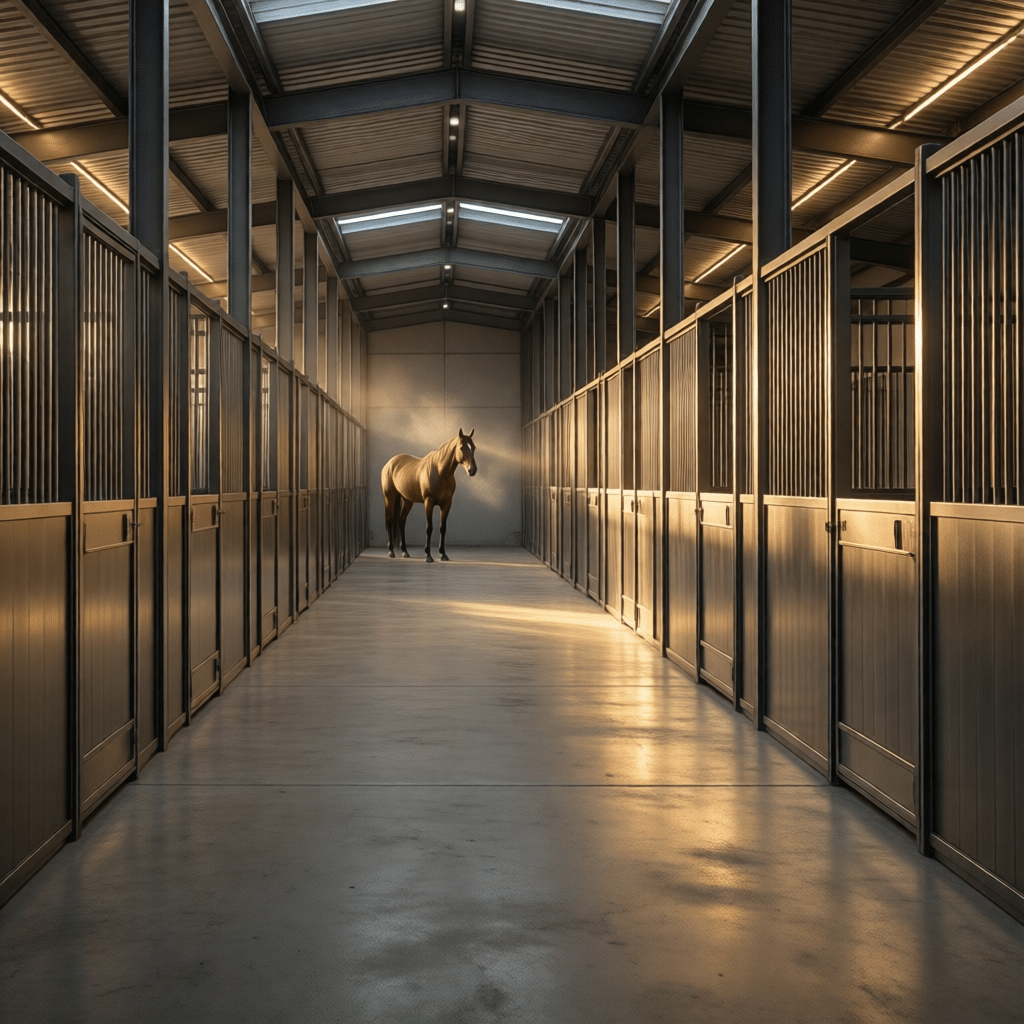
Sourcing modular horse stall kits for the USA market is a strict calculation of liability versus upfront cost. Many retail options utilize lighter 18-gauge steel to lower freight expenses, but this compromises the structural integrity required to safely contain a 1,000lb animal. For commercial barn builders, installing these lightweight panels invites catastrophic failure and potential injury claims. Real equine safety demands specific engineering standards that prevent steel from buckling under direct impact.
This analysis establishes why 14-gauge (2.0mm) tubing is the non-negotiable baseline for professional equine infrastructure. We evaluate the structural advantages of Q345B steel against generic mild options and explain how Feuerverzinkung after fabrication prevents internal corrosion. Understanding these specifications ensures your project meets the rigorous demands of active facilities while protecting your reputation against premature rust and breakage.
The American Standard: 12×12 Horse Stall Kits
Die 12′ x 12′ stall is the North American benchmark for equine safety, offering the minimum safe turning radius for a 1,000lb horse. Modular kits
standardize this footprint into bolt-together components, eliminating the need for onsite welding.

Why 12′ x 12′ is the North American Safety Benchmark
In the US market, 12′ x 12′ is not an arbitrary dimension; it is the calculated safety floor for housing standard riding horses (roughly 1,000 lbs). This footprint provides the minimum necessary turning radius for an animal to maneuver comfortably without striking walls. More importantly, it reduces “casting” incidents—where a horse lies down to roll and gets trapped against a wall because they lack the space to fully extend their legs to stand back up.
From a construction perspective, this dimension aligns perfectly with standard American post-frame barn architecture, which typically utilizes 12-foot column centers. This standardization allows builders to maximize stall count in commercial barns without requiring custom steel fabrication. While lighter 16-gauge or 18-gauge options exist in the retail market, professional facilities strictly demand 14-gauge (2.0mm to 2.5mm) structural steel to withstand the impact of a confined animal. At DB Stable, we treat 2.0mm as the absolute minimum floor for safety, often upgrading to Q345B steel for cold climates to prevent brittle fractures.
Anatomy of the Installation Kit: Panels, Infill, and Hardware
A professional “Stall Kit” is not a bundle of raw loose steel; it is a pre-engineered system designed for rapid assembly. For B2B distributors and large-scale builders, the value lies in the “No Welding” bolt-together design. A standard DB Stable kit is delivered as a flat-packed unit containing the following components:
- 1x Front Panel: Pre-fabricated frame featuring either a sliding or hinged door system, fully hot-dip galvanized after fabrication (ISO 1461).
- 1x Side Partition: Modular divider panel chosen based on the facility layout (solid, grilled top, or privacy).
- Pre-Cut Infill: Hochbelastbar HDPE (28mm-32mm) or Bamboo (28mm-38mm) planks, cut exactly to size so installers do not need to cut boards onsite.
- Hardware Kit: All necessary anchor bolts, connectors, and screws, manufactured strictly from 304 Edelstahl to prevent rust streaks.
- Steel Pallet Flat-Packs: We ship these on steel pallets to allow forklift unloading and to maximize shipping density (30-45 sets per 40HQ container), protecting distributor margins on freight.
Unmasking “Heavy Duty”: The 14-Gauge Minimum
Zusammenfassung: 14-gauge (2.0mm) is the non-negotiable engineering baseline for safe containment. Anything thinner risks catastrophic structural failure and injury under direct impact.
| Spezifikation | Retail “Economy” Grade | Professional Grade (DB Standard) |
|---|---|---|
| Wanddicke | 16-Gauge (1.5mm) or 18-Gauge (1.2mm) | 14-Gauge (2,0mm - 2,5mm) |
| Steel Composition | Generic Mild Steel | Q345B High-Strength Structural Steel |
| Zinc Coating | Pre-Galvanized (~15-20 microns) | Hot-Dip After Fab (>70-85 microns) |
| Impact Result | High Risk of Buckling / Sharp Edges | Kick-Proof Guarantee |
The Safety Threshold: Why 14-Gauge (2.0mm) is Mandatory
Marketing terms like “Heavy Duty” often mask dangerous cost-cutting. In the context of equine infrastructure, the difference between 1.5mm and 2.0mm steel is the difference between a bruised horse and a euthanized one. A 1,200 lb horse generates massive force during a kick. If the steel tubing lacks sufficient tensile strength, it does not just bend—it buckles and tears, creating jagged metal edges that can sever tendons.
Many retail stable kits utilize 16-gauge (1.5mm) or even 18-gauge (1.2mm) tubing to reduce shipping weight and material costs. These systems work for visual barriers but fail as physical containment. We strictly prohibit any tubing thinner than 2.0mm in our structural posts and rails. This specific thickness provides the necessary yield strength to absorb direct impact without catastrophic failure, forming the basis of our “Kick-Proof Guarantee.”
Material Synergy: Q345B Steel & Hot-Dip Protection
Gauge thickness is only half the equation; the metallurgy and processing define the final lifespan. Standard mild steel is soft. We utilize structural grade steel—specifically Q235B for standard applications and Q345B (Low Alloy High Strength) for cold climates. Q345B offers superior impact toughness, preventing brittle fractures when a horse kicks a frozen post in sub-zero temperatures.
- Chemische Bindung: We use “Hot-Dip After Fabrication” (ISO 1461), submerging the fully welded frame into molten zinc. This creates a metallurgical bond, not just a surface layer.
- Increased Thickness: This process adds an average of 70-85 microns of zinc to the steel. Effectively, this increases the final structural diameter and reinforces the 14-gauge base.
- Internal Protection: Unlike pre-galvanized “black tube” competitors that leave internal welds exposed, our dipping process coats the inside of the tube. This prevents the invisible “inside-out” rusting that causes hollow sections to fail unexpectedly.
Factory-Direct Stables Built for Extreme Climates

Bolt-Together Modularity: No Welder Required
Bolt-together systems eliminate on-site welding, reducing installation timelines by 40-60% while enabling flat-pack shipping that triples container capacity for distributors.
Reducing Labor Costs and Installation Risks
Traditional stable fabrication demands certified welders, fire watches, and “hot work” permits, all of which drive up site costs and liability. Our modular approach utilizes pre-engineered connections that require only standard hand tools. This shift allows general contractors or farm hands to handle assembly, effectively removing the bottleneck of specialized labor.
- Speed Efficiency: Prefabricated connections reduce total installation timelines by 40-60% compared to field welding.
- Safety Compliance: Eliminates fire hazards associated with on-site welding, simplifying insurance requirements for the facility.
- Schutz des Gewinns: Our flat-pack design fits 30-45 sets in a 40HQ container (vs. 12-15 welded sets), cutting freight costs by over 60%.
- “margin-bottom: 10px; line-height: 1.8;”>Future-Proofing: Bolt-together layouts allow for easy disassembly and reconfiguration if facility needs change.

The 304 Stainless Steel Hardware Standard
A hot-dip galvanized frame loses its value if the connecting hardware rusts within two years. Many manufacturers cut costs here by supplying zinc-plated fasteners, which inevitably corrode in ammonia-rich stable environments. We adhere to a stricter standard to ensure the joints last as long as the steel tubing.
- Materialspezifikation: All included anchor bolts, screws, and connectors are 304 Stainless Steel.
- Korrosionsbeständigkeit: 304 Grade offers superior resistance to moisture and acidity compared to standard zinc plating.
- Installation Kit: Every order includes Cold Galvanizing Spray to immediately treat any scratches or abrasions during assembly.
- Joint Integrity: Factory-drilled connections ensure consistent structural alignment without the variance of manual field welds.
Sliding vs Hinged Horse Stall Doors for US Aisles
Sliding doors dominate active barns by eliminating the 4-foot swing radius. Hinged options offer European aesthetics but require wide aisles and level concrete to prevent dragging.
Optimizing Space with the Hidden Track Sliding System
For commercial facilities and working barns, sliding doors are the functional standard. In a typical 12-foot American aisle, a hinged door demands 48 inches of swing clearance, effectively blocking traffic and creating a pinch point. Sliding doors require zero swing space, keeping the aisle clear for equipment, horses, and handlers at all times.
- Betriebssicherheit: Sliding doors eliminate the risk of wind slamming a door shut on a horse or catching a hip during movement.
- Hidden Track System: Our Professional Series utilizes a self-cleaning upper track design. Unlike open-bottom guides that clog with bedding, this system allows dirt to fall through, preventing jams.
- Traffic Flow: Essential for boarding barns where multiple owners and horses occupy the aisle simultaneously.
The Royal Series: When to Choose Traditional Hinged Fronts
Hinged doors are an architectural choice, best suited for private estates where aesthetics outrank high-volume efficiency. We reserve this mechanism for our Königliche Serie, which features European Arches and Brass/Gold Finials. However, this design demands specific infrastructure constraints that builders must respect.
- Floor Leveling: Installation requires a perfectly level concrete aisle. Uneven dirt or paver floors will cause the door bottom to drag or stick.
- Strukturelle Integrität: To support 40mm thick infill boards, we weld heavy-duty adjustable hinges directly to Q345B steel frames. This prevents the “sag” common in lighter, cheaper hinged systems.
- Space Requirements: We only recommend hinged fronts for aisles wider than 12 feet to ensure safe turning capability when the door is open.
Sourcing Direct: How B2B Ordering Saves Farm Builders Money
Direct sourcing removes retail markups, while high-density flat-pack logistics reduce ocean freight costs by over 60%, making large-scale stall installations economically viable.
The Economics of Factory-Direct Procurement
Traditional supply chains bleed profit margins through multiple layers of handling. When a builder buys from a local distributor, the price includes the manufacturer’s cost, the importer’s margin, domestic freight, and the distributor’s warehouse overhead. For large commercial projects, these added layers are unnecessary financial dead weight.
Sourcing directly from the manufacturer gives you access to “factory-gate” pricing. This model strips away broker fees and connects your budget directly to production costs—steel, labor, and galvanization. This strategy becomes viable at the “Project Order” level, defined as a single 20ft General Purpose (20GP) container. At this volume (approximately 10-15 sets), volume discounts activate, and the unit cost drops significantly compared to buying piecemeal from local stock.
Direct communication also fixes the “broken telephone” of budget forecasting. Instead of relying on a sales rep’s estimates, you get accurate lead times (typically 35-45 days for production) and transparent pricing based on current steel markets. This clarity allows for tighter bid calculations and prevents margin erosion from unexpected price hikes mid-project.
Reducing Freight Costs with the DB Flat-Pack System
In the steel industry, shipping air is the fastest way to lose money. Traditional pre-welded stall fronts are rigid and bulky, forcing you to pay for the empty space inside every frame. A standard 40HQ container typically maxes out at just 12 to 15 pre-welded sets. This inefficiency drives the landed cost per unit through the roof.
We engineered the DB Flat-Pack System to solve this specific logistics failure. By utilizing a modular, bolt-together design, we increase container density significantly. We fit 30 to 45 sets in the same 40HQ container. This density effectively slashes ocean freight costs by over 60% per unit, a strategy we call “Profit Protection” for our distributors.
- High-Density Loading: Increases capacity from 12-15 sets (welded) to 30-45 sets (flat-pack).
- Steel Pallet Packaging: Eliminates loose loading. Pallets are designed for safe, mechanized forklift unloading.
- Reduced Site Labor: Organized pallets mean faster inventory checks and less time hand-bombing loose components off a truck.
This approach shifts your budget allocation. Instead of spending money on shipping empty space across the ocean, you invest in higher-spec materials like 14-gauge structural steel and hot-dip galvanization.
Häufig gestellte Fragen
What is the best steel gauge for professional horse stalls?
14-gauge steel (2.0mm to 2.5mm) is the non-negotiable standard for professional equine facilities. Any tubing thinner than 2.0mm—often found in budget 16-gauge or 18-gauge kits—lacks the mass required to withstand the kinetic energy of a horse kick. We strictly prohibit tubing thinner than 2.0mm in our structural components to ensure the frame absorbs impact rather than buckling.
Is 12×12 feet the mandatory size for a horse stall?
While not a legal mandate, 12’x12′ (approx. 3.6m x 3.6m) is the operational benchmark for an average 1,000 lb horse. This footprint allows the animal to turn comfortably and lie down without becoming cast against a wall. For ponies, 10’x10′ suffices, but larger Warmbloods or foaling mares require 12’x14′ or larger footprints to ensure safety and welfare compliance.
Do I need a welder to install a modular stall kit?
No. Modular systems utilize a “bolt-together” assembly method designed for efficiency. Our frames undergo hot-dip galvanization nach fabrication at the factory, meaning all welding is complete before shipping. You simply connect the panels using the included 304 Stainless Steel hardware kit (connectors and anchor bolts). A team of 2-3 people can install these systems using standard drills and wrenches.
Why are sliding doors often preferred over hinged doors?
Sliding doors maximize usable barn space. Since they track along the stall front rather than swinging outward, they keep the aisle clear for grooming, equipment, and foot traffic. This design also eliminates the safety risk of a door swinging shut on a horse during windy conditions or blocking the aisle during an emergency evacuation.
What makes a stall panel “kick-proof”?
Real kick resistance requires high-tensile steel and dense infill. We spec Q345B High Strength Steel (ASTM Grade 50 equivalent) for our Professional Series to prevent brittle fractures, especially in cold climates. For the infill, we use 28mm-32mm HDPE or High-Density Bamboo (Janka Hardness > 3000 lbf). Softwoods or thin gauge steel will eventually fail under repetitive impact; these materials do not.
Abschließende Überlegungen
Specifying 14-gauge structural steel is not an upsell; it is the only viable defense against liability claims and catastrophic injury. While lighter retail kits offer lower upfront costs, they inevitably fail under the kinetic energy of a 1,000lb animal. Professional builders prioritize our ISO 1461 hot-dip galvanization and Q345B framework to guarantee infrastructure that outlasts the horses it houses.
Stop subsidizing inefficient logistics; our flat-pack system triples container density to slash your landed cost per unit. We encourage distributors and large-scale builders to request a project-specific estimate based on current steel markets and freight rates. Contact our engineering team today to secure production slots for your next 20GP or 40HQ container order.

 German
  English
  Spanish
  French
  Arabic
0 Kommentare