



Stressed horse safety at events depends on a specification most suppliers fail to mention: steel wall thickness. Sourcing stalls with under-gauged tubing is a direct route to equipment failure. A single panic kick can fracture thin-walled steel, creating a liability event that leads to severe animal injury, insurance claims, and catastrophic brand damage for event organizers.
This analysis benchmarks stall frames against the non-negotiable 14-gauge (2.0mm) Q235B structural steel standard. We evaluate material tolerance under impact to provide a clear engineering baseline for distributors and project managers. The goal is to eliminate structural failure and contain risk before it becomes a claim.
Der Fäulniskreislauf in Umgebungen mit hoher Luftfeuchtigkeit
The rot cycle is a bacterial skin infection in horses caused by *Dermatophilus congolensis*. It activates when moisture compromises the skin’s barrier, a process accelerated by high humidity.
How Moisture Activates Skin Infections
A horse’s skin has a natural protective barrier. Prolonged exposure to moisture from rain, sweat, or a damp stall softens this barrier, creating microscopic cracks. It’s the first step in a chain reaction.
These tiny breaks give dormant bacteria, specifically *Dermatophilus congolensis*, an entry point. The bacteria live harmlessly on healthy skin but activate once they penetrate its compromised outer layer.
Once active, the bacteria spread through water droplets. This triggers an inflammatory response, leading to the characteristic thick, crusty scabs and patches of hair loss that define rain rot.
The Role of Mold-Resistant Infill Materials
The right stall materials disrupt the environmental conditions that fuel this cycle. High-density strand-woven bamboo is engineered to be naturally resistant to the mold and rot that flourish in damp stalls. Its structure doesn’t absorb moisture, helping to maintain a drier resting environment.
UV-stabilized HDPE-Füllung is completely non-absorbent. It prevents moisture buildup inside the stall walls and provides a ‘Zero Maintenance’ surface. Because it doesn’t harbor bacteria, it directly removes one of the key variables needed for the rot cycle to begin.
Materialvergleich für tropische Klimazonen

In tropical climates, material choice is about moisture management, not just heat tolerance. Engineered solutions that actively resist rust, rot, and mold are non-negotiable for structural integrity.
| Merkmal | Hot-Dip Galvanized Steel Framework | UV-Stabilized HDPE Infill | Hochdichter gewebter Bambus |
|---|---|---|---|
| Primary Role | Structural Frame (Posts, Grills, Doors) | Infill Boards (Wall Panels) | Infill Boards (Wall Panels) |
| Threat Mitigation | Resists atmospheric corrosion and rust caused by constant high humidity and salt spray. | Eliminates risk of mold, mildew, and rot by being 100% waterproof and non-porous. | Prevents fungal rot and insect damage common to wood in tropical environments. |
| Wichtigste Spezifikation | Hot-dip galvanized after fabrication to ISO 1461, ensuring a zinc coating of over 70 microns. | Virtually zero water absorption (<0.01%). It does not swell, delaminate, or absorb moisture. | Thermally treated to remove sugars and starches, with a Janka hardness exceeding 3000 lbf. |
| Maintenance Profile | Minimal. Deep scratches may require a cold galvanizing spray to restore protection. | Zero maintenance. Requires no painting, sealing, or treating for its entire service life. | Low. Its high density and treatment process make it naturally resistant to decay. |
Hot-Dip Galvanized Steel Framework
In tropical regions, rust isn’t just a cosmetic issue; it’s a structural failure waiting to happen. Standard pre-galvanized or painted steel fails quickly because welding burns off the protective layer at the joints. The only viable solution is Feuerverzinkung *after* all fabrication is complete. This process creates a thick, metallurgical bond of zinc over every surface, including inside tubes and across all welds. Adhering to standards like ISO 1461 ensures the zinc coating is thick enough (70-85 microns) to withstand constant humidity and salt-laden air without degradation.
UV-Stabilized HDPE Infill
High-Density Polyethylene (HDPE) is a practical choice for stall infills where moisture is the primary enemy. Since the material is non-porous and waterproof, it provides no substrate for mold or mildew to grow. Unlike wood or wood composites, it cannot rot, swell, or warp from humidity. This “zero maintenance” attribute is its main advantage in a stable environment. UV stabilization is critical for tropical applications to prevent the material from becoming brittle under intense sun exposure, ensuring it retains its impact-absorbing properties.
Hochdichter gewebter Bambus
For applications demanding both aesthetics and extreme durability, stranggeflochtener Bambus is superior to traditional hardwoods. The manufacturing process involves shredding bamboo fibers, removing the natural sugars and starches through thermal treatment, and compressing them with resin under immense pressure. This creates a board that is incredibly dense and hard—often 3x harder than oak—and naturally resistant to the rot, mold, and termites that destroy other wood products in the tropics. Its low water absorption rate prevents the warping and decay cycle seen in untreated lumber.
Langlebige, konforme Ställe für jedes Klima
Luftstromdesign zur Verhinderung tropischer Pilzinfektionen

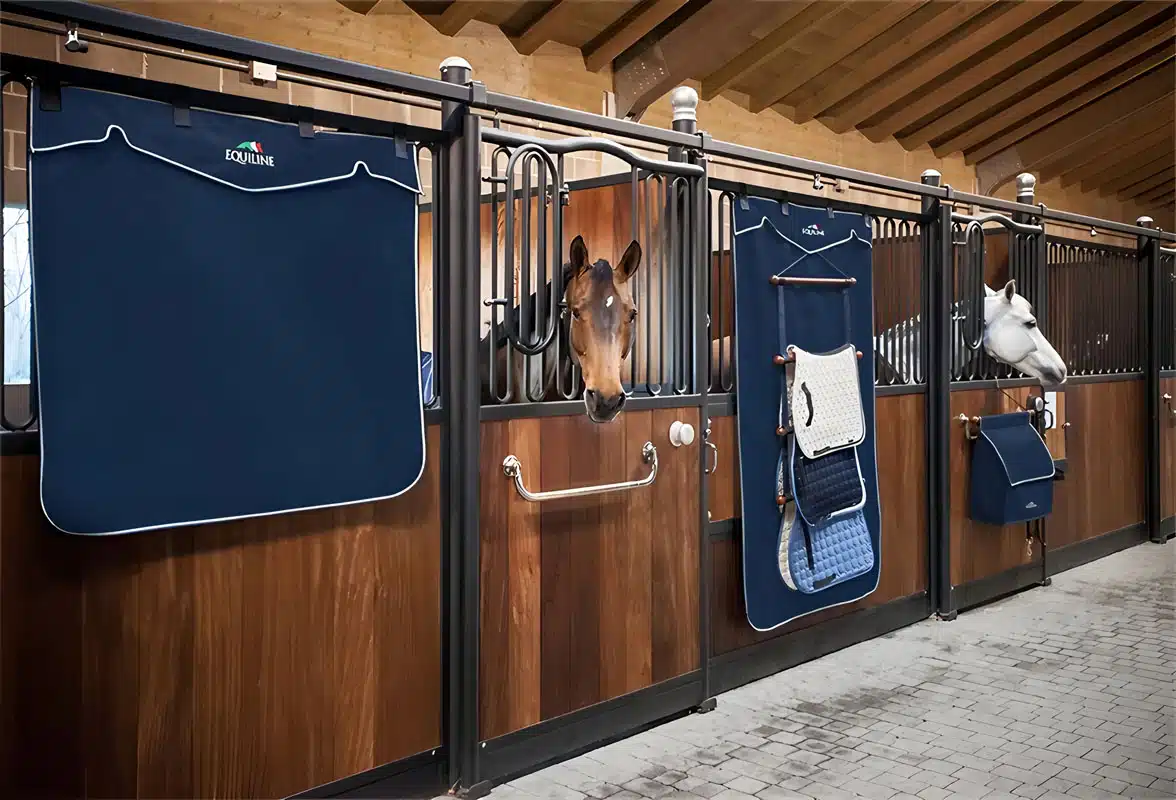
Open-grill stable panels create ‘stack effect’ ventilation, cycling out humid, contaminated air with fresh, dry air. This reduces airborne fungal spores and protects respiratory health.
The Link Between Stagnant Air and Fungal Health Risks
Indoor stabling naturally concentrates high levels of organic dust, which is often loaded with aerosolized fungal particles. In tropical and subtropical climates, this problem gets much worse. The combination of high humidity and warm temperatures creates an ideal breeding ground for these fungi, dramatically increasing the spore count in the air.
Without a proper air exchange system, this contaminated air becomes trapped inside the stall. Horses are left breathing a dense mix of spores, which significantly raises the risk of developing serious respiratory diseases.
Promoting Air Exchange with Stack Effect Belüftung
Our stable fronts are engineered with an open top grill, a simple but critical feature for encouraging natural air movement. This design makes use of a principle known as the ‘Stack Effect’.
The warm, moist air a horse exhales is less dense than the surrounding air, so it naturally rises. It escapes through the open grills at the top of the stable front. As this warm air exits, it creates a gentle, continuous current that pulls cooler, fresher, and drier air into the stall from below. This ensures the air is constantly cycling, preventing the buildup of harmful fungal spores.
Häufig gestellte Fragen
What materials do you recommend for stables in high-humidity climates?
In humid areas, you need materials that don’t absorb moisture. Our 28-32mm HDPE (High-Density Polyethylene) infill is ideal because it’s waterproof and won’t rot, swell, or grow mold, making it a zero-maintenance solution. Our 28-38mm high-density strand-woven bamboo is another top choice. It’s thermally treated and compressed to prevent moisture from getting in, which makes it extremely resistant to rot and mold for over 25 years.
How do your stable designs help prevent mold?
The best way to stop mold is to control moisture and ensure good ventilation. Our stable designs use open-top grills to promote what we call “stack effect ventilation,” which keeps air moving. More importantly, we use non-porous infills like our HDPE. Since HDPE doesn’t absorb moisture like wood, it eliminates the risk of mold growing directly on the stable walls and keeps the environment healthier for the horse.
Will your bamboo stall panels rot over time?
Untreated bamboo rots, but our panels are different. We use high-density strand-woven bamboo, which is an engineered material. It goes through a thermal modification process that removes starches and creates a board three times harder than oak. This process makes it extremely resistant to rot, mold, and insects, giving it a typical lifespan of 25 years or more with very little maintenance.
How waterproof is the HDPE infill material?
Our HDPE infill is waterproof for any practical stable application. It has a water absorption rate of less than 0.01%, so it won’t swell, warp, or degrade, even with constant moisture or frequent cleaning. Its surface repels water and prevents mildew, making it a true zero-maintenance solution for any climate.
How do your stable panels promote good ventilation?
Our systems are designed to maximize natural airflow. The open-grill design on our stable fronts and partitions allows for excellent cross-flow of air. This helps push out warm, moist air and reduce humidity, which is critical for a horse’s respiratory health. The design ensures constant air circulation without creating uncomfortable drafts.
Abschließende Überlegungen
While thinner 16-gauge stalls lower initial costs, they expose your brand to liability from kick-through failures. Our 14-Gauge-Stahl minimum, hot-dipped after fabrication, is the only way to prevent structural failure and safeguard your reputation. This is an engineering standard, not a premium feature.
Don’t take our word for it—verify the material thickness and galvanizing quality yourself. A trial order of 3-5 sets is the most logical next step to confirm our manufacturing standards. Contact our team to configure your trial shipment or to discuss specs for your next container.

 German
  English
  Spanish
  French
  Arabic
0 Kommentare