


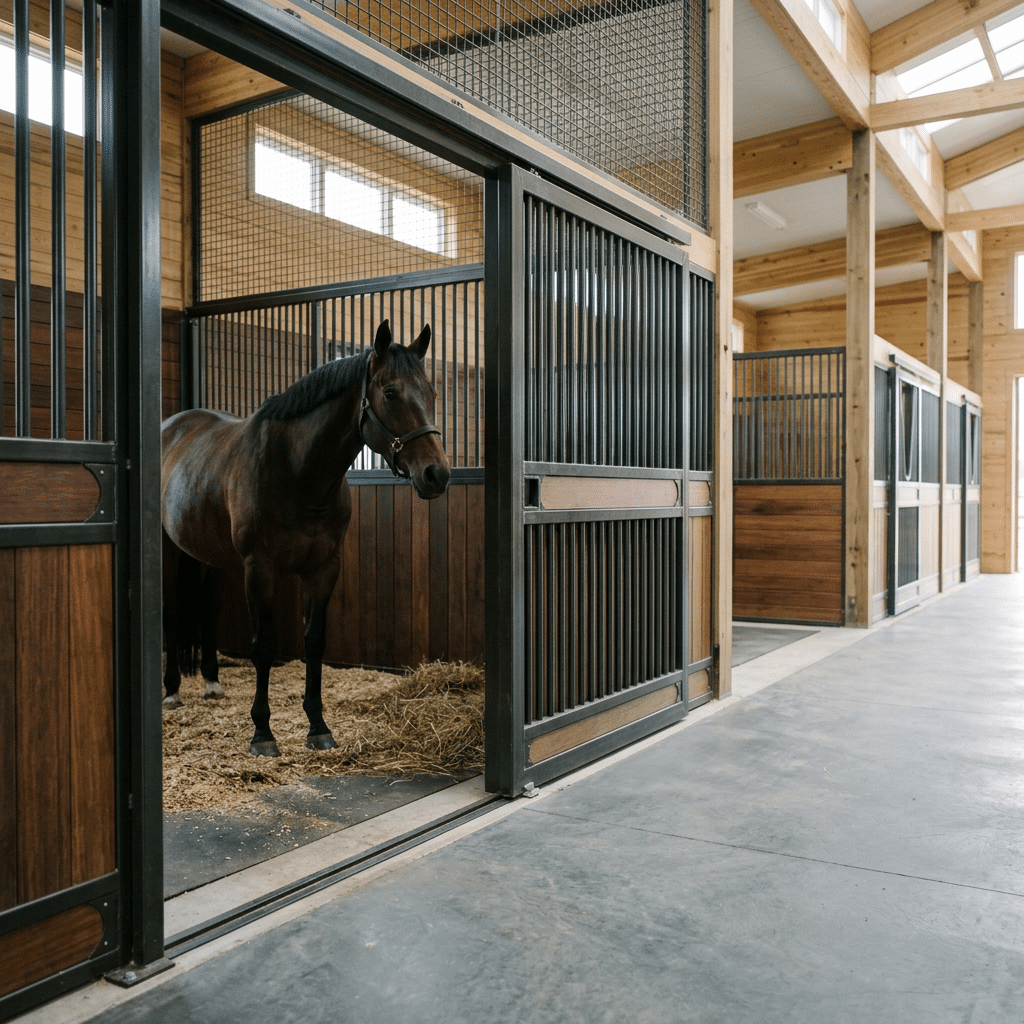
Protecting B2B Distributor Margins in the equestrian market depends on sourcing stables that eliminate post-sale failures. Competing products built with pre-galvanized tubing and wood infill are engineered to fail from rust and rot, creating warranty claims that destroy profitability and dealer reputation.
This analysis provides the technical benchmarks for a scalable partnership. We evaluate suppliers based on the BS EN ISO 1461 galvanizing standard, the use of non-porous HDPE infill, and flat-pack logistics that increase container load capacity by over 60%.
Das Mikroklima in einer Waschbucht: Wärme, Wasser und Gülle
A horse wash bay’s constant humidity, direct water exposure, and corrosive ammonia from manure aggressively attack standard building materials. Specialized rust protection is essential for structural safety and longevity.
The Challenge of Humidity and Ammonia
A wash bay is a permanent high-humidity zone. Constant water spray and condensation create the perfect conditions for rust to form on any unprotected or poorly coated steel. It’s not a matter of if, but when, corrosion will begin to compromise the structure.
The environment is also chemically aggressive. Ammonia, released from horse manure and urine, saturates the air and surfaces. This gas actively accelerates the degradation of metal frames and eats away at porous infill materials, weakening them from the inside out.
Material Resilience: Galvanization and Non-Porous Infill
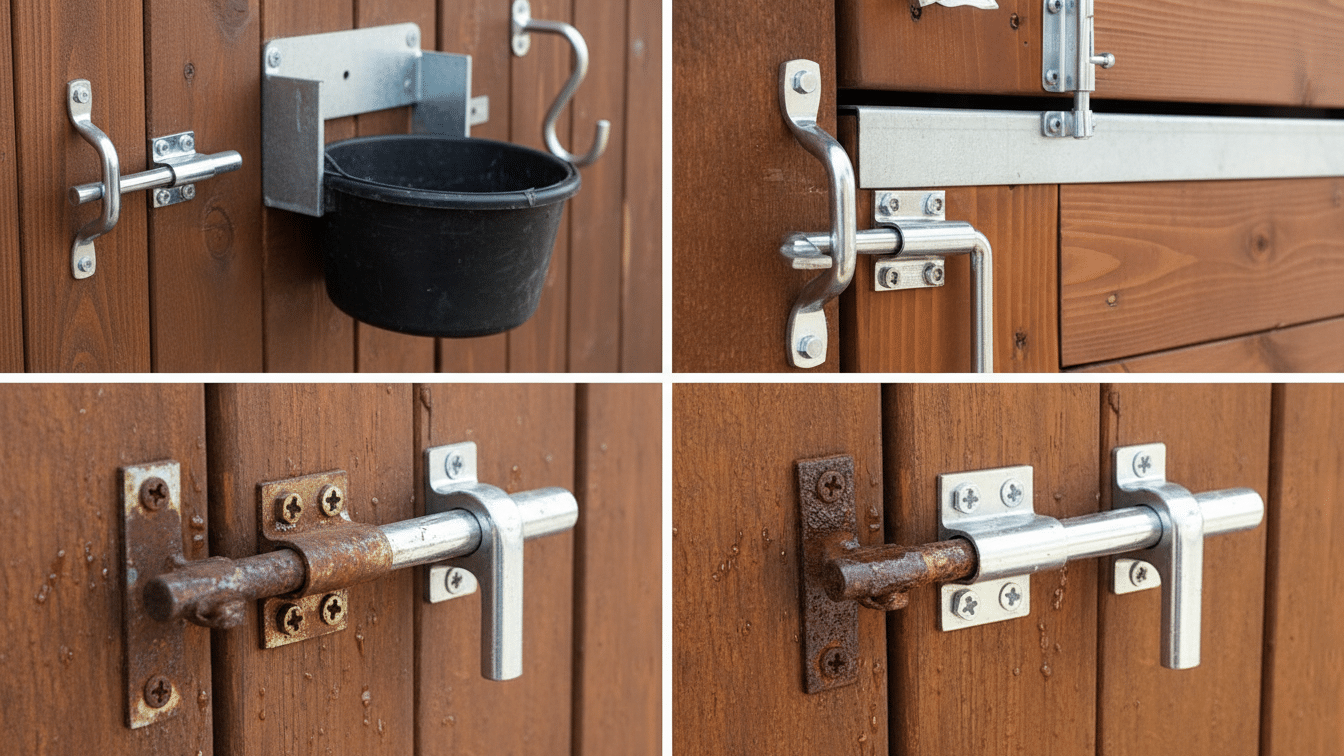
To combat these conditions, material choice is everything. At DB Stable, all steel components undergo Hot-Dip Galvanization After Fabrication. This process coats every surface, including the critical weld points, after the panel is fully constructed. This eliminates the hidden rust points common in pre-galvanized tubing used by other suppliers, which inevitably fail in wet areas.
For the partition walls, we use non-porous HDPE infill panels. Unlike wood or other porous materials, HDPE cannot absorb water, so it will never rot, swell, or grow mold. This delivers a true zero-maintenance solution built to withstand the daily abuse of a professional wash bay environment.
Mauern aus Beton: Porosität, Risse und schwierige Reinigung
Concrete walls absorb moisture, leading to salt buildup, cracking, and trapped bacteria. This makes effective cleaning nearly impossible. Non-porous HDPE and high-density bamboo are the superior, hygienic alternatives.
The Problem of Efflorescence and Moisture Absorption
Concrete is porous by natur
e. In a stable environment, it acts like a sponge, absorbing urine and wash water. This moisture penetrates deep into the material, creating permanent stains and locking in persistent odors that you can’t simply wash away.
As this trapped moisture evaporates, it pulls soluble salts from within the concrete to the surface. This process leaves behind a white, powdery residue known as efflorescence. While it can be scrubbed off, it always returns as long as the moisture problem exists.
This constant cycle of moisture absorption and drying does more than just look bad. It slowly weakens the concrete’s internal structure, eventually leading to cracking and compromising the wall’s integrity.
HDPE and Bamboo: The Non-Porous Infill Solution
Our HDPE infill is engineered as a direct counter to porous materials. It provides a ‘Zero Maintenance’ surface that is completely non-absorbent. Urine, water, and bacteria cannot penetrate it, so stains and odors don’t become a permanent issue.
Similarly, our high-density strand woven bamboo is naturally resistant to mold and rot. It offers a tough, durable alternative that won’t degrade or weaken, even with constant exposure to moisture in a stable or wash bay.
The biggest advantage is in the daily upkeep. You can easily pressure wash HDPE and bamboo panels without any risk of damage. Unlike concrete, there’s no danger of forcing water into the material or causing salts to leech out. Cleaning is fast, effective, and complete.
Globally Compliant Stables Built for Decades.
Gummimatten an Wänden: Die Schimmel- und Mehltau-Falle
Fixing rubber mats to walls traps moisture and blocks airflow. This dark, damp space becomes an ideal breeding ground for hidden mold and mildew on the wall itself.
How Trapped Moisture Creates a Hidden Problem
Bolting a rubber mat directly to a stall wall creates an impermeable seal. Any temperature difference can cause condensation to form in the gap between the mat and the wall. Since the rubber blocks all airflow, this moisture has nowhere to go. Porous materials like wood or unsealed concrete will absorb this trapped water, creating a dark, damp environment perfect for mold and mildew to grow completely out of sight.
High-Density Bamboo: A Mold-Resistant Infill Solution
The right material design prevents this problem from the start. Instead of creating a sealed trap, engineered stall systems focus on breathability and moisture resistance. Our high-density bamboo panels are a direct solution to this issue. The material itself is engineered to resist the conditions that cause decay.
- Material: We use high-density strand woven bamboo, a material naturally resistant to both mold and rot.
- Ventilation: Our panel systems are designed with intentional gaps that promote ‘Stack Effect Ventilation,’ ensuring constant air circulation and drying.
- Hardness: With a Janka Hardness rating over 3000 lbf, the bamboo is three times harder than oak, providing durability without the risk of moisture-related decay.
HDPE-Kunststoff: 100% Hydrophob und waschmaschinenfest
HDPE plastic is non-porous and hydrophobic. It doesn’t absorb water, preventing rot or bacteria growth. It can be power-washed repeatedly, making it a true zero-maintenance stable solution.
| Merkmal | HDPE-Füllung | Traditionelles Holz |
|---|---|---|
| Wasserabsorption | Zero (Non-porous) | High (Porous) |
| Rot, Mold, or Swell | Will not occur | Inevitable over time |
| Reinigungsmethode | Power washer, disinfectants | Gentle scrubbing, risk of damage |
| Ongoing Maintenance | Keine erforderlich | Requires sealing, painting, eventual replacement |
Die Wissenschaft hinter einer porenfreien Oberfläche
Wood is a natural sponge. Its porous structure absorbs moisture, urine, and cleaning agents, creating a perfect breeding ground for mold and bacteria. Over time, this saturation leads to rot, swelling, and structural failure. HDPE is the complete opposite. It’s a solid, non-porous material at a microscopic level, so water and contaminants simply cannot penetrate the surface.
This hydrophobic quality means you can use a high-pressure power washer to blast away manure and dirt without any risk of water damage. The smooth surface is easy to disinfect, ensuring a hygienic environment that wood can never achieve. It simply doesn’t hold onto moisture or organic matter.
DB Stable’s Zero-Maintenance Infill Standard
We use 28mm to 32mm thick, UV-stabilized HDPE planks as our standard infill. This isn’t an afterthought; it’s a core component of our ‘Zero Maintenance’ selling point for distributors. Facility owners eliminate the recurring labor and material costs associated with traditional timber stables.
There is no need for sealing, staining, painting, or planning for future board replacements. The material is inert and stable, delivering the same performance on day one as it does a decade later. For B2B clients, this translates to a stronger value proposition and fewer post-sale complaints about material degradation.
HDG Stahlzargen: Überleben in der Spritzwasserzone
The splash zone’s wet-dry cycle is the most corrosive environment for steel. We counter this by hot-dip galvanizing frames after fabrication, applying a >70 micron zinc coat.
The Corrosive Effect of Wet-Dry Cycles
A splash zone is more damaging to steel than full submersion. The constant cycle of being wetted by salt spray and then drying out creates a highly aggressive environment. This repeated process continuously exposes a reactive zinc surface to a fresh supply of oxygen and chlorides, which accelerates the corrosion process significantly.
A Defense Built on Coating Thickness
DB Stable frames are hot-dip galvanized after all welding and fabrication is complete. This critical step ensures every edge, corner, and joint is sealed under a protective layer of zinc. The process achieves an average coating thickness of over 70 microns (µm) on the steel tubing. This specification meets the BS EN ISO 1461 standard and provides a measurable, robust defense against accelerated rust in demanding environments.
Häufig gestellte Fragen
Welche Materialien eignen sich am besten für die Wände von Pferdewaschplätzen?
The ideal materials are waterproof, durable, and easy to clean. PVC and fiberglass-reinforced panels (FRP) are excellent choices because they resist moisture, prevent mold, and absorb impact. Properly sealed concrete blocks are another durable option, though less forgiving than PVC or FRP. Untreated wood and standard metal should be avoided, as they can rot, rust, or splinter over time.
Kann man Gummimatten an Stallwänden anbringen?
Yes, rolled rubber mats are commonly used as stall wall liners. They serve as a protective barrier that shields the wall structure from kicks and wear while also reducing the risk of injury to the horse. This application is different from floor matting and provides an effective layer of protection.
Wie kann man eine Pferdewaschanlage abdichten?
Effective waterproofing involves both the floor and walls. The floor must have a proper slope to a drain to prevent pooling water; common materials include scored concrete or specialized rubber pavers. For walls, moisture-proof materials like fiberglass-reinforced plastic (FRP) are recommended. All seams, corners, and edges should be sealed with silicone to create a watertight barrier.
Is HDPE an easy material to mold for manufacturing?
Yes, HDPE is widely used in injection molding because it offers a great balance of strength, impact resistance, and chemical resilience. While manufacturers must account for its natural shrinkage rate during the cooling process to ensure dimensional stability, its properties make it a reliable and cost-effective material for durable products like horse stall infill panels.
Abschließende Überlegungen
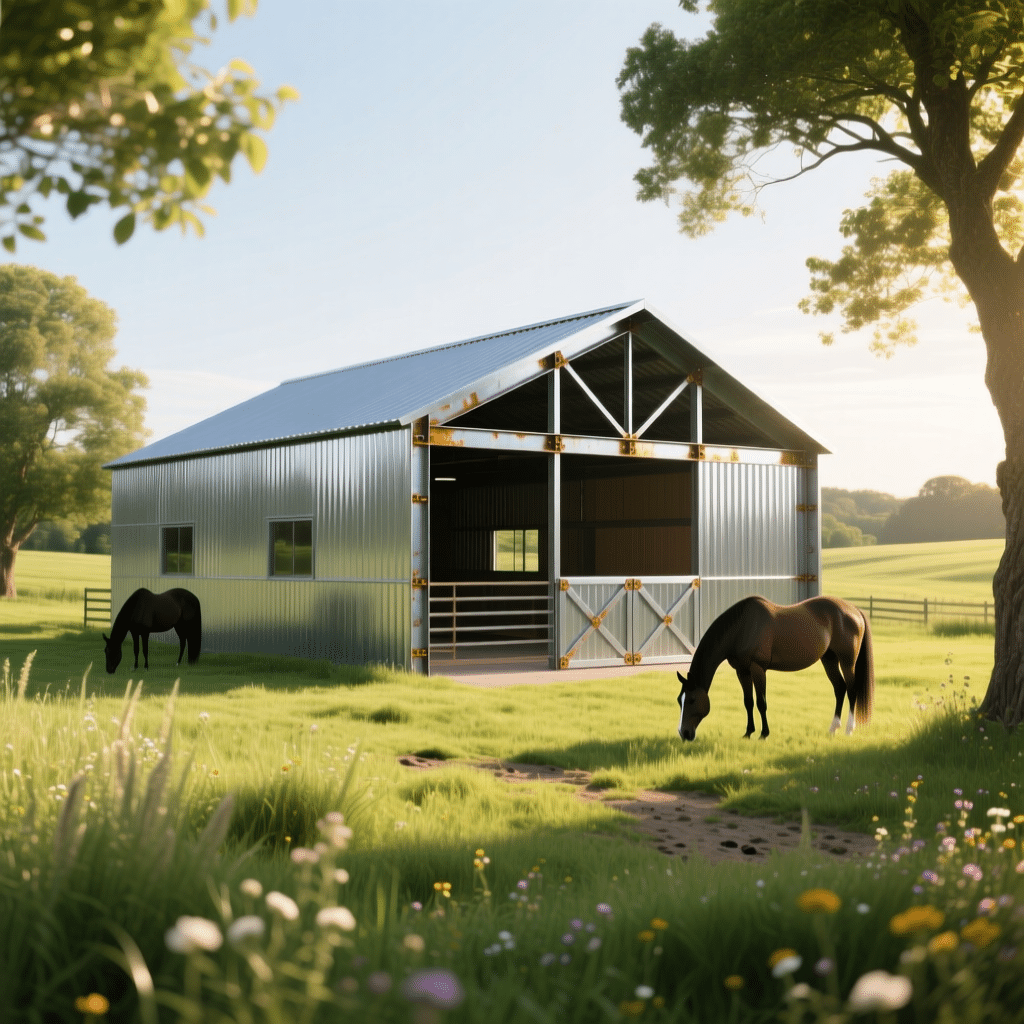
Generic stalls with pre-galvanized steel create future problems for you, the dealer. Our commitment to Hot-Dip Galvanization After Fabrication (ISO 1461) protects your reputation from rust claims and material failure. Selling a zero-maintenance solution is the only way to build long-term trust and secure your margins.
Verify the engineering and freight savings for yourself. A trial order of 3-5 stables is the logical next step to test our fitment and finish firsthand. Contact our team to review the technical files and discuss your OEM requirements.

 German
  English
  Spanish
  French
  Arabic
0 Kommentare