


Foaling stalls built with incorrect clearances or porous materials directly threaten the viability of a newborn. A seemingly minor design flaw, like an improper bottom gap, can lead to a cast foal, resulting in catastrophic veterinary bills and the potential loss of a valuable bloodline.
This analysis benchmarks stall designs against critical safety standards, including ‘cast-proof’ clearances and the use of non-porous HDPE infill. We evaluate how Hot-Dip Galvanized steel and hygienic materials combine to prevent injury, reduce biosecurity risks, and protect your investment.
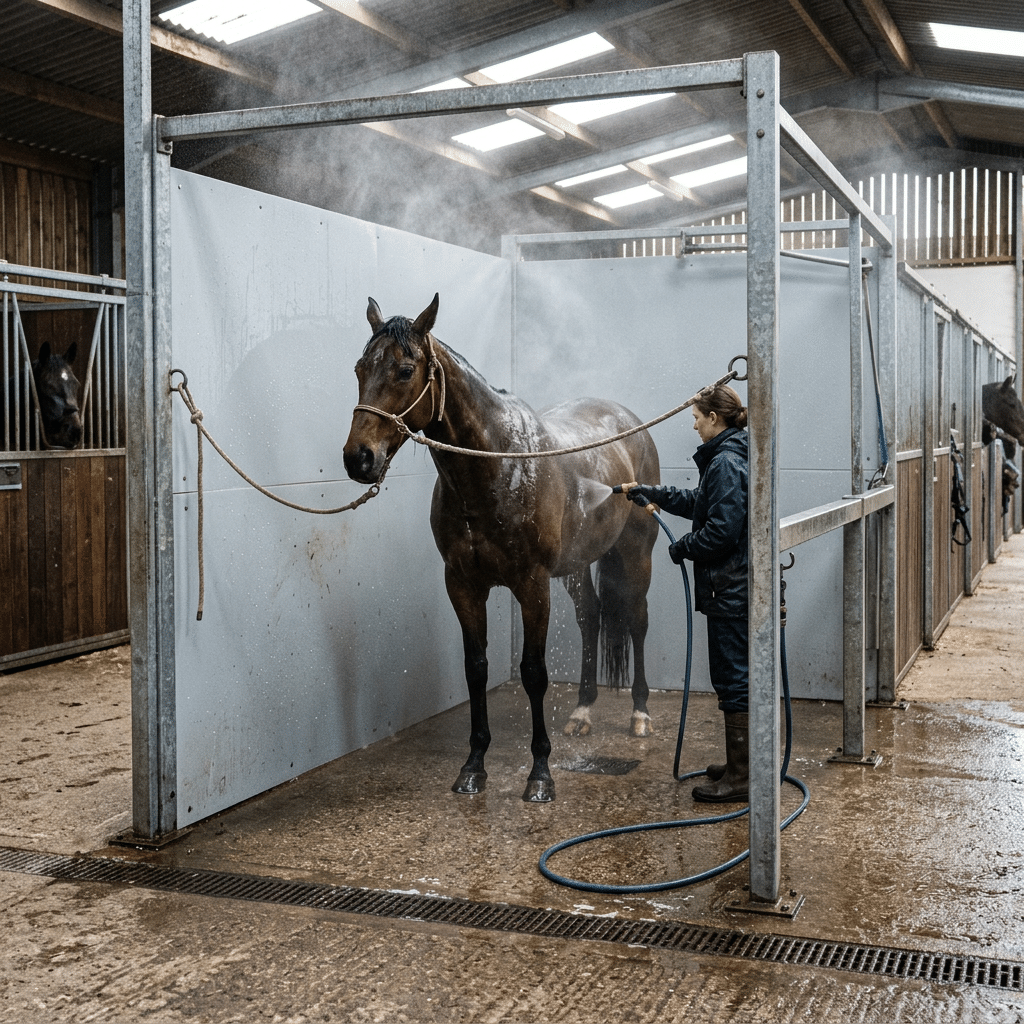
Das Mikroklima in einer Waschbucht: Wärme, Wasser und Gülle
A wash bay’s micro-climate is a harsh mix of humidity, water, and manure. Success depends on smart ventilation, sloped drainage, and using materials that resist rust, mold, and rot.
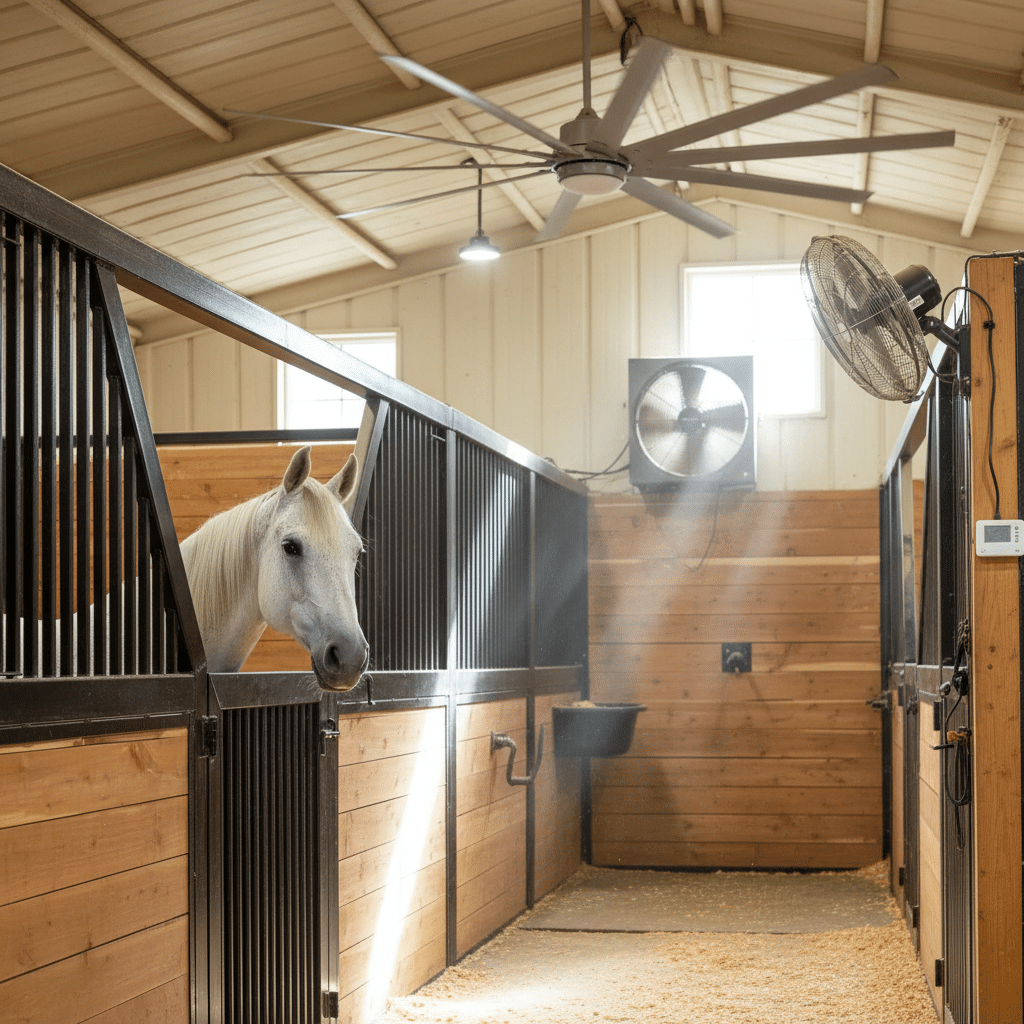
Controlling Humidity, Drainage, and Airflow
Trapped moisture is the primary enemy in a wash bay. Without effective ventilation, humidity builds up, creating a stuffy environ
ment that promotes mold and mildew growth on every surface. A proper ventilation design isn’t a bonus feature; it’s a core requirement to circulate air constantly and help the structure dry out between uses.
Standing water creates immediate safety and sanitation problems. Every wash bay floor needs a correctly engineered slope to keep water moving. This prevents puddles from forming, which are both a slip hazard and a breeding ground for bacteria. The water has to drain somewhere, and it can’t be allowed to sit.
All that runoff carries manure and hair, which will quickly clog a septic system. A heavy-duty grated drain is essential to block this debris from entering the lines. It’s a simple component that prevents major plumbing failures and ensures the entire system functions correctly over the long term.

Material Resilience to Corrosion and Decay
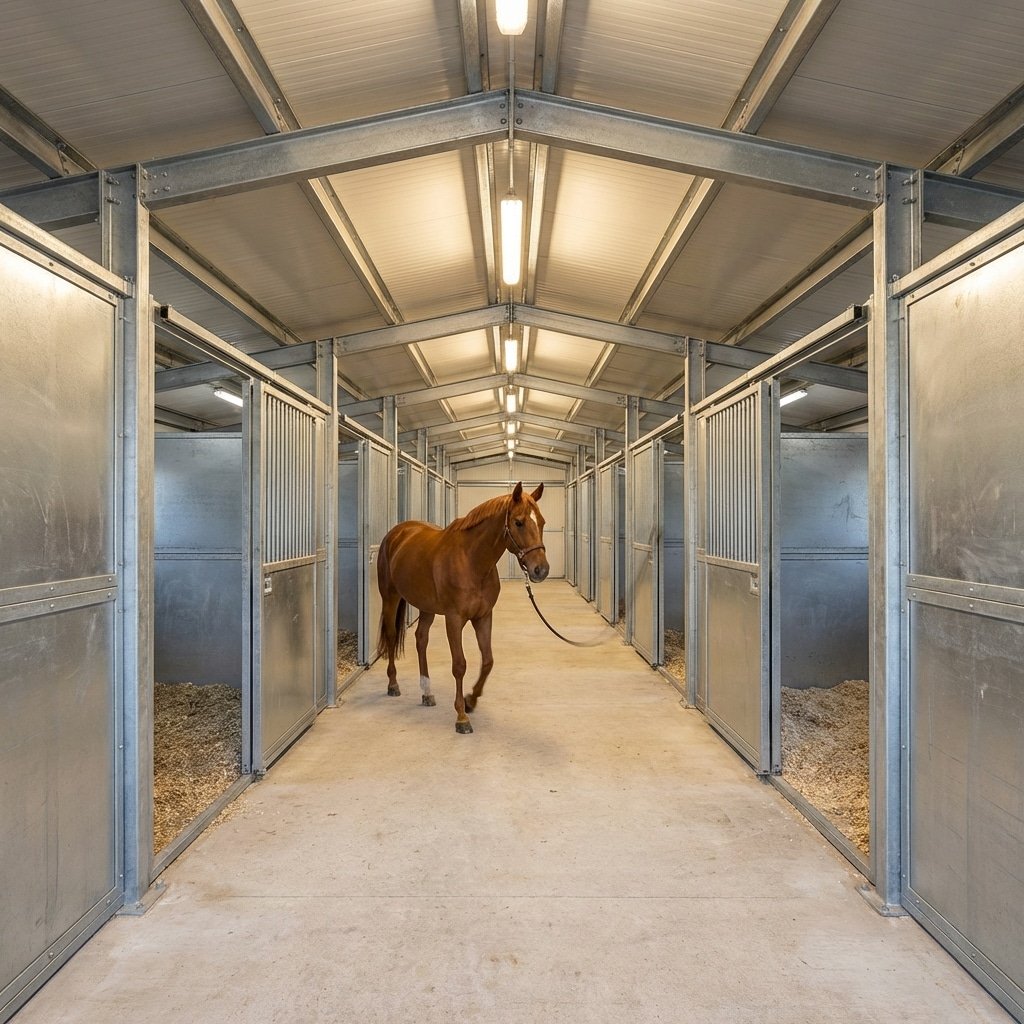
Steel frames will rust in a high-moisture environment unless they are properly protected. That’s why we weld the entire steel structure first, then perform a Hot-Dip Galvanization process that conforms to ISO 1461. This method coats every weld, corner, and cut edge, which is something pre-galvanized tubes simply can’t match.
The wall infill gets hit with water constantly, so the material has to be inert. We use either zero-maintenance HDPE or mold-resistant bamboo planks. Both options are engineered to withstand daily power washing without rotting, warping, or absorbing moisture. They provide a durable barrier that horses can’t easily damage.
A structure is only as strong as its weakest component. Rust often starts at the small connection points. To prevent this, our hardware kits feature 304 Stainless Steel for all bolts and connectors. This eliminates the common points of failure where corrosion typically begins.
Mauern aus Beton: Porosität, Risse und schwierige Reinigung
Concrete’s porous structure traps moisture and bacteria, making sanitation difficult. Non-porous HDPE offers a hygienic, zero-maintenance solution that is safer and easier to clean.
The Porosity Problem: Why Concrete Stays Damp
Concrete looks solid, but it’s full of tiny pores. This structure acts like a sponge, allowing water and dissolved salts to migrate right through the wall. This is why you often see a white, powdery residue called efflorescence on concrete surfaces. You can wash it off, but it always comes back because the moisture inside is constantly pushing more salts out.
Standard pressure washing only offers a temporary surface fix. It cleans the face of the problem but does nothing to stop the underlying moisture that feeds bacterial growth and makes true disinfection impossible.
HDPE Infill: A Non-Porous and Hygienic Solution
The engineering solution is to avoid porous materials entirely. Our HDPE (High-Density Polyethylene) infill panels are completely non-porous. They do not absorb moisture, urine, or bacteria, so all contaminants stay on the surface where they can be easily removed.
This creates a ‘Zero Maintenance’ wall. A quick power wash is all that’s needed to fully clean and disinfect a stall. HDPE also has impact-absorbing properties, providing a much safer cushion than hard concrete if a mare or foal kicks or leans against the wall.
Langlebige, konforme Ställe für jedes Klima
Gummimatten an Wänden: Die Schimmel- und Mehltau-Falle
Rubber mats on stall walls trap moisture, creating a perfect breeding ground for mold that harms foals. Solid, non-porous materials like HDPE are a much safer alternative.
How Trapped Moisture Becomes a Health Hazard
When you press a solid rubber mat against a stall wall, you cut off all air circulation. This creates a sealed pocket where any condensation or moisture gets trapped. The warm, humid air inside a foaling stall is the perfect temperature for mold and mildew to grow as soon as they have moisture.
Even with careful installation, the seals are never perfect. Urine, manure, or cleaning fluids can seep behind the mat through tiny gaps. Once back there, the dark, damp space becomes a hidden culture for fungus that you can’t see and can’t clean, posing a direct health risk to a vulnerable mare and foal.
Why Non-Porous HDPE Infill Is the Solution
Our HDPE infill boards solve this problem directly. The material is solid and non-porous, so it doesn’t absorb moisture at all. This prevents the fundamental conditions mold needs to grow. It’s a genuine ‘Zero Maintenance’ option because the surface will not rot or degrade, even with constant exposure to moisture.
The smooth surface of HDPE is also incredibly easy to keep hygienic. You can power wash it completely, removing all bacteria and contaminants. This ensures you can maintain a truly sterile environment, which is critical for the health of newborn foals.
HDPE-Kunststoff: 100% Hydrophob und waschmaschinenfest
HDPE is non-porous, repelling all moisture to prevent rot and bacterial growth. It withstands harsh chemicals and power-washing, delivering a true zero-maintenance solution for stalls.
| Material Property | Practical Benefit in DB Stables |
|---|---|
| Hydrophobic & Non-Porous Achieves less than 0.05% moisture absorption. Water cannot penetrate the material’s surface. | No Rot, Swelling, or Warping Unlike wood, HDPE planks never need sealing or replacement due to water damage. This is the foundation of our “Zero Maintenance” promise. |
| Chemically Inert Resistant to common acids, alcohols, and barn disinfectants without degrading or discoloring. | Power-Washable & Hygienic The material withstands repeated, aggressive cleaning protocols, ensuring top-tier biosecurity and a sanitary environment. |
| High Impact Resistance The polymer’s molecular structure is engineered to absorb and diffuse impact energy efficiently. | Kick-Proof Durability Our 28-32mm thick planks are designed to handle repeated kicks from shod horses, preventing cracks and ensuring animal safety. |
Die Wissenschaft hinter einer porenfreien Oberfläche
High-Density Polyethylene isn’t waterproof because of a coating; it’s waterproof at a molecular level. Its structure is naturally hydrophobic, meaning it physically repels water molecules. This prevents any meaningful moisture absorption—less than 0.05%—so the material cannot swell, rot, or warp. Because nothing gets in, the surface doesn’t provide a food source for mold, mildew, or bacteria. This non-porous quality makes HDPE inherently hygienic and is critical for maintaining effective biosecurity in any equine facility. The material is also resistant to a wide range of chemicals, including the acids and bases found in common barn disinfectants, so it won’t break down after years of cleaning.
DB Stable’s Zero-Maintenance HDPE Specification
We engineer our HDPE planks specifically for the high-stress environment of a horse stall. The boards are 28mm to 32mm thick, providing an impact-absorbing buffer that withstands powerful kicks without cracking or failing. This isn’t standard off-the-shelf plastic. We embed UV stabilizers directly into the material during manufacturing. This prevents the polymer from becoming brittle and degrading from sun exposure, a non-negotiable requirement for distributors in markets like Australia. The result is a true “Zero Maintenance” infill. Facility owners eliminate the recurring costs and labor of sealing, painting, or replacing wood planks for the life of the stable.
HDG Stahlzargen: Überleben in der Spritzwasserzone
The ‘splash zone’ is the lower stall area where moisture and ammonia corrode steel. Hot-dip galvanized (HDG) steel provides a thick, bonded zinc coating that prevents rust where paint fails.
Defining the Corrosive Threat in the Splash Zone
The lower portion of any stall frame is the splash zone. It’s constantly exposed to moisture from cleaning and, more critically, high concentrations of ammonia from horse urine. This combination creates a highly aggressive corrosive environment. Normal wear and tear, like impacts and scratches from hooves or equipment, will compromise weaker coatings like paint or powder-coating, creating an immediate entry point for rust to take hold and spread underneath the finish.
The ISO 1461 Standard: A 70+ Micron Shield
The only reliable defense is a process called ‘Hot-Dip After Fabrication’. We build the entire steel frame first, then immerse the whole structure in molten zinc. This method completely seals every weld, corner, and edge—areas where corrosion almost always starts on inferior products. This process achieves an average zinc coating thickness greater than 70 microns, conforming to the BS EN ISO 1461 standard. The zinc creates a metallurgically bonded shield that also provides cathodic protection. If the surface gets a deep scratch, the surrounding zinc sacrifices itself to protect the exposed steel, preventing rust from creeping underneath the coating.
Welche Materialien eignen sich am besten für die Wände von Pferdewaschplätzen?
The best options are materials that resist water damage and are easy to clean. Fiberglass-reinforced panels, concrete blocks with a waterproof sealant, or specialized products like Tuff Board work well. They provide a durable, safe, and low-maintenance surface. You should avoid standard metal panels, as they can rust and create loud noises that might startle horses.
The best options are materials that resist water damage and are easy to clean. Fiberglass-reinforced panels, concrete blocks with a waterproof sealant, or specialized products like Tuff Board work well. They provide a durable, safe, and low-maintenance surface. You should avoid standard metal panels, as they can rust and create loud noises that might startle horses.

 German
  English
  Spanish
  French
  Arabic
0 Kommentare