


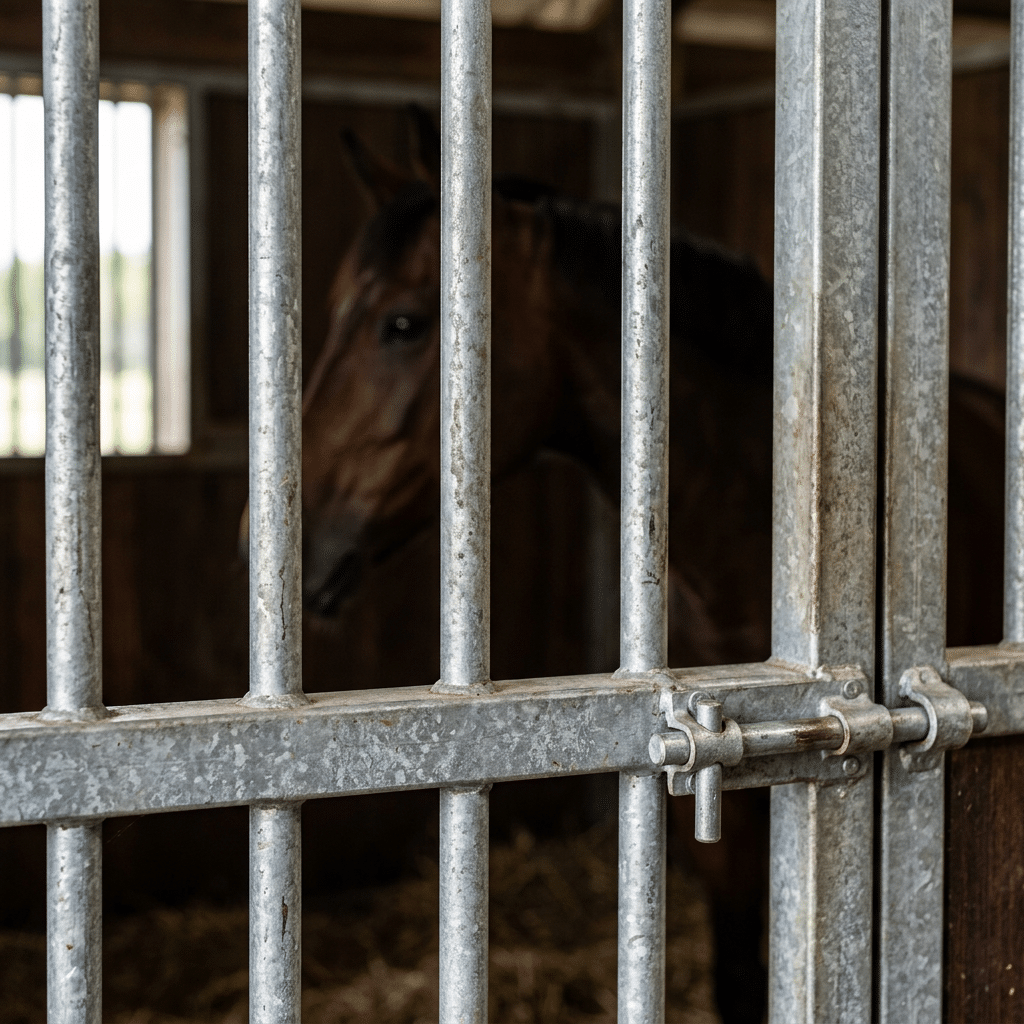
Effective scam & fraud avoidance is the primary defense against the most common sourcing failure: receiving horse stables built from thin, pre-galvanized steel. This manufacturing shortcut creates unprotected welds that rust within months, leading directly to costly warranty claims and significant damage to a distributor’s reputation.
This guide provides a technical due diligence framework for vetting factories. We benchmark suppliers against the non-negotiable BS EN ISO 1461 standard for Hot-Dip Galvanization After Fabrication and provide methods to physically verify a minimum 14-gauge (2.0mm) steel thickness before shipment.
5 Critical Red Flags to Watch For
Schneller Vergleich
| Szenario | Schwerpunktbereich | Hauptnutzen | Urteil |
|---|---|---|---|
| Prices That Are “Too Good to Be True” | Pricing & Vetting | Avoids Scams & Financial Loss | Essential for encouraging deeper due diligence on suppliers, preventing significant financial loss from deposit theft or receiving substandard products. |
| Refusal of Video Calls or Factory Visits | Supplier Verification | Confirms Operational Legitimacy | A crucial step that provides direct, undeniable proof of a factory’s existence and helps build a transparent, trusting relationship from the start. |
| The “Pre-Galvanized” Scam: Why Black Tube Welding Fails | Product Quality & Fraud | Ensures Product Integrity & Durability | Key technical knowledge that prevents receiving a product with a severely compromised lifespan by emphasizing the need for detailed material specifications. |
| Weight Discrepancies: Checking the Steel Gauge (14-Gauge min) | Quality Control & Compliance | Guarantees Material Specifications | A simple yet powerful and objective way to verify material compliance, protecting against structural failure and ensuring you get what you paid for. |
| Payment Safety: How to Protect Your Deposit | Financial Security | Mitigates Financial Risk | A critical financial safeguard. Using secure platforms with escrow and dispute resolution drastically reduces the risk of losing a deposit to fraud. |
# 🎨 TEMPLATE B: THE ANALYST CARD (For Features/Concepts)
**Filling Instructions:**
* `{INSERT_SLUG}`: Create a URL-friendly slug from the title (lowercase, hyphens for spaces).
* `{INSERT_TITLE}`: The feature/concept title from the input.
* `{INSERT_VERDICT}`: A 1-sentence summary of *why* this concept is important. **Bold** the key benefit.
* `{INSERT_DESC_P1}`: **What It Is.** Explain the concept simply and directly. (Max 3 sentences).
* `{INSERT_DESC_P2}`: **Why It Matters.** Focus on the business impact or strategic advantage. (Max 3 sentences).
* `{INSERT_CATEGORY}`: The category or domain this concept belongs to (e.g., from `location`).
* `{INSERT_BENEFIT}`: The primary outcome or value proposition (e.g., from `main_products`).
* `{INSERT_USE_CASE}`: The primary application or context (e.g., from `main_markets`).
* `{PROS_LI_ITEMS}`: Convert `what_we_love` into `
`. Limit to top 4.
* `{CONS_LI_ITEMS}`: Convert `things_to_consider` into `
`. Limit to top 2.
**HTML CODE B:**
“`html
{INSERT_TITLE}
{INSERT_VERDICT}
{INSERT_DESC_P1}
{INSERT_DESC_P2}
💡 Key Details:
- Category: {INSERT_CATEGORY}
- Main Benefit: {INSERT_BENEFIT}
- Primary Use Case: {INSERT_USE_CASE} Supplier Vetting
Analysis:
| ✅ The Upside | ⚠️ The Downside |
|---|---|
|
|
“`
“`html
Prices That Are “Too Good to Be True”
This red flag is a critical alert for potential fraud, helping you avoid counterfeit goods and outright financial loss by questioning unrealistic offers.
When a supplier’s price is dramatically lower than the market average, it’s a major warning. These deals often signal counterfeit products, a bait-and-switch scheme, or a scam to steal your deposit.
Paying attention to this forces you to validate a vendor’s legitimacy before committing funds. It’s a fundamental step in protecting your investment and ensuring you receive exactly what you paid for.
💡 Key Details:
- Category: Pricing & Vetting
- Main Benefit: Avoids Scams & Financial Loss
- Primary Use Case: Global Supplier Vetting
Analysis:
| ✅ The Upside | ⚠️ The Downside |
|---|---|
|
|
I have detected that the input data is a **FEATURE / CONCEPT**. I will now generate the HTML card using the appropriate template structure and the provided data.
“`html
Refusal of Video Calls or Factory Visits
A supplier’s refusal for real-time visual proof is a major red flag, blocking your ability to validate their legitimacy before you pay.
A supplier’s unwillingness to provide real-time visual verification of their operation is a major warning sign. In an era of digital threats, this refusal obstructs vendor legitimacy validation. A transparent partner will accommodate requests that prove their existence and capabilities.
📊 Auf einen Blick:
- 📂 Category: Supplier Verification
- 🎯 Key Benefit: Confirms Operational Legitimacy
- 🌍 Wichtige Märkte: Global
Why This Matters:
| ✅ Die Siege | ⚠️ Abwägungen |
|---|---|
|
|
I have identified the input data as a **TYPE B: FEATURE / CONCEPT**. To ensure data integrity and create a clear, user-friendly card, I will use a template structured for this data type, based on the visual styling of the provided examples.
The “Pre-Galvanized” Scam: Why Black Tube Welding Fails
This scam uses cheaper, pre-galvanized steel that fails at the weld seams, leading to premature rust and structural weakness.
Suppliers commit fraud by substituting cheaper pre-galvanized steel for the specified hot-dip galvanized material, a major issue for welded products.
The heat from welding destroys the thin, pre-applied zinc coating right at the seams. This leaves the weld points exposed and vulnerable to rust, which compromises the product’s integrity and lifespan.
📊 Quick Facts:
- 🏷️ Category: Product Quality & Fraud
- ✅ Main Benefit: Ensures Product Integrity & Durability
What This Means For You:
| ✅ Key Takeaways | ⚠️ Points to Consider |
|---|---|
|
|
Weight Discrepancies: Checking the Steel Gauge (14-Gauge min)
This simple check is crucial to guarantee material specifications, protecting you from receiving weaker, underweight products.
A common fraud scheme involves using thinner steel than specified, which creates a product that is lighter and structurally unsound. You can catch this by checking the product’s weight against its official specifications, ensuring you receive what you paid for.
📊 Auf einen Blick:
- 📍 Standort: Quality Control & Compliance
- 🏭 Kernkraft: Guarantees Material Specifications
- 🌍 Wichtige Märkte: Global
Warum wir sie ausgewählt haben:
| ✅ Die Siege | ⚠️ Abwägungen |
|---|---|
|
|
Payment Safety: How to Protect Your Deposit
Financial Security
This strategy protects your capital by routing payments through secure, traceable systems instead of risky direct transfers.
Protecting your deposit means avoiding high-risk payment methods, like sending direct wire transfers to personal accounts. This simple step helps you sidestep common scams where fraudsters disappear with your money.
Instead, use secure platforms that offer traceability and buyer protection, such as Letters of Credit or Alibaba Trade Assurance. These systems verify the recipient is a legitimate corporate entity and provide recourse if the deal fails.
📊 Quick Facts:
- 🎯 Core Benefit: Mitigates Financial Risk
- 🌍 Applicable To: Global
Analysis:
| ✅ What We Love | ⚠️ Things to Consider |
|---|---|
|
|
Global Horse Stables, Engineered for Durability

Red Flag 2: Refusal of Video Calls or Factory Visits
When sourcing a significant investment like horse stable systems, a supplier’s refusal to accommodate a video call or an on-site factory visit is a major warning sign. This lack of transparency often indicates they are a trading company, not a true manufacturer, or that their production facilities cannot support the quality and scale they claim.
The Video Call Litmus Test: Verifying Production Capabilities
A legitimate B2B manufacturer is proud to showcase their workshop. During a video call, ask them to walk you through their production line. You should see welding stations actively assembling frames, stacks of raw Q235B structural steel, and finished products ready for packaging onto steel pallets. Use this opportunity to verify critical quality claims. Ask them to show you a completed panel and explain how it’s prepared for the “Hot-Dip After Fabrication” stage. A transparent supplier can easily demonstrate this process, which is fundamentally different from simply welding cheaper, pre-galvanized tubes.
On-Site Audits: Confirming Quality Systems and Scale
A factory visit is the ultimate way to confirm scale and quality control. It allows your team to see firsthand if the operation can genuinely handle a distributor-level order, such as loading 30-45 stable sets into a 40HQ container. An audit gives you the chance to verify quality management systems, like our ISO 9001 certification, and inspect the materials and processes up close. If a potential supplier consistently refuses or creates excuses to avoid a visit, it is a strong indicator they are a small trading company, not a source factory, or that their actual facilities cannot back up their claims.
The “Pre-Galvanized” Scam: Why Black Tube Welding Fails
Welding pre-galvanized steel burns off the protective zinc coating at the seams, leaving the raw steel exposed to rust. This shortcut creates a critical failure point that compromises the safety and longevity of a horse stable. Our process, Hot-Dip Galvanization After Fabrication, ensures every weld is fully sealed under a thick layer of zinc for complete structural protection.
The Weakness of Welding Pre-Galvanized Steel
When a pre-galvanized tube is welded, the intense heat vaporizes the zinc coating around the joint, leaving the raw Q235B steel beneath it completely exposed. This unprotected seam is an open invitation for corrosion to begin. Some suppliers attempt to conceal this flaw with a thin layer of zinc-rich spray paint. This is only a cosmetic fix that provides poor protection and does not meet the stringent **BS EN ISO 1461** standard for hot-dip galvanizing.
This is precisely why our manufacturing is built around the **”Hot-Dip After Fabrication”** principle. We fabricate the entire stable front or partition from black steel first. Only after all welding and construction are complete do we submerge the entire, fully-welded structure in a molten zinc bath. This method guarantees a consistent, thick protective coating (over 70 microns) across every surface, edge, and weld seam, ensuring no weak points exist.
Why Welded Seams on Pre-Galvanized Material Rust First
The exposed weld on a pre-galvanized panel becomes the immediate failure point for the entire structure. It is the first place you will see rust, which then spreads and undermines the panel’s strength. This rapid, localized corrosion is especially aggressive in environments with high humidity or salt spray, such as those found in our key Australian and European markets.
A more deceptive problem is internal rust. Incomplete welds can trap moisture and cleaning fluids inside the hollow tubes. This trapped moisture attacks the steel from the inside, causing rust to bleed out from the joints and weakening the structure invisibly. This kind of failure presents a major safety hazard, as a weld could fail unexpectedly from a horse’s kick, compromising the entire stable’s integrity and risking injury to the animal.
Weight Discrepancies: Checking the Steel Gauge (14-Gauge min)
A critical risk when sourcing horse stables is the substitution of specified steel thickness. Suppliers may use lighter, cheaper steel (like 16-gauge instead of 14-gauge) while falsifying shipping weights. The only way to protect your investment and ensure animal safety is to physically measure the steel tube wall thickness with a digital caliper before shipment.
The Connection Between Steel Thickness, Weight, and Cost
A frequent scam involves a factory substituting the specified 14-gauge (2.0mm) steel with a thinner, cheaper material like 16-gauge. This tactic reduces the supplier’s material costs but significantly weakens the stable’s structural integrity. It directly undermines the safety we engineer into every component.
The fraud works because total shipping weight can be manipulated on official documents. Buyers might receive a lighter, inferior product but pay the full price quoted for heavy-duty steel. This deception impacts both the financial investment and, more importantly, the safety of the animals housed within the stable.
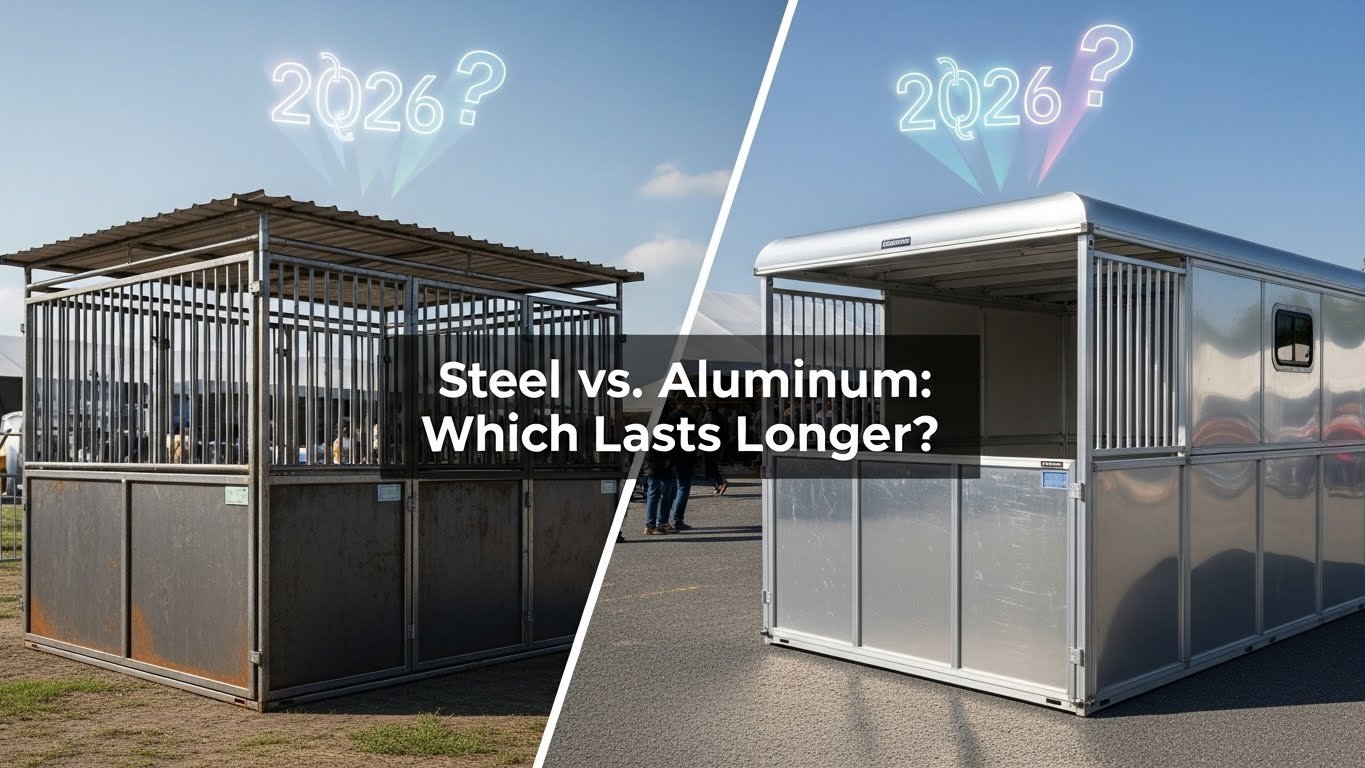
How to Verify Steel Thickness Before Acceptance
We advise our partners to always use a digital caliper to physically measure the steel tube wall thickness during any pre-shipment inspection. Do not rely on packing lists or weigh slips alone as your final verification.
For horse stables designed to withstand powerful impacts, the non-negotiable minimum is 14-gauge steel, which corresponds to a wall thickness of 2.0mm. Our factory standard for Q235B structural steel tubing is a robust 2.0mm to 2.5mm. This strict material specification is the foundation of our “Kick-Proof Guarantee” and ensures the long-term durability our clients expect.
Payment Safety: How to Protect Your Deposit
To protect your deposit when sourcing horse stables, adopt the industry-standard 30/70 Telegraphic Transfer (T/T) payment structure and thoroughly verify the supplier’s legitimacy before sending funds. This includes checking certifications like ISO 9001, confirming payment is to a matching corporate account, and insisting on a factory video tour.
Choosing the Right Payment Structure: The 30/70 T/T Split
The standard for international B2B equipment orders is a Telegraphic Transfer (T/T) payment. We operate on a 30/70 split: a 30% deposit is required to secure raw materials and schedule production, with the remaining 70% balance due only after you have approved the pre-shipment inspection photos and videos. This structure ensures a shared commitment to the project.
Be cautious of any supplier demanding 50% or more upfront. An established factory has the financial stability to procure the necessary Q235B structural steel for your project without relying on a majority of the payment in advance. A high deposit requirement can be a red flag.
Finally, always verify the payment details. Ensure you are sending funds to a corporate bank account that directly matches the company name on your proforma invoice. Payments to personal or mismatched accounts carry a significant risk and should always be avoided.
Verifying Supplier Legitimacy Before Sending a Deposit
Before you commit to a deposit, it’s essential to verify the supplier’s credentials. We encourage clients to request our business license and key quality certifications. Documents like our ISO 9001 certificate confirm that we operate under an internationally recognized quality management system.
A legitimate, engineering-focused manufacturer should also provide detailed technical proof of their standards. For example, we readily specify our adherence to **BS EN ISO 1461** for our **Hot-Dip Galvanization After Fabrication** process. A supplier who is vague about their technical standards may not have the expertise you need.
Don’t just rely on paperwork. Request a live video call for a factory tour. We are always happy to walk you through our workshop so you can see the steel stock, our welding stations, and finished products. A supplier who refuses a video tour or shows you a disorganized space may not be the direct manufacturer you believe them to be.
Abschließende Überlegungen
While pre-galvanized stables offer a lower price, specifying Hot-Dip Galvanization After Fabrication per ISO 1461 is the only way to protect your brand from rust claims. Settling for thin steel risks structural failure and damages your reputation as a dealer. Our 14-gauge minimum standard is non-negotiable and ensures the safety your customers demand.
Don’t risk an entire container on unverified claims. We recommend a small trial order to physically test our 14-gauge steel and the seamless finish of our galvanization. Contact our team to configure your sample sets and discuss your OEM requirements for your next shipment.
Häufig gestellte Fragen
Is it safe to wire money to China?
Yes, with the right precautions. A legitimate manufacturing partner will readily provide their business license and welcome a live video tour of their factory and production line. This transparency is a standard part of due diligence. Be cautious of any supplier who pressures for large upfront payments without offering this kind of verification.
How to avoid Alibaba scams?
Focus on verifiable specifications, not just the initial price. Scams often involve misrepresenting materials, like using thin, pre-galvanized steel that rusts at the welds within months. To protect your investment and reputation, insist that your contract specifies **”hot-dip galvanization after fabrication”** per ISO 1461 standards and a minimum **14-gauge (2.0mm)** steel wall thickness. This prevents costly warranty claims and protects your brand’s quality.
What is pre-galvanized vs hot-dip?
Pre-galvanized steel involves welding tubes that are already coated. This process burns off the zinc protection at every weld joint, creating guaranteed points for rust to start. In contrast, we exclusively use **hot-dip galvanization after fabrication**. This means we weld the entire stable panel first, then immerse the completed structure in molten zinc. The result is a seamless, much thicker coating that fully protects the welds and conforms to ISO 1461 for maximum longevity.
How to check steel thickness?
The most reliable method is to use a digital caliper to measure the steel’s wall thickness. For horse stables, safety and durability are paramount. We adhere to a strict minimum of **14-gauge (2.0mm)** tubing. Any material thinner than this is prone to denting or breaking from a horse’s kick, posing a significant risk. Verifying this specification is a critical quality control step to ensure the structure’s longevity and the animal’s safety.
Do I need a contract in Chinese?
A bilingual contract (English and Chinese) is the best practice for legal clarity and enforceability in China. To fully protect your investment, the contract should explicitly detail all critical specifications. This includes the steel grade (e.g., Q235B), the galvanization standard (**ISO 1461**), tube wall thickness (14-gauge minimum), and the exact infill material (e.g., high-density bamboo or HDPE). This level of detail removes ambiguity and ensures you receive exactly what you ordered.

 German
  English
  Spanish
  French
  Arabic
0 Kommentare