



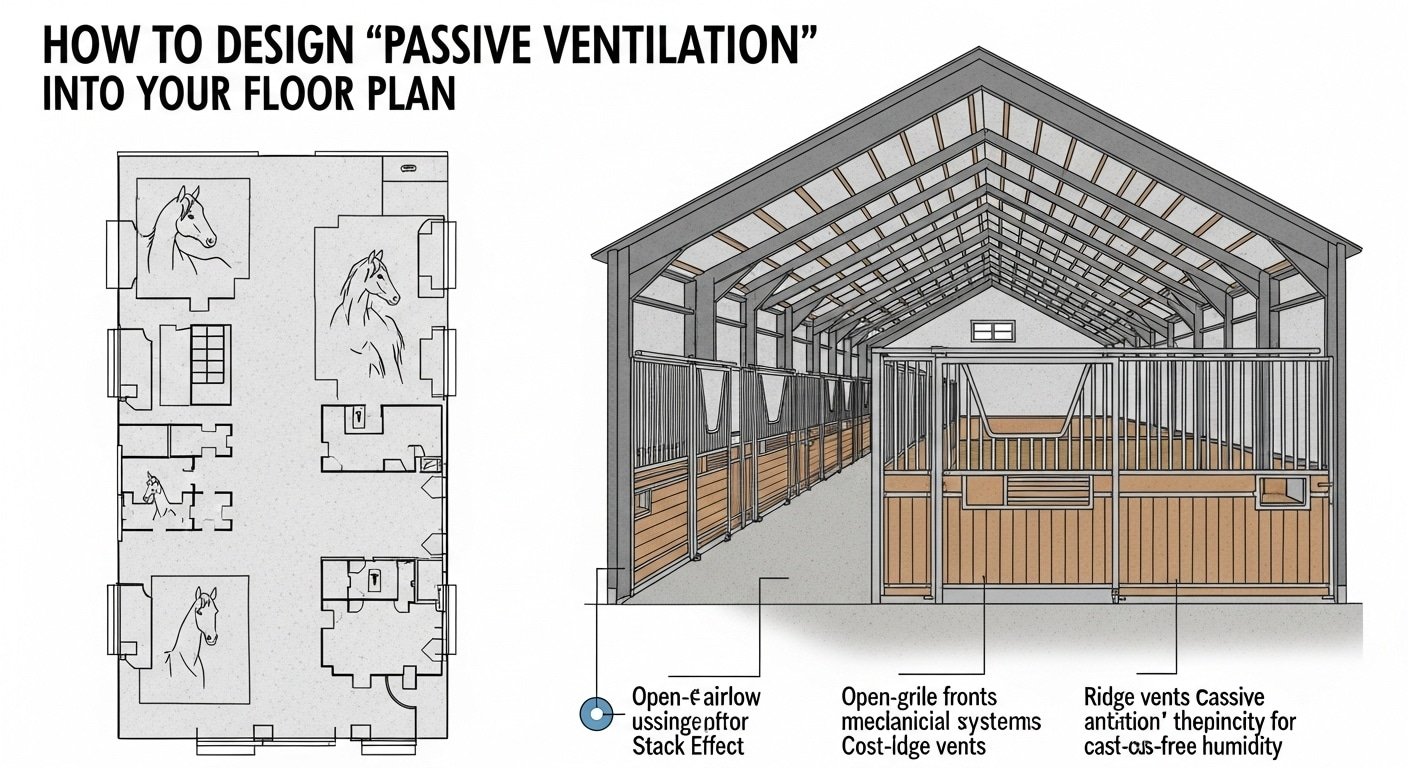
Improper horse barn ventilation design is a direct cause of respiratory illness, creating significant veterinary costs for owners and liability risks for facility engineers. Relying solely on mechanical systems increases operational expenses and introduces a critical point of failure, compromising the long-term health rating and asset value of the property.
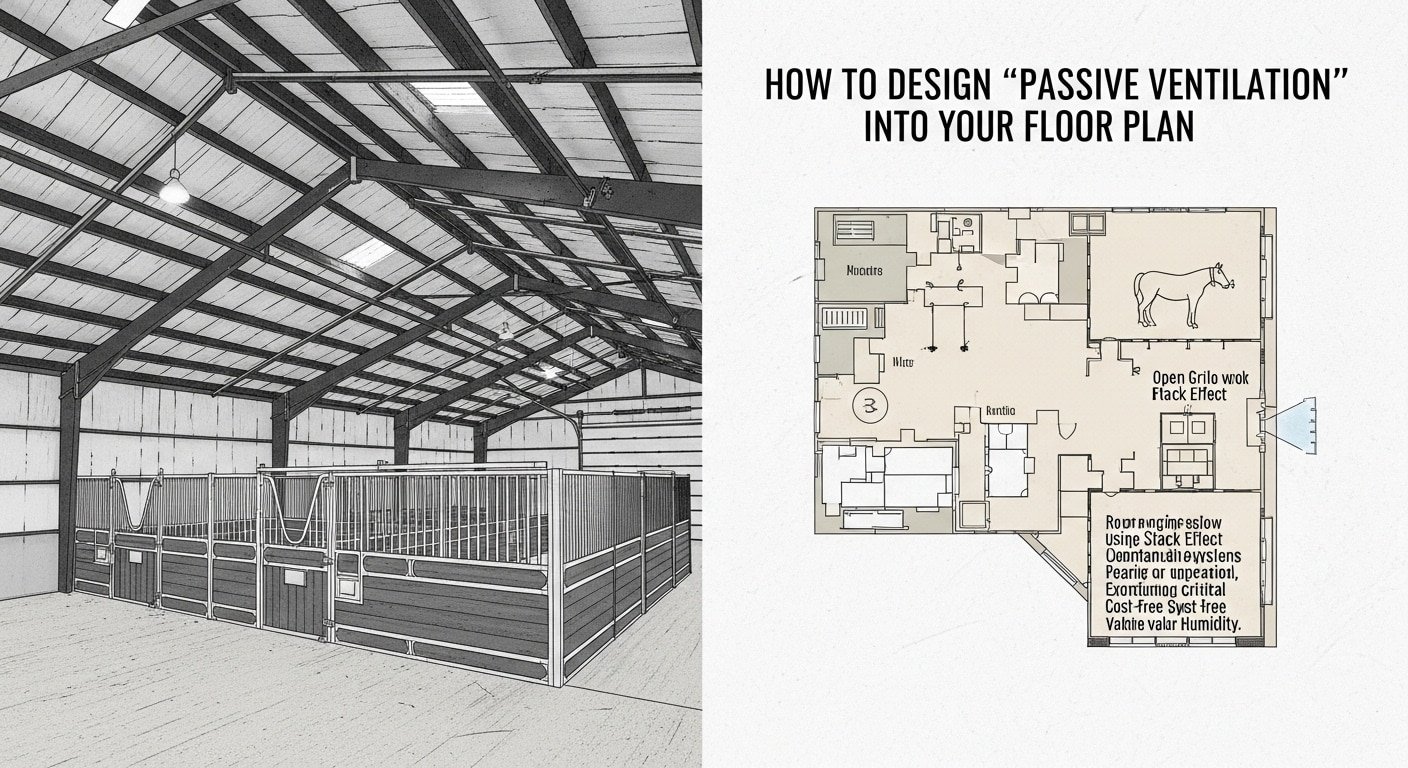
This analysis details how to engineer passive airflow using the “Stack Effect.” We examine how specific components, like open-grill stall fronts and ridge vents, integrate into a floor plan to create a continuous, cost-free system for managing air quality and humidity.

How to Maximize Space in a Compact Barn?
Maximieren Sie barn space with vertical storage and smart layouts. Modular, flat-pack equipment is key to reducing clutter and improving workflow before installation even begins.
Strategic Layouts and Vertical Storage
The foundation of an efficient barn is a layout that eliminates wasted movement. Define separate zones for stabling, work, and storage to prevent inefficient overlap and clutter. Once zones are set, use vertical space aggressively. Install shelves, racks, and loft areas to get equipment off the Boden. This approach keeps essential pathways clear for easy circulation and a safer working environment.
The Advantage of Flat-Pack Modular Systems
Space efficiency starts long before installation. Bulky, fully-welded stable components consume huge amounts of space during shipping and on-site storage. A flat-pack system solves this by allowing all components to be stacked compactly on steel pallets. This design difference has a massive impact on logistics and site management. The modular components are also easier to store if you need to reconfigure the barn layout later.
- Traditional Welded Stalls: In einen 40HQ-Container passen nur 12 bis 15 Sets.
- DB Stable Flat-Pack System: A 40HQ container fits **30-45 sets**, saving over 60% on freight.
Best 10 Design Features for Small Horse Barns
Wirksam small barn design pairs a center aisle layout with proper ventilation, correct stall sizes, and dedicated spaces like tack rooms and lofts for peak functionality.
Planning a small horse barn isn’t about shrinking a large design; it’s about optimizing every square foot for safety, workflow, and horse health. The right features make a compact space feel efficient and safe, while the wrong ones create daily frustrations. Below are the 10 features that deliver the most value in a small footprint.
| Design Feature | Hauptvorteil & Recommendation |
|---|---|
| 1. Center Aisle Layout | Creates a weather-protected, efficient workflow. This is the foundation of most functional 2 to 4-stall barn plans, allowing you to work indoors regardless of conditions. |
| 2. Adequate Aisle Width | Ensures safe passage for horses and handlers and allows for equipment access. A 12-foot width is the standard minimum. Commercial or busy private barns should aim for 14 feet. |
| 3. Proper Stall Dimensions | Prevents injury and stress by allowing horses to lie down and move comfortably. A 12×12 foot stall is the non-negotiable minimum; use 14×14 feet for larger breeds like warmbloods. |
| 4. Effective Ventilation Systems | Removes ammonia, moisture, and airborne pathogens, protecting respiratory health. Combine Firstentlüftungen with open-grill stall fronts to create a “stack effect” for continuous air exchange. |
| 5. Natural Light and Windows | Reduces electricity costs and improves horse well-being. Windows should be placed high (5+ feet) and protected with bars spaced no more than 3 inches apart to Unfälle verhindern. |
| 6. Mesh or Grill Stall Fronts | Maximizes cross-barn airflow without compromising stall security. This design also reduces social isolation for stabled horses, which can help lower stress levels. |
| 7. Dutch Doors | Provides an extra ventilation point and allows horses safe social interaction with their surroundings. These are ideal for exterior stall walls, giving horses a secondary view and fresh air source. |
| 8. Dedicated Tack & Feed Rooms | Secures expensive feed and tack from pests, moisture, and curious horses. A 10×10 foot room is the absolute minimum; a 12×12 foot space is far more practical for storage and organization. |
| 9. Storage and Loft Space | Utilizes vertical “dead air” to store hay and equipment, keeping aisles clear and safe. A structural loft can double your storage capacity without increasing the barn’s foundation size. |
| 10. Practical Interior Materials | Enhances safety, durability, and ease of maintenance. Prioritize non-slip flooring, cast-proof stall designs with minimal bottom gaps, and hot-dip galvanized steel components to prevent rust and injuries. |
Why Sliding Doors Are Mandatory for Small Aisles?
Schiebetüren are critical for small aisles because they don’t swing into the passageway. This design maximizes usable space and prevents collisions in confined areas.
Eliminating the Swing Radius Obstruction
A hinged door requires a large, clear arc to open fully. In a narrow aisle, this swing radius creates a temporary but complete obstruction, making the passage impassable. It Kräfte handlers to wait, creating workflow bottlenecks and safety risks. Sliding doors solve this problem directly. They move parallel to the stall wall along a track, consuming zero aisle space whether open, closed, or in motion. This ensures handlers and horses can pass safely at all times without risking a collision with a partially open door.
The Advantage of a Hidden Track System
Beyond just saving space, the design of the track system dictates long-term reliability. Our Professional Series stables use a hidden track system that protects the rollers from accumulating dirt, hay, and debris. This simple design feature is critical for ensuring smooth, quiet, and consistent door operation for years. The included hardware kits use 304 Stainless Steel components, which resist the corrosion common in barn environments and maintain their structural integrity.

Can Rotating Feeders Save You 5 Square Feet?
Yes. Rotating feeders integrate into the stall front, allowing feeding from the aisle. This eliminates dedicated internal feeding zones, reclaiming valuable floor space and streamlining chores.
How Rotating Feeders Reclaim Stall Space
Traditional floor feeders or fixed bins occupy a corner of the stall. A rotating feeder integrates this function directly into the stall front Panel. This design allows staff to fill feed and water from the barn aisle without entering the stall, which removes the need for a dedicated internal feeding area or the extra clearance space for a person carrying buckets.
The Swivel Feeder in the Professional Series
Swivel feeders are a standard, integrated feature in our DB Stable Professional Series stalls. The mechanism is constructed from lightweight, rust-proof aluminum for long-term durability and ease of operation, fitting directly into the stall’s heavy-duty Stahlrahmen.
How to Integrate a Tack Room in a 4-Stall Layout?
Use a 12×12 ft space, equivalent to one stall, at the end of a central aisle. Construct it with the same modular fronts and partitions for a cohesive, secure build.
Optimal Placement and Sizing in the Floor Plan
A tack room in a four-stall barn shouldn’t be an afterthought. Proper placement is key to workflow. The standard industry practice treats the tack room as a functional module, often occupying the footprint of what would be a fifth stall to maintain layout symmetry and structural integrity.
- Location: Position the room at one end of the central aisle. This gives staff convenient access from any stall.
- Footprint: Allocate a 10×10 ft or, ideally, a 12×12 ft space. This matches standard stall dimensions, simplifying the floor plan and material ordering.
- Aisle Clearance: Keep main barn aisles at least 12 feet wide to ensure safe movement of horses and equipment.
Using Modular Stall Partitions for Construction
You don’t need to source different materials to build a secure tack room. A modular, flat-pack stable system is designed for this purpose. You can use the exact same components specified for the Pferdeboxen to construct a durable and matching tack room, which simplifies logistics and installation.
- Entry Panel: Utilize a standard stabil front for the tack room’s entry and wall. This maintains a uniform appearance throughout the facility.
- Secure Walls: Select solid infill partitions. Zero-maintenance HDPE is practical and easy to sauber, while high-density bamboo offers superior impact resistance. Both provide necessary privacy and security for valuable equipment.
- System Integration: The flat-pack system allows a tack room module to be added seamlessly into any project plan without needing complex custom fabrication.
Weather-Proof Stables Built to Last Decades

Abschließende Überlegungen
While pre-galvanized stables lower initial quotes, they expose dealers to rust complaints and reputational damage. Our ISO 1461 Feuerverzinkung after fabrication is non-negotiable; it guarantees structural integrity and protects your brand. This standard, combined with our freight-saving flat-pack system, is how you secure long-term Gewinnspannen.
Verify our engineering claims yourself. We recommend a trial order of 3-5 stable sets to confirm the fit, finish, and material superiority firsthand. Contact our team to get the technical specifications and discuss OEM options for your market.
Häufig gestellte Fragen
What is ‘Hot-Dip Galvanization After Fabrication’ and why is it important?
This is our core rust-protection process. We fully weld the raw steel stable panels first, then submerge the entire structure in molten zinc. This coats every surface and weld according to ISO 1461 standards, with a coating over 70 microns thick. This method is far superior to using pre-galvanized tubes, which leaves the welded joints exposed and vulnerable to rust.
How does your flat-pack system reduce shipping costs for distributors?
Our steel pallet flat-pack system allows a 40HQ container to hold 30-45 stable sets. In comparison, traditional fully-welded stables can only fit 12-15 sets in the same space. This high-density loading significantly reduces freight costs per unit, directly protecting the profit margins of our B2B partners.
What is the difference between your HDPE and Bamboo infill options?
Both are premium, durable options. HDPE offers zero maintenance, excellent impact absorption, and is UV stabilized, making it ideal for busy facilities. Our high-density strand-woven bamboo is three times harder than oak, naturally resistant to mold, and provides a classic, high-end aesthetic for premier equestrian centers.
Do your stable designs help with barn ventilation?
Yes, our designs support natural airflow. The open-grill tops on our stable fronts and partitions are engineered to promote the ‘Stack Effect,’ allowing warm, stale air to rise and exit while fresh air is drawn in. This passive ventilation is critical for managing humidity and maintaining healthy Luftqualität within the barn.
Can a wash rack fit in a standard 4-stall barn?
Yes, you can fit a wash rack in a 4-stall barn, as the space requirements are quite modest compared to typical barn dimensions. The minimum recommended wash rack size is 8′ wide x 12′ long, with 10′ x 12′ being the preferred professional size. A typical 4-stall barn with standard 12′ x 12′ stalls and a 12′ work aisle provides ample space for a dedicated wash rack. When planning, consider space integration next to stalls, essential infrastructure like a sloped concrete floor and hot water, and design flexibility, as they are often enclosed on only three sides.
Is a 36×24 foot barn considered large enough?
Whether a 36×24 barn is large enough depends on its intended use and the number of animals. For horse barns, proper ventilation is critical, with a recommended rate of 25 cubic feet of air per minute (cfm) per 1,000 pounds of horse. A 36×24 barn (864 square feet) would need features like Firstentlüftungen and sidewall openings to ensure adequate air exchange. To determine if this size is sufficient, you must first define its purpose (e.g., storage, specific livestock) and capacity needs.
What is the best way to store hay in a small barn?
To properly store hay in a small barn, elevate the bales off the ground using pallets to prevent moisture absorption, which can cause up to 50% spoilage. Ensure hay is baled at 15% moisture or less to prevent combustion. Maximize ventilation by leaving at least 2 feet of space between the top bales and the ceiling and 18 inches from the walls. Stacking bales with alternating orientations also encourages drying and preserves quality.
Is a dedicated feed room necessary for a horse barn?
Yes, a dedicated feed room is essential for horse health and safety. It prevents horses from overeating grain, which can lead to serious conditions like colic or laminitis. A secure, well-ventilated feed room also protects feed quality by preventing mold and spoilage and keeps it safe from rodents and insects. It improves operational efficiency by providing an organized space for managing individual diets and medications.
Is it safe to use the barn aisle for grooming horses?
While many barns use the main aisle for grooming, it comes with safety risks due to it being a high-traffic area. If you use the aisle, ensure it is at least 10-12 feet wide with non-slip flooring and is kept clear of clutter. A safer alternative is a dedicated grooming stall, which provides a controlled environment away from the main traffic flow, minimizing potential accidents for both horse and handler.
What is the smallest recommended size for a tack room?
The smallest recommended tack room size is generally considered to be 10′ x 10′. This size is a practical minimum for storing basic equipment for a small to medium number of horses. A 12′ x 12′ room is also a common standard that provides more comfortable maneuvering and storage space. The ‘safe’ size ultimately depends on your specific storage needs, ensuring enough room to access equipment without crowding or creating hazards.

 German
  English
  Spanish
  French
  Arabic
0 Kommentare