


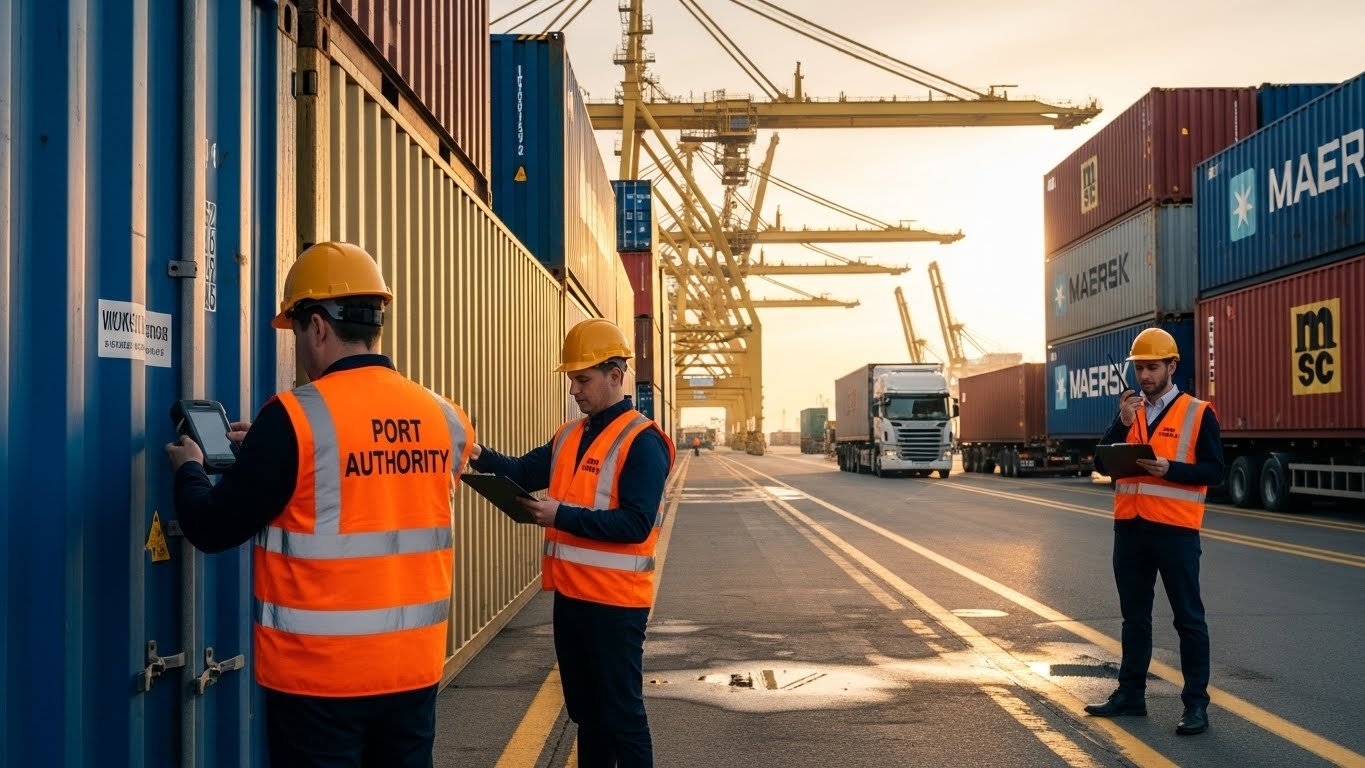
It’s one of the most frustrating updates for any importer: your container has been flagged for a customs exam. These delays often feel random, but they are driven by sophisticated risk-assessment algorithms. What starts as a simple flag can quickly lead to unexpected costs and disruptions to your supply chain.
This guide explains how customs exams really work. We’ll break down why your shipment gets selected and the differences between the three main inspection types: a quick VACIS/X-ray scan, a Tail Gate Exam, and a full Intensive Exam. You’ll also learn about the specific delays and costs for each—from a 2-3 day holdup for an X-ray to an intensive exam that can cost over $2,500 and take more than a week.
The “Random” Selection Algorithm
The ‘random’ selection algorithm isn’t actually random. Customs agencies use AI and machine learning systems to analyze every shipment’s data, calculating risk scores to flag items for inspection. This data-driven approach allows them to focus resources on high-risk cargo while automatically clearing the majority of low-risk shipments.
From Random Chance to Risk-Based Targeting
Modern customs selection is no longer a game of pure chance. Instead of pulling shipments for inspection randomly, agencies now use artificial intelligence and machine learning to target high-risk cargo. This systematic approach, known as risk profiling, analyzes shipment data to predict the likelihood of compliance issues or errors.
This strategy helps customs authorities manage millions of daily imports far more efficiently. By focusing inspector attention on shipments the system flags as problematic, they can let the vast majority of low-risk goods pass through without delay, concentrating resources where they are most needed.
How the Algorithm Calculates Risk
The algorithm analyzes every declaration to calculate specific error probabilities for each line item. For example, a system might determine that a particular shipment of tungsten powder has a 92.46% probability of having an incorrect product classification code. It computes this risk by weighing factors like product type, declared value, country of origin, and import license requirements to determine the “return expectation” of an inspection.
Based on this risk score, the system automatically assigns each shipment to a channel. A “green” channel assignment means automatic clearance, while “yellow” or “red” channels direct the shipment for different levels of document review or physical inspection. This automation is incredibly efficient; China’s customs system auto-processes 75% of all declarations and flags just 4% for a full physical exam.
VACIS / NII (X-Ray) Exam: 2-3 Days
A VACIS/NII exam is a non-intrusive X-ray or gamma-ray scan of a full container at the terminal. Although the scan itself takes only minutes, the total delay is typically 2-3 days. This is due to port congestion, scheduling, and the administrative time required to move the container to and from the scanning site.
| Inspection Type | Physical Scan Time | Total Logistics Delay |
|---|---|---|
| VACIS / NII (X-Ray) | Minutes per container | 2–3 Days |
The Scan Process: A Quick, Non-Intrusive Look
A VACIS (Vehicle and Cargo Inspection System) exam is a Non-Intrusive Inspection (NII) that uses X-ray or gamma-ray imaging to scan an entire container. The process happens directly at the port, where the truck drives through the scanner in a single pass without the container ever being opened. It works much like a medical X-ray, providing a quick look inside. The radiation exposure is minimal—around 0.05 micro-sieverts (µSv) per scan—which poses no risk to the cargo.
Why a Minutes-Long Scan Causes a Days-Long Delay
The main reason a scan that takes only minutes causes a 2-3 day delay is port logistics. The bottleneck isn’t the speed of the scanner, which can process a truck quickly. Instead, the holdup comes from terminal congestion, the queue of containers waiting for the machine, and the administrative time needed to schedule and move the container to and from the scanning location. Freight forwarders typically plan for a 1-2 day delay, but this can extend to 3 days at busier ports. The real challenge is the container handling and scheduling, not the inspection itself.
Tail Gate Exam: Peeking Inside
A Tail Gate Exam is a physical inspection where U.S. Customs officers break a container’s seal to visually check cargo against the manifest without unloading it. This exam typically adds 5-7 days to your shipping time and happens at a Centralized Examination Station (CES) after an initial X-ray scan shows a potential issue.
The Inspection Process: A Look Inside
The process begins after a container is flagged, often following an X-ray scan, and is moved to a secure Centralized Examination Station (CES). At the CES, a U.S. Customs and Border Protection (CBP) officer breaks the original shipping seal to open the container doors. The officer then performs a visual check of the cargo stacked at the rear of the container, comparing the visible items against the shipping manifest and packing list. During this stage, the cargo is not unloaded; the inspection is only a surface-level verification to check for immediate discrepancies.
Impact on Timeline, Costs, and Further Scrutiny
A tail gate exam introduces significant delays and costs. Shippers should expect an average delay of 5-7 days, which can extend to 10 days or more during periods of high port congestion. Daily costs add up quickly, with demurrage charges averaging $300-$350 per day and CES storage fees running between $150-$200 per day. If the inspecting officer finds a mismatch between the visible cargo and the provided documentation, the exam will escalate to a more costly and time-consuming intensive exam. Inaccurate or mismatched paperwork is the leading trigger for escalation, making a precise and detailed packing list critical to avoiding more significant delays and expenses.
Stables Engineered for Any Climate, Built for a Lifetime.
Intensive Exam (Strip Search): The Costly One
An Intensive Exam, often called a ‘strip search,’ is the most in-depth customs inspection. Triggered by anomalies found during an X-ray, it involves the Contraband Enforcement Team (CET) completely unloading a container to physically inspect all cargo, making it the most time-consuming and expensive exam for an importer.
| Trigger | Process Overview | Typical Impact |
|---|---|---|
| An anomaly or discrepancy found during a VACIS (X-ray) exam. | The container is moved to a CES, where a Contraband Enforcement Team (CET) fully unloads all cargo for a physical inspection. | Highest cost and longest delays due to extensive labor for destuffing, inspection, and restuffing. |
From X-Ray Anomaly to Full Unload
This thorough inspection begins after a VACIS X-ray scan reveals a potential problem that warrants a closer look. A Contraband Enforcement Team (CET) then flags the container for an Intensive Exam. The process requires moving the container to a Centralized Examination Station (CES), where it is completely “stripped,” meaning all cargo is unloaded. From there, officials conduct a hands-on, physical examination of the goods to identify any contraband or non-compliant items.
Procedural Rigor and High Costs
An Intensive Exam is the most resource-heavy inspection an importer can face. The labor involved in unloading, segregating, examining, and reloading the cargo drives up costs substantially. While there is no single standard fee, it is consistently the most expensive type of exam. The nickname “strip search” underscores the detailed and rigorous nature of the procedure, which is why it inevitably causes the most significant delays and cost increases in the shipping process.
Who Pays for the Exam? (Spoiler: You Do)
The importer of record is always responsible for paying all costs associated with a customs exam. These fees are not paid by the government but are billed by private facilities through your freight forwarder or customs broker. Costs can range from about $300 for an X-ray to over $2,500 for an intensive exam.
The Importer Bears All Costs
When a shipment is flagged for a customs exam, the importer of record is financially responsible for all associated charges. These costs are not covered by the government. Instead, private facilities known as Customs Exam Sites (CES) perform the physical inspection and bill your carrier. Your freight forwarder or customs broker then passes these charges on to you through an invoice. This policy holds true even if your shipment was selected at random and is found to be fully compliant.
Cost Breakdown by Exam Type (2026 Estimates)
Exam costs vary significantly based on the inspection type. As of 2026, a non-intrusive VACIS or X-ray exam typically costs around $300 per container, though the range can be anywhere from $100 to $600. A Tailgate Exam, where an officer inspects the rear of the container, usually starts at $100 and up depending on the port. The most expensive is the Intensive Exam, which can run from $500 to over $2,500 due to labor and facility fees. For LCL (Less-than-Container Load) shipments, these charges are often divided proportionally among the importers, sometimes starting from $25 per cubic meter (CBM). The final bill will also include associated fees for transportation to the exam site, storage (demurrage), and handling.
Final Thoughts
Getting flagged for a customs exam can feel like bad luck, but it’s usually the result of a data-driven risk assessment. From a quick X-ray to a full container unload, each inspection level adds time and cost to your shipment. The process isn’t personal; it’s a systematic approach designed to keep borders secure while managing an enormous volume of trade.
You can’t control the selection algorithm, but you can influence your risk score. Working with a reliable freight forwarder and ensuring your paperwork is precise and complete are the most effective steps you can take. Accurate documentation not only helps you avoid exams but also ensures that if an inspection does happen, it resolves as quickly and inexpensively as possible.

Frequently Asked Questions
How long does a customs exam take?
U.S. customs exams typically take 2-7 days depending on the inspection type. Basic X-ray/NII exams can take a few hours to 3 days, tailgate exams take 2-5 days, and intensive exams for ocean freight often last 5-7 days or longer.
Do I have to pay for the inspection?
While there is no separate fee for the inspection itself, importers must pay all associated processing fees, duties, and taxes before goods can be released. These costs cover the compliance and examination process.
Why was my container selected?
Containers are selected for customs exams based on various risk factors. These can include hazardous material declarations, general cargo type, or shipment volume. U.S. CBP often uses non-intrusive imaging first, and only escalates to a physical exam if anomalies are detected.
Can I speed up a customs exam?
You cannot directly speed up an exam once your shipment is selected, as the timing is controlled by U.S. Customs. You can, though, reduce the likelihood of an exam by ensuring on-time ISF filing, providing accurate documentation, and participating in trusted-trader programs like CTPAT.
Will an exam damage the goods?
Damage is very unlikely. Most inspections use non-intrusive methods like X-ray and gamma-ray scanning to examine shipments without physically opening the container or causing harm to the contents.
What is a CET exam?
A CET exam is an intensive physical inspection conducted by a Contraband Enforcement Team to find illegal goods like drugs or weapons. The container is moved to a Centralized Examination Station (CES), completely unloaded, and every item is examined.



 English
  Spanish
  French
  Arabic
  German
0 Comments