


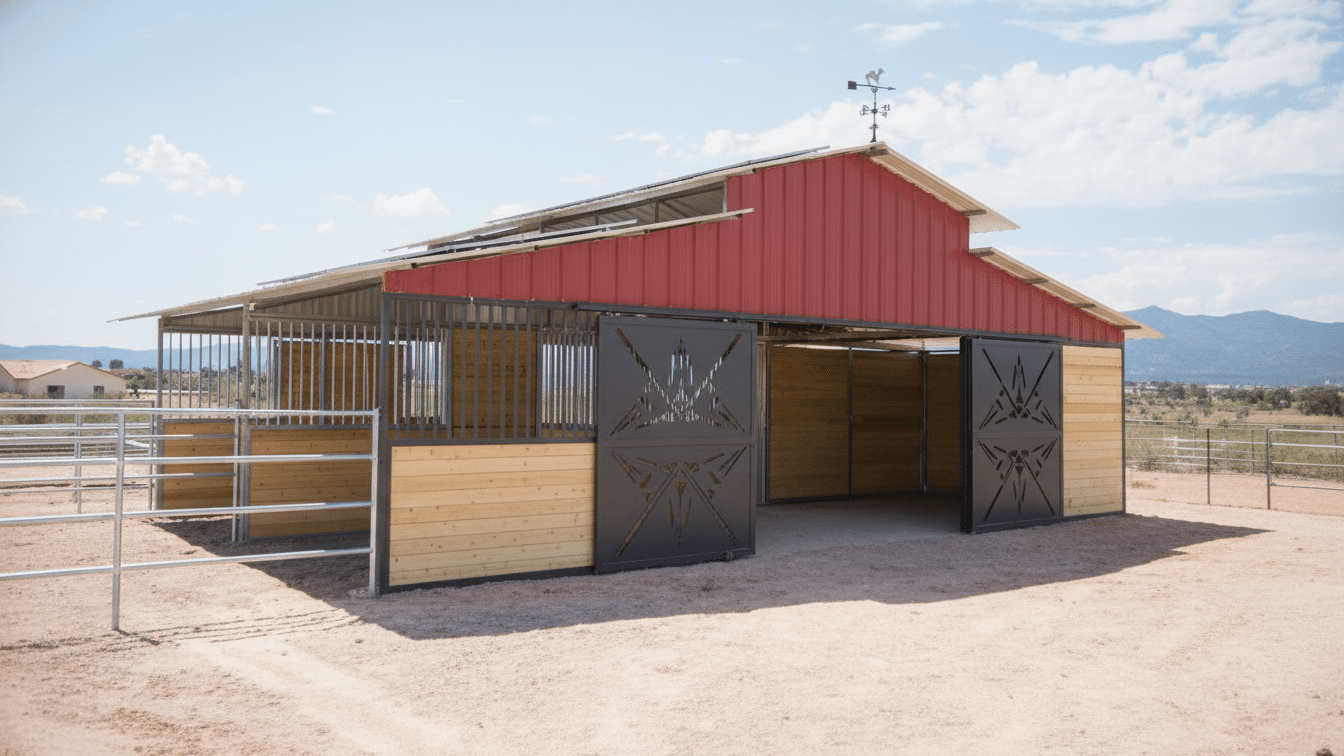
This guide details how OEM services bridge that gap. We cover the technical specifics of RAL system color matching, laser-cutting logos to ±0.25mm tolerances, and upgrading materials with options like thermo-treated bamboo.
The Value of Custom Branding for Equine Facilities
Custom branding for equine facilities adds value by creating a professional, recognizable environment that enhances brand identity. It also increases property value, making custom features like indoor arenas or unique design elements a major selling point for future buyers, blending aesthetic appeal with tangible asset growth.
Branding Beyond Logos: Enhancing Reputation and Property Value
A well-branded equine facility does more than just display a logo. It creates a complete, professional atmosphere that leaves a lasting impression on visitors and clients. This consistent identity signals quality and attention to detail, building a strong reputation in the equestrian community.
Beyond looks, custom features add real, measurable value to your property. A custom-built indoor riding arena, for example, is a significant upgrade that increases the facility’s market price. When it comes time to sell, a thoughtfully branded and equipped property becomes a key selling point, attracting serious buyers who appreciate its unique character and functionality.
Key Elements in a Custom Branded Facility
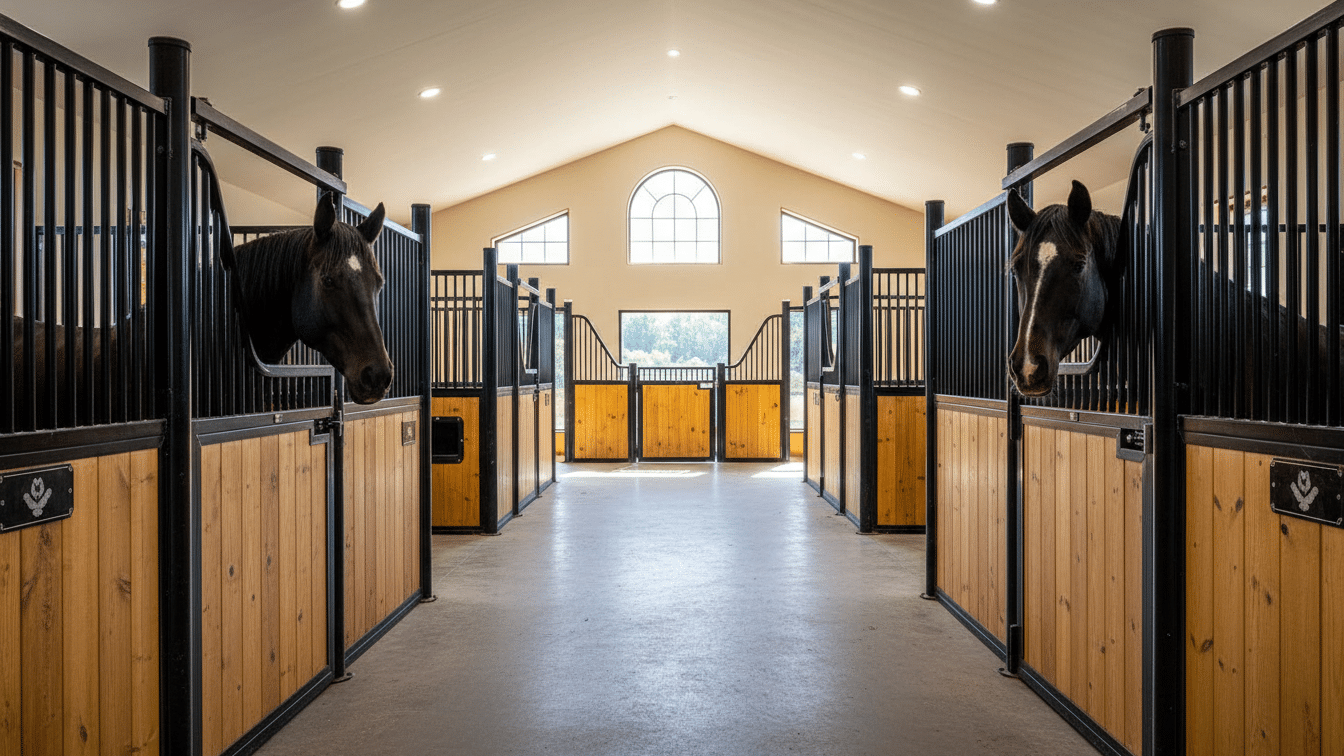
Creating a branded environment involves combining specific design choices that reflect your identity. These elements work together to build a cohesive and valuable facility.
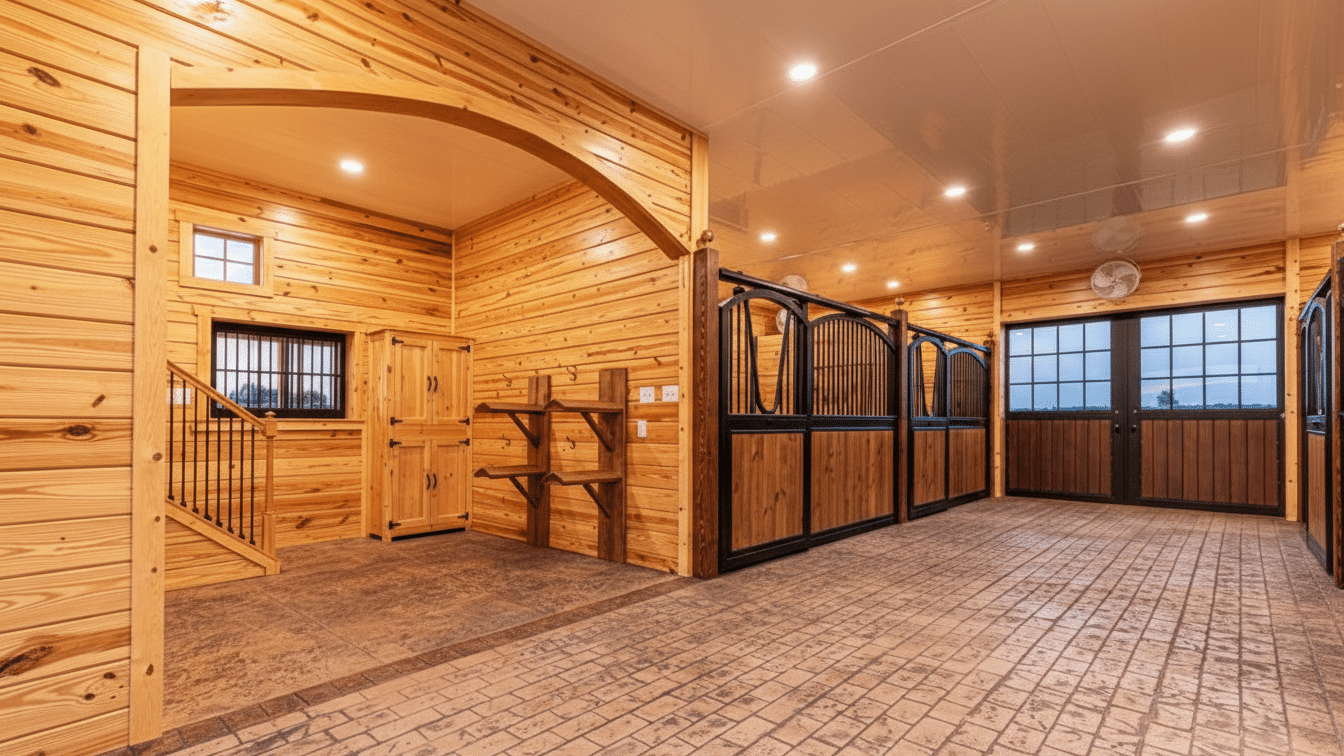
- Architectural Features: Details like cupolas with windows for better light, custom wrought iron fixtures, and stone or brick accents give a facility a distinct, high-end feel.
- Brand Integration: Simple touches like using team colors throughout the property, adding logos to stall plates, and designing color-coordinated tack rooms create a unified look.
- Functional Aesthetics: Even practical items can enhance your brand. Designer lighting fixtures can improve visibility in stalls and arenas while adding to the overall aesthetic.
Branded Facilities in Action: Real-World Examples
Large-scale equestrian centers show how effective custom branding can be. The Palm Meadows Training Center in Florida, for instance, includes over 118,000 square feet of custom horse barn pavilions, creating a massive, unified environment. Similarly, the Red Tail Ranch Equestrian Center features a 30,800 square foot fully enclosed and branded riding arena, showcasing how a single structure can anchor a facility’s identity.
This approach isn’t limited to a single region. One supplier’s portfolio shows its scalability, with over 120 custom projects completed across 55 countries, proving that a branded vision can be executed anywhere.
How DB Stable Delivers Scalable Customization
DB Stable helps facilities of all sizes achieve a custom, branded look. Whether you need a single portable stall or a large, multi-unit barn, the components can be tailored to match your specific aesthetic and functional needs.
- ✅ Customizable Options: Choose from swing or sliding doors, various roof designs, and durable HDPE infill panels that can align with your facility’s color scheme.
- ✅ Solutions for Any Scale: The product line is designed for flexibility, accommodating everything from small private barns to large professional training centers.
- ✅ Proven Expertise: With a history of serving the Australian and New Zealand markets since 2013, DB Stable has the experience to deliver high-quality, customized stable solutions built to last.
Powder Coating Options and Color Matching (RAL System)
The RAL system is an industry-standard color matching and identification tool used in manufacturing to ensure color consistency across different production batches and materials. It provides a universal code for each color, which is critical for projects requiring precise color reproduction for components like powder-coated steel panels.
Understanding the Three Main RAL Systems
The RAL system acts like a universal paint swatch book for industrial products, ensuring a specific color looks the same no matter where or when it’s applied. It is divided into three main palettes for different uses.
- RAL Classic: This is the original and most common system, containing 213 standardized colors. It’s the go-to choice for industrial and architectural uses, like powder coating steel frames or building panels.
- RAL Design: An expanded library with over 1,600 colors, this system is built for architects and designers. It uses a more technical model to define colors, giving creatives precise control over shades and tones.
- RAL Effect: This specialized collection includes 420 solid colors and 70 matching metallic shades. It’s often used in products where appearance is key, such as automotive parts or decorative items.
Technical Codes, Standards, and Formulations
Each RAL color has a technical identity to ensure it can be replicated perfectly. The RAL Classic system uses a simple four-digit code, where the first number tells you the color family. For example, any code starting with a ‘7’ is a shade of grey, and any code starting with a ‘9’ is a shade of white or black.
Coatings also adhere to industry standards like AAMA 2603 for typical residential use or the more robust AAMA 2604 for outdoor products that face harsh weather. The powder itself is made from different resins. TGIC Polyester is a common, durable choice, while epoxy-based powders offer extra protection against chemicals. The powder is sprayed onto a metal part and then baked at a specific temperature, like 375°F for 10 minutes, which cures it into a hard, protective shell.

How DB Stable Applies Powder Coating for Durability
DB Stable uses powder coating to protect its steel board roofs, giving them a tough finish that resists weather damage. The standard grey color we offer for roofing comes from the RAL 7xxx series, which guarantees a consistent and professional look that matches the hot-dip galvanized steel frames.
This coating process creates a physical barrier that shields the steel from rust and sun degradation. It is a key part of what makes the stable’s roofing system last for years, maintaining both its function and appearance. By using a standardized color system, we ensure that every roof panel has the exact same shade of grey, creating a clean and uniform look for the entire barn.
Laser Cut Logos and Personalized Designs
Laser cutting for logos and designs uses precise laser beams to create intricate shapes, operating under strict engineering parameters. Key constraints include minimum bridge dimensions (0.5x material thickness) and feature sizes (1x material thickness) to maintain design integrity, achieving tolerances as fine as ±0.25mm for high-quality reproduction.
Core Principles of Laser Cutting for Custom Designs
Creating a custom logo with a laser cutter involves more than just pointing a beam. The technology relies on specific rules to ensure the final design is both beautiful and structurally sound. Different lasers are used for different materials; CO2 lasers work on non-metals like the HDPE panels on a DB Stable, while Fiber lasers are for metals like our steel frames.
One of the most important rules involves cutouts, like the center of the letter ‘O’ or ‘A’. To keep these inner pieces from falling out, small connections called bridges must be included in the design. Think of them like the connections in a stencil. These bridges need to be at least half as wide as the material is thick (0.5x) to hold everything together.
Another key factor is the laser’s cutting path, or kerf. This is the tiny sliver of material the laser vaporizes. Any detail in your design, like a thin line or small shape, must be at least as thick as the material itself (1x). If it’s smaller, the kerf can distort it or burn it away completely.
Technical Design Parameters and Tolerances
Precision is everything when reproducing a brand’s logo. Our laser cutting process follows strict technical parameters to ensure every detail is accurate. This allows us to achieve a standard cutting tolerance of ±0.25mm, meaning the final product will be an extremely faithful version of the original digital design.
The geometry of corners also follows specific rules based on the material’s thickness. It’s difficult to create a perfectly sharp internal corner, so a small radius is required. This radius might be as small as 0.5mm for a 3mm thick material or up to 3mm for a 20mm thick plate. Following these guidelines prevents weak spots and ensures a clean cut.
Other technical requirements include:
- Minimum Corner Fillets: To ensure strength, corners must have a fillet that is at least half the material’s thickness or 0.125 inches, whichever is larger.
- Engraved Details: For designs with engraved elements from a STEP file, the engraving must be at least 0.2mm deep and cannot cross any of the outer cut lines.
File Preparation and Material Compatibility
A successful cut starts with a properly prepared file. The laser cutter reads vector-based CAD files, which are essentially digital blueprints that tell the machine exactly where to cut. For your custom designs, we require files in formats like DXF, DWG, NC, or SVG.
This technology is ideal for adding precise logos and text to materials ranging from 0.3mm to 8mm thick. This covers many of the components used in DB Stable products, from steel plates to durable HDPE panels. Setting up the file correctly—defining the cut paths and respecting the design rules—is the final step to ensuring your personalized design comes out exactly as you imagined.
Durable Horse Stables for Any Climate
Our stables are built with hot-dipped galvanized steel and weather-resistant materials like HDPE and bamboo, offering up to 20 years of rust-proof performance. From Australia’s heat to Poland’s winters, each design is customized to meet local climate needs and safety standards, ensuring your horses are safe and comfortable.

The OEM Process: From Concept to Prototype
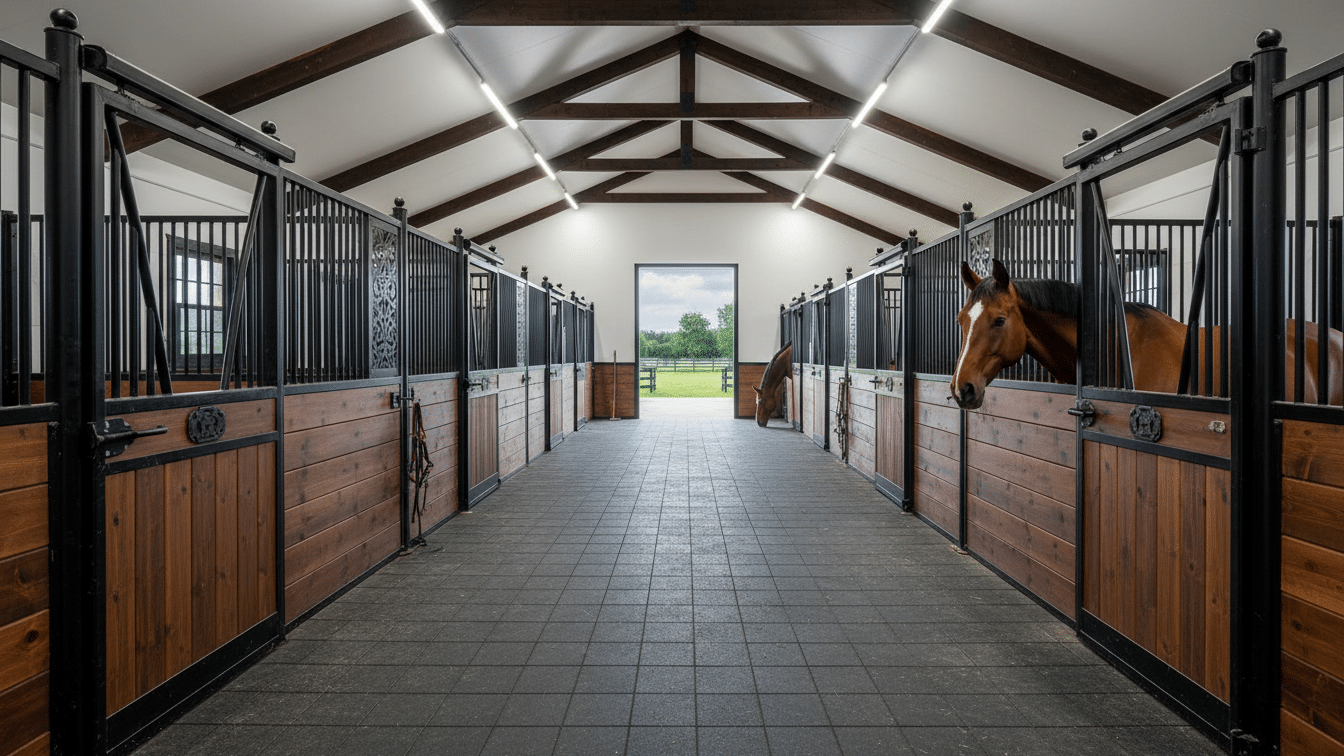
The Original Equipment Manufacturer (OEM) process transforms a concept into a production-ready prototype through structured stages. It begins with a detailed design submission and technical review, moves to 3D modeling and manufacturability analysis, and culminates in the approval of a ‘golden sample’ which serves as the definitive standard for all future production.
Stage 1: Design Submission and Technical Review
The process starts when a client provides a comprehensive design brief. This isn’t just a rough idea; it includes specific details like power output, frequency response, impedance ratings, physical dimensions, and even aesthetic preferences. Our engineering team conducts a thorough technical review to assess if the design is feasible. A clear and precise initial brief is the best way to prevent costly revisions and delays later on.
Stage 2: Prototyping and Manufacturability Analysis
Next, we turn the digital design into a physical product. Before building anything, our engineers perform a Design for Manufacturability (DFM) analysis. Think of this as checking a recipe to ensure the steps are efficient and repeatable for mass production. We create 3D models for visualization and then build “alpha” prototypes to test core functions. These early models help us refine tolerances, materials, and assembly methods, ensuring the final product is both high-quality and cost-effective to produce.
Stage 3: The Golden Sample for Production Approval
The “golden sample” is the final, perfected prototype. Once the client approves it, this sample becomes the definitive standard for quality. Every single unit that comes off the production line must match it exactly, from its performance down to its cosmetic finish. Any unit that deviates from the golden sample is considered a quality defect. This step locks in the design and gives us the green light to begin mass production.
How DB Stable Manages the Custom Stable Design Process
At DB Stable, our team of over five product experts applies a similar structured process to create custom portable horse stables. We work with clients to translate their unique needs into a functional and durable design. This ensures every detail is accounted for before production starts.
- ✅ Configurations: Clients can specify single, double, or even quadruple stall units to fit their property and needs.
- ✅ doors & Access: You can choose between classic swing doors or space-saving sliding doors.
- ✅ Frame Durability: We use hot-dip galvanized steel frames. This process creates a protective zinc coating over 42 microns thick, shielding the steel from rust for years.
- ✅ Materials: Customizations include choices for roofing, such as 0.4mm or 0.8mm steel, and infill panels made from 10mm thick, UV-resistant HDPE boards that won’t crack or fade in the sun.
Balancing Customization with Cost and Lead Time
Balancing customization with cost and lead time in 2026 relies on a modular product architecture and strategic inventory positioning. Using an Assemble-to-Order (ATO) model, where pre-fabricated components are stocked, allows for custom final assembly upon order, significantly reducing delivery timelines compared to building from scratch.
Core Strategies: Assemble-to-Order vs. Make-to-Order
The two main approaches to custom manufacturing are Assemble-to-Order (ATO) and Make-to-Order (MTO). Think of it like ordering food. MTO is like a restaurant that only starts cooking your meal from raw ingredients after you order, which takes a long time. ATO is more like a high-end deli that has all the fresh ingredients prepped and ready to assemble your custom sandwich the moment you ask for it.
- Assemble-to-Order (ATO): This model stocks standardized, pre-made components. Final assembly begins only after a customer places an order. This method drastically cuts down waiting time because the foundational parts are already built.
- Make-to-Order (MTO): This process starts from zero, using raw materials to build a product only after an order is confirmed. It offers deep customization but results in much longer delivery timelines.
- Modular Architecture: The ATO model relies on a modular design. It’s like using a set of building blocks. Standard components can be combined in many different ways to create a unique final product, avoiding the time and cost of fabricating every single piece from scratch.
Tactical Adjustments to Reduce Production Delays
Small adjustments in design and sourcing can prevent major bottlenecks in production. By planning ahead and standardizing certain elements, manufacturers can compress the timeline significantly. This involves smart decisions that eliminate common waiting periods.
- ✅ Design Standardization: Using common material sizes, like standard sheet metal or bar stock, removes delays caused by waiting for custom raw materials to arrive.
- ✅ Tolerance Management: Avoiding overly precise measurements in non-critical areas prevents slowdowns. Insisting on extreme precision everywhere is like demanding a photo-perfect finish on a part of a machine that will never be seen; it adds time without adding value.
- ✅ Digital Platform Consolidation: Managing all components through a single digital system simplifies logistics. A robotics company cut its order lead time from over three weeks to just one by using one platform instead of juggling multiple suppliers.
- ✅ Parallel Workflows: Modern quoting systems allow sourcing to happen at the same time as design. This overlap can shave weeks off the traditional purchase order cycle, where each step must wait for the previous one to finish.
How DB Stable Balances Quality and Production Speed
DB Stable applies these principles to deliver durable, semi-custom portable horse stables without long waits. The entire process is built around efficiency and quality control, from design to delivery.
- Modular, Prefabricated Design: DB Stable uses a “9 Parts Stable Panel” system. This modular approach ensures that each panel is built to a high standard and can be quickly assembled on-site, providing structural integrity without a lengthy custom build process.
- Standardized High-Quality Materials: By stocking key materials like hot-dip galvanized steel (over 42 microns) and 10mm thick UV-resistant HDPE boards, the company avoids supply chain delays. Having these core components ready means production can start immediately.
- Direct Factory Model: Operating as a direct factory since 2013 gives DB Stable complete control over the production schedule. This eliminates communication gaps with third-party suppliers and helps them deliver products in what customers have called “record time.”
Material Upgrades: Bamboo, Mesh, and Premium Finishes
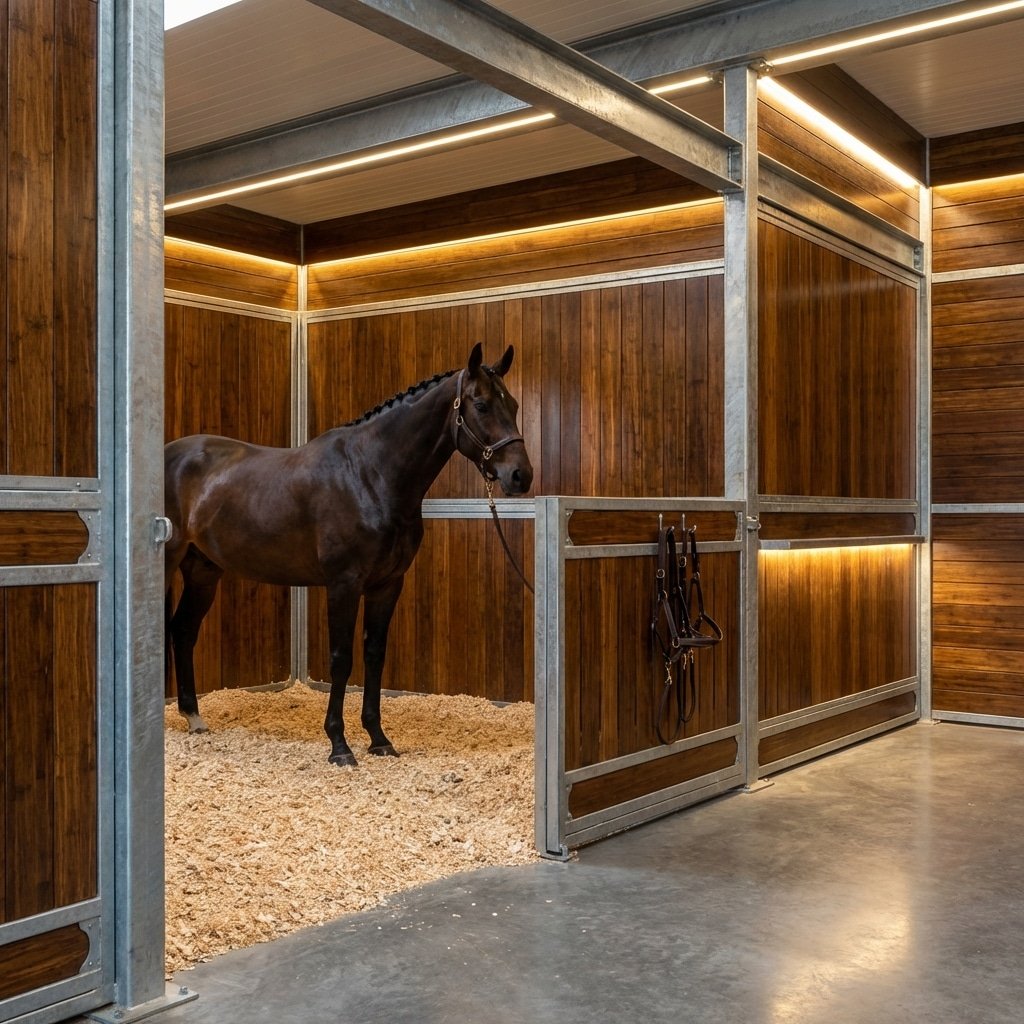
Engineered materials like thermo-treated bamboo offer significant performance upgrades over traditional wood. With superior tensile strength (~160 N/mm²), high density (1,200 kg/m³), and excellent dimensional stability (1.13% change), these materials provide enhanced durability, safety, and aesthetic consistency for high-end equestrian facilities and OEM customizations.
Engineered Bamboo: Superior Strength and Durability
Engineered bamboo isn’t just wood; it’s a high-performance material re-engineered for strength. Its unique fiber structure allows it to handle stress far better than many traditional woods, making it an ideal choice for environments that demand resilience.
- ✅ Tensile Strength: It can withstand pulling forces of around 160 N/mm², which is 3 to 4 times more than typical wood. This means it resists snapping when stretched.
- ✅ Compressive Strength: It handles being squeezed or compressed with 40–80 N/mm² of force, roughly double that of many woods.
- ✅ Bending Strength: With an average rating of 50.30 MPa, it has robust integrity, similar to hardwoods, so it won’t easily break under a load.
- ✅ Shear Strength: It resists internal sliding forces twice as well as tropical woods, preventing splintering under stress.
- ✅ Fiber Architecture: Bamboo fibers run the entire length of the plant. This structure allows the material to bend slightly under pressure and return to its original shape without damage.
Key Technical Specifications and Standards
Performance isn’t just a claim; it’s measured. High-quality engineered bamboo meets specific technical benchmarks that guarantee its performance. These standards ensure consistency and reliability for any custom project.
- Density: High-density versions reach up to 1,200 kg/m³, making the material incredibly solid and resistant to impact.
- Hardness: Following EN 1534 tests, thermo-treated bamboo scores a Brinell hardness of 87 N/mm², confirming its high resistance to dents and wear.
- Dimensional Stability: It shows only a 1.13% change after being soaked in water for 24 hours. This means it resists warping and swelling, keeping its shape over time.
- Moisture Content: An optimal moisture level of 8–12% is maintained to ensure the material retains its strength and stability.
- Governing Standards: Performance is verified against international standards like ISO 22157 and ISO 19624, which confirm its mechanical properties and structural quality.
Safety and Application-Specific Properties
In equestrian environments, safety and function are critical. Engineered bamboo is tested to meet strict safety ratings, ensuring it’s a suitable and secure material for stables and high-traffic areas.
- Fire Reaction: It achieves a Bfl-s1 classification and a Class A flame propagation rating (ASTM E84), meaning it performs very well in fire safety tests.
- Slip Resistance: With an R10 (wet) and R11 (dry) rating, it provides secure footing to help prevent slips, even in damp conditions.
- Moisture Management: The material’s compressive strength can decrease if moisture levels get too high. This makes it perfect for premium indoor finishes where the environment is controlled.
Why Material Quality Matters for DB Stable Customizations
Using materials with proven specifications is fundamental to creating a durable and safe product. At DB Stable, this commitment is already part of our process. We use high-performance materials like UV-resistant HDPE and hot-dip galvanized steel with over 42 microns of coating to ensure longevity. Applying this same principle to premium finishes like engineered bamboo allows us to deliver custom-built stables that offer long-term structural integrity, resistance to wear, and a flawless aesthetic for any OEM project.
Prototyping and 3D Modeling Services
Prototyping and 3D modeling services convert digital CAD designs into physical models using advanced additive manufacturing technologies. These services offer rapid turnaround times, often within 1–2 days, enabling design validation and functional testing with over 50 engineering-grade materials before full-scale production.
Core Technologies in Modern Prototyping
Modern prototyping uses several advanced methods to turn a digital file into a physical object. It’s like having different tools for different jobs. The right technology depends on the material, required finish, and part complexity. Services easily work with common design files like STL, STEP, and IGES, but STL is often recommended for the best print resolution.
- ✅ Stereolithography (SLA): This method provides the best surface finish and accuracy. Think of it as painting with a laser on a liquid resin, hardening it layer by layer to create a perfectly smooth part.
- ✅ Fused Deposition Modeling (FDM): Ideal for making large, strong prototypes in a single piece. This process works like a precise hot glue gun, laying down lines of durable plastic like ABS or PC to build the model from the ground up.
- ✅ Rapid Injection Molding: For creating multiple identical and highly durable prototypes, this method is used. It offers an initial batch of parts in about two weeks.
- ✅ Other Supported Technologies: A full suite of options is typically available, including SLS, PolyJet, DLP P3, and SAF™, to meet any project need.
Quality Assurance and Material Specifications
Ensuring a prototype performs as expected requires strict quality control and the right materials. Professional services follow established standards to guarantee that every part is reliable and meets its design goals. This starts with a shared language for design specifications.
Designs often follow GD&T (Geometric Dimensioning and Tolerancing) standards, a universal system that ensures every measurement and tolerance is clearly understood. With access to over 50 engineering-grade materials, engineers can select the perfect thermoplastic or resin for the job. Quality checks like First Article Inspection (FAI) and Parts Production Approval Process (PPAP) confirm that every part is made correctly. For specialized industries, certifications are key.
- ✅ ISO 9001 and AS9100 Certified: These certifications show that a provider follows a strict rulebook for quality management, with AS9100 being the higher standard for aerospace parts.
- ✅ ITAR-Compliant: For sensitive defense and aerospace projects, providers are often DDTC-registered and ITAR-compliant to handle controlled information securely.
Streamlining the Design-to-Production Workflow
Prototyping services accelerate the entire development cycle from a rough idea to a finished product. By validating designs early, companies avoid costly mistakes and tooling changes down the line. The process is built for speed and flexibility, integrating smoothly with existing design tools.
Standard parts can often be produced in just one or two days, and there is no minimum order quantity. This allows for anything from a single concept model to a small batch for testing. These services are compatible with major CAD platforms like SolidWorks, Siemens NX, and CREO, so design files can be sent directly for production. The biggest advantage is cost reduction through design-for-manufacturing (DFM) analysis, where 3D simulations identify potential issues before any material is used.
How DB Stable Applies Design Validation for Durable Stables
The same principles of professional design and material selection are critical in manufacturing high-quality portable horse stables. DB Stable uses a similar data-driven approach to ensure every component contributes to structural integrity and long-term durability.
- ✅ Expert-Led Design: The process starts with a professional design team, just like in a prototyping workflow. This ensures every stable is structurally sound from the very beginning.
- ✅ Material Specification: Choosing the right material is key. DB Stable selects hot-dip galvanized steel with a coating over 42 microns. Think of this as a permanent, bonded shield against rust that lasts for years. They also use UV-resistant HDPE boards, which prevents sun damage and cracking over time.
- ✅ Component Testing: Critical parts, like the fully welded 6mm steel plate connectors, are designed for maximum strength. This mirrors the stress analysis used in digital modeling, where a part’s strength is proven on a computer before it is ever built.
Exclusive Distribution Agreements
An exclusive distribution agreement is a legal contract where a supplier grants a single distributor the sole right to sell its products within a specific geographic territory. These agreements are common for high-value goods, outlining terms like sales targets, territory, and performance metrics to ensure focused market penetration and brand control.
Core Legal Components of an Exclusive Agreement
These agreements are built on a few key legal pillars to prevent confusion and protect both the supplier and the distributor. They create clear rules for the business relationship.
- Territory and Exclusivity: The contract clearly states that one specific distributor is the only one allowed to sell the product in a defined area, whether it’s a city, state, or an entire country.
- Performance and Reporting: It sets the expectations. This includes sales goals the distributor must meet and how they need to report their progress back to the supplier.
- Termination and Renewal: The agreement outlines exactly how and why the contract can be ended by either side. It also explains the process for renewing the partnership if things go well.
- Confidentiality and IP: This clause protects the supplier’s secrets, like product designs or customer lists. It ensures the distributor cannot share sensitive information or misuse the brand’s trademarks.
Financial Terms and Performance Metrics
The financial side of an exclusive agreement is where performance is measured in numbers. These terms ensure the partnership is profitable for the supplier and holds the distributor accountable.
- Minimum Purchase Requirements: The distributor must commit to buying a certain amount of product to keep their exclusive rights. A common example is a target like buying $50,000 worth of goods each quarter.
- Licensing Fees: In some cases, a distributor might pay a fee for the right to sell the products. This could be a set percentage, such as 15% of the retail price for each item sold.
- Verifiable Data: The performance of these agreements is often public. You can find concrete financial details, like revenue and market share, in public records like SEC filings or detailed industry reports.
Industry Applications and Real-World Examples
Exclusive agreements are most common where brand image and a controlled customer experience are critical. Think of products that are as much about status as they are about function.
You’ll see this strategy used for luxury cars, high-end electronics, pharmaceuticals, and designer goods. The goal is to create scarcity and maintain a premium feel.
- ✅ Rolex: To protect its luxury status, Rolex limits its distribution network tightly. A major city like Miami might have just 5 authorized retailers.
- ✅ Lamborghini: Similarly, the automaker maintains strict control over its sales network. The entire state of Florida might have only 5 official showrooms to ensure a consistent, high-end buying experience.
How Agreements Secure Markets for DB Stable Exports
For a specialized manufacturer like DB Stable, exclusive agreements are a powerful tool for global trade. Since 2013, this strategy has helped establish a strong presence in key markets like Australia and New Zealand.
By partnering with a single, dedicated distributor in a region, DB Stable ensures that partner is fully invested in the brand’s success. This distributor focuses all their marketing efforts on showcasing the unique features of DB Stable products, from the durable hot-dip galvanized steel frames to the UV-resistant HDPE panels.
This approach also helps maintain a consistent brand image and high level of service. It guarantees that the customer experience, from the factory in China to the final installation, meets the same quality standard every time.
Frequently Asked Questions
Can powder coating withstand equine impact and chewing?
Yes, architectural-grade powder coating is specifically engineered for high-impact environments. Think of it as a flexible, protective skin fused to the steel. Its elasticity allows it to absorb the force from a 1,200-pound horse without chipping or flaking, unlike brittle liquid paint that cracks under pressure.
The hard outer shell resists surface damage from chewing and abrasion. This durability comes from a three-layer system, totaling 3-5 mils thick, which includes a zinc-rich primer for rust prevention, a shock-absorbing middle layer, and a UV-resistant topcoat. This system demonstrates over 4,000 hours of salt spray resistance and maintains its bond even during extreme temperature swings.
What are the limitations of laser-cutting logos in steel?
The main limitations are material thickness, heat distortion, and material reflectivity. For detailed logos, the practical cutting thickness for stainless steel is around 5-8mm. A laser is like a highly focused heat source, and trying to cut through material that is too thick can result in a rough, imprecise finish.
The intense heat creates a heat-affected zone (HAZ) that can cause thin parts of a logo to warp or discolor. Highly reflective metals like stainless steel can also bounce the laser beam, reducing cutting efficiency. Lastly, the laser vaporizes a small amount of material, creating a gap called a kerf (0.1mm to 1mm), which can compromise the sharpness of very fine, intricate designs.
How does custom sizing affect structural load ratings?
Custom sizing directly changes a structure’s ability to safely carry weight. Think of a wooden plank across a stream; a thicker, wider plank can hold more weight than a thin one. Similarly, altering the dimensions of a steel beam or column changes its cross-sectional area and strength, which determines its load-bearing capacity.
It also affects how loads are distributed. Each support column in a structure is responsible for a specific section of the floor, known as its tributary area. Changing the size or location of a support alters these calculations, potentially shifting more weight onto certain components. Engineers use standards like ANSI/AISC 360-16 and specialized software to calculate these new load ratings accurately.
How does bespoke design impact production lead time?
Bespoke design significantly extends lead times because it adds custom design, sampling, and tooling stages that do not exist in standard production. A standard project might take 4–6 weeks, but a bespoke project typically requires 8–12 weeks. This extra time is needed to create unique plans and produce physical samples for approval.
The sampling stage is often the longest part, adding 2–6 weeks to the timeline. It usually involves 2–3 rounds of creating a prototype, getting feedback, and making revisions, with each round taking about 7–10 days. Sourcing specialty materials or creating custom manufacturing tools for a one-of-a-kind design can also introduce delays.
Final Thoughts
Custom design moves beyond standard kits to build a permanent brand identity for your facility. Every detail, from precise RAL color matching to laser-cut logos, transforms a structure into a professional asset. Executing this requires a partner capable of translating a unique vision into an engineered reality.
A structured OEM process ensures your design is not only visually distinct but also built for long-term performance. This approach protects your investment, enhances property value, and delivers a facility that performs as well as it looks.

 English
  Spanish
  French
  Arabic
  German
0 Comments