


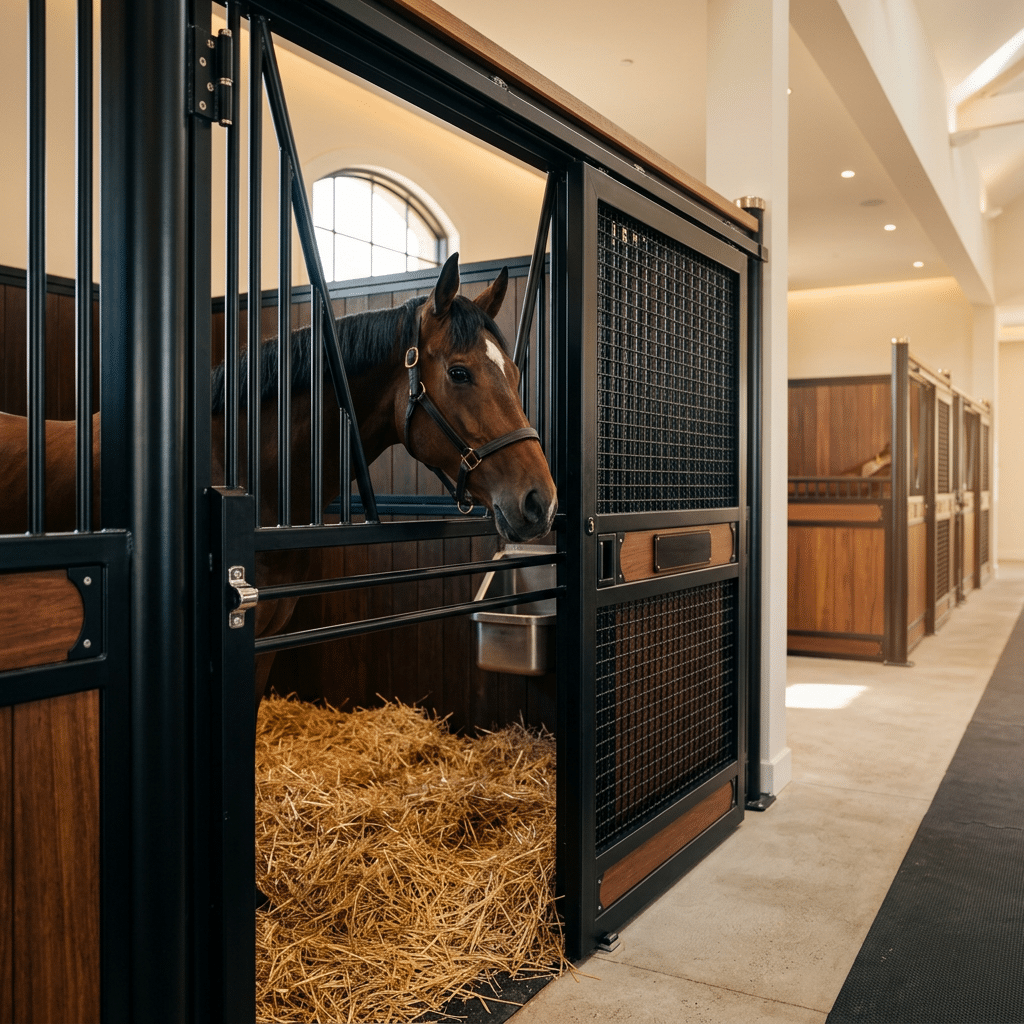
Strategic Alibaba Sourcing for horse stables is the only defense against the widespread broker trap that inflates costs by 40% while delivering inferior product. Many buyers are lured by low quotes for pre-galvanized tubing, unaware that these welded joints will rust rapidly in ammonia-rich environments and destroy distributor reputations. Securing your margin requires bypassing these middlemen to find the actual engineering source.
This analysis benchmarks top suppliers against the strict ISO 1461 Hot-Dip After Fabrication standard necessary for true corrosion resistance. We evaluate manufacturers on their ability to prove raw black steel fabrication, verify zinc coating thickness above 70 microns, and utilize steel pallet flat-pack logistics to reduce ocean freight costs by over 60%.
أفضل 5 مصانع موردة معتمدة من الشركات المصنعة للمعدات الأصلية
Identifying a true source factory requires looking past product photos to verify third-party audits and manufacturing standards. The top-tier OEM partners are defined by the Alibaba Verified Supplier badge, possession of ISO 1461 galvanization certifications, and the internal capacity for R&D rather than simple assembly.
The Verification Baseline: SGS and ISO Certification
Finding a reliable manufacturing partner starts with filtering for the Verified Supplier badge on platforms like Alibaba. This badge confirms that the facility has undergone physical on-site audits by independent global agencies such as SGS, TUV Rheinlandأو Intertek. Unlike a basic business license check, these audits validate that the machinery, production lines, and staff claimed in the profile actually exist on the factory floor.
For high-stakes equestrian infrastructure, general quality management (ISO 9001) is necessary but insufficient. A true top-tier manufacturer must also hold ISO 1461, the specific international standard for hot-dip galvanizing after fabrication. This certification ensures that our steel frameworks achieve the required zinc coating thickness—greater than 85 microns for structural parts—guaranteeing the rust protection necessary for damp stable environments.
| Verification Criteria | True OEM Factory (DB Stable) | Trading Intermediary |
|---|---|---|
| Audit Status | Verified Supplier (SGS/TUV) | Unverified or Basic Gold Supplier |
| Galvanization Process | الطلاء بالغمس الساخن بعد التصنيع (ISO 1461) | Pre-Galvanized Tubes (Weld Rust Risk) |
| Steel Spec | Q235B / Q345B Structural Steel | Often unspecified or scrap mix |
| التخصيص | Full ODM/R&D In-House | Limited to standard catalog |
Identifying True OEM Capabilities: R&D and Manufacturing
Top OEM source factories distinguish themselves through full ODM services and in-house R&D capabilities. At DB Stable, we do not simply weld pre-cut tubes; we engineer solutions like our specialized Q345B cold-climate steel and flat-pack logistics systems that triple container capacity. Buyers should look for manufacturers who can produce detailed engineering drawings and adapt specifications, such as upgrading infill from HDPE to high-density bamboo, rather than just selling fixed stock.
The most critical technical differentiator is the galvanization method. Legitimate manufacturers strictly utilize الجلفنة بالغمس الساخن بعد التصنيع. This process involves submerging the entire welded door frame into molten zinc, sealing every joint and weld against corrosion. Intermediaries often mask inferior “pre-galvanized” tubing—where welds are painted over and prone to rust—behind lower price points, compromising the long-term structural integrity of the stable.
Finally, reliable factories protect your investment through Trade Assurance. This system safeguards steel product orders by holding payments in escrow until quality standards and shipping timelines are met. It ensures a transparent, traceable production history, allowing us to maintain accountability from the raw steel billet to the final flat-packed container arriving at your facility.
Engineered For Durability: 20-Year Rust-Proof Stables

فخ «علي بابا»: سماسرة يتنكرون في هيئة مصانع
Sourcing through online marketplaces often exposes buyers to “The Alibaba Trap”—a scenario where non-manufacturing intermediaries masquerade as direct factories. This layer of opacity artificially inflates costs by 30-40% and introduces severe quality control risks, such as the substitution of hot-dip galvanization with inferior pre-galvanized materials. Securing your profit margins requires identifying and bypassing these brokers to establish direct lines with the actual engineering source.
Recognizing the Three Types of Non-Factory Entities
<
p style=”line-height: 1.8; margin-bottom: 28px;”>
Navigating global sourcing requires the ability to distinguish between a true OEM manufacturer and a commercial middleman. While many listings claim “factory direct” status, they often fall into three distinct categories of intermediaries that add cost without adding value.
- Trading Companies
These entities source products from multiple factories and resell them at a significant markup. Their primary disconnect is technical; they often lack the engineering expertise to discuss specific steel grades, such as the difference between standard Q235B and cold-climate Q345B. When you ask about galvanization depth or yield strength, the answer is often a guess rather than a guarantee.
- Freelance Agents
These are typically individuals or small teams acting as brokers who connect buyers with factories for a commission. While they may offer lower prices than trading companies, they possess absolutely no control over production schedules, ISO 9001 quality standards, or raw material verification. If a batch of steel fails a salt spray test, an agent has no authority to halt the line.
- Online Marketers & The “Gold Supplier” Illusion
A common misconception is that a “Verified” or “Gold” badge indicates a manufacturing plant. In reality, this often indicates a marketing budget. Many top-ranked accounts operate from commercial high-rises rather than industrial zones. These marketers purchase bulk inventory to rebrand and list without direct factory relationships, eliminating the possibility of custom OEM modifications required for large projects.
The Operational Risks of Indirect Sourcing
Engaging with intermediaries does more than just increase the unit price; it introduces structural risks to your supply chain that can endanger animal safety and long-term durability.
Inflated Costs and Margin Erosion
Intermediaries stack their profit margins on top of the base product price and logistics costs. Direct sourcing from a manufacturer like DB Stable typically saves 30-40% by eliminating these hidden fees. For distributors, this difference is often the deciding factor in maintaining a competitive edge in the local market.
Quality Control Blind Spots
Brokers prioritize their margins over your product’s longevity. A pervasive issue in our industry involves substituting true Hot-Dip Galvanization (ISO 1461) with cheaper pre-galvanized tubing. While pre-galv looks shiny when new, the welded joints are unprotected and will rot from the inside out. Without direct access to the factory floor, verifying the zinc coating thickness—crucial for our 96-hour salt spray test standard—is impossible.
Communication and Specification Drift
Technical specifications get lost in translation when passed through a middleman. Direct access ensures precise execution of safety requirements, such as our strict 14-gauge (2.0mm+) wall thickness or the specific density of bamboo infills. When you speak to us, you speak to the engineers who set the machine parameters, ensuring your specific “Kick-Proof” requirements are met without compromise.
خدعة “المجلفن مسبقًا”: لماذا تتآكل العروض الرخيصة
Many “bargain” quotes undercut the market by 30-50% by using pre-galvanized tubing rather than post-fabrication dipping. This method leaves welded joints unprotected, relying on silver spray paint to hide raw steel. We strictly adhere to the “Hot-Dip After Fabrication” process (ISO 1461), ensuring every weld is metallurgically sealed against ammonia and moisture.
The Technical Cheat: Pre-Galvanized Tubing vs. Hot-Dip After Fabrication
In the competitive B2B market, distributors often encounter quotes that seem impossibly low. These savings are usually achieved through a material substitution known as “pre-galvanized” tubing. In this process, the steel coil receives a thin layer of zinc before it is ever cut or welded into a stable front. While the straight sections of the tube appear protected, the manufacturing process creates a critical flaw.
When these pre-coated tubes are welded together to form a door or side panel, the extreme heat of the welding torch burns the zinc layer off entirely at the connection points. This leaves the structural joints—the areas under the most stress from horses—as raw, black steel. At DB Stable, we utilize the “Hot-Dip After Fabrication” standard. We weld the entire frame using Q235B or Q345B black steel first, and only then do we submerge the complete unit into a bath of molten zinc. This ensures that the zinc bonds chemically to the steel, covering every weld, corner, and internal surface.
The “Silver Spray” Cover-Up: Detecting Thin Coatings and Rust Risks
To conceal the burnt zinc at the weld points, budget manufacturers apply a layer of “cold galvanizing” spray—essentially silver paint—over the joints. Visually, this mimics a galvanized finish on day one. However, this cosmetic layer offers zero metallurgical protection and often peels within months when exposed to the humid, ammonia-rich environment of a stable.
The difference is quantifiable in coating thickness. A pre-galvanized tube typically carries only 15-20 microns of zinc. In contrast, our ISO 1461 compliance guarantees an average coating thickness of over 70 microns for tubing and over 85 microns for structural parts. You can verify this difference quickly: scratch a weld joint with a key. If the silver layer scrapes off to reveal black steel underneath, the product relies on paint rather than true galvanization, posing a significant risk to long-term durability and safety.
كيفية طلب إجراء فحص مباشر بالفيديو لحوض الزنك
Authentic hot-dip galvanization involves welding raw “black steel” first, then submerging the completed frame in molten zinc. To protect your inventory from premature rust, we recommend requesting a live video audit to verify the raw materials before the finishing process begins. If the welding station features shiny silver tubes, the factory is using pre-galvanized material, which leaves welded joints unprotected.
Identifying Black Steel Welding (The “Pre-Dip” Check)
When you connect with a supplier via live video, ask to see the welding station immediately. In our facility, you will see technicians working with Q235B or Q345B “black steel.” This raw, uncoated metal has a dark, matte finish. This step is critical because true hot-dip galvanization (ISO 1461) requires the entire frame to be fabricated from raw steel before it ever touches the zinc bath. If the video shows workers welding tubes that are already shiny and silver, they are using pre-galvanized material. This method burns the zinc off at the weld points, creating immediate rust points that paint cannot permanently hide.
You should also ask the camera operator to zoom in on the corners of the frames. For the hot-dip process to be safe and effective, we d
rill specific drain and vent holes in every tube. These holes allow molten zinc to flow inside the tubing, coating the interior surfaces, and prevent pressure explosions when the air inside expands in the 450°C bath. If a supplier cannot show you these vent holes, they do not intend to hot-dip the product after fabrication.
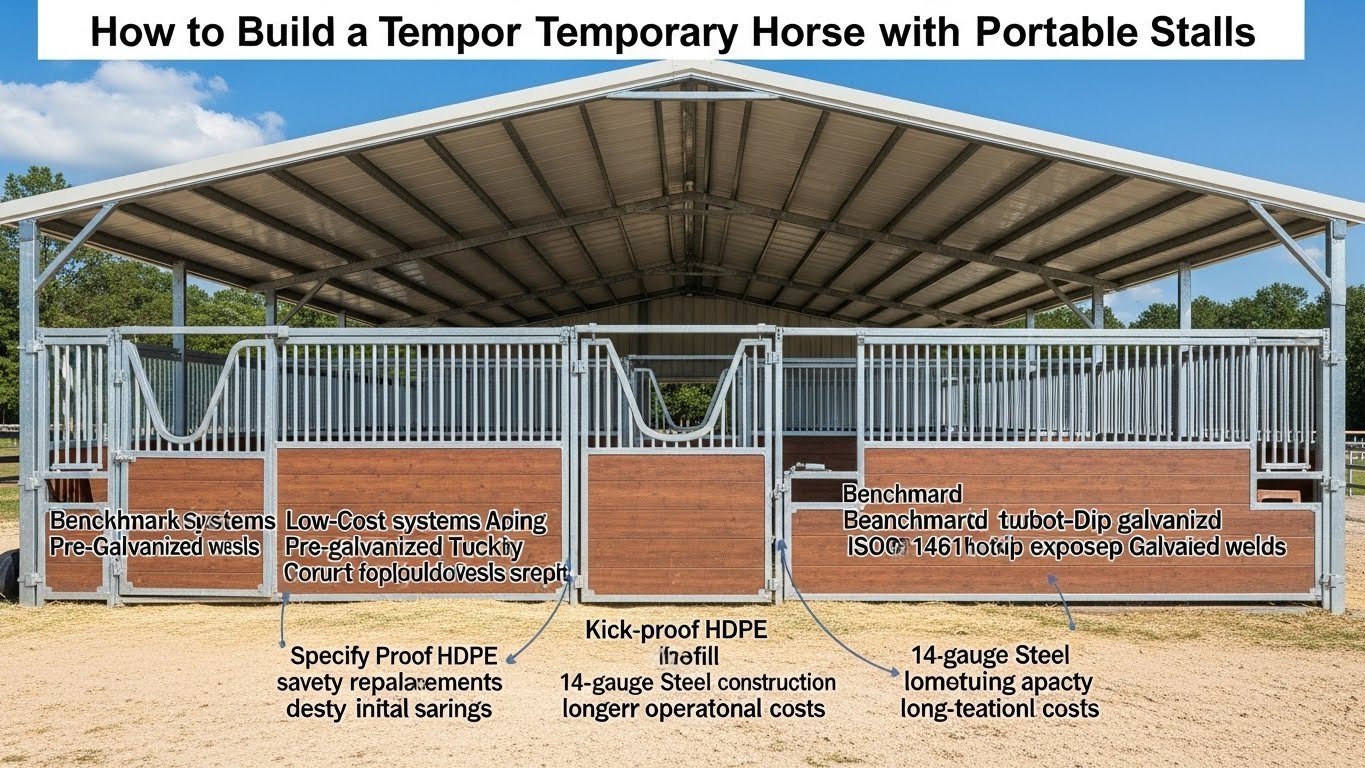
Live Thickness Testing & Bath Access
A visual check of the finished product is not enough; you need data. Ask the supplier to place a digital elcometer (coating thickness gauge) on a finished stable front during the call. A compliant hot-dip finish under BS EN ISO 1461 must read over 85 microns (μm) for structural parts and over 70 microns for tubing. Pre-galvanized or electro-plated products typically read between 15 to 20 microns, which offers significantly less protection against ammonia and moisture in a stable environment.
Finally, challenge the lead time logic. Real hot-dip galvanizing after fabrication adds time to the production cycle, as it involves scheduling with the galvanizing plant. Our standard production lead time is 35-45 days to account for this quality step. If a supplier claims “instant” readiness or a lead time under 20 days for a custom order, they are likely selling inferior pre-galvanized stock. Asking to see the transport logistics or the galvanizing facility itself helps confirm you are dealing with a manufacturer committed to the “Lifetime” standard rather than a broker moving stock.
التسعير المباشر بين الشركات (B2B) لدى DB مقابل هوامش الربح لدى علي بابا
Sourcing directly from our factory eliminates the 15-30% markup commonly added by Alibaba trading companies while ensuring verified ISO 1461 galvanization standards. By combining factory-direct pricing with our high-density flat-pack logistics, we reduce ocean freight costs by over 60% per unit, protecting the profit margins of distributors and large project developers.
Bypassing the Middleman: Source Factory vs. Platform Brokers
Many storefronts on general marketplaces operate as trading companies rather than actual manufacturers. These intermediaries typically add 15-30% to the base product cost to cover platform fees and agent commissions, often disguising themselves as factories without having direct control over production quality or scheduling.
As a verified OEM/ODM source factory, we eliminate these layers to offer direct access to production costs. This model is specifically designed for distributors and large projects, ensuring that your margin is not eroded by broker fees. We maintain internal ISO 9001 and ISO 1461 certifications, proving authentic manufacturing capability rather than relying on the outsourced or shared documentation frequently seen on third-party platforms.
The Logistics Multiplier: How Flat-Pack Tech Cuts Landed Costs
A low FOB unit price can be deceptive if the shipping strategy is inefficient. Traditional fully welded frames take up significant volume, limiting a 40HQ container to approximately 12-15 sets. This inefficiency causes ocean freight costs to spike per unit, inflating the final landed cost for the buyer.
We utilize a proprietary Steel Pallet Flat-Pack system that allows us to load 30-45 sets into a single 40HQ container. This logistics optimization reduces shipping costs by over 60% per stable, providing a substantial competitive edge for importers in Australia and North America. We also classify our products under HS Code 7308.90 (Structures of Iron/Steel), which helps our clients avoid the complex regulatory hurdles and potential high tariffs often associated with “prefabricated buildings.”
الأفكار النهائية
While cutting corners with pre-galvanized tubing offers a lower upfront price, it guarantees structural rust and costly warranty claims within months. True commercial viability relies on the ISO 1461 “Hot-Dip After Fabrication” standard, ensuring every weld is metallurgically sealed against ammonia. Protecting your brand reputation requires inventory that survives the stable environment, not just the shipping container.
Stop guessing on quality and demand a live video audit of our raw “black steel” welding lines to verify authentic manufacturing. We invite distributors to test our proprietary Flat-Pack system, which optimizes logistics to load up to 45 sets per 40HQ container and drastically reduce your landed costs. Contact our engineering team today to secure your production slot and lock in direct OEM pricing.
الأسئلة المتداولة
هل من الآمن شراء حظائر الخيول من موقع علي بابا؟
Sourcing on Alibaba is safe only if you strictly verify the supplier. Many listings come from trading companies rather than actual manufacturers, which adds costs and dilutes accountability. We recommend using Trade Assurance and demanding a live video audit of the facility to confirm you are dealing with a legitimate source factory that meets safety standards like 14-gauge minimum tubing thickness.
كيف يمكن العثور على مصنع حقيقي على موقع Alibaba؟
Real factories can show you their production line instantly. Ask for a live video call to see the welding robots and raw steel inventory; trading companies often refuse this or show stock photos. Always verify that the business license name matches the ISO 9001 certificate. We operate with full transparency and welcome video audits of our galvanizing and welding lines.
ما هو حظيرة الخيول المجلفنة مسبقًا؟
Pre-galvanized stalls use tubing coated with zinc before welding. The welding process burns off the zinc, leaving joints exposed to rust immediately. We reject this method explicitly. Instead, we use Hot-Dip Galvanization After Fabrication, dipping the fully welded frame to protect every seam and joint. This ensures our “Lifetime” standard with a zinc coating thickness exceeding 70 microns on tubing.
كيف يمكن التحقق من شهادة ISO 1461؟
True ISO 1461 compliance requires a zinc coating thickness averaging 85 microns for structural steel and over 70 microns for tubing. Request the galvanizing report and specific zinc thickness data. We also support third-party inspections (like SGS) to physically measure the coating depth before we load the container to ensure your project meets the required corrosion resistance standards.
Alibaba Trade Assurance for steel products?
Trade Assurance acts as an escrow service, holding your payment until you confirm the order quality. For steel stalls, you must explicitly list specs like Q235B or Q345B steel grade and 85-micron zinc thickness in the contract. This guarantees the platform protects you if the product falls short of the engineering parameters we agreed upon.

 Arabic
  English
  Spanish
  French
  German
0 تعليق