


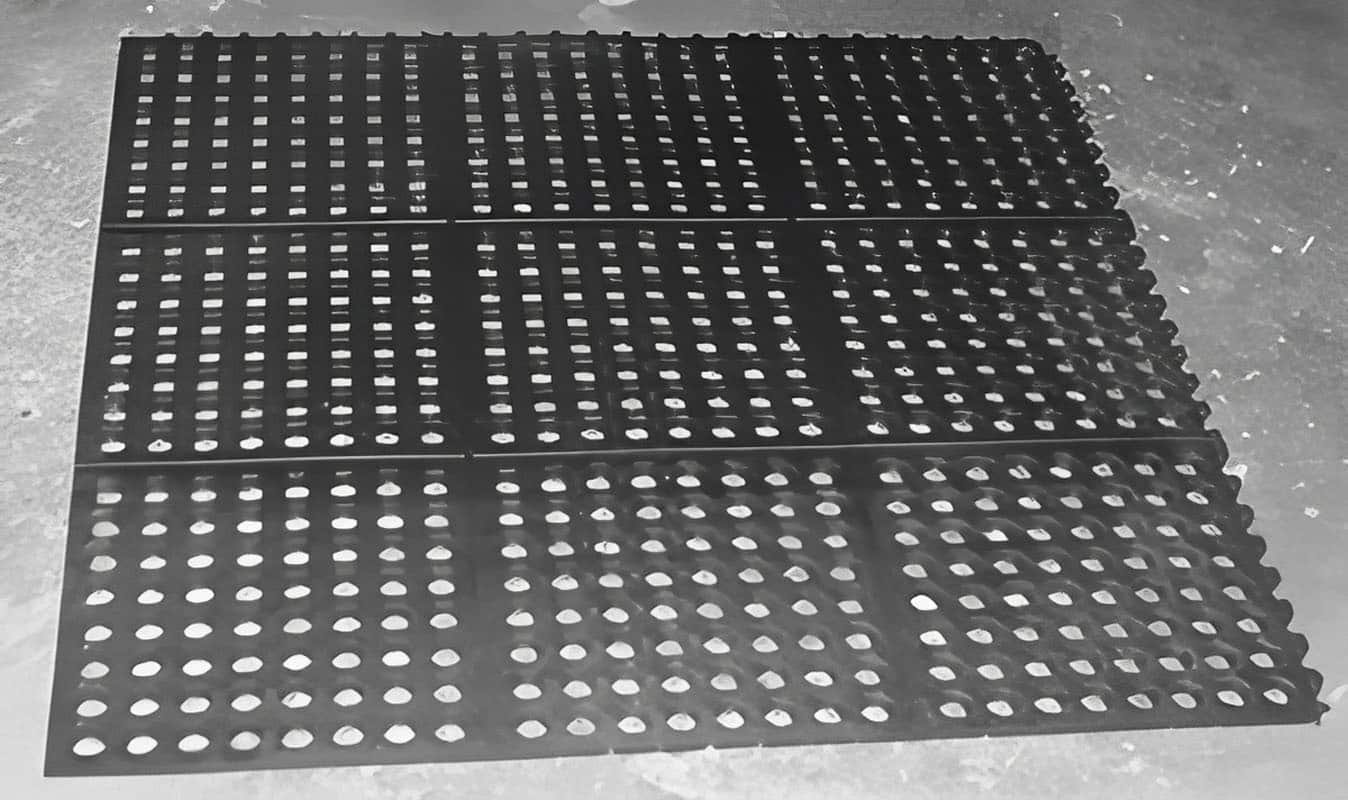
Rubber stable mats come in two formats, and the choice between them is not about quality — interlocking and sheet mats are both available in heavy, non-slip grades suitable for stalls and arenas. The choice is about geometry: how the floor assembles, how many seams it has, and how it behaves on the subfloor underneath. Get that match wrong and the best mat in the catalog still lifts, gaps or walks across the stall.
This guide compares interlocking and sheet rubber stable mats at the level that matters in procurement: installation logic, seam behavior, replacement economics and subfloor fit. It also sets out the specification data every supplier should hand over before you commit — because the numbers that decide how a mat performs are exactly the ones you have to ask for in writing.
Key Takeaways
- Format is not quality: both interlocking and sheet mats come in heavy-duty non-slip grades; the format decides seam count, installation method and replacement logic.
- Interlocking mats lock edge-to-edge: more seams, but a damaged section is swapped tile by tile instead of replacing a whole mat.
- Sheet mats cover in single pieces: the fewest seams and nothing to open up mid-floor, but damage means replacing the entire sheet.
- The subfloor is the deciding variable: seam behavior on uneven support differs between formats — demand a written subfloor preparation requirement for the one you choose.
- There is no universal thickness: thickness, weight, density, slip resistance and ammonia tolerance are supplier data, not industry constants — get them per product, in writing.
- Ordering context: flooring is typically ordered with stabling systems, which start at a 10-set MOQ, ship globally in 4-6 weeks, and carry 5-15% batch discounts.
Two Formats, One Job
An interlocking mat carries molded locks along its edges: each tile or plank clips to its neighbors, and the assembled floor behaves as one connected surface that can still be taken apart piece by piece. A sheet mat is a large single piece that covers an area in one or few units, cut on site where the layout demands it. Both formats protect the subfloor, cushion the horse’s legs and give grip underfoot — the compound and the format each do part of the work.
For a B2B buyer, the interesting differences are operational. Seam count drives installation labor and the long-term maintenance list. Replacement economics differ sharply: a floor you can open in one corner is serviced differently from a floor you cannot. None of that shows up on a product photo, which is why the format decision belongs early in the specification, not at the end.
How Interlocking Mats Are Built and Installed
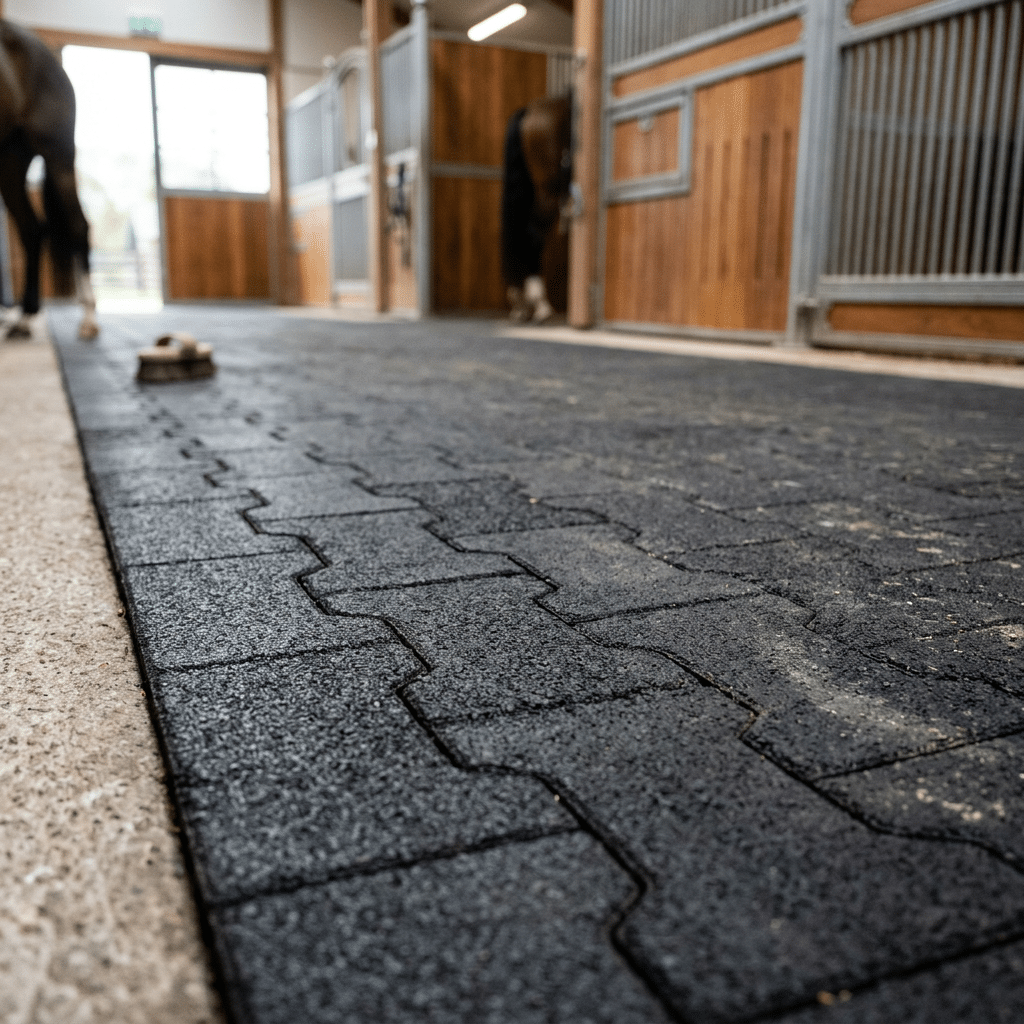
Installation is assembly. Each mat locks to the next along molded edges, so the floor builds out from a starting point and can be disassembled in the reverse order. A stable aisle or a stall can be floored section by section, and a section can be lifted — to dry a wet patch underneath, to clean beneath the mats, or to inspect the subfloor — without breaking up the whole floor.
The trade is the seam count. Every lock line is a joint, and joints are where a floor shows its age: a lock damaged in handling, or an assembly done with gaps, leaves an edge that can lift under traffic. Edge-lift risk on an interlocking floor concentrates at the joints — that is the failure mode to inspect for, both on delivery and during the maintenance walk.
Replacement is the format’s strength. A worn or torn tile comes out and a new one clips in; you carry spares sized to the tile, not to the stall. For facilities that strip and disinfect stall floors on a schedule, that serviceability is worth more over ten years than any difference in the purchase price.
How Sheet Mats Are Built and Installed
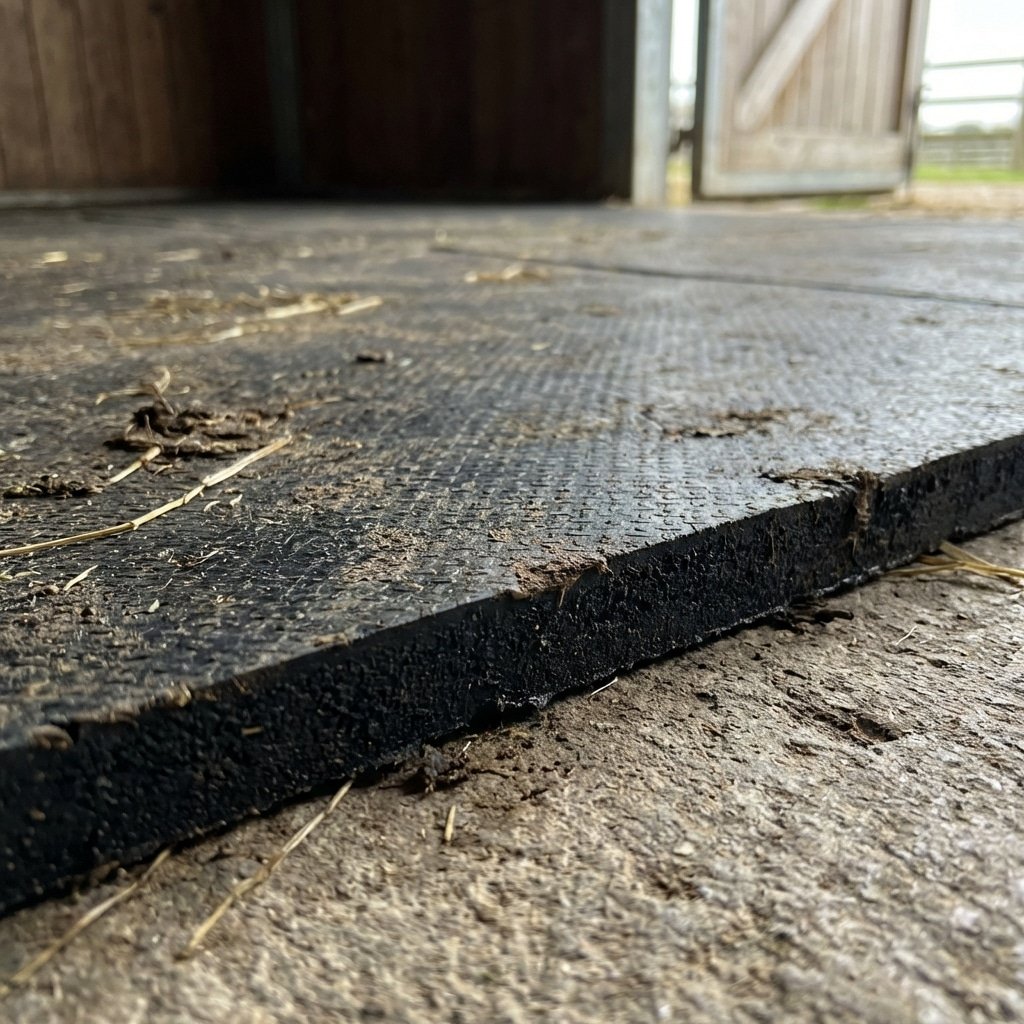
A sheet mat installs by placement. The mat goes down as one unit and covers the stall or aisle in a single piece, with seams only where sheets meet at their edges. In the middle of the floor there is nothing to open, nothing to gap and nothing to catch a fork tine — a continuous surface that sweeps and washes as one plane.
Handling is the cost. Large single mats are heavy, awkward units: positioning and cutting them around stall posts is a multi-person job, and the cutting has to be right the first time. The edge-lift risk on a sheet floor sits at the perimeter and at the seams between sheets — where the mat ends, it wants something to hold the edge down, whether that is the stall wall, a curb or the mat’s own weight.
Replacement economics run the other way. Damage to a sheet — a tear at a divider post, a worn patch under the standing zone — means replacing the whole sheet, because a patch inside a single piece rarely stays flat. Facilities that never lift their mats and wash in place get the best out of the format; facilities that strip floors regularly pay for it in whole-sheet replacements.
Matching the Format to the Subfloor
On a smooth, level concrete slab, either format installs cleanly and the decision is driven by maintenance style rather than the slab. Move away from that ideal and the formats diverge. An interlocking floor has joints at regular intervals, and each joint follows the subfloor underneath it: a hollow under a lock line is where the joint works and eventually opens. A sheet bridges the same hollow as one piece — but if the support is bad enough, the whole mat rocks or ponds rather than one seam failing.
That difference is exactly what your supplier should be able to address in writing. Ask for the subfloor preparation requirement per format: what flatness the interlocking locks assume, what the sheet format needs under its middle span, and what the supplier recommends for your actual base — new concrete, an existing worn slab, or compacted aggregate. A supplier who answers that question with a number and a method has engineered the product; one who answers “both work everywhere” is guessing with your floor.
Moisture is the second half of the subfloor question. Mats do not replace drainage design — urine has to leave the stall, whether it crosses a sealed sheet surface toward a channel or moves out from under a lifted interlocking section. Our stable drainage planning guide covers the slope and layout side of that problem; the mat decision should follow the drainage plan, not fight it.
The Specification Checklist
Rubber mat specifications are product data, not industry constants — there is no universal thickness or weight that makes a mat “stable grade.” What you can insist on is that the supplier states, per product and in writing:
- Thickness and dimensional tolerance: the stated thickness per mat, with the tolerance the production actually holds.
- Weight and density: weight per mat or per unit area and the material density — the numbers that decide whether the mat stays put under a horse and how it wears.
- Slip resistance: the surface pattern’s wet-performance claim and how it was measured.
- Chemical tolerance: what the mat withstands from ammonia-laden bedding and the disinfectants your washdown routine uses.
- Load behavior: suitability for a standing horse and stored bedding, stated by the supplier rather than assumed.
- Format data: for interlocking, the lock type and the spares policy; for sheets, the available sizes and whether cutting to your layout is a service or your job on site.
If the answers come back as “very thick, very heavy, very durable,” you have learned nothing. The numbers that matter are the ones in writing, attached to a quotation, where they can be compared across suppliers and checked on delivery.
Flooring is normally ordered as part of a stabling project rather than on its own. Stabling systems start at a 10-set MOQ, batch discounts run 5-15% by volume, and global lead time is 4-6 weeks — with 1-2 week expedited shipping from the Sydney and Warsaw regional warehouses where your project sits in those regions. Orders above 20 sets include a dedicated regional account manager, which is the right channel for the subfloor and specification questions above. The flooring line itself is summarized on the rubber mats page.
الأسئلة المتداولة
Which format is better for horse stalls, interlocking or sheet?
For stalls that get stripped and disinfected on a schedule, interlocking wins on serviceability — you lift and replace sections instead of whole mats. For aisles and stable slabs where a continuous surface matters most, sheets give fewer seams and nothing to open up.
How thick should rubber stable mats be?
There is no universal answer — thickness is product data. Demand the stated thickness, tolerance, weight and density from each supplier in writing, then compare products on equal data instead of on adjectives.
Can I install rubber mats over compacted aggregate instead of concrete?
Both formats can go over aggregate bases, but the seam behavior differs — lock joints can work loose over hollows that a sheet bridges. Ask the supplier for the written subfloor preparation requirement for the specific format before ordering.
How do rubber stable mats work with stable drainage?
Mats complement drainage design, never replace it — urine still has to leave the stall by slope and layout. Plan drainage first, then choose the mat format that suits how the floor will be washed and serviced.
الخاتمة
Interlocking and sheet rubber stable mats both do the core job — the format decision is about seams, service and the subfloor. Interlocking buys you a floor you can open and repair tile by tile, at the price of more joints to inspect. Sheet buys you a continuous surface with nothing to gap mid-floor, at the price of whole-mat replacement when damage comes. Your maintenance schedule and the floor underneath decide which price you should pay.
Before ordering, run the specification checklist against every product on your shortlist and get the subfloor requirement in writing. Start with the rubber mats line, and if the flooring is part of a wider stabling build, fold it into the stable system order so the specification questions land with one supplier.


 Arabic
  English
  Spanish
  French
  German
0 تعليق