
Buy a circular training enclosure and the catalog gives you two names for what looks like the same product: the lunging pen and the round pen. They are not the same tool. The difference sits in three decisions — the diameter of the circle, the height of the wall, and the surface underfoot — and those decisions determine which horses you can train, what you can train them for, and how the enclosure behaves after a week of weather. Choosing wrong is expensive in both directions: too small and the enclosure restricts the work; overbuilt and you paid for steel and surface you never use.
This comparison walks through the three decisions as a buyer’s specification exercise. DB HorseStable manufactures lunging pens as part of its training equipment line — alongside horse walkers and FEI-standard show jumps — for training centers across nine export markets, so the trade-offs below come from real specification conversations, not catalog theory.
Key takeaways
- Circle size sets the workload: a smaller circle loads the horse’s inside legs more on every stride; a larger circle permits faster, more balanced gait work — size the pen to the work, not the other way round.
- Wall height follows the horse, not the budget: taller walls contain green or fresh horses and block visual distractions; lower walls keep the handler’s sightline and invite connection.
- The surface is a training surface: footing depth and material decide traction, concussion and dust — treat it as equipment, not as fill.
- Panels and posts carry the whole load: hot-dip galvanized steel with a 20-year rust-resistance service life is the baseline spec for outdoor circular enclosures.
- Round pens and lunging pens often coexist: a facility that trains young stock typically ends up with both, because they answer different questions.
- Ask for the wind story: a circular wall is a continuous sail — confirm panel anchoring and post setting for your site’s exposure before ordering.
What the Two Names Actually Mean
A lunging pen is the smaller, handler-centered enclosure: one person, one horse, one lunge line, working the horse on a circle at the end of the line. The horse learns rhythm, balance and voice cues; the handler stays near the center. A round pen is the larger, liberty-work enclosure: the horse moves free, the handler uses body position and pressure to shape behavior, and the extra space gives a fresh or young horse room to make mistakes without either of you paying for them.
The overlap is real — you can lunge in a round pen, and a quiet horse can do liberty work in a larger lunging pen. But the equipment reflects the intent. Lunging pens tend toward tighter circles, lower or part-height walls and surfaces tuned for repetitive circular work. Round pens go bigger, taller and heavier, because liberty work generates speed, and speed generates force at the fence line.
Decision One: Diameter
Diameter is a biomechanics decision before it is a budget decision. A horse on a circle is never straight: the inside limbs travel a smaller circle than the outside limbs, and the tighter the circle, the greater the asymmetry in loading between them. Small circles ask more of the inside legs and the horse’s balance on every stride. That is precisely the point for suppling and collection work — and precisely the wrong thing to overdo with a young, undeveloped horse.
So the specification logic runs in one direction: choose the work, then the circle. Programs that are mostly lunge-line training — rhythm, voice cues, rehabilitation at walk and trot — specify smaller circles and accept the higher per-stride loading in exchange for handler control. Programs starting young horses at liberty go larger: the wider circle lets the horse travel in a more natural frame, at more natural speeds, with less asymmetric stress.
One planning note that buyers regularly miss: diameter interacts with your site, not just your program. A large circular enclosure has a surprising footprint once you add the gate swing, the surface margin and machinery access for surface maintenance. Measure the site with the surface equipment in mind, not just the fence line.
Decision Two: Wall Height
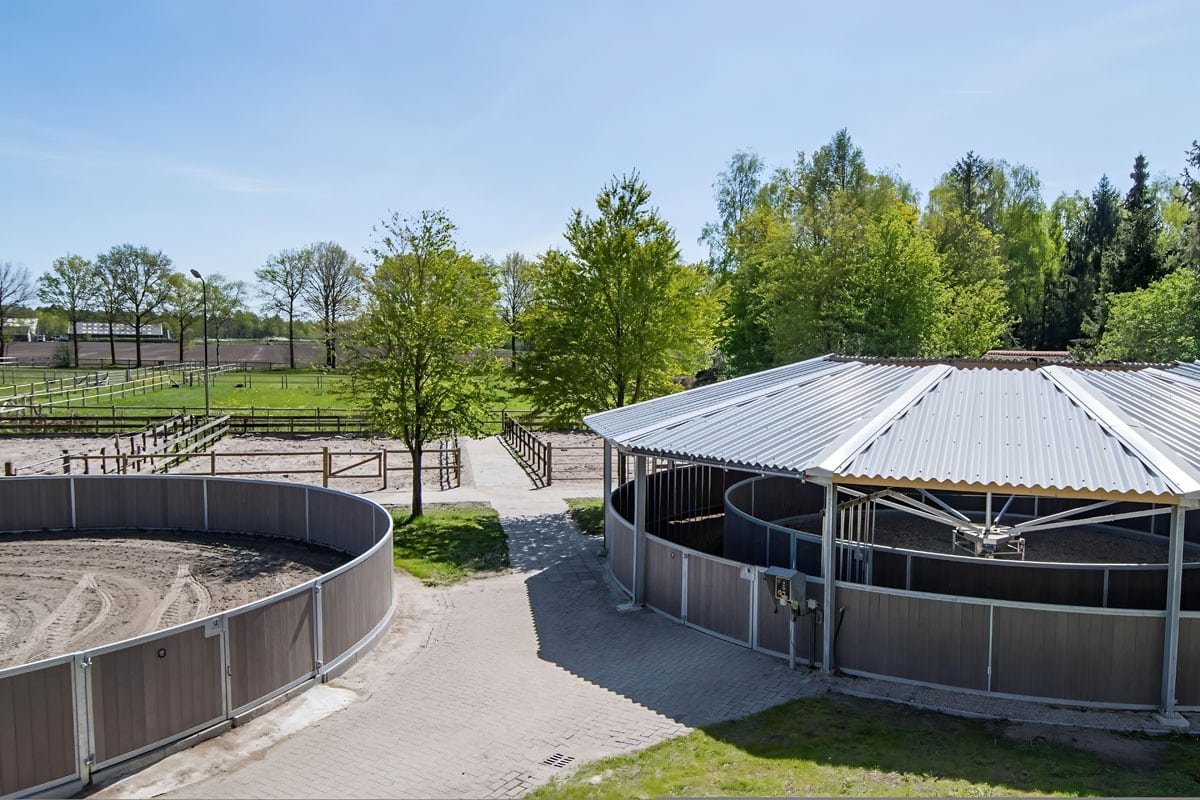
Wall height decides two things at once: what the enclosure can hold in, and what it lets out. Taller walls contain the explosion — the fresh horse that bolts along the fence, the young stock that has not yet learned to respect a boundary. They also block the visual world beyond the pen, which helps a distracted horse settle and helps a nervous one stop scanning for exit routes. For starting pens and public venues where a horse getting out is a liability event, height is cheap insurance.
Lower walls trade containment for connection. The handler sees out — important in a multi-ring facility where a lunge session shares space with riders — and the horse sees out, which for a settled schoolmaster is enrichment, not distraction. Lower panels also make the pen read as a training space rather than a cage, and they reduce the wind load on the entire structure, which in exposed sites is a specification benefit that quietly saves anchoring cost.
Match the wall to the wildest horse you will honestly put in the pen — not the wildest horse you can imagine.
Decision Three: Surface
The surface does the actual training. Circular work concentrates wear into a track, loads the same limbs in the same direction for entire sessions, and exaggerates whatever the footing does — a slippery surface slips on every circle, a hard one concusses on every stride, a deep one fatigues on every lap. Because the traffic pattern never moves, the surface choice matters more in a circular enclosure than in almost any other part of the facility.
In practice the choice comes down to a managed sand or sand-mix footing for the budget-conscious outdoor pen, and engineered footing — often with rubber content — for indoor and high-use pens. Heavy-duty anti-slip rubber matting belongs in the conversation wherever the enclosure doubles for grooming, tacking or veterinary work: it drains, it cushions, and unlike loose footing it does not migrate out of the circle on every turn. Drainage belongs in the same conversation as the material: an outdoor circular pen with a poorly prepared base becomes a moat with a fence around it after the first wet week, and no surface fixes a base that holds water.
For buyers specifying a full training facility, the surface decision is also where the lunging pen meets the rest of the equipment plan. Heavy-duty rubber mat systems that serve stalls and wash areas can often be specified for the pen’s working zones at the same time — one supplier, one specification, one freight calculation. Our overview of rubber mat options for stables and arenas covers the formats and subfloor pairing.
Structure: Panels and Anchoring
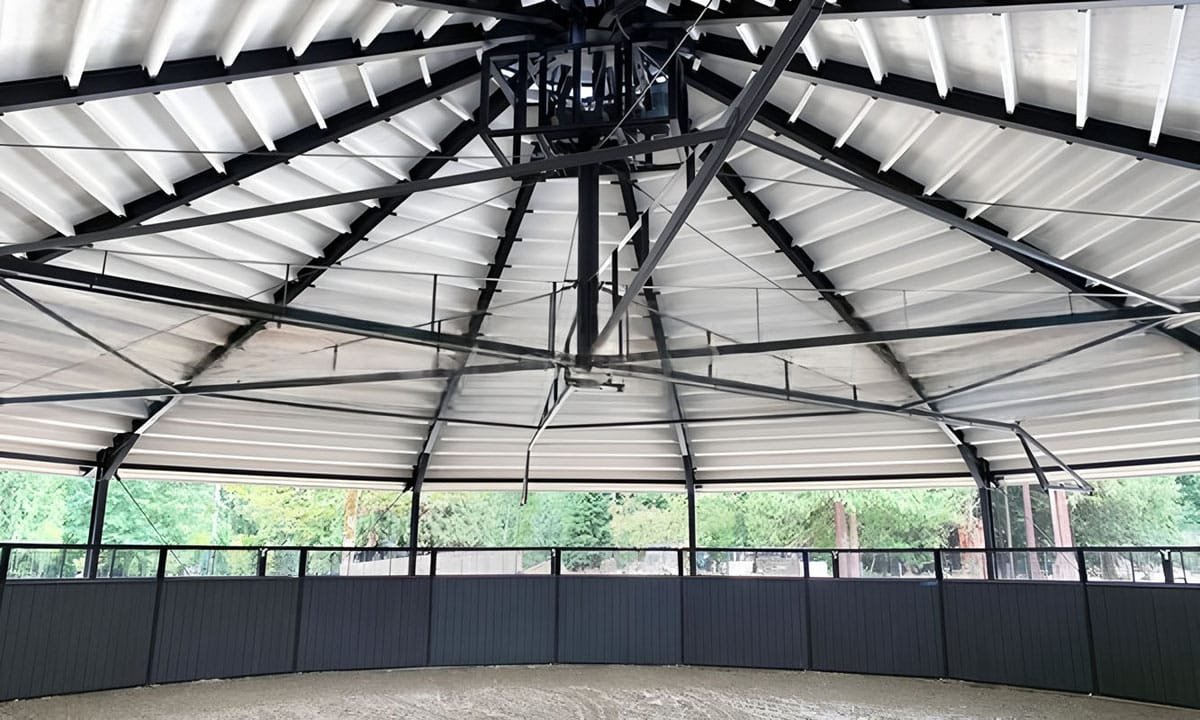
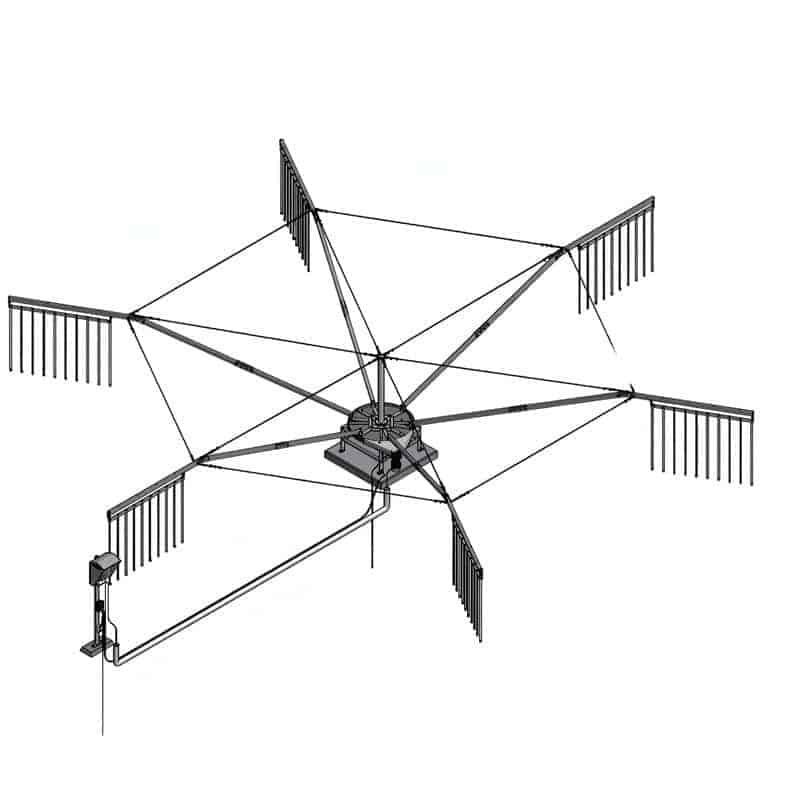
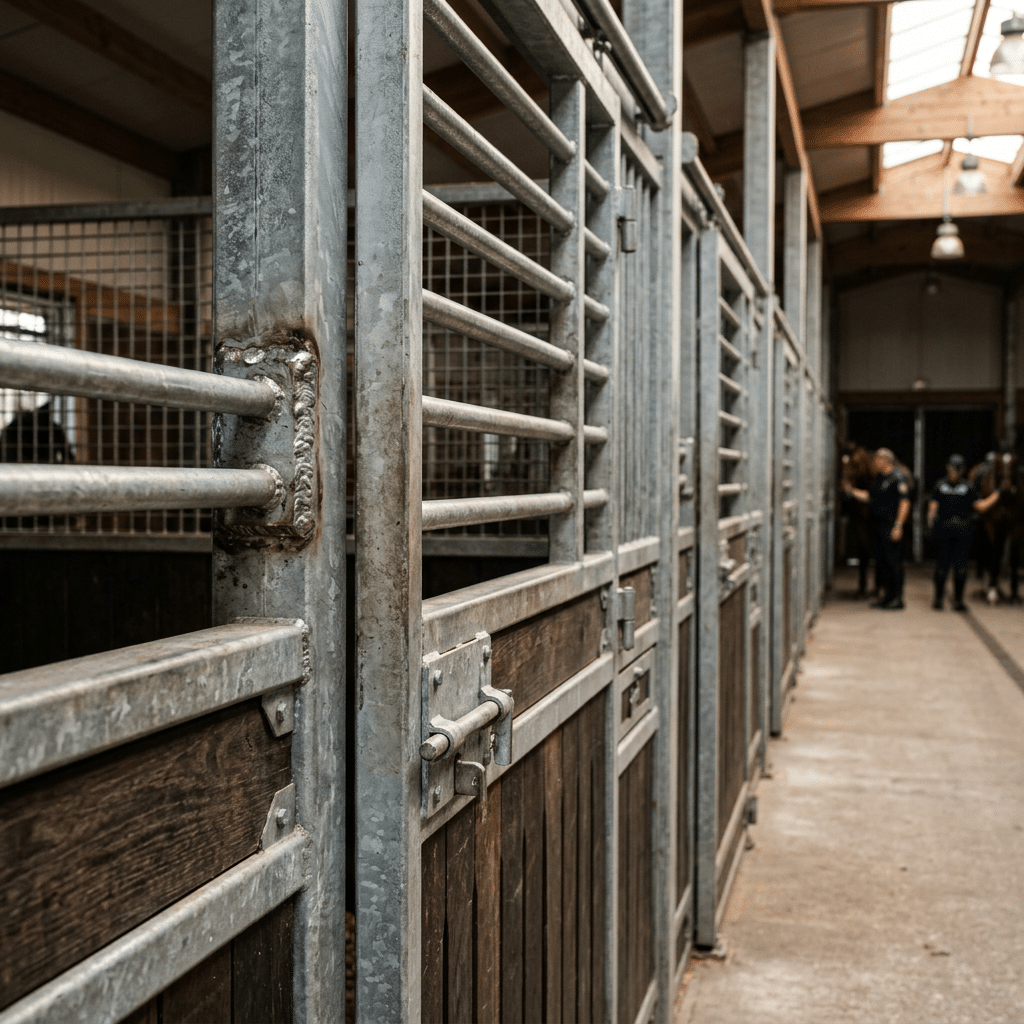
The wall is a machine, and its working parts are the panels, the posts and the connections. Hot-dip galvanized steel is the baseline specification for outdoor circular enclosures — the galvanizing layer stands between the structure and years of weather, sweat and surface moisture, and it is why a galvanized pen carries a 20-year rust-resistance service life, where painted finishes cannot offer comparable protection without ongoing maintenance. Our guide to reading steel gauge specifications applies to pen panels exactly as it does to stall fronts.
Anchoring deserves its own line on the specification. A circular wall presents a continuous curved surface to the wind — it is a sail in every direction, and the taller the wall and the more open the site, the harder the anchoring question. Post setting depth, base plates and the panel-to-post connections are the three points where wind load either transfers safely into the ground or accumulates until something yields. On exposed sites, this is the item to raise with the supplier before the order, not after the first storm.
Matching the Enclosure to Your Program
Put the three decisions together and the choice usually resolves itself. A lunge-line program with schoolmasters: smaller circle, lower wall, engineered surface. A young-stock starting program: larger circle, taller wall, forgiving footing with drainage engineered in. A rehabilitation or veterinary-focus facility: tight control, mat-surfaced zones, low walls for sightlines. A competition yard that already runs a horse walker for conditioning typically adds a round pen for foundation work — the walker trains fitness while the pen trains behavior.
For B2B buyers, the specification conversation should land on paper: diameter, wall height, panel gauge and finish, post and anchoring method, gate specification, and the surface build-up. Manufacturing capacity is not a bottleneck at project scale — CNC machining and automated 360-degree welding support a production capacity of 500-plus sets per month — so the schedule is governed by shipping: four to six weeks globally, and buyers near a regional warehouse can expedite to one to two weeks.
الأسئلة المتداولة
Can I use one pen for both lunging and liberty work?
Yes, with a compromise on size — a mid-range circle handles both, but neither discipline gets its ideal. Facilities that train young stock seriously usually end up with two enclosures sized to their jobs.
Does wall height really matter for a quiet horse?
Less for containment, more for environment: lower walls keep sightlines open for the handler and reduce wind load on the structure. Height becomes safety-critical with green, fresh or young horses.
What finish should the panels have outdoors?
Hot-dip galvanized steel — the coating carries a 20-year rust-resistance service life and is the baseline for outdoor circular enclosures exposed to weather, sweat and surface moisture year-round.
Is a lunging pen a substitute for a horse walker?
No — a walker trains controlled, repeatable fitness; a pen trains responsiveness, rhythm and foundation behavior with the handler in the loop. Most training centers run both.
How long does a pen order take to deliver?
Standard global lead time is four to six weeks; buyers near a regional warehouse (Sydney or Warsaw) can expedite to one to two weeks. Plan the surface works to the same schedule.
الخاتمة
The lunging pen and the round pen are different tools that happen to share a shape. Diameter sets the biomechanics, wall height sets the containment and the wind load, and the surface decides whether the enclosure trains horses or injures them. Specify all three against your actual program, keep the anchoring conversation honest on exposed sites, and the enclosure becomes the most-used square meters on the property.
To spec a pen alongside walkers, jumps or stall systems, review the lunging pen and horse walker range and put your program details to the manufacturer — the specification conversation costs nothing and changes everything.

 Arabic
  English
  Spanish
  French
  German
0 تعليق