A German training yard ordering FEI compliant training equipment is buying two things at once — the hardware that arrives on the pallet, and the paper that says what that hardware is. The machine can be inspected in an afternoon. The paper trail is where most sourcing files quietly fall apart.
DB HorseStable is an Anping-based manufacturer founded in 2013, exporting stabling, fencing and training equipment to nine markets including Germany. Its published positioning for that market pairs two ideas: sustainable stable design and FEI-compliant training setups. Both are claims. What follows is the documentation that turns each claim into something a purchase order can hold.
النقاط الرئيسية
- A “FEI compliant” line in a quotation is a scope claim. Ask which rule or approval, which edition, and which components it covers — standards, poles, cups, bases, or the whole set.
- FEI equipment rules bite at sanctioned competitions. A private training hall is bought on durability, knockdown behavior, spare-part supply and storage footprint, not on a rulebook no judge will open there.
- “Italian motors” is this site’s published description of the walker range. Make, model, rated power and warranty conditions belong in the quotation before the phrase means anything.
- ISO 9001 and CE are published as company status; certificate and declaration numbers are not. Request copies in writing before any deposit.
- Commercials you can quote today: minimum order of 10 stall sets or 50 fence panels, 5-15% volume discounts, 4-6 weeks lead time worldwide, 1-2 weeks expedited from the Warsaw hub — the route to test on a German address.
- Anything numeric this site does not publish — walker diameter, stall dimensions, prices — is a written question to the supplier, never an assumption carried into the order.
What FEI Rules Actually Reach
The FEI — the International Equestrian Federation — writes equipment rules for the competitions it sanctions: how a jump may be built, what may hold a pole, how knockable elements should behave. It does not certify every product sold to a training yard, and a supplier quoting “FEI standard” has to say which rule and which edition that phrase rests on. This site’s explainer on what the jump rules actually require covers the sporting side; this article stays on the sourcing side.
For a German buyer the practical split is simple. A facility that will host sanctioned rounds should order to the named rule and keep the reference on file. A private training base — and most are — buys on durability and knockdown behavior instead. That is a legitimate purchase at a different price, and conflating the two is how yards overpay for paint and underpay for steel. A third layer is European paperwork: the site lists ISO 9001 and CE among its credentials and designs to frameworks including EU Directive 98/58/EC, the minimum welfare standard for kept animals. Ask which directive a CE declaration actually names, and treat welfare compliance as a question for your local authority, not a sticker.
Horse Walkers: The Motor, the Frame, the Paper
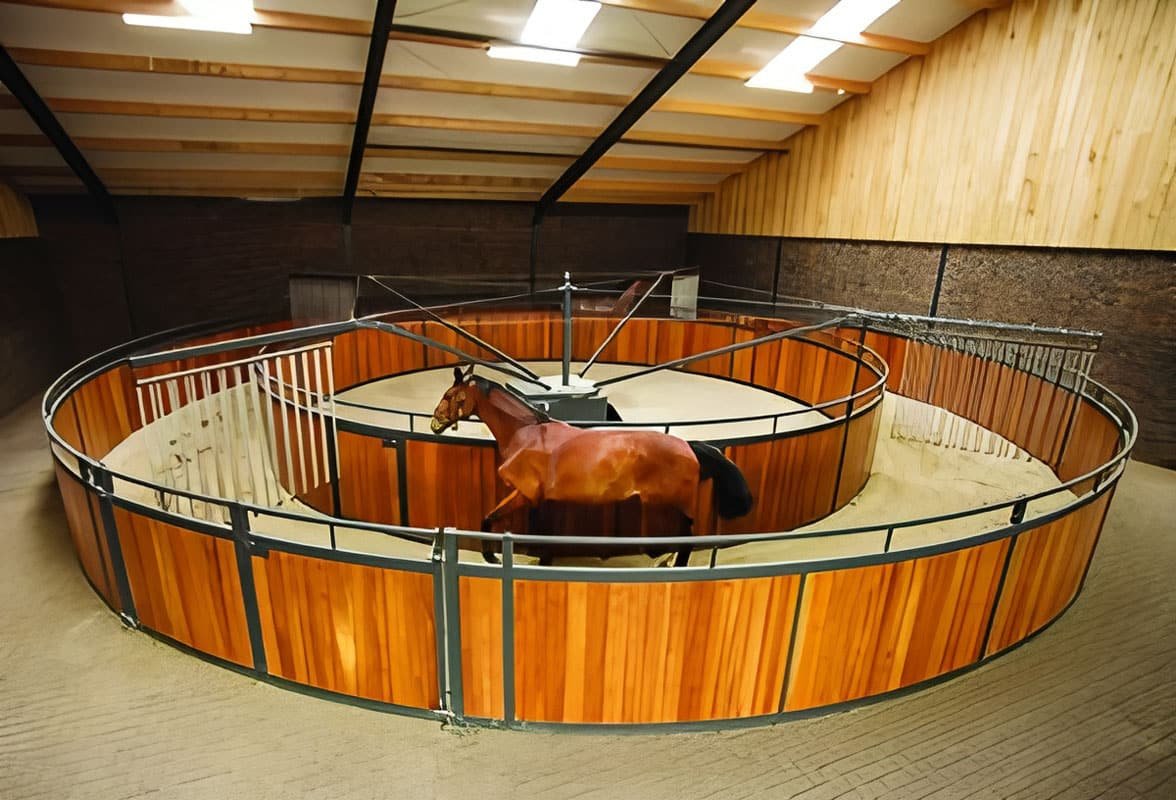
A walker is the one line in this order that moves, carries a living animal and cannot be judged from a catalog page. Three claims deserve written answers before anything else. The first is drive. The published description for this range is Italian motors — that phrase tells you where the drive unit may come from, not what will arrive. Make, model, rated power, gearbox specification and the warranty behind them belong in the quotation. And ask what is manufactured where: a motor bought in Italy does not make the whole machine Italian.
The second claim is the frame. This line is hot-dip galvanized steel, and the durability figure the site publishes is 20 years of rust resistance — a manufacturer’s stated claim. The coating detail behind it, including any micron figures, is not published here and should be requested in writing. Cutting and welding are described as CNC-punched parts joined by automated 360-degree welding, at a stated scale of 500-plus stall sets per month; treat that scale as factory capacity, not a promise on your batch.
The third claim is the walkaround: emergency stops, gate interlocks and speed control can separate well-specified equipment from a liability claim. This site already publishes a walker safety checklist worth walking with your supplier’s spec sheet open. Anchoring, foundations and building review sit with your engineer and your municipality — not in any container.
One Jump Order, Two Different Specs
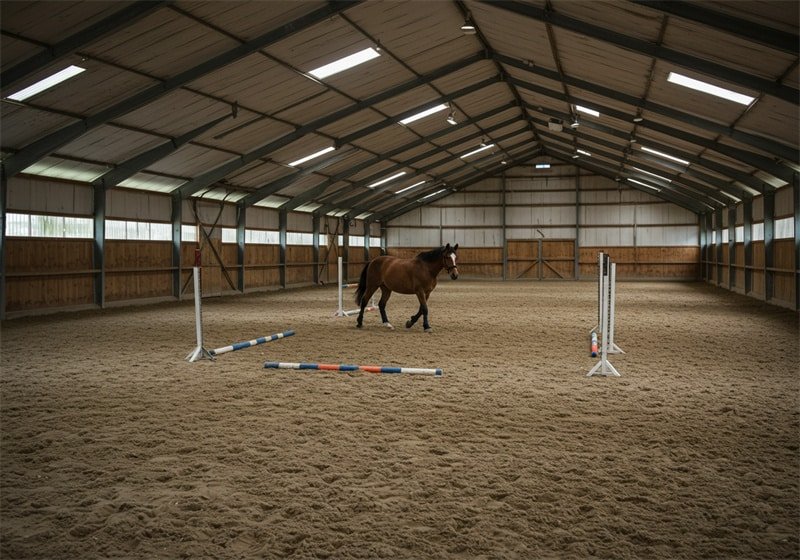
A single training-facility order usually hides two specifications, and they should be priced as two lines. The daily kit is ground poles, cavaletti and simple standards — gear a horse steps on, drags and leaves on damp footing between sessions. Buy that list for cheap replacement and stackable storage, and accept that it will be retired. The show-and-clinic set is painted standards, cups and pins, wings and fills: what a course setter judges, and where an FEI claim, if you want one, has to live.

The wear on the second list concentrates in small metal: jump cups and pins carry every rail a horse brings down. Ask for a spare-parts price and lead time to sit with the order, because a cup nobody stocks turns one knocked standard into a new standard. The same question applies to any surface a horse can chew or step — finish systems and replaceable kick boards are cheaper to specify now than to retrofit in January.
Lead Times, MOQ and the Six-Document Order File
The commercial terms this site publishes are concrete enough to plan around: a 10-stall-set or 50-panel minimum, volume discounts of 5-15%, 4-6 weeks lead time worldwide, and 1-2 weeks expedited from regional hubs in Sydney and Warsaw. For a German delivery, the Warsaw line is the one to question: what expedited includes, whether your items are held there, and who files customs.
Our position: a supplier who cannot answer “which document proves which claim” in a single email does not belong on a German shortlist. The silence is a specification.
| Document | What it settles |
|---|---|
| ISO 9001 certificate copy | Number, validity and whether the certified scope covers the line you order. |
| CE declarations | Which directive each part falls under — a walker’s electrics and a steel frame are not one declaration. |
| Motor datasheet | Make, model, rated power and warranty terms behind the “Italian motor” phrase. |
| Coating basis | Written support for the 20-year rust-resistance claim and what the warranty excludes. |
| FEI claim statement | Which rule, which edition, which components — or removal of the phrase from the quotation. |
| Spare-parts list | Cups, pins, latches and hinge hardware with prices and lead times — the repairability answer a sustainable yard actually uses. |
What you will not find published anywhere on this site is prices, stall dimensions or walker diameters. Those are written questions. The Germany solutions page is where the specification conversation starts here.
الأسئلة المتداولة
Does training equipment need to be FEI approved?
No. FEI rules govern competition at sanctioned events. A private training hall is bought on durability and safety. Order to FEI spec only when you will host sanctioned rounds or want the knockdown behavior the rules describe.
What should FEI standard mean in a quotation?
A named rule, a named edition and a named component list. If the quotation cannot produce all three, ask for the phrase to be removed or documented — an undefined claim helps nobody in a tender.
How fast can equipment reach Germany?
This site publishes 4-6 weeks worldwide, and 1-2 weeks expedited from its Warsaw and Sydney hubs. Ask in writing what an expedited slot on a German address actually includes.
What is the minimum order?
Ten stall sets or fifty fence panels, with volume discounts of 5-15% on larger runs. Orders of 20 sets or more come with a dedicated regional account manager for customization and logistics questions.
Is Italian motors the same as an Italian-made walker?
No. It describes the drive unit. The frame, electrics and assembly have their own origin, so request a build breakdown in writing whenever market-of-origin claims matter to your tender documents.
الخاتمة
German yards buy on paper first — certificates, declarations, datasheets — and training equipment is no exception. The FEI phrase, the Italian motor phrase, the 20-year phrase: each becomes a line item the moment you ask which document supports it. Sorting suppliers on that basis is also the sustainability answer, because equipment with a spare-parts trail stays in service instead of becoming freight.
Send the six-document list to every supplier on your shortlist — this one included — and compare answers rather than brochures.

 Arabic
 English
 Spanish
 French
 German
0 تعليق