

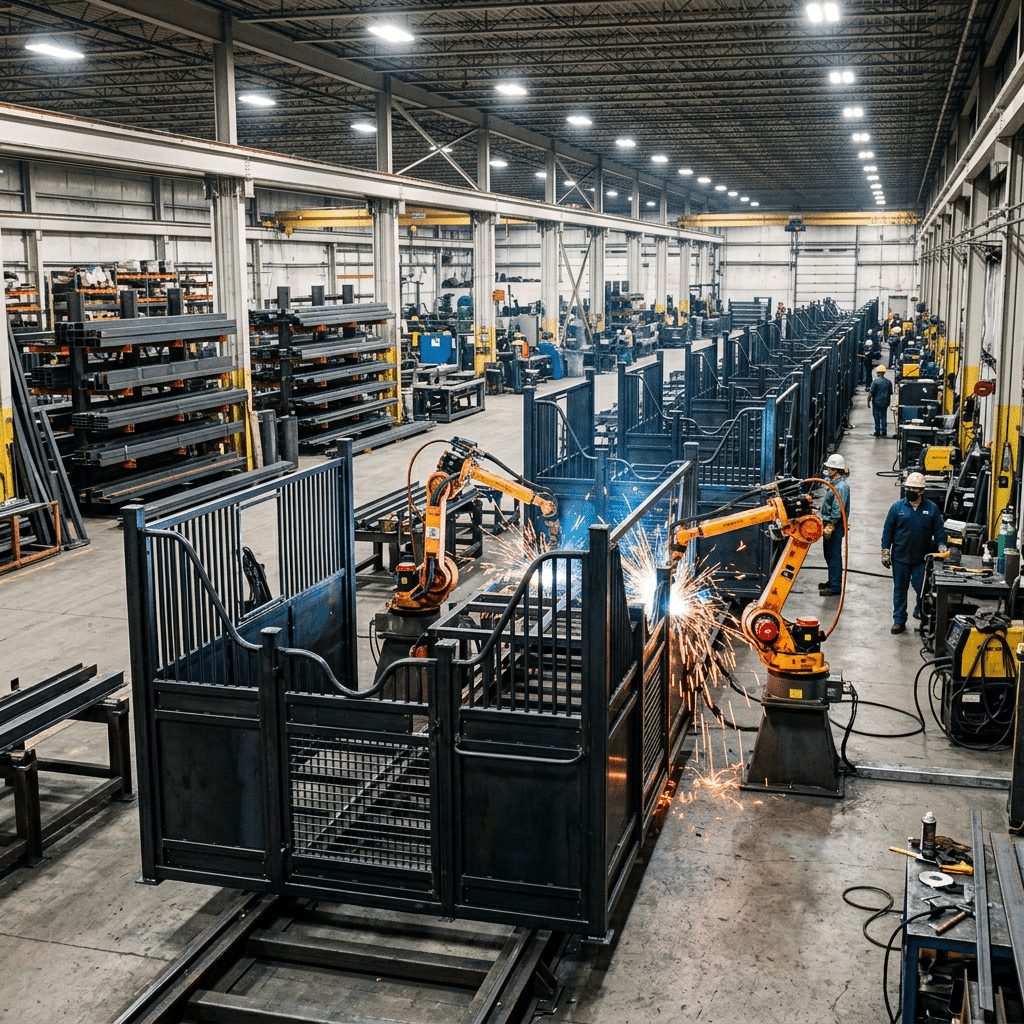
clean hot dip galvanized horse is the first checkpoint buyers should lock before they approve a supplier, budget, or production slot. A $50,000 order for horse stalls gets approved after sample inspection. Three months later, the buyer finds rust at every weld joint. That’s the moment when ‘clean hot dip galvanized horse stalls‘ becomes the critical specification — a specification that the pre-production sample, cut from pre-coated sheet, never revealed.
Supplier audits across a dozen countries show a consistent flaw: FOB pricing on pre-galvanized stalls looks 15% lower, and sample approval rarely catches the hidden defect. The quality tolerance at cut edges and weld seams is where the coating fails, and that failure accelerates in high-ammonia stable environments. Hot-dip galvanizing solves this by immersing the fully welded structure in molten zinc at 840°F, creating a metallurgical bond that protects every joint. That 20-year difference in lifespan separates a sound investment from a recurring maintenance headache.
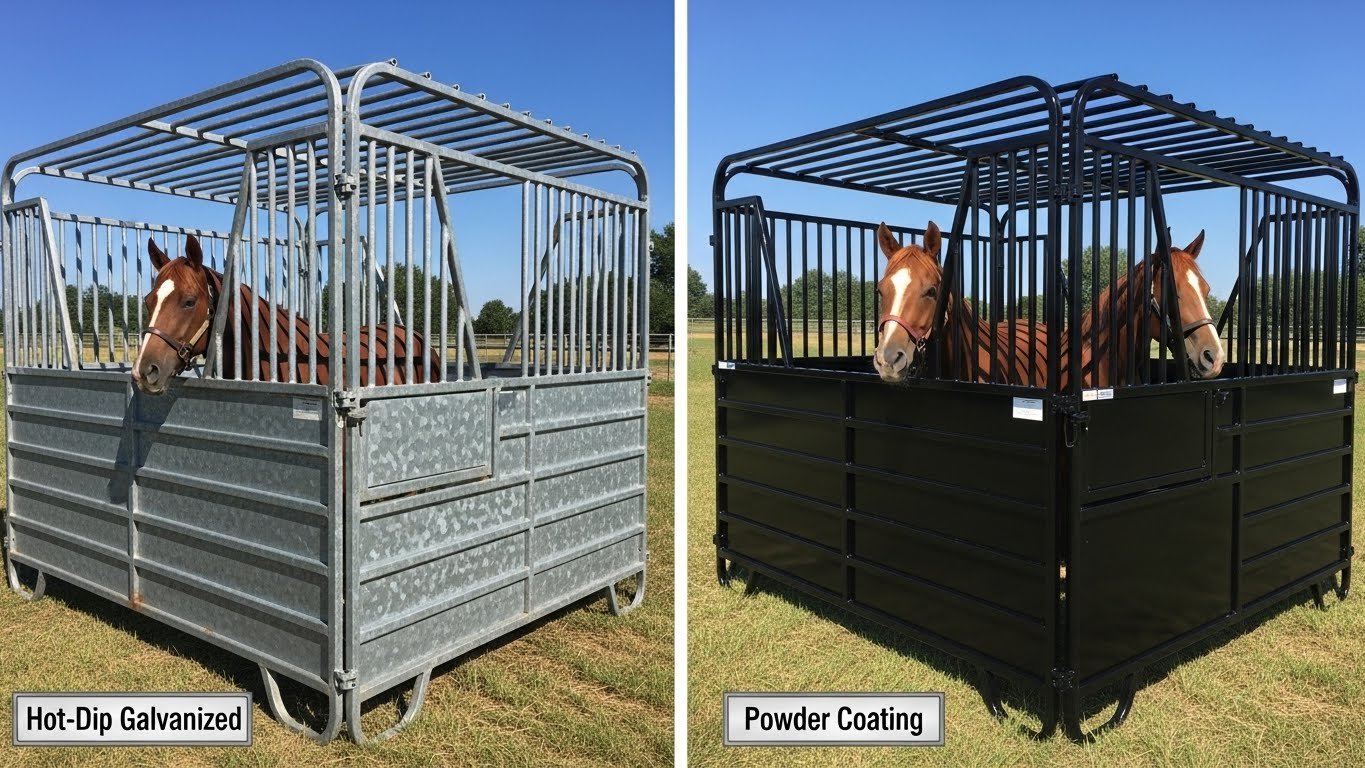
Why Pre-Galvanized Steel Fails Fast
Pre-galvanized steel trades upfront savings for hidden corrosion at every cut edge and weld.
The manufacturing process is the root cause. Pre-galvanized steel is coated before fabrication — the sheet passes through an electroplating bath, receiving a thin zinc layer (10–20 microns). Then the material is cut, punched, and welded to form stall panels. Every cut edge exposes raw steel, and welding vaporizes the zinc around the joint. In a stable environment with ammonia from horse waste, those unprotected areas begin corroding within months.
- Cut-Edge Corrosion: The zinc layer ends at the shear line. Exposed steel oxidizes immediately. Moisture and ammonia accelerate crevice corrosion along every panel edge.
- Weld-Point Failure: Welding destroys the coating at the joint, leaving a bare spot. Industry data shows these points fail in 3–5 years in high-ammonia environments, making stall disassembly and replacement unavoidable.
- Steel Gauge Scam: To keep total cost low, pre-galvanized suppliers often use lighter-gauge steel. Thinner metal plus no coating at edges means the structure loses integrity faster. A 1.5 mm wall with a 10-micron coating corrodes through more quickly than a 2.0 mm wall protected by 60–85 microns of hot-dip galvanizing.
The only fix is reversing the sequence: weld first, then immerse the whole assembly in molten zinc at 840°F. That seals every cut, weld, and corner with a metallurgically bonded layer — exactly what the market calls a clean hot-dip galvanized finish. Pre-galvanized cuts that step to save on vat size and energy, and the buyer pays for it with premature rust.
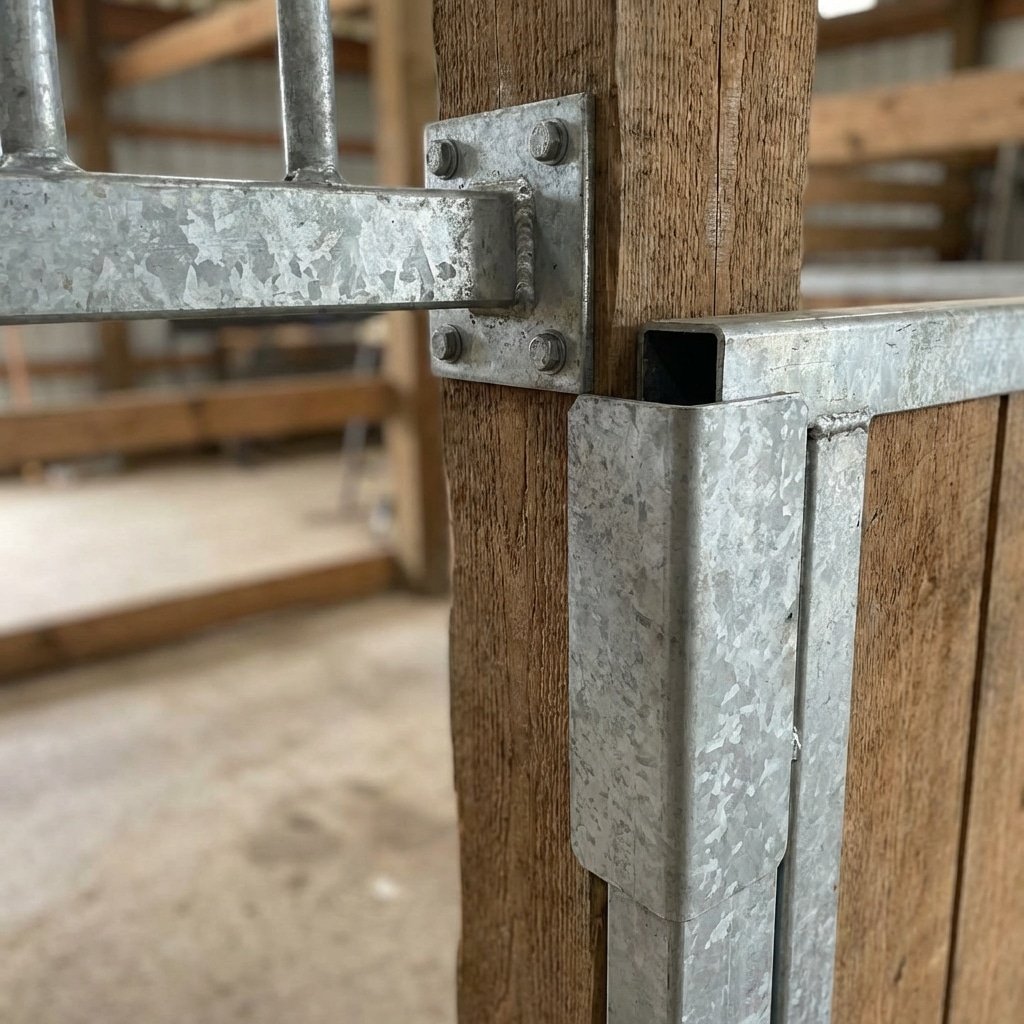
The Metallurgy of Hot-Dip Protection
Hot-dip at 840°F creates a metallurgical bond, not just a coating.
When steel is immersed in molten zinc at roughly 840°F, it initiates a diffusion reaction. The zinc reacts with the iron to form distinct intermetallic layers: Gamma, Delta, and Zeta phases. These layers are actually fused with the base steel — not simply adhered. Saratoga Stalls data shows these alloy layers can exceed 50 years of service in normal barn environments.
The real engineering advantage is the self-healing barrier. If the coating is scratched to bare steel, the zinc adjacent to the scratch sacrificially corrodes, forming a protective zinc carbonate patina (that matte grey finish). That patina is your self-maintaining shield. The mistake many facility managers make is cleaning it with acidic agents like vinegar, which strips the patina and accelerates rust. Neutral pH cleaners only.
- Hot-Dip Thickness: 60–85 microns, per ASTM A123. That’s the minimum spec for industrial-grade horse stall panels.
- Pre-Galvanized Thickness: 10–20 microns, applied via electroplating before fabrication. Leaves cut edges and welds completely exposed.
- Failure Mode: Pre-galvanized stalls show rust at weld points within 3–5 years in high-ammonia stable environments. Hot-dip stalls maintain 20+ years.
Here’s the trap most buyers miss: cheap pre-galvanized producers skip post-weld immersion to save on vat size and energy costs. They weld the stall, then call it done. The only way to guarantee zero rust at joints is to weld first, then dip the entire assembled unit. That’s why DB Stable’s production line uses a hot-dip vat large enough to submerge a fully welded horse stall — every weld seam, every cut edge, every bracket gets full 60–85 micron coverage.
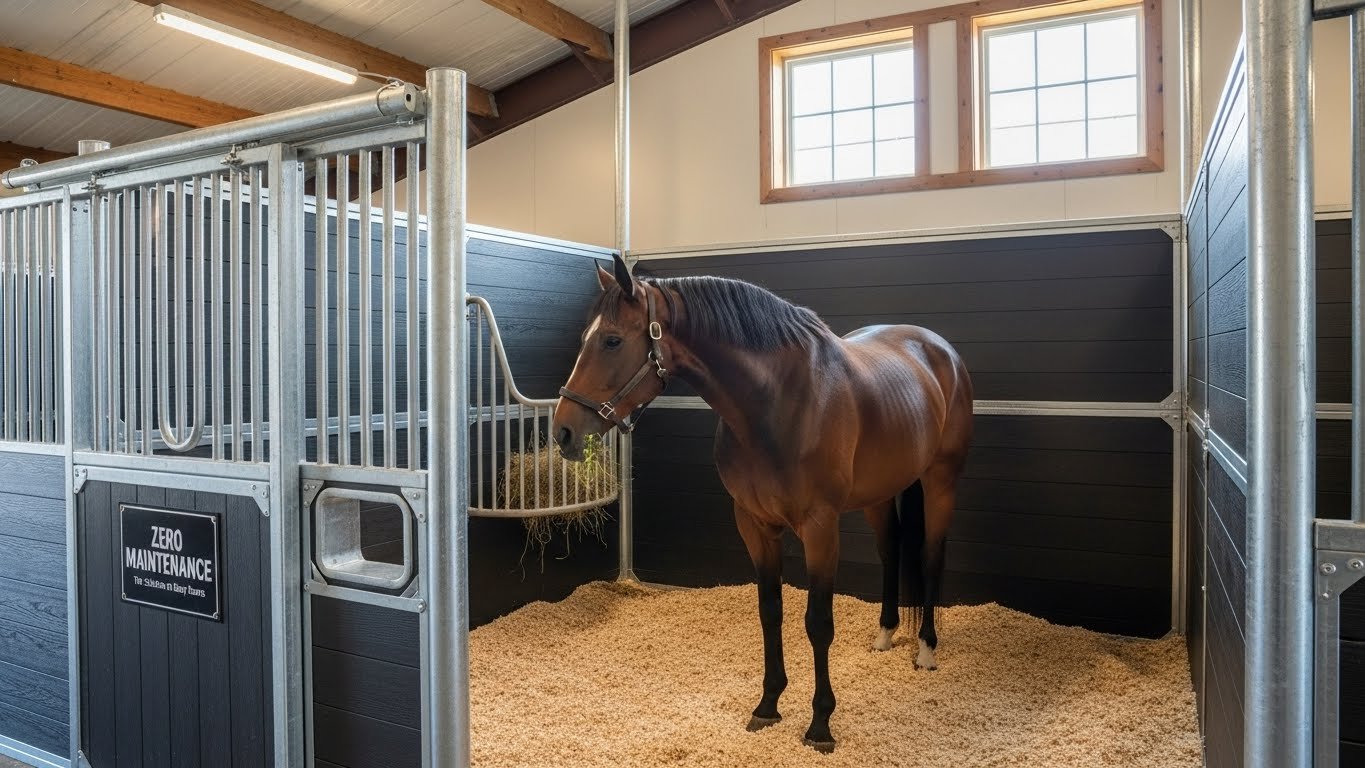
Weld Point Weakness: Where Stables Rust
Weld points in pre-galvanized stalls fail within 3-5 years.
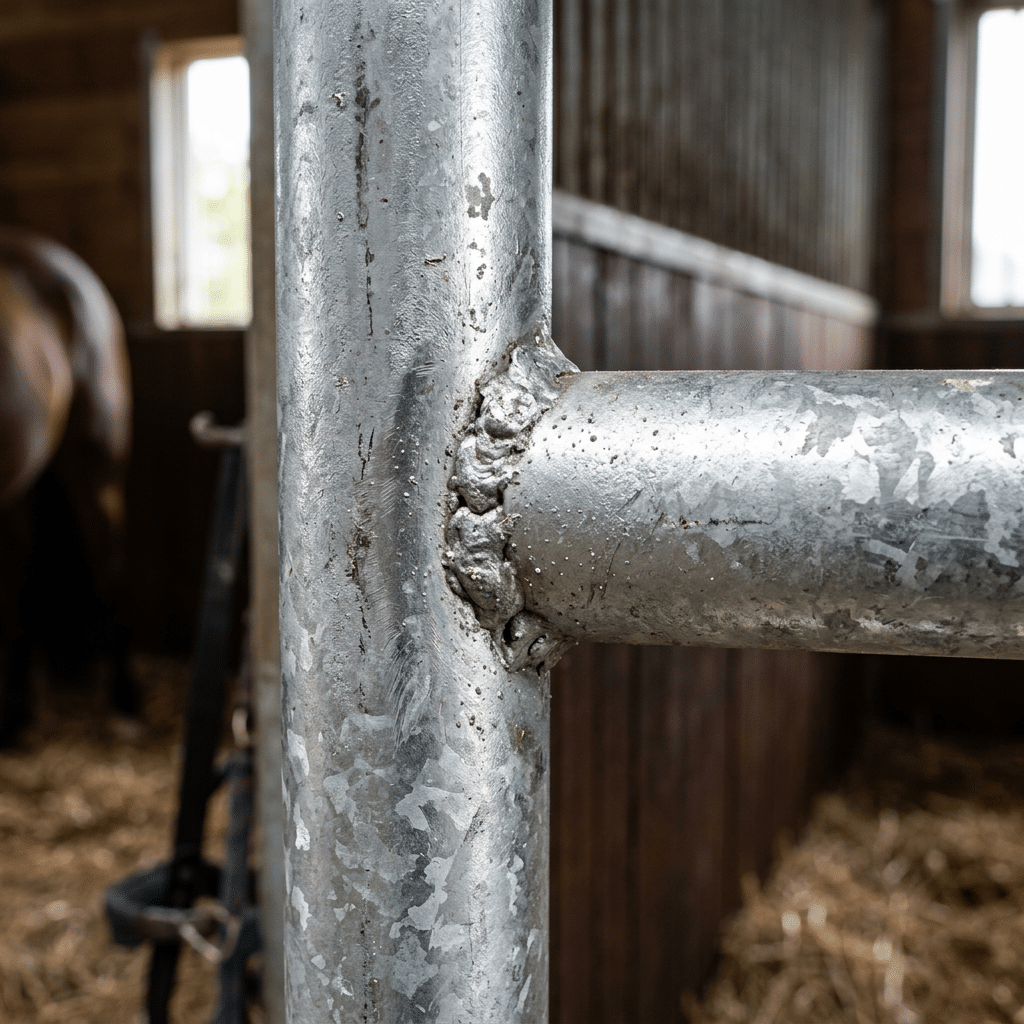
The cut edge of a pre-galvanized sheet is bare steel. When the sheet is sheared to size, the zinc coating does not wrap around the cut. That edge is exposed to moisture and ammonia from day one. Weld points are worse — the heat burns off all surrounding zinc, leaving a corrosion crater. In hot-dip galvanizing, the entire assembled structure is immersed in molten zinc at 840°F. The molten zinc flows into every cut edge and fills the weld zone, restoring full protection. The result is a uniform coating of 60-85 microns versus the 10-20 microns on pre-galvanized sheet, and zero unprotected edges.
This is the number one failure point for rental fleets and commercial farms. A stall that looks fine from a distance has rust blooming at every joint within three years. Once the red rust appears, structural integrity degrades quickly. For a rental fleet operator, that means constant patching and early replacement. For a commercial farm, it means horses rubbing against sharp rusted edges and owners losing trust in the facility. The contrast is stark: hot-dip stalls routinely pass 20 years in service with only superficial patina changes.
Maintenance of hot-dip galvanized stalls is not zero, but it is different. The protective zinc carbonate patina that forms naturally is fragile. Cleaning with acidic agents like white vinegar strips it away, accelerating corrosion. The dedicated guide ‘Clean Hot-Dip Galvanized Horse Stalls Safely’ outlines neutral-pH cleaning protocols that preserve the self-healing layer. A QA engineer should insist that facility staff follow that protocol — it is the difference between a 20-year asset and a 10-year liability.
Long-Term ROI for B2B Fleets
Hot-dip stalls cut total ownership cost by 30% over 20 years.
Run the numbers on a 100-stall fleet. Pre-galvanized stalls need full replacement every 5 years in high-ammonia environments—that’s four capital cycles in 20 years. Hot-dip galvanized stalls, with 60–85 microns of metallurgically bonded zinc, last the full two decades. The upfront premium of 10–15% vanishes against the cost of three extra replacements, plus the labor and downtime for each swap.
- Brand reputation risk: Corroded weld points and rust streaks signal neglect to clients and inspectors. A single high-visibility failure—like a gate hinge snapping at a show—can cost contracts and trigger FEI compliance audits. Hot-dip stalls maintain a uniform, self-healing patina that projects quality for decades.
- Maintenance downtime reduction: Pre-galvanized stalls demand annual spot painting of welds and edges, requiring stall vacating, surface prep, and curing time—roughly 4 hours per stall per year. For a 100-stall facility, that’s 400 labor hours annually. Hot-dip stalls are self-maintaining: no painting, no patching, no lost boarding revenue.
الخاتمة
The difference between a stable that lasts 20 years and one that rusts out in five isn’t in the steel gauge or the brand name. It’s in the coating process. Hot-dip galvanizing, with its post-weld immersion and 60–85 micron metallurgical bond, seals the cut edges and weld points that pre-galvanized stalls leave exposed. But there’s a detail most buyers miss: even hot-dip steel needs a specific cleaning protocol. Harsh acids or abrasive pads strip the protective zinc carbonate patina. Use neutral pH cleaners and a soft cloth. That habit keeps the coating self-healing for decades.
For your next large-scale equestrian project, don’t settle for generic specifications. Request the actual coating thickness report and the compliance certificates for your region — BHS for the UK, FEI for competition yards, or local drainage standards for rainy climates. A manufacturer that provides these documents as standard, not as a special request, is one you can trust for the long haul.
الأسئلة المتداولة
Is hot-dipped galvanized the same as pre-galvanized?
No, hot-dip galvanizing applies 60–85 microns of zinc via molten immersion creating a metallurgical bond, while pre-galvanized is a thin electroplated coating of 10–20 microns. Pre-galvanized fails at cut edges and welds because coating is applied. Choose hot-dip for long-term asset protection.
Which is better, hot-dipped or galvanized?
Hot-dip galvanized is better for horse stables because it fully coats all joints and edges, preventing rust where pre-galvanized fails within 3–5 years. The metallurgical bond at 840°F provides 20-year rust resistance. For commercial fleets, hot-dip is the only viable long-term choice.
What are the disadvantages of hot dip galvanizing?
Hot-dip galvanizing costs 15–20% more upfront than pre-galvanized, and the dipping tank size limits part dimensions. However, the total cost of ownership over 20 years is lower because pre-galvanized stalls need full. The higher initial investment is offset by eliminating replacement costs.
What does white vinegar do to galvanized metal?
White vinegar’s acidity reacts with the zinc coating, causing whitish corrosion spots and accelerating zinc depletion. For clean hot-dip galvanized horse stalls, vinegar cleaning strips the sacrificial layer and reduces rust protection over time. Use only pH-neutral cleaners on hot-dip galvanized stalls.
Does welding destroy galvanized coating?
Yes, welding burns off zinc at the weld zone, exposing bare steel to rapid rust. Pre-galvanized stalls fail at weld points within 3–5 years; hot-dip galvanizing after fabrication coats the entire assembled unit including. Always specify post-weld hot-dip galvanizing to seal welds.

 Arabic
  English
  Spanish
  French
  German
0 تعليق