



Integrating Trench Drains into commercial wash bays often forces builders to choose between drainage efficiency and structural integrity. Installing solid-base stall fronts directly over these channels creates a dam effect that traps corrosive ammonia and accelerates steel failure. This common design error voids galvanization warranties and leads to expensive retrofit costs for the facility owner.
Our approach utilizes the standard 50mm Cast-Proof clearance to bridge the drain without modifying the Q235B Structural Steel framework. By preserving the ISO 1461 Hot-Dip Galvanized coating and eliminating on-site cutting, this method ensures a seamless installation that satisfies both hygiene protocols and long-term asset protection.

The Superiority of the Linear Trench Drain
Linear trench drains utilize a unidirectional slope to eliminate water pooling and create a flat floor plane, significantly simplifying the installation of rigid prefabricated steel stable fronts.
Maximizing Hygiene with Unidirectional Slopes
Traditional center-drain designs require a four-way compound slope, creating a “bowl” effect that often leads to inconsistent drainage. In contrast, linear drains rely on a simple unidirectional slope. This fundamental design difference directly impacts facility hygiene by eliminating the low spots where urine and water typically pool.
- Prevents Stagnation: Removes the standing water and urine pools common in center-drain designs, cutting down on odor and insect breeding.
- Ammonia Control: Efficient evacuation of waste liquids reduces ammonia buildup and bacteria growth, supporting High Animal Welfare Standards.
- Safety Improvement: Removes the need for raised curbs around the drain area, effectively lowering trip hazards in the aisle.
Compatibility with Prefabricated Steel Frameworks
From an installation perspective, linear drains are the only logical choice for rigid modular stables. Prefabricated systems, particularly those built from Q235B Structural Steel, are engineered to sit on a flat, single-plane surface. Installing straight, rigid panels over the compound curves of a center-drain floor inevitably leads to alignment issues and structural stress.
- Flat Installation Plane: Provides a consistent surface ideal for anchoring rigid steel panels without gaps or stress points.
- Eliminates Uneven Footing: Avoids the technical headaches caused by the 4-way compound slopes of traditional drains, where the floor height changes along the length of the wall.
- Faster Assembly: Simplifies the vertical alignment of 50mm x 50mm RHS posts, removing the need for excessive shimming or on-site modification of the steel frame.
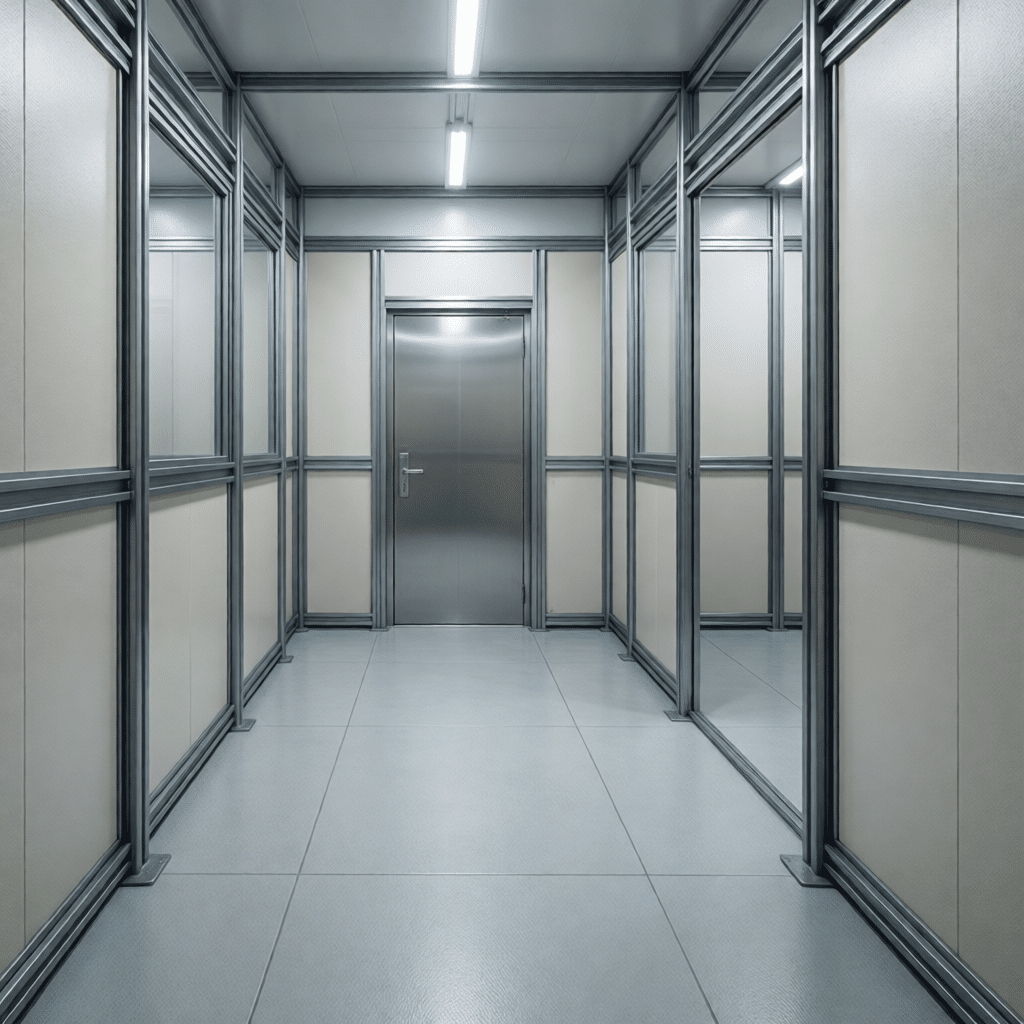
The Interference Problem with Solid Base Plates
Solid base plates block liquid flow and overlap with drain channels, making secure anchoring impossible. Proper design requires a 50mm clearance to ensure drainage and structural stability.
The “Dam Effect” on Liquid Run-off
When you install a stable front or partition with a solid steel base plate that sits flush against the floor, you effectively build a wall against your drainage system. Ideally, linear trench drains run directly underneath the partition line to capture runoff from both sides. But a solid plate creates a physical barrier, trapping urine and wash water inside the stall instead of allowing it to pass into the channel.
This obstruction negates the hydraulic advantage of the trench drain. The liquid pools against the steel, leading to rapid ammonia buildup and accelerating corrosion at the base of the frame. To fix this, we utilize a “Cast-Proof” design with a 50mm bottom clearance. This gap lifts the steel off the floor, allowing fluids to flow unobstructed into the drain while keeping the metal framework dry and rust-free.
Conflict with Standard Anchor Bolt Installation
Structural integrity relies on drilling 304 Stainless Steel Anchor Bolts into solid concrete. Linear drains create a necessary void in the floor—essentially a hole running the length of the stall front. If you use a solid base plate, the steel usually bridges right over this void.
This creates a critical installation failure: you cannot anchor the heavy Q235B/Q345B Steel Framework into an empty drain channel or a grate. The base plate leaves the posts unsupported at the specific points where they need to be bolted down. By eliminating the continuous bottom plate and using independent posts with proper spacing, we ensure every anchor point hits the solid concrete slab on either side of the trench, securing the structure firmly to the foundation.
Premium Stables Engineered For 20-Year Durability

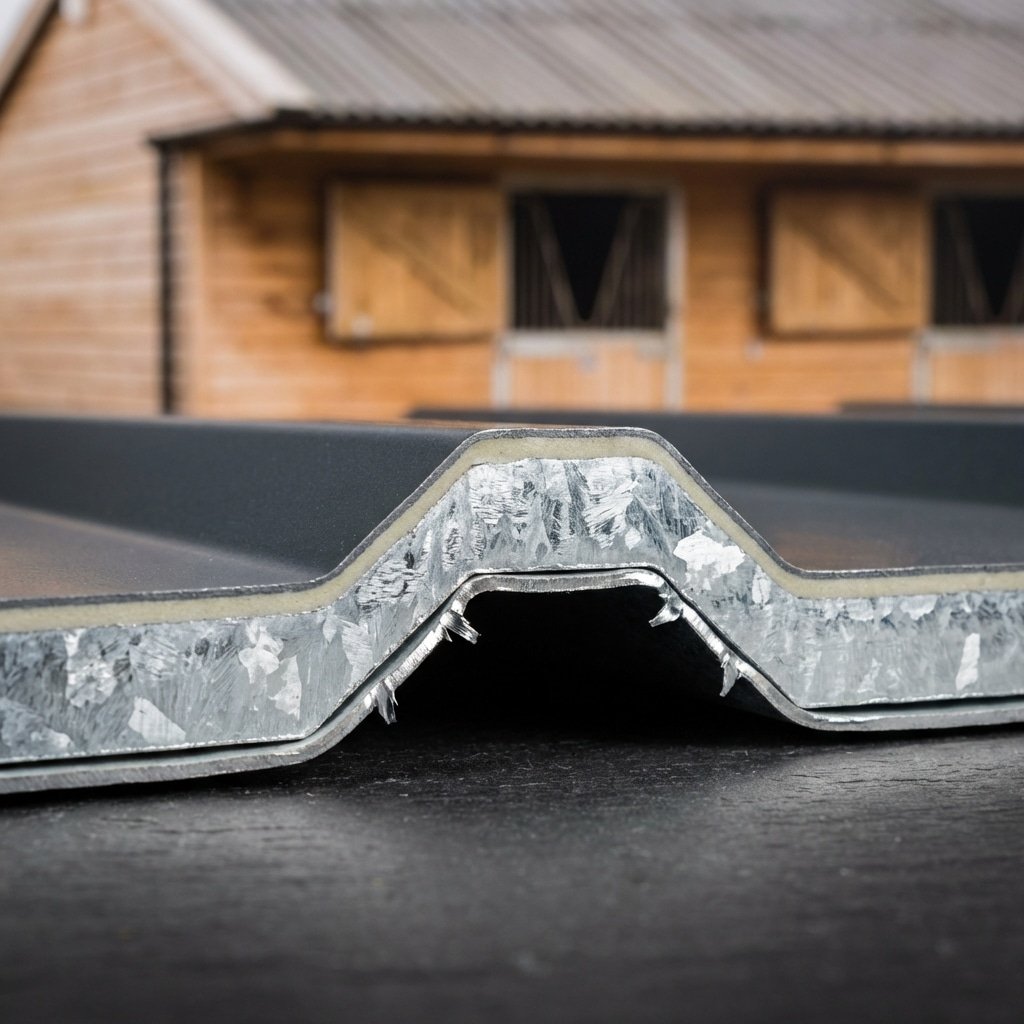
Utilizing the 50mm Bottom Clearance of DB Panels
The standard 50mm safety gap allows continuous trench drains to pass under partitions without cutting steel frames, preserving the hot-dip galvanized coating and structural integrity.
Continuous Linear Drainage Across Multiple Stalls
In commercial equine facility design, drainage efficiency often fights against structural rigidity. Traditional stall systems flush with the floor force contractors to install individual drains in every stall or make dangerous cuts into the steel partition frames to allow water flow. DB Stable panels resolve this by incorporating a standard 50mm (approx. 2-inch) bottom clearance.
This clearance allows for a single, continuous linear trench drain to run the entire length of a barn row. Installers lay the drain channel first, then bolt the partition panels into the concrete on either side of the trench. This method creates a “bridge” over the drain, ensuring the Q235B/Q345B structural steel frame remains intact.
- Preserves Galvanization Warranty: Cutting a steel frame on-site breaks the zinc seal created during our “Hot-Dip After Fabrication” process (ISO 1461). Keeping the frame whole prevents the rust creep that inevitably destroys modified panels.
- Consistent Slope Management: A single linear run allows for a consistent 1% slope across multiple stalls, preventing the pooling common in individual center-drain layouts.
- Hygiene Control: Wash-down water and urine flow freely under the partition wall to the drain, preventing cross-contamination buildup that typically accumulates at the base of flush-mounted walls.
| الميزة | DB Stable Method (Pass-Through) | Traditional Method (Cut-to-Fit) |
|---|---|---|
| Steel Frame Integrity | 100% Intact (Factory Sealed) | Compromised (Field Cut) |
| Corrosion Risk | Low ( elevated above moisture) | High (Exposed raw steel) |
| Drainage Flow | Continuous, Unobstructed | Interrupted by Frame Legs |
| Installation Speed | Fast (No modification needed) | Slow (Requires grinding/sealing) |
The Dual Function of the 50mm “Cast-Proof” Gap
While the drainage utility is a major advantage for facility engineers, the 50mm gap originates from our core safety protocols. In the DB Stable Product Bible, this is defined as “Cast-Proof Design.” It solves two problems simultaneously: keeping horses safe and keeping the steel structure alive.
- Primary Safety Function: The gap is strictly engineered to be small enough (approx. 50mm) to prevent a rolling horse from getting a hoof or leg trapped under the partition, a common cause of catastrophic injury in older stable designs.
- Drainage Clearance: This safety gap provides just enough vertical clearance for standard trench drain grates to pass underneath. It eliminates interference between the partition frame and the drain cover.
- Corrosion Prevention: By elevating the bottom frame rail 50mm off the floor, we keep the critical hot-dip galvanized steel out of the “moisture zone.” Standing water, urine, and wet bedding do not remain in constant contact with the steel, significantly extending the lifespan of the equipment.

Shimming Panels to Maintain the Floor Slope
Rigid stable panels require shimming on sloped drainage floors to ensure level top rails. The 50mm bottom clearance absorbs this height variation without compromising safety.
The Conflict Between Drainage Gradients and Rigid Frames
Proper equine flooring is never perfectly flat. To effectively manage urine and wash water, professional stables incorporate a 1% to 2% slope towards the drains. While this protects the horse’s hoof health, it creates a geometric conflict with the stable front.
DB Stable fronts are prefabricated using heavy-duty Q235B or Q345B structural steel. We weld these frames into precise, rigid 90-degree corners to ensure structural integrity. Unlike wood, which can be cut to match a grade, galvanized steel frames cannot flex. If you install a square frame directly onto a sloped concrete floor without adjustment, the vertical posts will lean. This misalignment prevents أبواب منزلقة from rolling smoothly and causes latch mechanisms to jam.
Leveling Posts Within the 50mm Cast-Proof Clearance
Installers must mechanically level the frame to compensate for the floor grade. This involves placing durable metal washers or steel shims under the base plates of the posts on the “down-slope” side. You continue to add shims until the top rail checks perfectly level.
- Shim Placement: Lift the post on the lower side of the slope using metal shims until the bubble level on the top rail reads true.
- Anchoring: Once leveled, secure the posts through the shims using the provided 304 Stainless Steel Anchor Bolts. This grade of stainless steel resists corrosion at the critical floor contact point where urine accumulates.
- Gap Management: Our standard “Cast-Proof” design features a 50mm bottom clearance. On a sloped floor, this gap might increase to 60mm or 70mm on the low side. This variance remains well within safety standards, preventing hoof entrapment while accommodating the drainage slope.
الأسئلة المتداولة
Where should the trench drain be positioned in a wash bay?
Place the drain approximately two feet from the rear wall using a 4-inch-wide trench system. This position prevents the horse from standing in pooled water and stops them from spooking at a dark drain line in the center of the floor. It also keeps the main standing area drier for the handler.
What is the recommended floor slope for drainage?
Target a slope of one inch per 6 feet (roughly 1.5%). This grade moves water effectively without creating steep angles that stress a horse’s tendons. If you use a linear trench drain, you can get away with a slightly gentler slope of 1 inch per 10 feet.
What are the ideal dimensions for a horse wash stall?
Safety dictates a minimum width of 10 feet and a depth of 12 feet. Ideally, build a 12-by-12-foot space. This gives the handler enough room to move safely around the horse without getting pinned against a wall or feeling trapped.
How do I prevent the drain from clogging with hair and sediment?
Install a removable sediment basket or hair trap inside the trench system before water enters the main 4-6 inch PVC outflow. You must clear the grate after every use to keep the system functional and stop expensive underground blockages.
الأفكار النهائية
Modifying standard stall fronts on-site to accommodate drainage destroys the hot-dip galvanized seal and immediately voids warranty coverage. Our “Cast-Proof” design incorporates a precise 50mm clearance to bridge linear drains without cutting the Q235B steel frame. This engineering choice preserves the ISO 1461 finish and ensures your projects remain rust-free for decades.
Stop losing margin on labor-intensive installations and upgrade to a system built for commercial wash bays. Request our technical specification sheets today to see how our flat-pack profiles integrate with standard trench layouts. We encourage new partners to secure a trial order to validate the structural quality firsthand.

 Arabic
  English
  Spanish
  French
  German
0 تعليق