


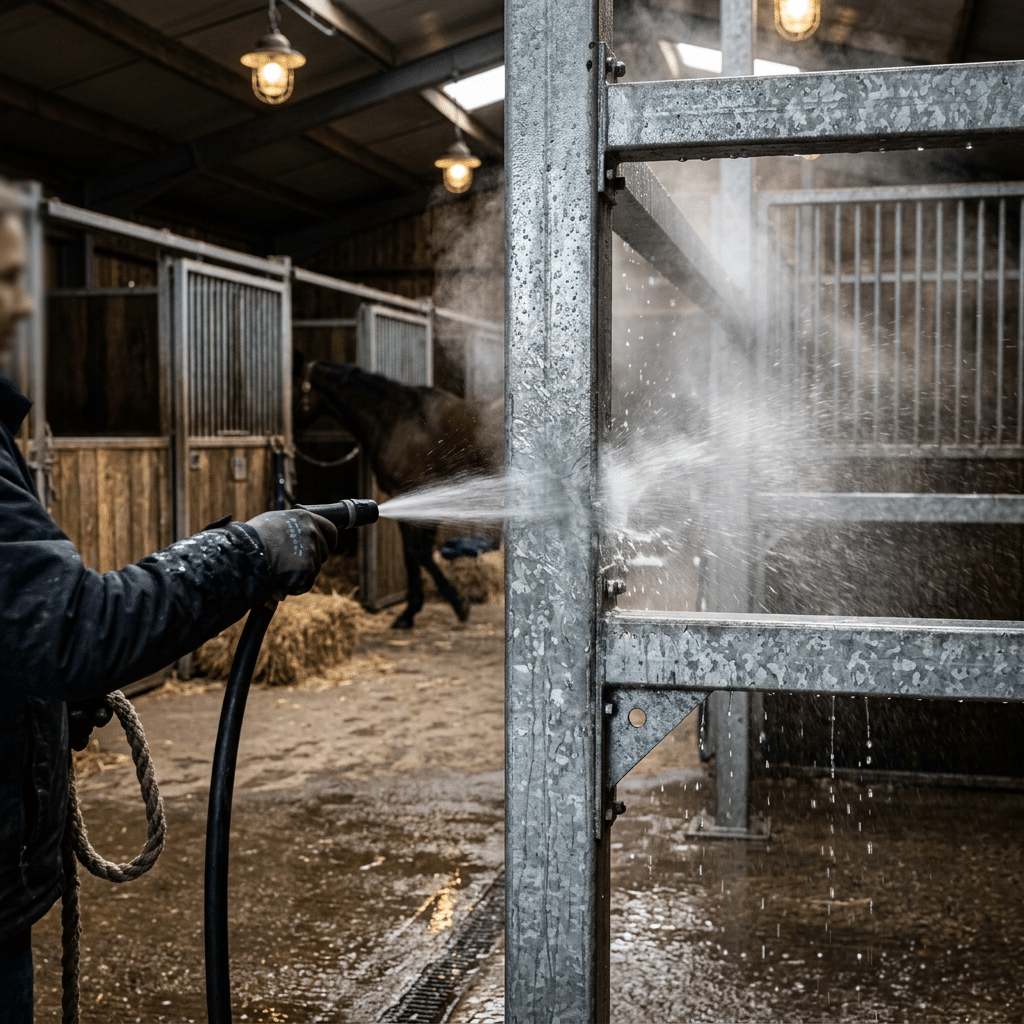
Deploying Earth Augers allows tenants to secure structural assets without triggering costly land restoration clauses. Poured concrete foundations often violate lease agreements, forcing agricultural renters to forfeit their deposit or fund expensive soil remediation upon departure.
We engineer a dry-mounting interface linking 30-inch helical anchors directly to Q235B structural steel posts. By utilizing 304 Stainless Steel hardware and a hot-dip galvanized chassis, this modular system meets ASCE wind load standards while remaining 100% portable for asset protection.
Building Shelters on Leased Agricultural Land
Building on leased land requires bypassing permanent concrete foundations to comply with strict restoration clauses. Portable modular stables allow rapid deployment and complete removal without damaging soil integrity.
Navigating Foundation Restrictions and Soil Preservation
Constructing equine housing on rented agricultural property presents a specific conflict: you need safe, robust structures, but the landowner protects the soil’s agricultural classification at all costs. Most standard lease agreements explicitly prohibit the installation of permanent concrete footings or slab foundations. This is not just about aesthetics; pouring concrete often triggers a change in land use status, creating tax liabilities for the owner.
Tenants also face strict “restoration clauses.” These contract terms legally bind you to return the property to its original state upon lease termination. If you utilize traditional construction methods involving deep excavation and concrete pouring, you face massive remediation costs to remove those foundations and repair the soil structure when you move. Traditional excavation also damages the soil profile, compacting the earth and disrupting drainage, which can create long-term liability issues regarding land value.

The Strategic Advantage of DB Stable’s Portable Design
We engineered the DB Stable system specifically to solve the “permanent vs. temporary” dilemma. By shifting the asset class from a fixed building to movable equipment, tenants can invest in high-quality stabling without sinking capital into land they do not own. Our design addresses the three main pain points of temporary tenure:
- Prefabricated Modular System: Unlike welded structures that require cutting to remove, our panels utilize a fully bolted assembly with 304 Stainless Steel hardware. This allows for 100% disassembly and relocation without compromising structural integrity.
- Regulatory Classification: We utilize HS Code 7308.90 (Structures of Iron/Steel). This helps define the stables as removable agricultural equipment rather than permanent “Prefabricated Buildings,” often bypassing complex planning permissions required for fixed structures.
- حماية الأرباح: The system is delivered and stored on our specialized steel pallet flat-pack system. If your lease ends, the stables can be stacked and economically transported to a new location, ensuring you retain the full value of your investment.
Why T-Posts Are Insufficient for Wind Loads
Executive Insight: T-posts are designed for wire permeability, not solid resistance. Solid-wall shelters create a “sail effect” that generates leverage exceeding the yield strength of high-carbon rail steel.
The Mechanics of Overturning Moments and Lateral Drag
Agricultural T-posts are engineered for one specific function: holding tensioned wir
e. Wire fencing creates negligible wind drag because the air passes directly through the mesh. The post only needs to support vertical weight and minor lateral tension. Solid-wall horse shelters function differently. They act as a “sail.” When wind hits a solid infill panel, it cannot pass through, so it exerts lateral force across the entire surface area.
This creates a structural failure point known as the “Overturning Moment.” You cannot simply rely on the ground friction of a driven spade to resist this force. The physics of the failure are calculated as follows:
- The Sail Effect: Solid panels catch 100% of the wind load, converting velocity into pressure (psf).
- Torque Calculation: Total Wind Load × (Structure Height ÷ 2). This determines the leverage applied at the ground level.
- Friction vs. Leverage: T-posts rely on soil friction. Friction is effective against vertical pull-out but fails catastrophically against the high-torque leverage of a tall, solid wall.
Cross-Sectional Deficiencies vs. Structural Q235B Standards
The geometry of the steel itself is the second point of failure. A T-post has a minimal cross-sectional area with a weak axis. If wind hits the “flat” side of the T-profile, the post provides almost no resistance to bending. This is why engineered structures require closed-profile tubing.
We compare the standard agricultural post against the DB Stable engineering baseline below:
- Profile Rigidity: A T-post is an open shape prone to twisting. DB Stable uses 50mm x 50mm RHS (Square Hollow Section) with a minimum 2.0mm wall thickness, creating isotropic strength that resists bending from any wind direction.
- Material Ductility: T-posts are often made from re-rolled high-carbon rail steel. While hard, this material is brittle and snaps under shock loads. We use Q235B Structural Steel (or Q345B for cold climates), which is ductile and absorbs energy without fracturing.
- Code Compliance: T-posts fail to meet ASCE 7-10 أو AS1170.2 standards for wind loads on occupied outbuildings. They are fence stakes, not structural columns.
Engineered for 20 Years of Rust Resistance

The 30-Inch Steel Earth Auger Anchor System
This 30-inch corkscrew anchor locks into the subsoil to generate 2,400 lbs of holding force, solving wind uplift issues where concrete foundations aren’t an option.
| المواصفات | Measurement / Rating |
|---|---|
| Total Length | 30 Inches (76 cm) |
| Helix Diameter | 4 Inches (10 cm) Welded Plate |
| Rod Construction | 1/2-Inch Solid Steel |
| Holding Capacity | ~2,400 lbs (Vertical Pull) |
Structural Specs: 30-Inch Shaft with 4-Inch Helix
Most temporary shelter failures happen because anchors are too shallow or too thin. A standard tent peg or straight stake relies entirely on friction against the soil, which fails the moment the ground gets wet or the wind gusts. The 30-inch earth auger changes the mechanics by physically engaging the soil structure rather than just sitting inside it.
- Total Length: At 30 inches, the shaft penetrates well below the loose topsoil layer (typically the top 6-12 inches) and bites into the compacted subsoil where holding power is highest.
- Helix Dimensions: The 4-inch outer diameter welded helix acts as the primary load-bearing surface. Unlike a smooth rod, this plate must displace a massive amount of soil to be pulled out vertically.
- Core Strength: We use a 1/2-inch solid steel rod with a fully welded eyelet. This prevents the eye from snapping open under high tension, a common failure point in cheap bent-wire anchors.
- المتانة: The steel is finished with a powder coating or galvanization to resist corrosion, which is critical since these anchors sit permanently in damp agricultural ground.

Performance Data: 2,400 lbs Uplift Resistance
The primary job of an earth anchor is to counteract “uplift”—the force of wind trying to lift a roof structure off the ground. إسطبلات محمولة و run-in sheds lack the heavy concrete footings of permanent barns, so the anchors must provide that counter-weight artificially.
In normal soil conditions, this auger design generates approximately 2,400 lbs of vertical holding force. This works through the “cone of soil” principle. When wind pulls up on the anchor, the 4-inch helix catches a cone-shaped wedge of earth above it. To pull the anchor out, the wind would have to lift not just the metal, but hundreds of pounds of compressed soil sitting on top of that helix.
- Stability: It provides the necessary mechanical lock for structures on leased land where pouring concrete is prohibited.
- Resistance Mechanics: The corkscrew design prevents the “wobble effect” seen in straight stakes, where lateral wind movement widens the hole and loosens the stake over time.
- Installation Method: You cannot hammer these in. They require a leverage bar or an impact driver to screw completely into the ground, ensuring the soil structure remains undisturbed and tight around the shaft.
Bolting the Augers to DB’s Pre-Drilled Base Plates
DB’s dry-mounting system uses 304 Stainless Steel hardware to bolt pre-drilled stable posts directly to earth augers, eliminating concrete curing times for immediate structural rigidity.
Aligning the Structural Interface
Traditional stable installation relies on wet concrete, which forces a construction pause while foundations cure. We engineered a mechanical “dry-mount” alternative that eliminates this bottleneck. By using earth augers as the primary anchor, you replace the concrete footer with a steel helical pile that creates immediate load-bearing capacity.
The connection process is straightforward. DB stable posts come with pre-welded, hot-dip galvanized base plates featuring pre-drilled slot holes. You simply align these holes with the universal mounting plate on the exposed head of the installed earth auger. This interface creates a rigid, moment-resisting connection instantly. For projects on leased land where permanent concrete
footings are prohibited, this mechanical link provides the necessary structural stability while remaining 100% reversible.
Utilizing DB’s 304 Stainless Steel Hardware Kit
Connecting a galvanized steel frame to a ground anchor requires specific metallurgy to prevent failure. Many competitors supply standard zinc-plated fasteners, which degrade quickly when in contact with treated timber or soil-adjacent environments. We supply a dedicated installation kit designed to last the life of the stable.
- Anti-Corrosion Materials: We use 304 Stainless Steel bolts to prevent galvanic corrosion between the fastener and the hot-dip galvanized base plate.
- High-Tensile Strength: The fasteners are rated to resist significant wind uplift and the lateral impact of animals kicking the frame.
- Complete Component Set: The kit includes all necessary locking nuts and washers, eliminating the need to source compatible metric hardware locally.
الأسئلة المتداولة
How can I anchor horse stalls without a concrete foundation?
The most effective method is using auger-style earth anchors that screw directly into the ground to create mechanical holding capacity. Installation involves drilling a pilot hole, twisting the anchor until the eyelet is flush with the ground, and backfilling the soil to prevent water seepage. You then secure the structure with cables or turnbuckles. This provides a stable hold on leased land where permanent concrete works are not permitted.
Are earth augers suitable for installing portable barns?
Yes, earth augers are widely used to prepare foundation holes for portable barn posts. Heavy-duty towable augers can drill holes up to 18 inches in diameter and 12 feet deep, making them ideal for setting structural posts. For securing the frame itself, screw-in anchors provide necessary uplift resistance while maintaining the ability to remove and relocate the structure later.
What is the best way to secure run-in sheds on dirt?
Auger-style ground anchors are the industry standard for dirt foundations. You should install anchors at all four corners and along the sidewalls at intervals of 10 feet or less. For average soil conditions, anchors should be driven at least 30 inches deep into stable, undisturbed earth. Connection kits using chains or cables then link the shed frame to these ground points to prevent wind uplift.
الأفكار النهائية
Pouring concrete on leased land burns capital you cannot recover, but our modular system retains 100% of its asset value. By utilizing HS Code 7308.90 compliant structures anchored with 30-inch earth augers, you secure a heavy-duty facility that relocates when you do. This strategic shift from fixed building to movable equipment insulates your bottom line against lease termination clauses.
Stop compromising safety with temporary fixes and upgrade to a professional, hot-dip galvanized standard. Contact our engineering team today to configure a layout that meets your specific soil and wind load requirements. We recommend initiating a 1x 20GP Project Order to validate the stability of our dry-mount system firsthand.

 Arabic
  English
  Spanish
  French
  German
0 تعليق