



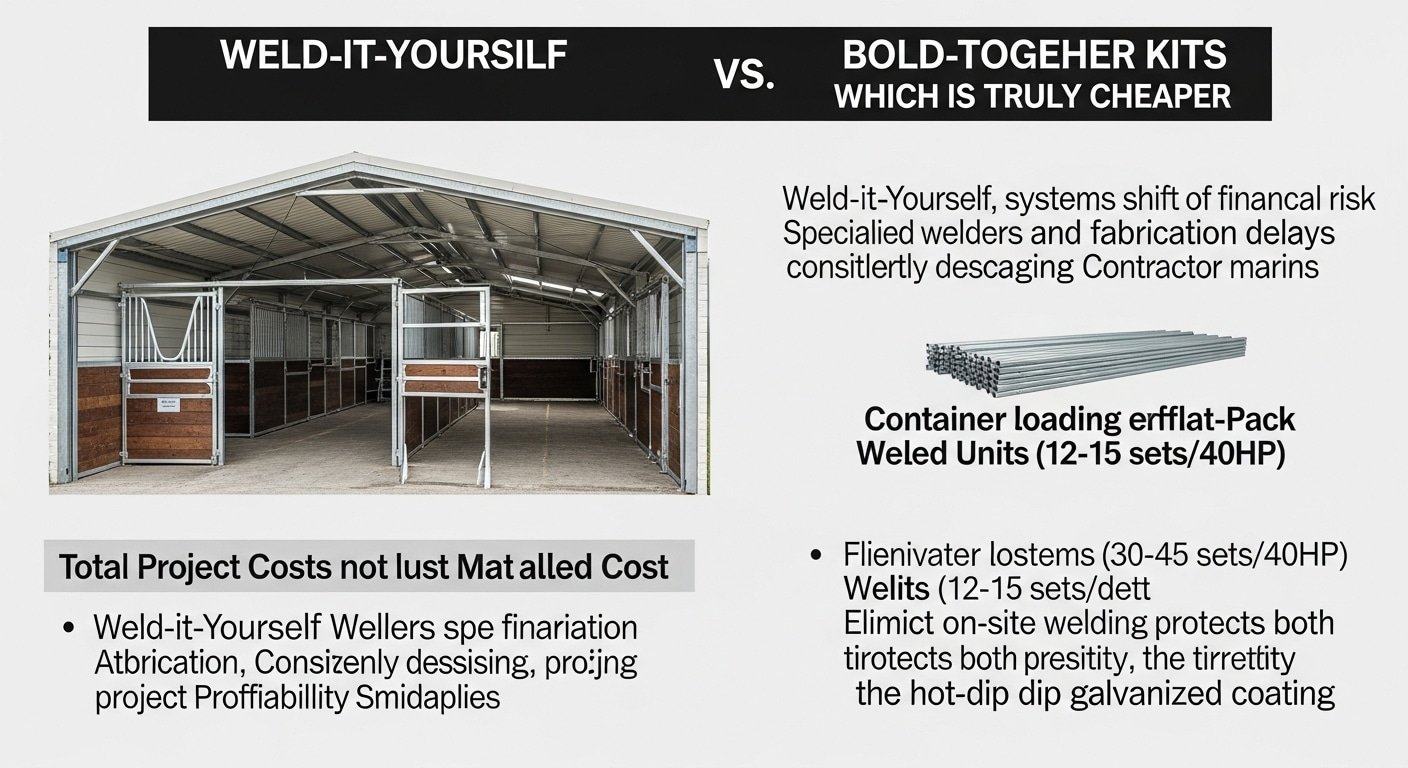
Evaluating the true labor savings prefab horse stall kits provide requires looking past the material quote to the total installed cost. Weld-it-yourself systems shift the financial risk of specialized welders and fabrication delays directly onto the installer, consistently destroying project profitability and contractor margins.
This analysis benchmarks total project costs, not just material prices. We compare the container loading efficiency of flat-pack systems (30-45 sets/40HQ) against welded units (12-15 sets/40HQ) and detail how eliminating on-site welding protects both project timelines and the integrity of the hot-dip galvanized coating.

Weld-It-Yourself vs. Bolt-Together: What is the Real Cost?
Bolt-together systems may have a higher initial price but deliver a lower total cost by cutting specialized labor, international freight, and future maintenance, directly improving distributor profitability.
| Cost Factor | Weld-It-Yourself System | DB Stable Bolt-Together System |
|---|---|---|
| On-Site Labor | High (Requires certified welders) | Low (General labor can assemble) |
| Shipping Logistics | Inefficient (Bulky, non-stackable) | Highly Efficient (Flat-packed) |
| Container Load (40HQ) | ~12-15 Sets | ~30-45 Sets |
| Long-Term Maintenance | Difficult (Requires cutting & re-welding) | Simple (Components unbolt for replacement) |
Comparing Upfront Material vs. Total Project Expenses
The initial quote for materials is only a small piece of the puzzle. Weld-it-yourself kits often look cheaper on paper but shift massive, unpredictable costs onto the installer. These hidden expenses in labor and long-term upkeep are where project budgets fail.
- Fabrication Labor: Welded systems demand certified welders and specialized equipment on-site. This skilled labor is expensive and often difficult to schedule. Bolt-together kits reduce assembly time and can be installed by general contractors, drastically lowering labor costs.
- Rust Protection: On-site welding burns off any pre-galvanized coating, creating weak points for rust. Our process of hot-dip galvanizing *after* fabrication ensures complete protection. Any repairs on welded structures require re-welding, which again compromises the coating. Bolted components can be replaced without damaging the finish of adjacent parts.
- Maintenance & Repairs: Fixing a damaged welded stall is a major project involving cutting torches and mobile welders. With a bolted system, you just unbolt the damaged component and install a replacement. This cuts repair time and cost by over 90%.
How Flat-Pack Logistics Reduce Landed Costs
For any international distributor, ocean freight is a primary cost driver that can destroy margins. The physical volume of fully welded stalls makes them financially unviable to ship in large quantities. This logistical inefficiency is a hidden tax on the final price.
Our entire system is designed for container efficiency. By flat-packing every component onto steel pallets, we fundamentally change the cost equation. The numbers speak for themselves:
- Traditional Welded Stalls: A 40HQ container fits only 12-15 sets.
- DB Stable Flat-Pack System: A 40HQ container fits 30-45 sets.
This translates to a freight saving of over 60% per unit. It’s a core part of our “Profit Protection” strategy for distributors, ensuring the product is profitable when it lands, not just when it leaves the factory.

Why is “Site Labor” the Biggest Hidden Cost in 2026?
Bids show base wages, but the true cost is 40-60% higher. Overlooked expenses like labor burden, rework, and overtime systematically erode contractor profit margins.
Beyond the Hourly Rate: Unpacking True Labor Burden
A worker’s advertised hourly rate is deceptive. The fully-burdened cost is 33-60% higher once you account for payroll taxes, workers’ compensation, and liability insurance. These are fixed expenses that don’t appear in a simple wage calculation but hit the bottom line hard.
Indirect costs add another 20-30% to the total labor bill. This includes non-productive time like supervision, job site mobilization, weather delays, and rework. Paying twice to fix a mistake is a common, unbudgeted expense that eats directly into profit.
Aggressive project schedules also force overtime hours at 1.5x the base rate. A few weeks of overtime can easily eliminate an entire project’s profit margin if it wasn’t factored into the original bid, which it rarely is.
How Flat-Pack Systems Reduce On-Site Labor Exposure
The most volatile on-site cost is specialized labor. On-site welding and fabrication demand certified professionals at premium rates, introducing budget and timeline risks. The DB Stable system is engineered to eliminate this entire category of expense.
The entire stable arrives in a Steel Pallet Flat-Pack designed for simple bolt-together assembly. This removes the need for welders or fabricators on the job site. The system is intentionally designed for a small, general labor crew to assemble rapidly, giving project managers predictable control over installation costs.
Each kit includes pre-cut HDPE or high-density Bamboo infill planks and a complete 304 Stainless Steel hardware package. Everything needed for assembly is in the pallet, turning a complex construction task into a straightforward mechanical process and protecting project margins from unpredictable site labor costs.
Get Durable, Climate-Ready Stables Shipped Globally.
Can a 2-Man Crew Install 10 DB Stalls in One Day?
Installing 10 stalls in one day depends entirely on the system. Component kits make it impossible; a pre-fabricated system makes it manageable, but it’s still a stretch.
Estimating Labor: Pre-Fabricated vs. Component Kits
The biggest variable in on-site labor is the type of stall you buy. Complex component kits often require 10 or more man-hours per stall for a crew to sort, assemble, and install. At that rate, a 10-stall project is a week-long job, not a one-day task.
A pre-fabricated, fully welded system cuts that time down to roughly 2 man-hours per stall. The skilled work is done in the factory, not on your site. For a 10-stall barn, you’re looking at a baseline of 20 total man-hours. For a two-person crew, that’s 10 hours of work each, which pushes beyond a standard 8-hour day.
How the DB Flat-Pack System Streamlines Installation
We designed our system to eliminate common on-site delays. Every stall system ships on a steel pallet as a complete, flat-packed unit. All components arrive together, so your crew isn’t wasting time hunting for missing parts or waiting on a second delivery.
The included Installation Kit contains pre-cut infill planks, either HDPE or Bamboo, and all necessary 304 Stainless Steel hardware. There is no on-site cutting of boards or last-minute trips to the hardware store for bolts. This preparation at the factory is what makes a fast installation possible.
Finally, the bolt-together design means no on-site welding is required. This not only makes assembly faster but also protects the integrity of the hot-dip galvanized coating, which would be compromised by welding heat. Your crew can assemble the stalls quickly without needing specialized welding skills or equipment.

Does Welding On-Site Ruin the Galvanized Coating?
Yes, welding burns away the protective zinc coating. This exposes the raw steel, creating a major vulnerability for rust that is difficult to properly repair in the field.
The Impact of Welding Heat on Zinc Coatings
The intense heat from welding vaporizes the zinc layer, leaving the base steel completely exposed. This damaged area immediately becomes the primary failure point where rust and corrosion will start.
Field repairs using cold galvanizing sprays are a stop-gap measure at best. They rarely match the durability or controlled thickness of a proper factory hot-dip finish, leaving the steel vulnerable over the long term.
Why ‘Hot-Dip After Fabrication’ is the Professional Standard
The correct industrial process is to weld all raw steel components first. Only after fabrication is complete do we dip the entire structure into molten zinc. This is the ‘Hot-Dip After Fabrication’ method.
This approach creates a seamless, uniform zinc coating that flows over every weld, corner, and joint. It eliminates the risk of on-site coating damage and guarantees comprehensive rust protection from day one.
Our process delivers a true lifetime finish that meets strict international standards:
- Governing Standard: Conforms to BS EN ISO 1461.
- Coating Thickness: Averages over 70 microns (μm) on all tubing.
- Result: Complete, uninterrupted corrosion protection with no weak points.

Which Kit Type Yields Higher Profit for Contractors?
Bolt-together kits boost contractor profits by cutting on-site labor hours and freight costs. The flat-pack design protects margins on materials and logistics.
On-Site Labor: The Biggest Variable Cost in Barn Construction
The primary way contractors protect their profit is by reducing unpredictable on-site labor hours. Prefabricated kits are engineered for assembly, cutting construction time by up to 40% compared to traditional stick-built or weld-it-yourself methods. Projects that require on-site welding depend on specialized, expensive labor. They are also far more vulnerable to weather delays or site complications that directly erode a contractor’s margin.
How Flat-Pack Kits Protect Logistics and Labor Margins
Logistics and labor are the two areas where profits are most often lost. The DB Stable Flat-Pack System provides direct ‘Profit Protection’ by fitting 30-45 stable sets into a single 40HQ container. Fully-welded systems can only fit 12-15 sets, dramatically increasing freight costs per unit. Every kit arrives as a complete system with all necessary 304 Stainless Steel hardware. This lets a 2-man crew assemble stalls efficiently without needing specialized welding equipment, keeping labor costs predictable and low.
Final Thoughts
A low material quote for a welded kit often hides higher total costs in freight, specialized labor, and future rust repairs. The DB Stable flat-pack system is engineered to control these variables from the factory. This protects your landed cost and locks in project profitability.
Verify the numbers for your business. Request a formal quote to see how our flat-pack logistics lower your per-unit cost. Our team can also build a custom trial order to prove the quality and ease of assembly firsthand.
Frequently Asked Questions
How are your stables protected against rust in demanding climates like Australia?
Every steel component is hot-dip galvanized *after* fabrication, conforming to the ISO 1461 standard. This process provides a zinc coating exceeding 70 microns, far superior to pre-galvanized tubing, and ensures long-term protection against high humidity and salt spray. All connecting hardware is 304 stainless steel.
How does your flat-pack system reduce shipping costs for distributors?
Our bolt-together design allows us to ship stables flat-packed on steel pallets. This efficient method enables loading 30-45 stable sets into a single 40HQ container, compared to only 12-15 sets for traditional welded stables. This 60%+ increase in loading capacity directly reduces per-unit freight costs for our B2B clients.
What is the difference between your HDPE and Bamboo infill options?
Our HDPE infill is a zero-maintenance, UV-stabilized material that absorbs impact, making it extremely safe and easy to clean. Our high-density strand woven bamboo is over three times harder than oak, naturally resistant to mold, and offers a premium, classic aesthetic for high-end equestrian centers.
What is included in a standard DB Stable kit?
A complete kit includes one stable front panel (with door), one side partition panel, all pre-cut infill planks (HDPE or Bamboo), and a full hardware kit containing all necessary 304 stainless steel bolts and connectors for assembly. A can of cold galvanizing touch-up spray is also provided.
Do I need a certified welder to install a DB Stable kit?
No. Our stable systems are engineered as bolt-together kits that do not require any on-site welding or metal fabrication. Installation can be completed using standard tools.
Is the structural integrity of a kit stall less than a fully welded one?
While fully welded systems are strong, our kits are engineered for exceptional durability using heavy-gauge Q235B or Q345B steel. The bolted connections are designed to withstand high impact, offering robust integrity for professional equestrian environments.
Will the bolted connections loosen over time?
All bolted joints can be affected by vibration. We mitigate this by providing a high-quality 304 Stainless Steel hardware kit. When properly torqued during installation, these connections are designed to remain secure under normal equine activity.
Can I disassemble and move the stables later?
Yes, a key feature of our bolt-together system is its modularity. The stables can be disassembled, relocated, or reconfigured, offering long-term flexibility that permanently welded structures cannot match.
What is ‘Hot-Dip Galvanization After Fabrication’?
This means we weld the entire steel panel first, then dip it into molten zinc. This process coats every edge, corner, and weld seam, ensuring complete rust protection that meets BS EN ISO 1461 standards. It is far superior to using pre-galvanized tubes where the welds are left exposed to corrosion.


 English
  Spanish
  French
  Arabic
  German
0 Comments