


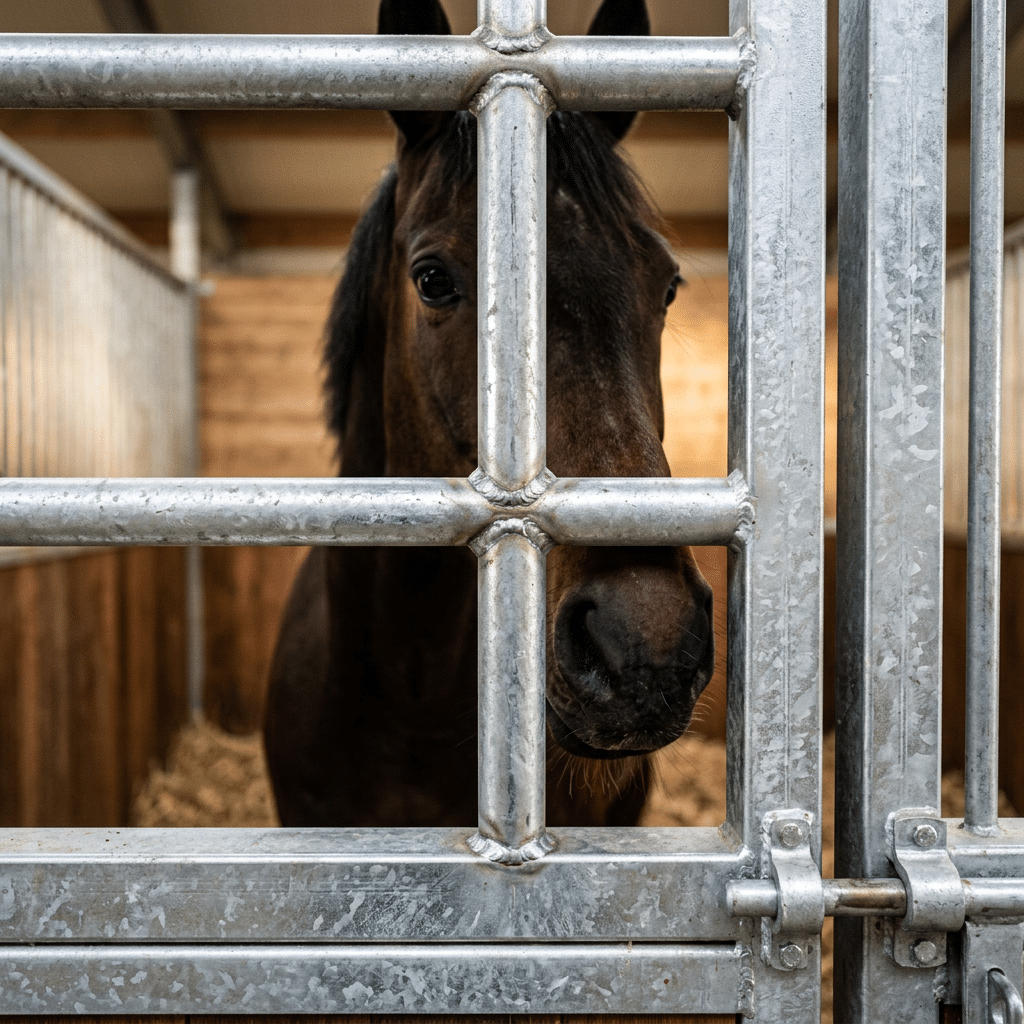
Rusted fasteners are the single most common point of failure in stable systems, turning a $2 hardware choice into a $100 emergency labor bill. The corrosive mix of ammonia and moisture guarantees standard zinc-plated bolts will seize, leading to predictable and costly repair jobs that erase any initial savings.
This analysis benchmarks hardware performance against the corrosive micro-climate of a horse stall. We evaluate the failure curve of zinc plating versus the inherent corrosion resistance of a complete 304 Stainless Steel hardware kit, engineering out the problem from the start.
The Corrosive Micro-Climate of a Horse Stall
A horse stall combines ammonia, constant moisture, and stagnant air into a highly corrosive environment. This mix rapidly destroys standard steel, paint, and thin zinc plating.
The Corrosive Trio: Ammonia, Moisture, and Stagnant Air
You can’t talk about stall longevity without first understanding what you’re up against. The air inside a horse stall is a chemical soup designed to destroy metal. High ammonia levels from urine and manure gases actively eat away at protective coatings on steel. Add in constant moisture from bedding, waterers, and condensation, and you have the perfect catalyst for rust. Poor ventilation traps these corrosive agents against the metal surfaces, keeping them damp and accelerating the damage around the clock.
Counteracting Corrosion with Hot-Dip Galvanization
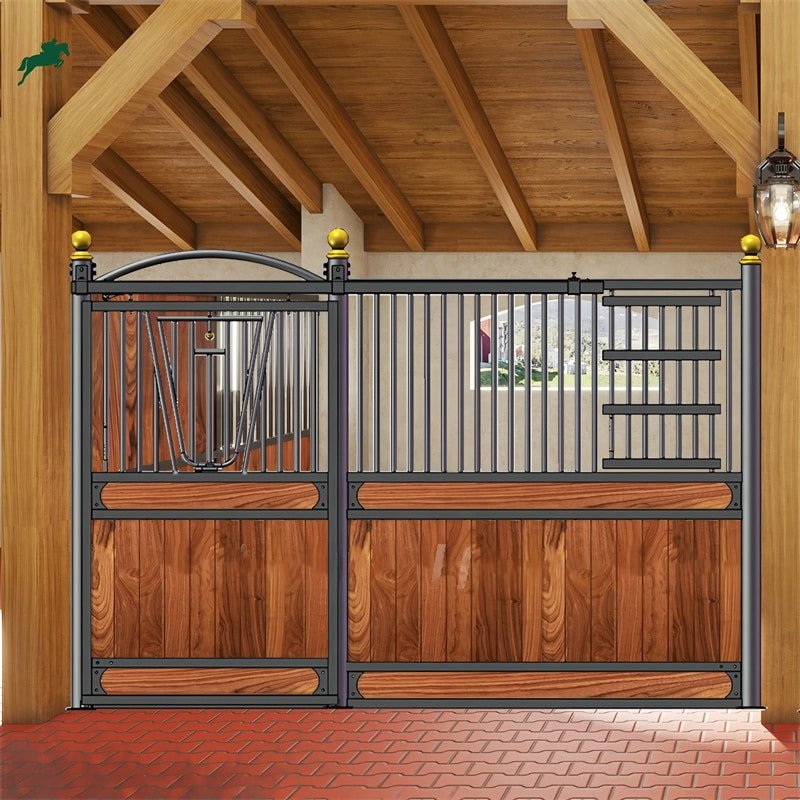
Standard paint or thin plating doesn’t stand a chance in this environment. The only effective defense is a complete, metallurgical bond of zinc to the steel. We use a process called **Hot-Dip Galvanization After Fabrication**, which means the entire steel frame is welded first and then submerged in molten zinc. This process seals every single cut, corner, and weld joint that cheaper pre-galvanized tubing leaves exposed.
This isn’t just a thin coating; it’s a heavy-duty protective layer built to specific engineering standards.
- Guaranteed Standard: All galvanization conforms to **BS EN ISO 1461**, ensuring consistent quality.
- Épaisseur du revêtement : We achieve an average zinc coating of **70-85 microns (μm)**, thick enough to endure long-term ammonia and moisture exposure.
- Résilience vérifiée : The coating is validated through **ASTM B117 salt spray testing for over 96 hours** with no red rust, confirming its ability to perform in the harshest conditions.
The Failure Curve of Zinc-Plated Bolts (White Rust to Seizure)
Zinc-plated bolts fail in predictable stages. Moisture causes white rust, consuming the zinc coating. This exposes the steel, leading to red rust that eventually seizes the bolt.
The Four Stages of Galvanic Corrosion Failure
Standard zinc-plated bolts don’t fail overnight. They follow
a clear and predictable path of degradation, starting with a cosmetic issue and ending in complete mechanical seizure.
- Stage 1: White Rust Formation. Moisture and air react with the outer zinc coating. This creates zinc hydroxide, a chalky white substance that actively consumes the protective layer it’s meant to be.
- Stage 2: Coating Breakdown. As the white rust eats away at the zinc, the coating develops micro-cracks. This exposes the underlying steel substrate to the corrosive environment for the first time.
- Stage 3: Red Rust and Expansion. With the steel exposed, true rust (iron oxide) forms. This red rust expands as it grows, building up pressure within the tight tolerances of the bolt’s threads.
- Stage 4: Mechanical Seizure. The accumulation of expanding rust locks the nut and bolt together. At this point, a wrench is useless. The fastener is seized and can only be removed by cutting it off.
The Inadequacy of Zinc Plating for Equine Environments
The failure curve accelerates dramatically inside a horse stall. The unique micro-climate, rich with ammonia from urine and constant moisture, attacks zinc plating far more aggressively than a standard outdoor environment. For any hardware used in a stable, seizure isn’t a possibility; it’s a certainty.
This is why comparing zinc-plated hardware to a proper solution like 304 Stainless Steel is critical. Zinc plating is just a temporary coating that is designed to be consumed. In contrast, 304 Stainless Steel is inherently corrosion-resistant through its entire structure. It doesn’t rely on a sacrificial layer, so it doesn’t experience this predictable failure curve at all.
Invest in Stables That Outlast the Elements
The True Cost: Paying a Welder to Cut Off a $2 Latch
A cheap, rusty latch costs $2. Hiring a welder to cut it off costs over $100 per hour. Quality hardware pays for itself by preventing this exact problem.
The Economics of Professional Labor for Minor Repairs
The math on small repairs rarely makes sense. Professional welders in the US bill between $100 to $125 an hour. You’re not just paying for their time, but their expertise, equipment, and travel. Many won’t even show up for a job without a minimum service fee, which often starts around $50.
So when that cheap zinc-plated latch seizes up with rust, the five minutes it takes a welder to cut it off can easily cost more than four times the price of the part itself. It’s a classic case of a small saving upfront creating a much larger expense down the road.
How 304 Stainless Steel Hardware Prevents This Scenario
This entire expensive mess is completely avoidable. It’s a problem that should be engineered out from the beginning. That’s why every DB Stable system ships with a complete hardware kit—every single bolt, connector, and screw is made from 304 Stainless Steel.
This material doesn’t rust. It resists the corrosion from moisture and ammonia common in any barn environment. Latches and hinges continue to operate smoothly for years, because the root cause of the failure—corrosion—is eliminated. Investing in the right hardware from the start means you’ll never have to pay a welder to fix a preventable problem.
The DB Standard: 100% 304 Stainless Steel Hardware Kits
Every DB Stable hardware kit uses 100% 304 stainless steel. This prevents rust and seizure in corrosive stall environments, eliminating the need for costly future repairs.
We get asked why we’re so rigid about hardware. The answer is simple: fasteners are the single most common point of failure in any stable system. The constant exposure to ammonia from urine and high moisture levels creates a micro-climate that aggressively attacks metal. Standard zinc-plated or galvanized bolts will eventually fail, seizing up or rusting through. That failure isn’t just an inconvenience; it’s a structural risk and a costly fix. Paying a welder to cut off a single $5 seized bolt can easily cost $100 in labor. Our standard is to prevent that problem from ever happening.
Why 304 Stainless Steel Prevents Seizure and Rust
The environment inside a horse stall is more corrosive than many coastal salt-air environments. Standard hardware doesn’t stand a chance. 304 stainless steel isn’t just a coating; its corrosion res
istance is built into the metal itself.
- Superior Corrosion Resistance: Unlike zinc plating, which is a sacrificial coating that ammonia gases quickly erode, 304 stainless steel’s chromium content creates a passive, self-healing oxide layer. This non-reactive surface protects the steel from moisture and chemicals, stopping rust before it starts.
- No Seizure Under Load: Rust deposits on standard bolts cause threads to seize, making disassembly or adjustments impossible without a cutting torch. Because 304 stainless steel hardware doesn’t rust, every bolt and nut remains functional for the life of the stable. You can easily adjust, relocate, or sell the system years later.
The Standard Hardware Kit: Every Component Guaranteed
There are no hidden upgrades or “heavy-duty” options. Every DB Stable system ships with a complete installation kit where every single piece of hardware is certified 304 stainless steel. We don’t mix and match materials. This ensures a consistent standard of quality across the entire structure.
| Component Type | Objectif |
|---|---|
| Anchor Bolts | Securely fasten all stable posts to the concrete foundation. |
| Structural Connectors | Join stable fronts and partition panels, creating a rigid frame. |
| Assorted Screws & Fasteners | Attach all latches, guides, and other operational fittings. |
Bolt-On Adjustable Hinges vs. Fixed Welded Hinges
Bolt-on hinges offer adjustment but create rust-prone failure points. Fixed welded hinges are permanently fused to the frame, providing superior strength for long-term, zero-maintenance use in stables.
The Trade-Off: Adjustability vs. Long-Term Reliability
The choice between hinge types comes down to one thing: installation convenience versus lifetime performance. Bolt-on hinges let you make small alignment corrections after the fact, which can seem helpful during initial setup. But that convenience introduces fasteners—bolts, nuts, and screws—that become a long-term liability. They need periodic tightening and are the first components to corrode and fail in a humid, high-ammonia stable environment.
Fixed welded hinges are a different philosophy entirely. By fusing the hinge directly to the steel frame, you create a single, unified structure. This approach eliminates the fasteners, which means there’s nothing to loosen, nothing to vibrate, and no weak points for rust to attack. It’s a permanent solution built for maximum strength and reliability from day one.
Why Welded Hinges are the Standard for Equestrian Safety
In a horse stable, a failing hinge isn’t just an inconvenience; it’s a safety hazard. The ammonia from urine and manure creates a highly corrosive atmosphere that aggressively attacks standard zinc-plated fasteners. Welding the hinge directly to the frame removes this primary point of failure. You eliminate the risk of a door sagging or detaching because its bolts rusted through.
The permanent bond of a welded hinge also provides a far greater load capacity. This is non-negotiable when dealing with 1,200-pound animals. A welded connection distributes impact forces from kicks or leaning across the entire frame, not just on a few small bolt threads. For any serious equestrian facility, this level of structural integrity is the baseline requirement for ensuring animal and human safety.
Questions fréquemment posées
What is the difference between 304 stainless steel and galvanized hardware?
The primary difference is how they resist corrosion. Galvanized hardware is standard steel coated with a protective layer of zinc. This works well until the coating is scratched or wears away, exposing the steel to rust. In contrast, 304 stainless steel has chromium mixed into the metal itself, creating a surface that is inherently rust-resistant and self-repairs from minor scratches. Stainless steel provides superior long-term durability, especially in moist barn environments.
Why do standard zinc-plated bolts rust inside a horse barn?
Standard zinc-plated bolts fail in barns due to the harsh micro-climate. Constant exposure to moisture, humidity, and corrosive ammonia from animal waste quickly breaks down the thin zinc coating. Once that protective layer is compromised, the steel bolt underneath begins to corrode rapidly, leading to rust, seizing, and failure.
Are adjustable hinges really necessary for heavy stable doors?
Yes, they are critical for long-term performance. All structures, especially those with heavy doors, settle over time. Wood and composite materials also expand and contract with seasonal changes in temperature and humidity. Adjustable hinges allow for simple corrections to keep the door perfectly aligned, preventing it from dragging, binding, or becoming difficult to operate.
How do I fix a stable door that sags or is hard to open?
The most common cause is loose hinge screws. First, try tightening all the screws on both the door and the frame. If the door still sags, the screws in the top hinge may be too short. Replacing them with longer, 3-inch screws that anchor into the solid wall framing provides much greater support and often solves the problem.
Réflexions finales
The math is simple: paying a welder $100 to cut off a seized $5 bolt is a failed business model. Our standard of 100% 304 Stainless Steel hardware eliminates this risk entirely. This isn’t an upgrade; it’s the baseline for building a reputation on reliability.
The next step is to verify our engineering firsthand. We recommend a trial order to confirm the fit, finish, and material integrity of our systems. Contact our team to review your project specifications or discuss OEM requirements.

 French
  English
  Spanish
  Arabic
  German
0 commentaires