


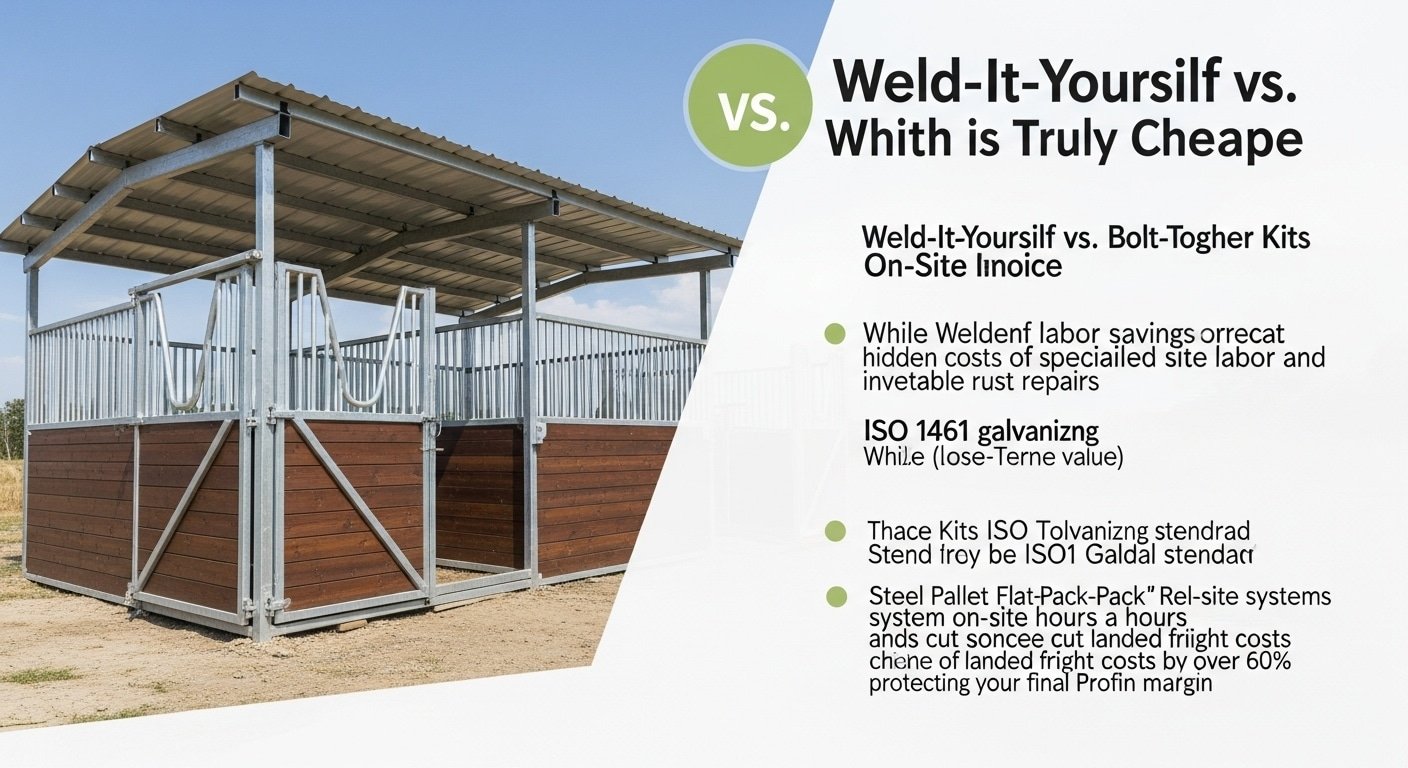
The promise of labor savings from prefab horse stall kits is lost when projects rely on on-site welding. While a weld-it-yourself kit appears cheaper on the initial invoice, the hidden costs of specialized site labor and inevitable rust repairs can destroy a project’s profitability.
This analysis compares kits based on the ISO 1461 galvanizing standard to determine true long-term value. We break down how ‘Steel Pallet Flat-Pack’ systems reduce on-site hours and cut landed freight costs by over 60%, protecting your final profit margin.

Weld-It-Yourself vs. Bolt-Together: What is the Real Cost?
Bolt-together systems are more cost-effective than welded kits. They cut skilled labor costs, protect galvanized coatings, and save distributors over 60% on freight with flat-pack shipping.
| Facteur de coût | Weld-It-Yourself (On-Site) | DB Stable Bolt-Together |
|---|---|---|
| On-Site Labor | High (Requires certified welders) | Low (Uses general labor) |
| Coating Integrity | Destroyed at weld points | Preserved (ISO 1461 Galvanized) |
| Freight Cost | High (Bulky, 12-15 sets/container) | Low (Flat-pack, 30-45 sets/container) |
| Long-Term Repair | Complex & expensive (Cut and re-weld) | Simple & cheap (Unbolt and replace) |
Upfront Material Costs vs. Hidden On-Site Labor
The initial invoice for a weld-together kit is misleading. It ignores the biggest variable: specialized site labor. On-site welding demands certified professionals, driving up hourly rates and extending project timelines. Bolted systems can be installed by general labor, which dramatically cuts installation costs. Studies confirm that when all fabrication and labor are factored in, bolted connections can be 6-7% cheaper overall.
The most significant hidden cost of on-site welding is the destruction of the protection contre la rouille. The intense heat vaporizes the zinc coating around every weld point, creating an immediate weak spot for rust. This voids any corrosion warranty and sets up future maintenance problems. DB Stable avoids this entirely by performing all welding *before* the hot-dip galvanizing process, ensuring a complete, unbroken protective layer that meets ISO 1461 standards.
The Logistics Advantage of the DB Flat-Pack System
For distributors, landed cost is everything. A fully welded décrochage is a bulky, inefficient object to ship. You can only fit about 12 to 15 welded sets into a 40HQ container. Our flat-pack system changes that math completely. By shipping components stacked on steel pallets, we can load 30 to 45 stable sets into the same container. This efficiency cuts ocean freight costs by over 60%, directly protecting your profit margin.
This system also eliminates hidden costs at the destination. Every kit includes a complete hardware package with 304 Stainless Steel bolts and connectors, so your team isn’t sourcing missing parts. The steel pallet packaging ensures organized, damage-free unloading, preventing the kind of product loss that erodes profitability on large projects.

Why is “Site Labor” the Biggest Hidden Cost in 2026?
Site labor is a hidden cost due to untracked expenses like burden rates, delays, and overtime. Pre-fabricated systems offer a predictable alternative by minimizing on-site hours.
Beyond the Hourly Wage: Unpacking True Labor Expenses
Base wages are just the starting point. True labor costs include burden like payroll taxes, workers’ compensation, and insurance, which can add 30-45% to every dollar spent. Untracked indirect costs from supervision, weather delays, and rework often account for another 20-30%. The ongoing labor shortage also drives up wages and forces costly overtime to meet deadlines, quickly eating into project profit.
Reducing Site Hours with a Flat-Pack Bolt-Together System
Our ‘Steel Pallet Flat-Pack’ system is engineered to directly counter these variables. We eliminate the need for any on-site cutting, welding, or specialized fabrication. Each kit arrives with pre-cut infill planks (HDPE or Bamboo) and a complete hardware set featuring 304 Stainless Steel connectors. This bolt-together design lets a small crew install multiple étals in a single day, protecting project budgets from labor shortages and unpredictable site costs.
Future-Proof Your Facility With Durable Stables.


Can a 2-Man Crew Install 10 DB Stalls in One Day?
Yes, a skilled 2-man crew can install 10 stalls in a day. A complete flat-pack system with a bolt-together design makes a 10-hour workday target achievable.
Establishing the Installation Benchmark
The goal of installing 10 stalls in a single day is aggressive but entirely possible with the right system and preparation. The math breaks down based on established industry metrics for prefabricated stall kits.
- Installation data shows a two-person crew can typically assemble one prefabricated stall front in about one hour.
- This benchmark makes an 8-stall installation fit within a standard 8-hour workday. A 10-stall project becomes the target for a slightly longer day.
- Final speed always depends on crew experience and site readiness, especially having a level concrete foundation prepared in advance.
How a Flat-Pack System Accelerates the Process
Turning a multi-day job into a single-day task requires a system designed to eliminate on-site delays and guesswork. This is where the engineering of the kit itself becomes the critical factor.
- Organized Delivery: Each project arrives on a Steel Pallet Flat-Pack. All components are organized and accounted for, so crews can access parts without losing time.
- Complete Hardware Kit: The kit includes all necessary 304 Stainless Steel anchor bolts, connectors, and screws. This eliminates trips to the hardware store for missing fasteners.
- No On-Site Welding: The system is entirely bolt-together. Since all welding is completed during fabrication, assembly is predictable, clean, and efficient.
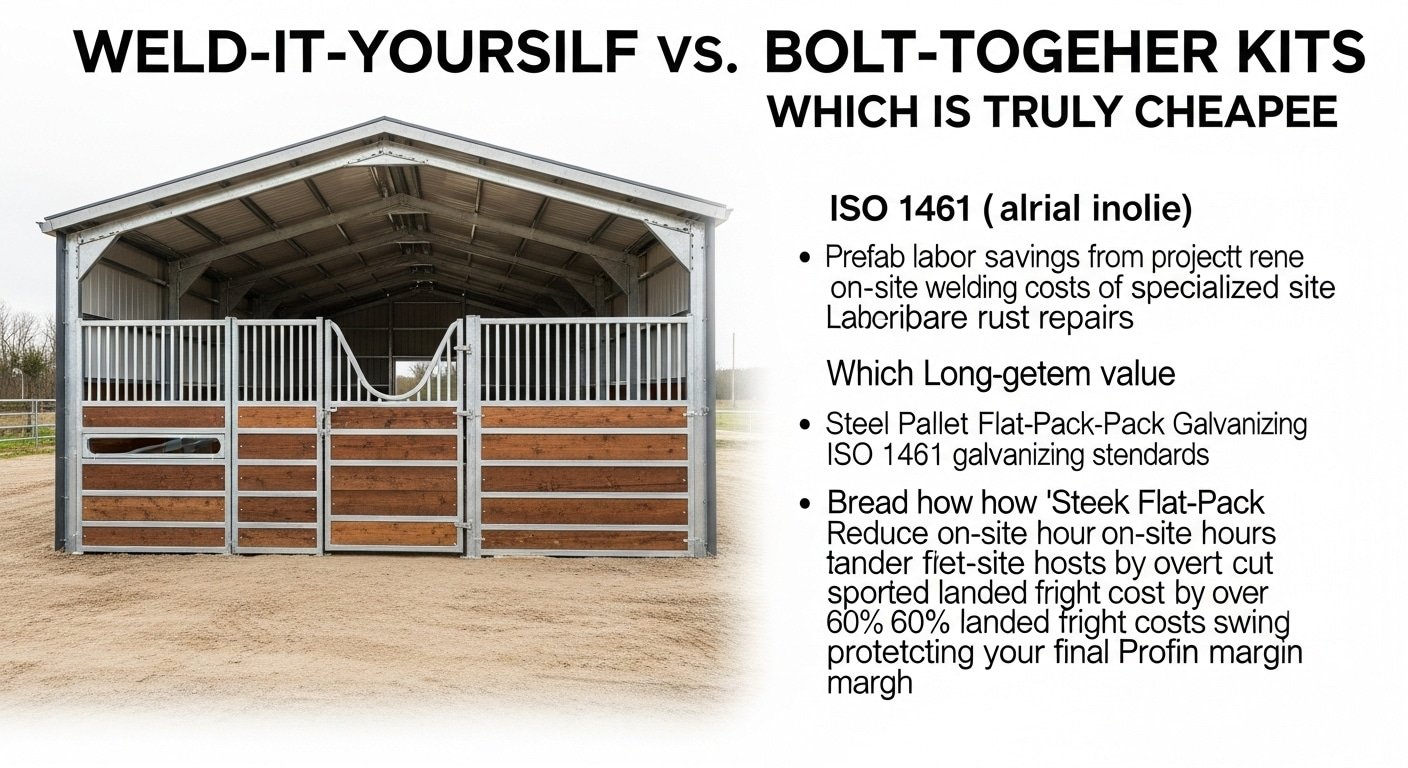
Does Welding On-Site Ruin the Galvanized Coating?
Yes, on-site welding heat vaporizes the protective zinc coating. This exposes the raw steel at and around the weld, creating a critical failure point for rust.
How Welding Heat Destroys the Zinc Barrier
The heat from a welding arc is far above the melting point of zinc. It instantly vaporizes the protective coating, creating fumes and removing the protective layer from the weld zone. The intense heat also compromises the surrounding steel, potentially damaging the coating’s adhesion and leaving the structure susceptible to rust.
The ‘Hot-Dip After Fabrication’ Solution
The correct industrial method avoids this problem entirely. Our process involves welding all components from raw structural steel (Q235B or Q345B) first. The fully assembled panel is then submerged in molten zinc. This process, known as ‘Hot-Dip Galvanization After Fabrication’, guarantees a seamless, robust coating compliant with BS EN ISO 1461. No weld points are ever left exposed.
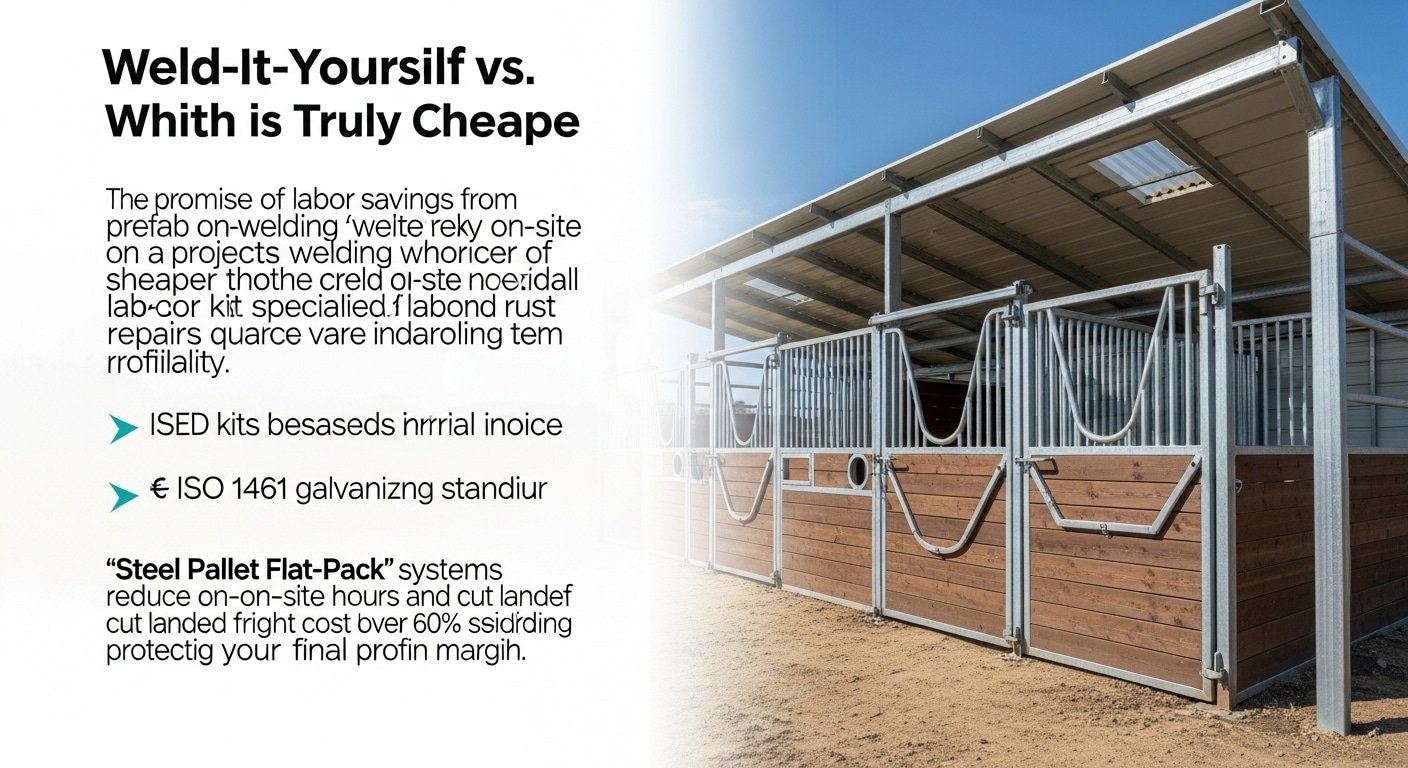
Which Kit Type Yields Higher Profit for Contractors?
Flat-pack, bolt-together kits boost contractor profit by slashing on-site labor and freight costs, unlike bulky fully-welded alternatives that erode margins.
Calculating Profit: The Cost of On-Site Labor vs. Materials
A contractor’s annual profit depends more on project turnover and labor efficiency than on simple material markup. Faster construction, like the 40% time reduction seen with pre-engineered kits, allows contractors to complete more jobs each year. Bolt-together systems also eliminate the need for specialized on-site labor, like certified welders, which reduces project complexity and wage costs. The most direct path to increasing yearly profit is reducing the hours spent on each installation.
The Logistics Advantage: How Flat-Pack Design Boosts Margins
Logistics directly impact your bottom line. Traditional, fully-welded stalls are bulky and inefficient to ship, typically fitting only 12-15 sets in a single 40HQ container. DB Stable’s flat-pack system allows 30-45 sets to fit in the same space. This delivers a 60%+ freight saving that provides direct ‘Profit Protection’ by lowering the landed cost for the distributor or contractor. This design shifts expenses away from unpredictable on-site labor and into efficient, predictable factory manufacturing and logistics.
Réflexions finales
The initial invoice for a weld-it-yourself kit is deceptive; the true cost is paid in rust claims, specialized labor, and rework. Our ‘Hot-Dip After Fabrication’ standard (ISO 1461) eliminates this risk by guaranteeing a complete zinc barrier. This is the difference between a short-term fix and a long-term, profitable asset.
Eliminate the guesswork on your next project’s budget. We recommend a trial order to validate our installation times and flat-pack freight savings firsthand. Contact our team to configure a kit and calculate your true landed cost.
Questions fréquemment posées
How are your stable panels protected against rust?
We use a ‘Hot-Dip After Fabrication’ process. The entire steel panel is welded first, then fully submerged in molten zinc. This method meets the ISO 1461 standard, guaranteeing an average coating thickness over 70 microns on all tubing. This provides decades of rust protection, even in coastal or humid regions.
How does your flat-pack system save on shipping costs?
Our steel pallet flat-pack design allows us to load 30-45 stable sets into a single 40HQ container. This is more than double the 12-15 set capacity of traditionally shipped stables, which significantly reduces sea freight costs for our B2B clients and protects their project profits.
What is the difference between HDPE and Bamboo infill?
HDPE is a zero-maintenance, impact-absorbing material that is UV-stabilized and easy to clean, ideal for busy facilities. High-density strand woven bamboo is three times harder than oak (Janka Hardness > 3000 lbf), naturally resists mold and rot, and provides a premium look for high-end equestrian centers.
What is included in a standard stable kit?
Each kit is a complete system with one stable front panel and door, one side panel, all pre-cut infill planks (HDPE or Bamboo), and a hardware kit with 304 stainless steel connectors and anchor bolts. We also include a can of cold galvanizing spray for any touch-ups needed after installation.
Do I need a certified welder to install these stalls?
No. Our des systèmes stables are designed for bolt-together assembly. All welding is completed at our factory before the hot-dip galvanizing process. This ensures every part is fully protected against rust, a key feature that on-site welding would compromise.
Is a bolt-together kit weaker than a fully welded one?
Not at all. The structural integrity comes from the design and materials, like the heavy-gauge Q235 or Q345 cadres en acier. Our kits use factory-welded core components which are then assembled on-site. This modular approach provides the same strength as a welded structure but with significant savings on shipping and installation labor.
Will the bolted joints loosen over time from horse kicks or vibration?
When installed correctly, the joints are engineered to remain secure. Our kits include high-quality 304 Stainless Steel hardware specifically chosen for its durability and resistance to loosening. Proper tightening during assembly ensures a rigid and lasting structure.
Can I disassemble and move the stables later?
Yes. The ability to disassemble, reconfigure, or relocate is a core benefit of our system. Because the panels are bolted, you can easily adapt your barn layout or move the entire setup to a new location if your needs change.
What tools are required for assembly?
You will need standard hand and power tools, such as an impact driver, wrenches, and a level. We provide all the necessary specialized hardware, including anchor bolts and connectors, in the installation kit. No welding or cutting is required.
référencement naturel
Title: Weld-It-Yourself vs. Bolt-Together Kits: Which is Truly Cheaper?
Description : Prefab horse stall kits with ISO 1461 hot-dip galvanizing. Flat-pack design saves 60%+ on freight. B2B wholesale/OEM only.
URL: prefab-horse-stall-kits
Keywords: Prefab Horse Stall Kits



 Français
  English
  Español
  العربية
  Deutsch
0 commentaires