


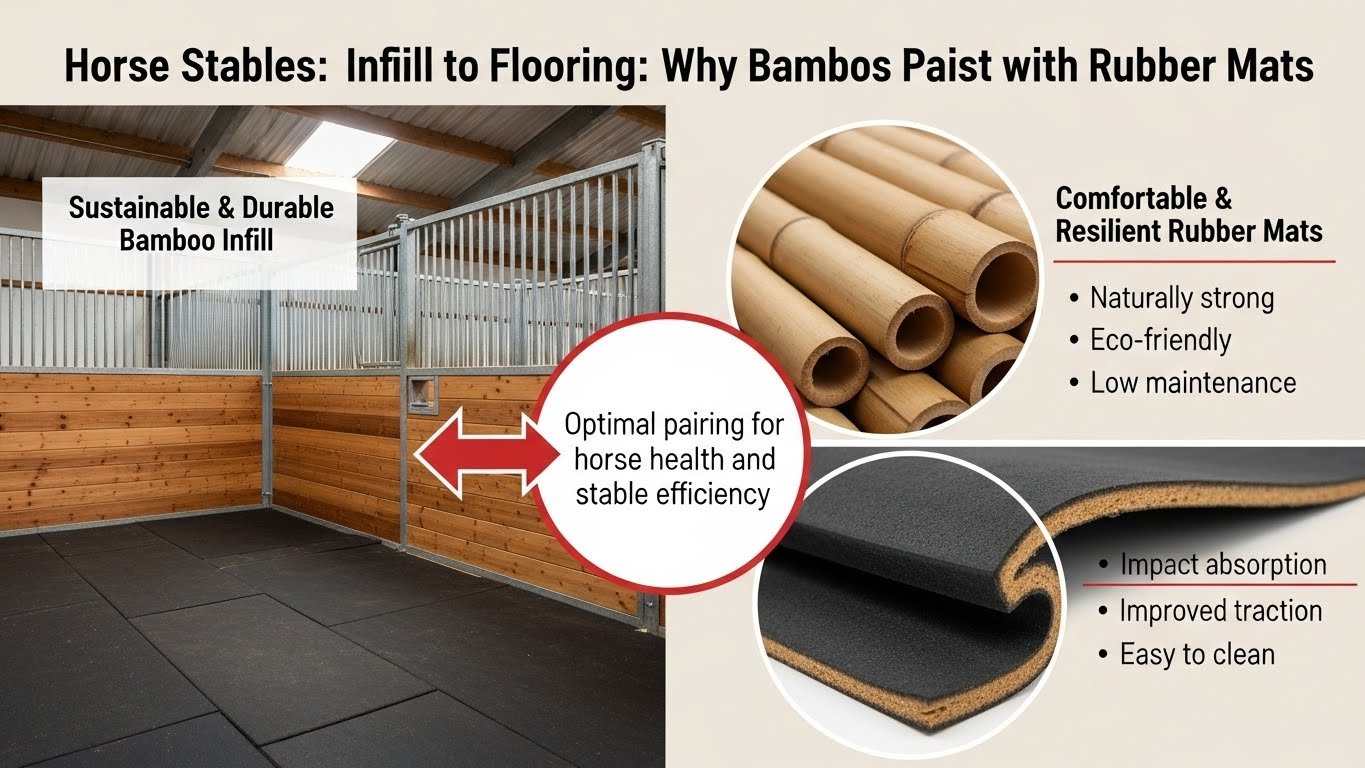
Wood stall walls often rot from the bottom up, a costly problem caused by trapped moisture. Choosing the right wall and flooring combination is the best way to prevent this structural decay and build a safe, long-lasting environment for your horses.
This guide explains how pairing bamboo walls with high-density rubber matting creates a superior stall system. We will cover the specific installation details needed to create a seamless surface, where any level change greater than 6.4 mm (0.25 in) requires a beveled edge. You will also learn how this combination avoids the moisture issues that cause traditional wood walls to fail, a problem often starting when perimeter sealants break down in just 10-15 years.
![Matching Infill to Flooring Why Bamboo Pairs Best with [Rubber Mats] (2)](https://dbhorsestable.com/wp-content/uploads/2025/12/Matching-Infill-to-Flooring-Why-Bamboo-Pairs-Best-with-Rubber-Mats-2.jpeg)
The “Wall-to-Floor” Connection
The wall-to-floor connection in a horse décrochage must be perfectly flush to prevent a horse from trapping a hoof or leg. Any gaps, steps, or offsets are strictly controlled, with manufacturers specifying tolerances like 1 ¾ inches for hardware and requiring gaps over 3 inches to be filled to eliminate all potential hazards.
Preventing Leg Traps with a Flush Finish
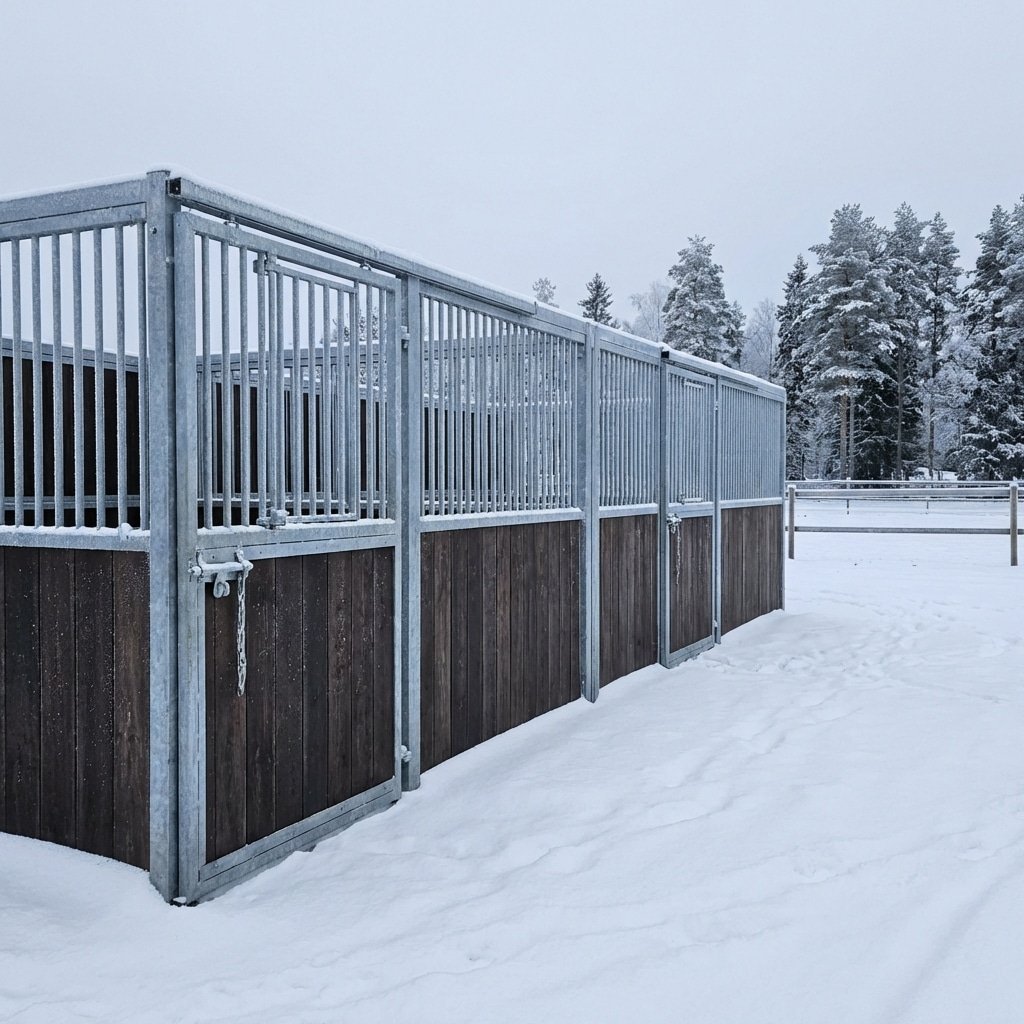
The primary safety goal at the wall-to-floor joint is to eliminate any space where a horse could trap a hoof. Stall walls must sit perfectly flush with the finished floor. Any recess or undercut at the base of a partition creates a dangerous “leg trap” that installers must avoid. To ensure a tight, gap-free seal, many designs use solid walls, such as those built from 2×8 inch tongue-and-groove lumber, that extend fully to the floor, leaving no room for injury.
Tolerances for Gaps, Offsets, and Slopes
Real-world installations often deal with uneven surfaces. Stall hardware manufacturers provide specific tolerances to manage these imperfections. For example, wall connectors can typically accommodate small offsets up to 1 ¾ inches. Larger gaps must be corrected by shimming or filling the space to ensure a secure, flush fit. To prevent a leg trap, any cavity behind the stall wall that exceeds 3 inches must be completely filled.
Sloped floors also affect installation. Since stall systems are prefabricated to be square, they will not connect correctly on a sloped surface. Installers must use shims to make the mounting brackets square to the floor, compensating for the angle. Hardware offers minimal flexibility, often only about ± 1/8 inch of adjustment, so precise shimming is essential for a safe and stable l'installation.
![Matching Infill to Flooring Why Bamboo Pairs Best with [Rubber Mats] (7)](https://dbhorsestable.com/wp-content/uploads/2025/12/Matching-Infill-to-Flooring-Why-Bamboo-Pairs-Best-with-Rubber-Mats-7.jpeg)
Why Wood Walls Rot at the Bottom
Wood walls rot at the bottom mainly because of prolonged moisture exposure. Water ponds around poorly sealed penetrations like baseplates or gets behind inadequate flashing, creating a damp environment where brown rot fungi can thrive. These fungi then break down the wood’s cellulose, causing it to crack, shrink, and collapse.
Moisture Trapping from Poor Detailing
The process often starts with design or installation flaws that trap water. For example, top-mounted guard baseplates can compress underlying waterproofing materials, creating small depressions where rainwater ponds. Water also seeps behind protective layers when membrane flashing upturns are too short, falling below the recommended 100mm to 150mm height. A common point of failure is the perimeter sealant around baseplates, which has a service life of only 10-15 years. Once it fails, it creates a direct path for water entry long before other building components require replacement.
Fungal Decay and Structural Breakdown
Once consistent moisture is present, it creates an ideal environment for fungal growth. Brown rot fungi are a key cause of decay, as they specifically target and consume the cellulose within the wood structure. The first signs of this decay often appear at vulnerable areas like the bottom edges or end grain of wood panels. This fungal attack causes the wood to turn brown, develop cracks that run across the grain, shrink significantly, and ultimately collapse under its own weight or any applied load.
![Matching Infill to Flooring Why Bamboo Pairs Best with [Rubber Mats] (3)](https://dbhorsestable.com/wp-content/uploads/2025/12/Matching-Infill-to-Flooring-Why-Bamboo-Pairs-Best-with-Rubber-Mats-3.jpeg)
The “Gap” Solution for Drainage
An air gap is a physical separation between a drainage pipe’s outlet and the flood level of a receiving drain. This simple but critical feature, mandated by plumbing codes to be at least 1 inch high, prevents contaminated water from siphoning back into a clean water system.
| Exigence | Spécifications | Notes |
|---|---|---|
| Minimum Vertical Separation | ≥ 1 inch (25.4 mm) | Mandated by plumbing codes to prevent backflow. |
| Performance Certification | ASME A112.1.2 | Standard for certified air gap fittings. |
| Common Materials | Injection-molded PVC / Epoxy-coated cast iron | PVC is used for floor sinks; cast iron is for mechanical rooms. |
| Typical Flow Capacity | ~7–8 GPM | Applies to a standard 3/4-inch outlet fitting. |
Preventing Contamination with a Physical Air Gap
An air gap creates a vertical, open-air space that physically separates a discharge pipe from the flood level of a receiving drain. This simple separation is a powerful safeguard against backflow, which happens when contaminated water from a drain is siphoned back into a clean water system. Plumbing codes universally mandate a minimum vertical air gap of 1 inch (25.4 mm). This distance ensures that even if a drain backs up, the waste water cannot reach the outlet of the discharge pipe and compromise the propre water source.
Technical Specifications for Air Gap Fittings
Engineered air gap fittings provide a reliable way to meet code requirements. These devices are tested to performance standards like ASME A112.1.2 to ensure they function correctly under various conditions. Manufacturers select materials based on the application. For example, injection-molded PVC is common for floor sinks due to its durability and smooth, easy-to-clean surface. In contrast, epoxy-coated cast iron is often used for fittings in mechanical rooms where greater structural strength is needed.
Proper installation is critical for an air gap to work. The fitting’s critical level (C/L) mark must sit at least 1 inch above the drain’s flood rim. A typical fitting with a 3/4-inch outlet can handle a flow rate of about 7–8 GPM. The piping downstream from the air gap must be short—ideally 2–3 feet or less—and have minimal bends to prevent backpressure that could reduce or eliminate the air gap’s effectiveness.
Horse Stables Engineered to Last, Customized for Your Climate.

![Matching Infill to Flooring Why Bamboo Pairs Best with [Rubber Mats] (4)](https://dbhorsestable.com/wp-content/uploads/2025/12/Matching-Infill-to-Flooring-Why-Bamboo-Pairs-Best-with-Rubber-Mats-4.jpeg)
Integrating Rubber Matting Edges
Proper integration of tapis en caoutchouc edges involves creating a flush or smoothly ramped transition to prevent tripping hazards, as any level change over 6.4 mm (0.25 in) requires a bevel. This is achieved using specialized ramped edge profiles or by ensuring the mat’s thickness matches the adjacent floor level for a seamless finish.
| Parameter | Specification / Value | Fonction principale |
|---|---|---|
| Trip Hazard Threshold | > 6.4 mm (0.25 in) | Requires beveled edge to ensure safety |
| Drainage Slope | 3% integrated slope | Channels liquids away from standing areas |
| Material Hardness | Shore A ~95 | Prevents edge rolling and deformation |
| Thickness Tolerance | ±0.5 mm | Minimizes lipping between adjacent mats |
Methods for Creating Safe, Trip-Free Transitions
To eliminate trip hazards and protect the mat’s integrity, its edges must either sit flush with the surrounding floor or be formed into a smooth, ramped transition. Any abrupt level change greater than 6.4 mm (0.25 in) is a potential trip risk and requires a beveled edge for a safe transition. Where a flush installation is not feasible, prefabricated solutions like fixed ramp systems or dedicated PVC/rubber edge strips provide a durable, clean border that prevents edge peeling and hoof catching.
Material Stability and Drainage Design
The stability of the matting edge depends on its material properties. High-density rubber with a Shore A hardness of approximately 95 provides enough rigidity to resist rolling or deforming under concentrated hoof pressure. Precision is also critical; CNC-cut tiles with a tight thickness tolerance of ±0.5 mm create a nearly seamless surface, which prevents small lips that can lead to edge damage and manure infiltration. For improved hygiene, some systems integrate a 3% slope toward the edges, actively channeling urine and water away from standing areas and reducing moisture buildup under the mat.
![Matching Infill to Flooring Why Bamboo Pairs Best with [Rubber Mats] (5)](https://dbhorsestable.com/wp-content/uploads/2025/12/Matching-Infill-to-Flooring-Why-Bamboo-Pairs-Best-with-Rubber-Mats-5.jpeg)
Réflexions finales
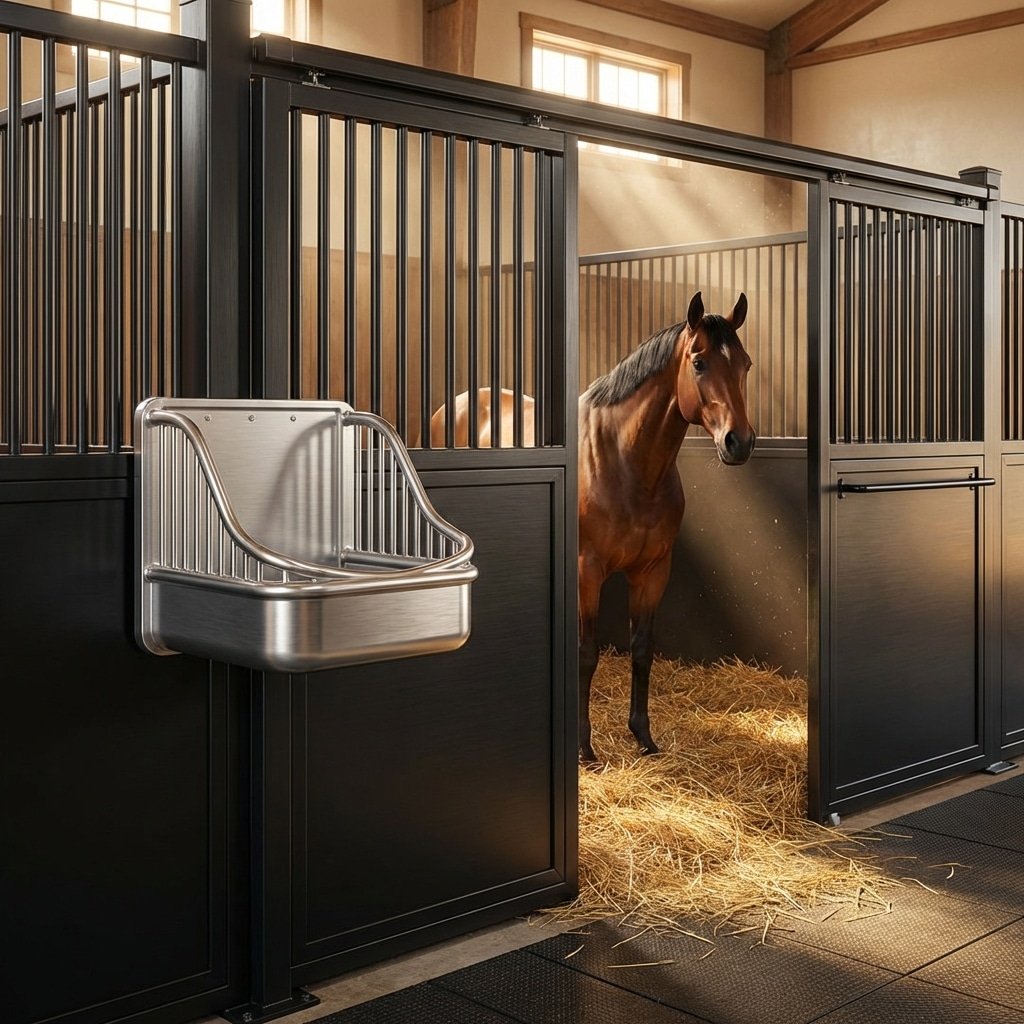
Creating a safe and long-lasting horse stall means solving two critical issues at the floor level: eliminating dangerous gaps and preventing moisture-induced rot. While traditional wood walls are vulnerable to decay where they meet the floor, bamboo offers superior moisture resistance. Pairing bamboo partitions with thick, high-density rubber matting provides a complete solution. The rubber creates a cushioned, non-slip surface that can be installed perfectly flush against the stall walls, closing any potential leg traps and improving hygiene.
This pairing highlights the importance of viewing the stall as an integrated system rather than a collection of separate parts. The wall infill and flooring must work together to ensure safety and longevity. Bamboo provides a stable, rot-resistant foundation that won’t degrade from contact with moisture, while properly installed tapis en caoutchouc ensures a safe, gap-free surface. Ultimately, this combination creates a low-maintenance and structurally sound environment that prioritizes the horse’s well-being for years to come.
![Matching Infill to Flooring Why Bamboo Pairs Best with [Rubber Mats] (6)](https://dbhorsestable.com/wp-content/uploads/2025/12/Matching-Infill-to-Flooring-Why-Bamboo-Pairs-Best-with-Rubber-Mats-6.jpeg)
Questions fréquemment posées
Should there be a gap under horse stall walls?
No. Stall partitions must be installed flush with the sub-floor to stop a horse’s hoof from getting trapped underneath.
How can I prevent wood rot in my horse stall?
Use pressure-treated lumber for the bottom courses of the walls that contact the ground. You should also seal all exposed wood with a stable-grade, non-toxic wood preservative to block moisture and provide good drainage and ventilation.
What is the best flooring to use with bamboo stalls?
The recommended flooring for bamboo stalls is a high-density bamboo plank floor installed over a solid concrete base. This should be topped with thick tapis en caoutchouc (at least 20-25 mm) for slip resistance and impact protection.
What is the difference between rubber stall mats and a stall mattress system?
Standard ¾-inch thick rubber mats are the durable, lower-cost option. Engineered stall mattress systems are a higher-cost, orthopedic alternative that provides significantly better joint cushioning and pressure relief, equivalent to having 4-6 inches of bedding.
Can I install stall fronts directly onto a concrete floor?
Yes, you can anchor stall posts or baseplates directly to a concrete floor. This requires using specific concrete anchors or bolts to ensure the structure is secure.
What is the best way to create drainage in a horse stall?
Proper drainage involves a floor sloped at 1-2% towards a side channel, a permeable base of 4-5 inches of gravel, and elevating the stall at least 12 inches above the outside ground level. Open channel drains along a wall are better than center drains.


 French
  English
  Spanish
  Arabic
  German
0 commentaires