


A fence line that reads as level on the plan rarely lands that way on the ground. Set an uneven ground fence panel layout down badly and you get the two failures most yard managers recognize: a gap you can put a hand through under one panel, and a joint that is being pulled sideways because the next panel does not run the same way. Both are decided in the first hour of setting out, long before anyone tightens a bolt.
Work the problem from what is actually published. This manufacturer’s fencing range is economic galvanized horse fence panels plus UV-resistant PVC arena fencing, from a plant with a stated capacity of 500+ sets a month, with a stated MOQ of 50 panels or 10 stall systems, 20 years of rust resistance for hot-dip galvanized steel and 15 years for UV-resistant PVC. What is not published is a maximum slope, a panel length, a post spacing, an allowable step height or a foundation detail for falling ground. The layout is therefore your call; the supplier’s job is to tell you what the panels can be connected to.
Points clés à retenir
- Two layout methods, one decision. Stepping keeps each panel level and staggers the posts. Raking keeps the post line even and tilts every panel by the same angle. The slope and the panel type decide which one you use.
- Raking puts load into the connections. A tilted panel tends to pull on its fixings along the line rather than straight across it, and a horizontal gap under a railed panel can be wider than it looks.
- No slope or step data is published. Nothing on this range states a maximum gradient, a panel dimension, a post spacing or a footing depth — those are site numbers, and they are yours to set with your builder.
- Set the line out before you dig. Chalk, pegs and a level across two panel lengths reveal the dip that a plan hides. Mark the transition points where the method changes.
- Drainage is part of the layout. A stepped line on a slope can dam water along the fence; decide the falls before the post holes are marked.
- Change the specification where the ground changes. Corner, end and transition posts differ from the run, so list them separately — on the supplier’s order if posts are inside their scope, and otherwise in your own ground-work specification.
What is published, and what the site has to add
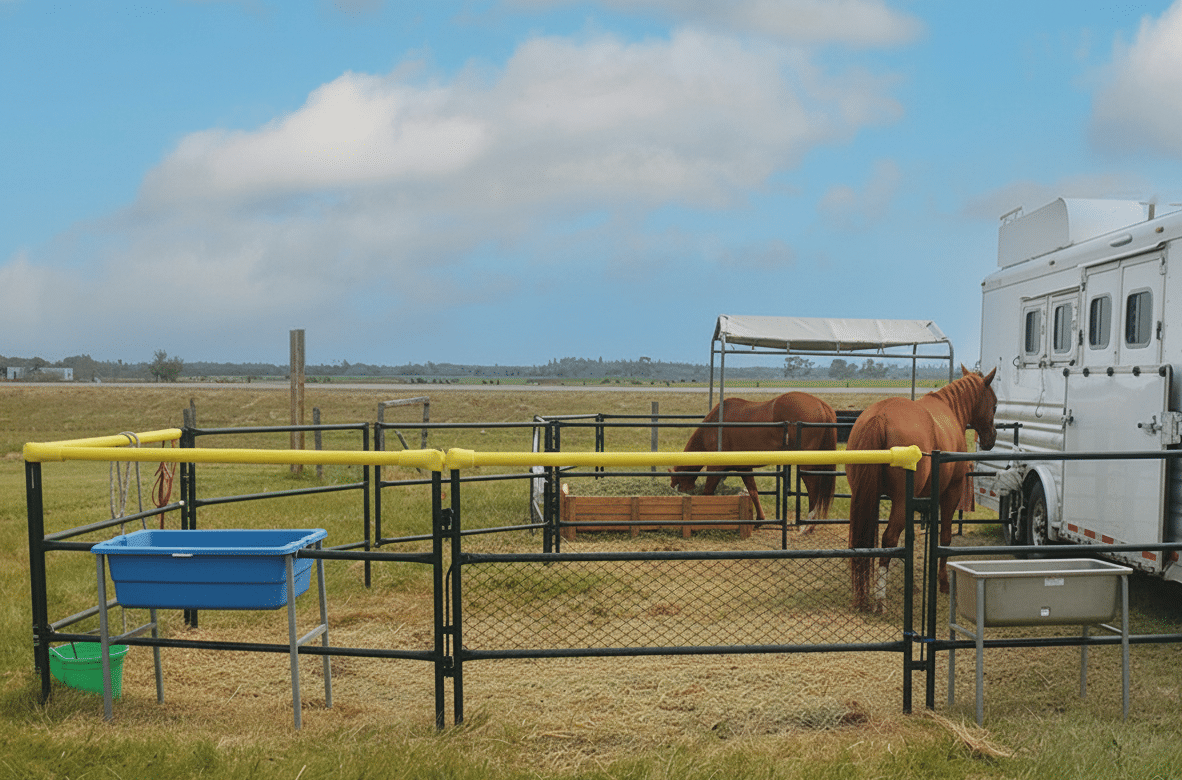
Be precise about the split of responsibility. Panels welded off CNC-machined stock with automated 360-degree equipment arrive as finished bays with defined connections. Ground does not arrive defined. A run across a paddle-shaped paddock will cross a drainage line, a shallow gully and a bank of soft ground, and each of those changes what the post wants to be. Buying panels against a drawing traced off an aerial photograph commonly ends the same way: the line is short at the ends and the last panel gets cut on site.
Stepping or raking: how to choose on the slope
Two methods exist and each one has a cost, so pick deliberately rather than defaulting to whatever the last crew did.
| Méthode | What it costs you | Where it suits |
|---|---|---|
| Stepped line: every panel level, posts at staggered heights | More post holes at different depths, and a step gap at each junction to manage | Steeper ground, multi-rail panels, and horses where a tilted rail reads as a step |
| Raked line: panels follow the fall, posts evenly spaced on the slope | Rail heights vary along the run, and connections can carry a sideways pull | Gentle, consistent grades where a continuous visual line matters |
| Mixed: raked on the shallow runs, stepped at the sharp change | Extra transition posts and a drawing that must state where each method starts | Most real sites, which are neither flat nor uniformly falling |
Our position: on any line a horse will be turned out to, step it. A raked rail line keeps a tidy silhouette but presents rails at heights the animal meets inconsistently along the run, and the low end of a tilted panel is where a hoof or a muzzle can end up underneath. Rake only where the grade is genuinely shallow and continuous, and if you do, have the resulting gap and load path checked by whoever designs your fence posts.
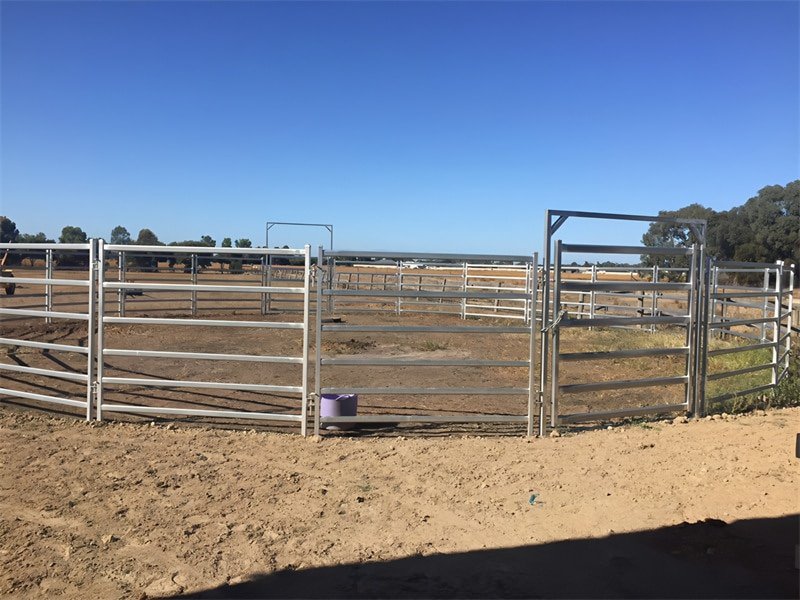
Set-out: gap control and the post line
Set the line out on the ground with pegs and a chalk line, then lay a level across two panel lengths and photograph what you find. Three measurements decide the job: how much the ground drops over one panel, whether that drop is steady or concentrated in one hollow, and where the drainage wants to go. A dip in the middle of a run is a stepping decision; a steady fall is a raking decision; water running along the fence line is a drainage decision that overrides both.
Gap control is mostly a fixing-height question. If every panel is set to the same rail heights above its own posts, the under-track gap varies with the ground. If instead you set each panel to clear the ground beneath it while keeping the bottom member above the highest point a horse can reach under, you have made a deliberate choice — record it, because the next crew will not be able to tell. The same logic applies at the joint: a stepped line leaves a vertical offset between two panels, and the way that offset is closed is a fixing detail rather than an afterthought. How load and movement travel through pins and clamps between panels is covered in horse fence panel connection systems.
What to write on the order and the drawing

Turn the set-out into one page before you order, and put four things on it: the run broken into segments by gradient, where stepping and raking each apply, the count of corner, end and transition posts against intermediate posts, and the fixings used at each offset. Standard bays are ordered against a stated MOQ of 50 panels, so a line that needs six different conditions still needs a single, complete quantity — the mixed load is a scheduling question you raise before production, not a note added at packing. Confirm in writing whether posts sit inside the panel supplier’s scope; the published fencing range here names panels and PVC rails, and if posts come from elsewhere they belong in your own specification. Panel arrangements along a working fence line, including where feeders and gates sit relative to the bays, are handled separately in fence line feeding systems and panel layouts.
Then ask two written questions. Does the supplier permit field modification of a galvanized panel — cutting, drilling or welding — and what happens to the 20-year rust-resistance statement where the coating is penetrated. And where ground conditions mean a post cannot reach firm bearing, who owns that detail: a base or sleeve option from the fencing supplier, or a concrete footing specified by your own builder. On frost-prone ground the second question becomes a depth question, and depth is a call for your engineer and soil data rather than a product line.
Questions fréquemment posées
Should fence panels be level or follow the slope?
Both are legitimate, and the slope decides. Steeper ground is usually stepped so each panel sits level; a shallow, steady fall can be raked. Nothing published for this range states a maximum gradient.
How big a gap under a fence panel is a problem?
Treat it as a management decision, not a standard number. A low opening invites a hoof or a muzzle under the line, so fix your own maximum on the drawing and check it after the first wet season when the ground has moved.
Can galvanized panels be cut on site to fit?
Ask before you do it. Cutting or drilling exposes bare steel at the edge, and the published rust-resistance statement covers hot-dip galvanized steel as supplied, not a modified bay.
Do I need more posts on uneven ground?
Usually more at transitions than along the run. Each place the method changes behaves like a corner load, so list those posts separately — on the supplier’s order if posts are in scope, otherwise in your own ground works specification.
Conclusion
Uneven ground does not defeat a fence line; an undecided layout does. A line where the method, the gap and the transition posts are recorded is buildable twice by two different crews and comes out the same.
Walk the ground with pegs and a level before you order, choose stepping or raking segment by segment, and send the supplier two written questions — about modifying bays and about post base options. The published panel and arena fencing range is on the horse fence page.


 French
 English
 Spanish
 Arabic
 German
0 commentaires