


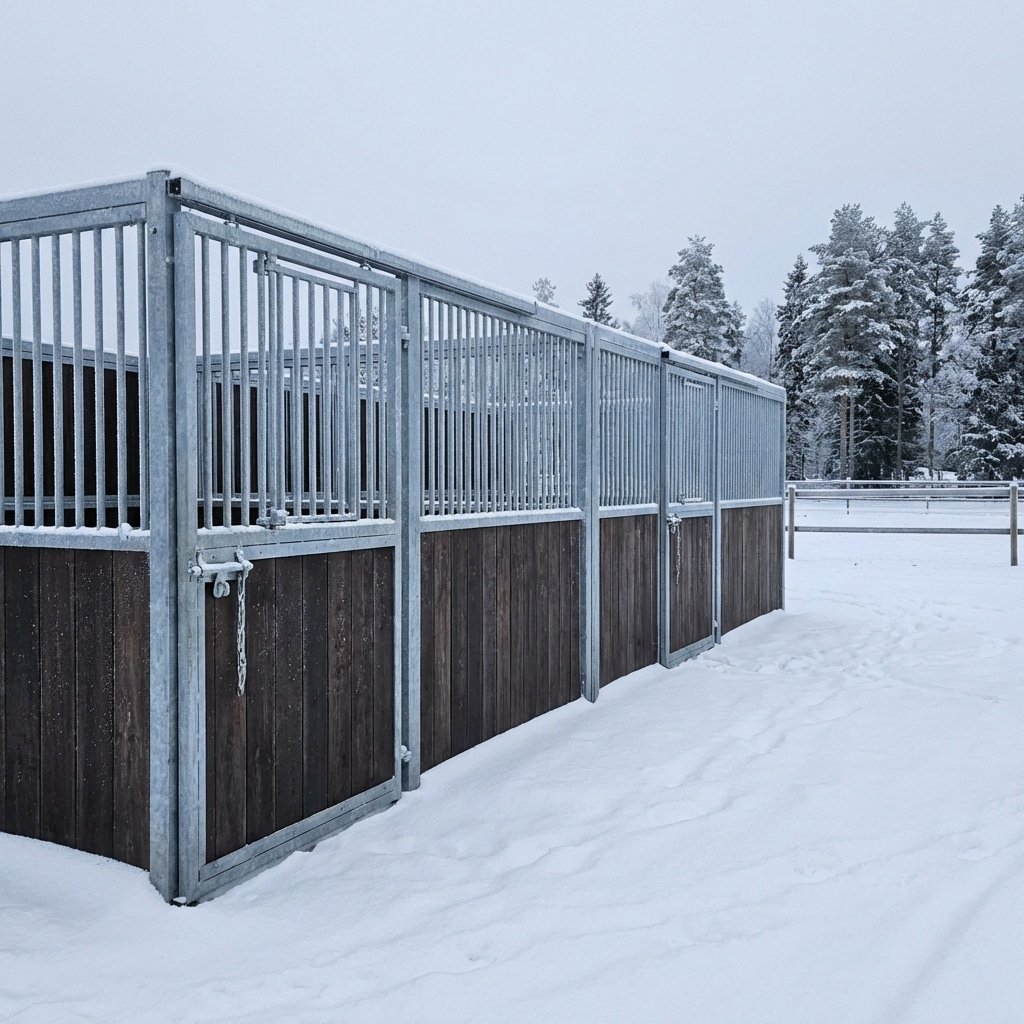
A stable that stands for season after season in Denmark or northern Germany will not do it by luck. Cold itself rarely breaks a structure; what works on it is the freeze-thaw cycle — water in the ground freezing, expanding, lifting the soil a little, then thawing and letting it drop again, month after month. That repeated movement is the reason frost resistant horse stables are a site-engineering problem rather than a product label, and it is why anchoring and drainage decide whether a stall line stays square or slowly racks out of true.
This guide is written for the farm owners, equestrian centers and dealers in the northern European markets DB HorseStable serves — Denmark, Germany, France, Poland and the wider region. The cold case we can put a number on is Poland, where our market guidance plans for a -10°C winter; Denmark and its neighbours share the same freeze-thaw regime even where the exact low differs, so the engineering logic here travels across the region. What this piece deliberately does not cover is insulation and ventilation — that winter-stabling balance is the subject of our guide to cold-climate stabling in deep-freeze winters. Anchoring is its own problem, and it starts in the ground.
Points clés à retenir
- Freeze-thaw, not cold, is the enemy. Frost heave lifts and drops the soil in a cycle, and it is that movement — not the temperature — that pulls posts and racks stall lines.
- Anchoring depth is a site-and-code number. Set footings below the local frost line; the correct depth varies by soil and region, so confirm it with the site engineer and put it on the order.
- Water at the base is what makes heave severe. Drainage away from the post, not just the rail, decides how hard each winter works the footing.
- The ground line is a double duty zone. Freeze-thaw and soil moisture attack the coating and the fixing together — a 20-year hot-dip galvanizing specification is the floor, not the finish, at that height.
- Steel moves in the cold too. Gates and hardware that sat true in summer can pull out of alignment through a frost season, so inspection is seasonal, not one-off.
- Time the order to the ground. Global delivery runs 4-6 weeks, Warsaw hub shortens European supply to 1-2 weeks — close anchoring before the first hard freeze.
Why Freeze-Thaw, Not Cold, Breaks a Stable
Steel and timber shrug off low temperature — a frame just gets colder. Soil does not. When the ground around a post freezes, water in it expands and pushes upward; when it thaws, it softens and settles. A post that only reaches partway down the freeze zone gets lifted on one side and dropped on the other each cycle — and after enough cycles, “a little each winter” becomes a gate that no longer closes, a stall front that has gone out of plumb, and a row that looks tired long before the metal is worn out.
The severity is not a single number, which is why any page that hands you a fixed depth is guessing. Frost depth depends on how cold the site gets, how long, and how wet or sandy the soil is. A saturated clay paddock heaves far harder than a free-draining gravel yard at the same air temperature. So the starting point is not “how cold does Denmark get” but “what does this ground do in winter”, which the site engineer answers for the plot.
Anchoring Below the Frost Line
The core anchoring principle across northern climates is agreed: carry the footing below the depth the ground freezes, so the heave zone sits above the foundation rather than under it. Below that, choices split by load. Corner, gate and end-of-row posts take the real pull and want the strongest footing; an interior run of stalls is less demanding. The exact depth and method — mass concrete, a pier, a driven or helical anchor where the site suits it — are site answers, not catalog answers, and the buyer’s job is to get them in writing before the pour.

What you can control at the purchase-order stage is the material the footing grips. The stall fronts, posts and brackets in this line are hot-dip galvanized steel to a 20-year rust protection specification, machined and welded on a CNC and automated 360° welding line, so the fixing buried at the base is the same traceable steel as the rail above it. Ask the supplier to state the post and base-fixing gauge for your configuration, and match the anchoring method to that gauge — a deep footing only helps if the steel it holds is up to the load the horse actually applies.
Ground-Line Water and the Base Detail
If freeze-thaw is the mechanism, water is the fuel. The single most effective anchoring decision on a wet northern site is often not deeper concrete but better drainage: move water away from the post base and the heave it causes shrinks. That means fall away from the structure, free-draining backfill around each footing, and keeping the base clear of the mud and manure build-up that holds moisture against the steel through a thaw. It is the same ground-line logic that governs how a fence ages in damp — covered in our guide to corrosion zones and coating life — only here the stakes are whether the post stays plumb, not just whether it rusts.
The ground line is also where two enemies overlap. Moisture sitting against the base attacks the coating while freeze-thaw works the same zone mechanically, so the hot-dip galvanized floor matters most exactly where the anchoring matters most. Detail the two together: a properly drained base protects both the footing holding the post and the steel the footing is holding.
Thermal Movement, Timing and the Delivery Check
The steel does not sit still in the cold either. A long run of tubing contracts as temperature drops, and gates set true on a mild day can take up the difference as small misalignments by deep winter. That is not a defect — it is why you check the line after the first cold spell rather than trusting the summer install, and why the hardware should be re-tensionable as the seasons move.
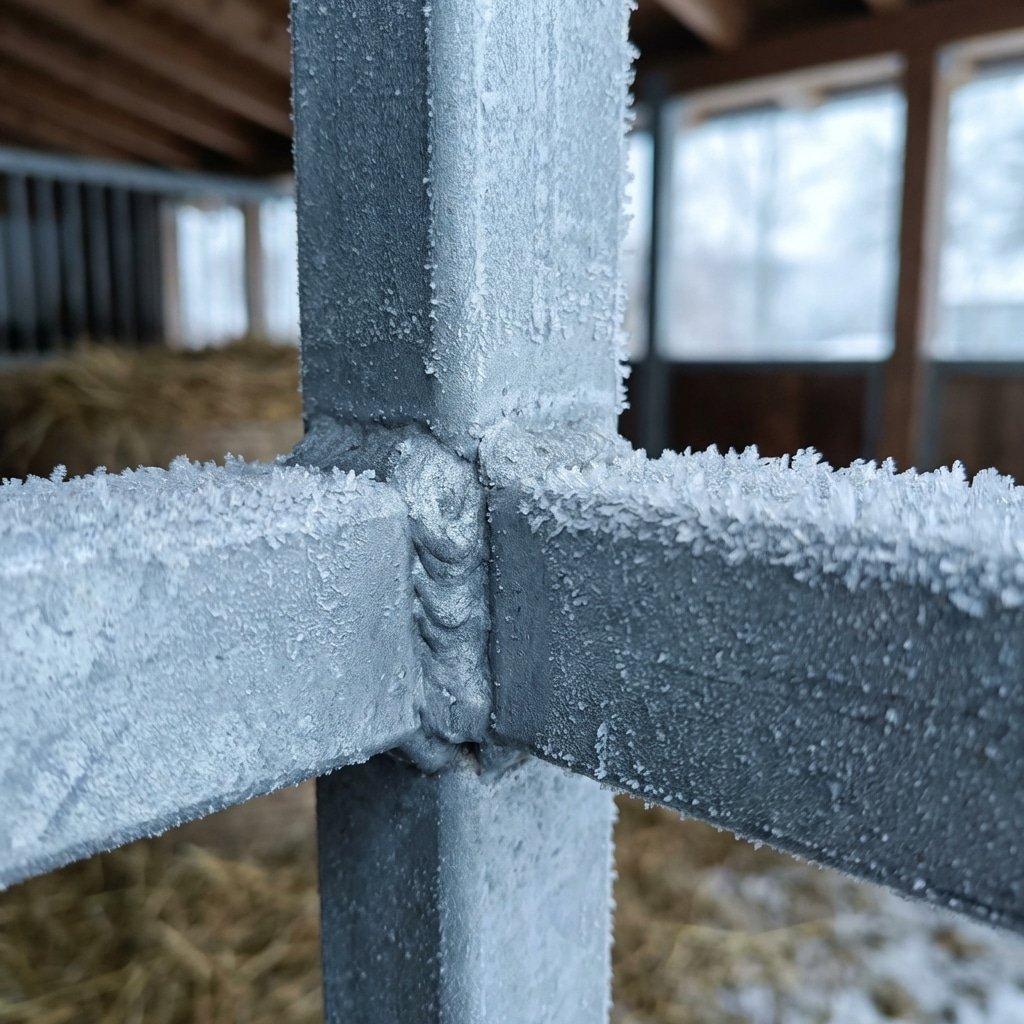
Timing is part of anchoring in this region. Ground about to freeze is a poor thing to pour into, so close footings and fixings before the first hard frost. That is where supply helps a northern buyer: global orders run 4-6 weeks, Warsaw hub shortens European expedited delivery to 1-2 weeks — the difference between anchoring in the working season and standing on soft ground into winter. At this scale — a 10-set MOQ, 5-15% tiered volume pricing, orders of 20 sets and up getting a dedicated regional account manager — the footing and anchoring spec belongs on the order alongside the set count.
Questions fréquemment posées
À quelle profondeur faut-il enfoncer les poteaux de stabilisation dans un sol gelé ?
En dessous de la limite locale de gel, qui correspond à un numéro de chantier et de référentiel plutôt qu'à une valeur fixe. Vérifiez-la auprès de l'ingénieur de chantier pour la parcelle concernée et indiquez la profondeur convenue dans la commande.
Quelles sont les causes du soulèvement dû au gel sous une écurie ?
L'eau contenue dans le sol gèle et se dilate, puis dégèle et se tasse. À température égale, les sols fins et saturés se soulèvent bien davantage que le gravier bien drainé ; les conditions du sol ont donc autant d'importance que la température.
Le drainage est-il plus important qu'une semelle plus profonde ?
Souvent, oui. Éloigner l’eau de la base du poteau réduit le soulèvement à la source ; ainsi, un remblai meuble et bien drainé, ainsi qu’une base bien conçue, peuvent être tout aussi importants que l’augmentation de la profondeur — il convient donc de combiner ces deux mesures lorsque le terrain est humide.
Une nouvelle écurie va-t-elle changer de propriétaire au cours de son premier hiver ?
Une ligne correctement ancrée ne devrait pas poser de problème, mais vérifiez-la tout de même après le premier gel important. Les portails et les ferrures installés par temps clément peuvent subir des déformations thermiques se traduisant par de légers désalignements, faciles et peu coûteux à corriger à un stade précoce.
Que doit préciser la commande pour un site situé dans une région au climat froid ?
La décision relative à l'ancrage, et pas seulement le matériel : profondeur des semelles par rapport à la ligne de gel, gabarit de fixation des poteaux et des socles, détails relatifs au drainage au niveau de la base, et délai de livraison permettant la mise en place des semelles avant les premières gelées importantes.
Conclusion
Frost resistant horse stables in northern Europe are built from the ground up: footings below the frost line, water moved away from the base, and a steel gauge that matches the anchoring method. The temperature sets the season; the ground and the detail set whether the line still stands square in five winters’ time.
Specify the stabling and its base fixings against the horse stable product line, convenez des numéros de site avec votre ingénieur et consultez notre guide sur deep-freeze winter stabling for the insulation and ventilation side that pairs with it.


 French
 English
 Spanish
 Arabic
 German
0 commentaires