


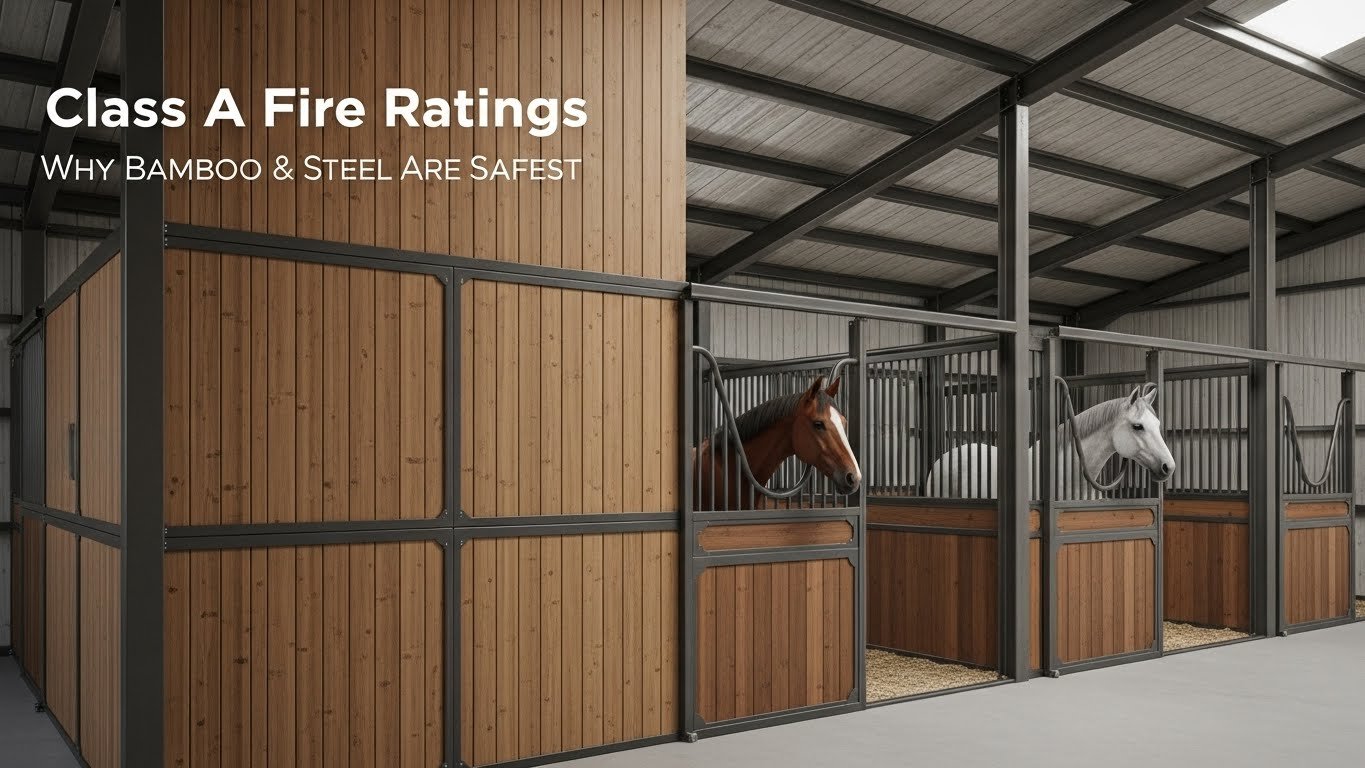
Protecting people and property from fire is paramount in any building project, especially in sensitive environments like horse stalls. Traditional materials like pine can accelerate fire rapidly, creating serious risks and compromising safety for both animals and staff.
Understanding fire ratings helps you choose the safest options. This article explains Class A flame spread ratings, which require a Flame Spread Index (FSI) between 0-25 and a Smoke Developed Index (SDI) of 450 or less. We explore why engineered bamboo and steel offer superior fire resistance compared to materials like pine, which typically falls into Class C–D. You’ll learn how advanced treatments make bamboo self-extinguishing, with treated bamboo delaying ignition by up to six times (from ~20 seconds to 116 seconds), and why steel, while non-combustible, requires protection to maintain structural integrity in high heat.
The Reality of Barn Fires
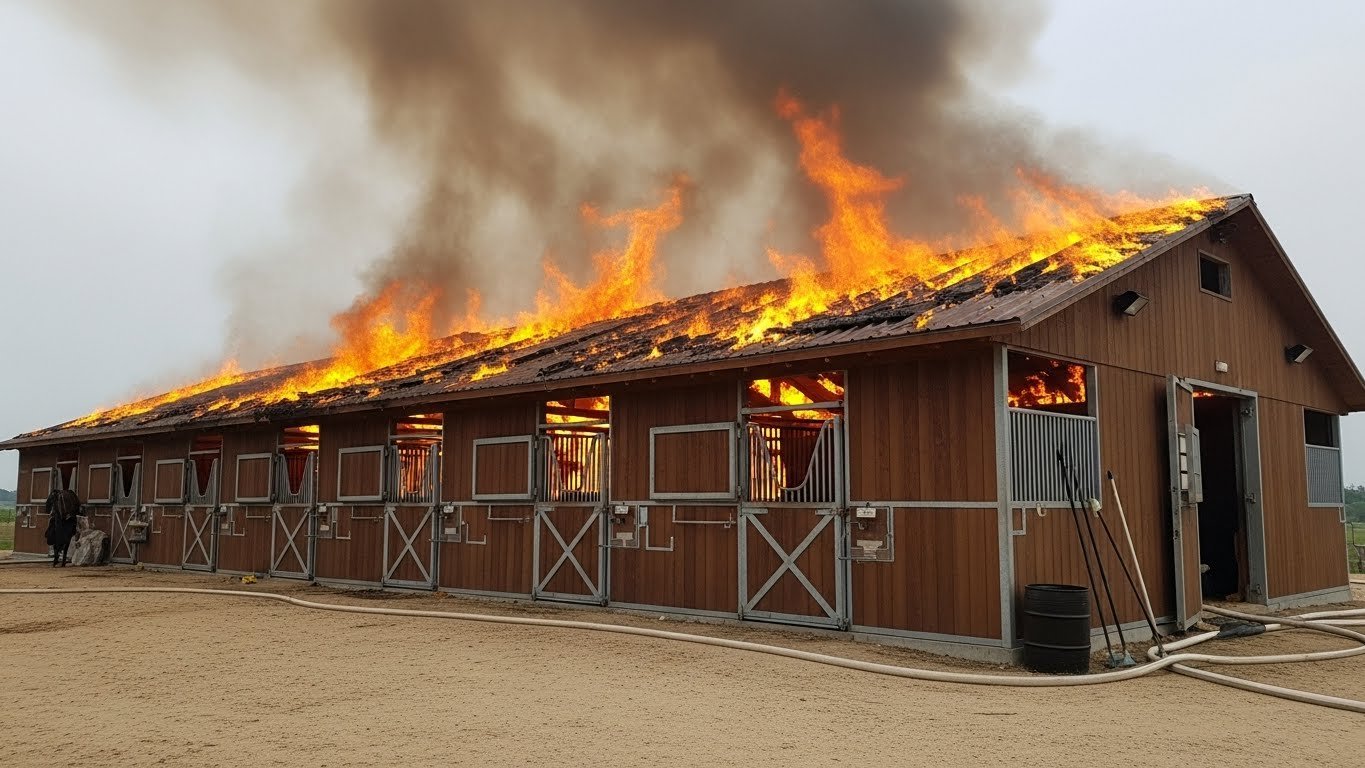
Barn fires are uniquely destructive, fast-spreading Class A events driven by high fuel loads and often exacerbated by lax codes de construction. By 2026, adherence to NFPA 150, 13, 10, and 101 for engineered controls, structural fire-resistance, and rigorous emergency planning is crucial to mitigate significant property damage and animal loss, even where not locally mandated.
The Intrinsic Hazards of Barn Fires
Barn fires are inherently rapid, high-fuel-load Class A fires, producing high heat release rates and heavy smoke.
Many barn structures historically lacked modern fire-resistance, compartmentation, and integrated detection/suppression systems.
A significant regulatory gap persists in various jurisdictions, leaving many agricultural facilities, including horse barns, without mandated state-level fire codes.
Operational factors like faulty electrical systems, unmaintained motors and heaters, and poor material storage practices often serve as common ignition sources.
Applying Engineering Controls and NFPA Guidance
Historical data indicates U.S. animal housing fires caused $102 million in direct property damage annually between 2014 and 2018.
NFPA 150 (2019 code) now mandates quick-response sprinkler systems compliant with NFPA 13 for larger Class A facilities (over 5,000 ft²) and Class B barns with sleeping quarters.
Ventilation design recommends 1 ft² of ceiling vent per 100 ft² of floor area, increasing to 1 ft² per 30–50 ft² in areas with hay storage.
Engineering practice dictates maintaining over 18 inches (approximately 450 mm) of separation between motors/heaters and combustible materials like hay or bedding.
Robust firewalls should offer a ≥1-hour fire resistance rating, extend ≥18 inches above a frame roof, and incorporate UL/FM-listed fire-retardant wood.
Emergency plans require a documented strategy, an annual live drill, and personnel training on the use of NFPA 10 compliant portable fire extinguishers.
Understanding Flame Spread Ratings
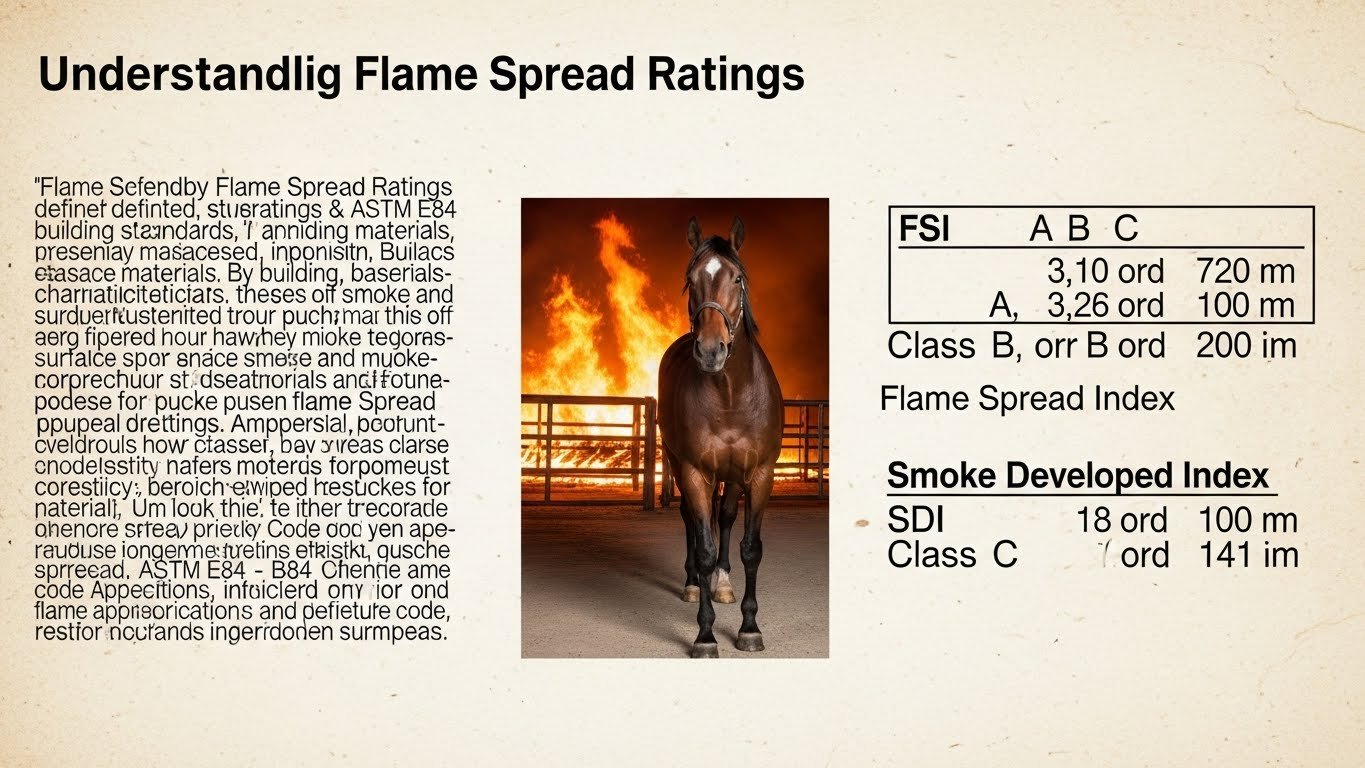
Flame spread ratings, primarily defined by standards like ASTM E84, classify building materials based on their surface burning characteristics. They measure how quickly flames spread and how much smoke materials produce, assigning a Flame Spread Index (FSI) and Smoke Developed Index (SDI) that determine a material’s Class (A, B, or C) for code applications like interior finishes.
| Classification | FSI Range | SDI Limit |
|---|---|---|
| Class A (Class I) | 0–25 | ≤ 450 |
| Class B (Class II) | 26–75 | ≤ 450 |
| Class C (Class III) | 76–200 | ≤ 450 |
Fundamentals of Flame Spread Index (FSI) Testing
Standardized tests like ASTM E84, UL 723, and NFPA 255 assess how building materials burn on their surface. These methods establish the characteristics that define a material’s fire behavior.
The Flame Spread Index (FSI) quantifies how fast flames propagate across a material’s surface.
FSI is usually measured on a scale from 0 to 200 for classification. The test compares a material’s flame spread against two reference points: inorganic reinforced cement board, which has an FSI of 0, and red oak, which has an FSI of 100.
This test, often called the tunnel test, measures surface flame spread and smoke development. It applies to materials used in walls, partitions, ceilings, and similar assemblies.
Material Classification and Code Compliance
Building codes, such as IBC Chapter 8 and NFPA 101 Life Safety Code, classify materials into three groups based on their FSI. These are Class A (0-25 FSI), Class B (26-75 FSI), and Class C (76-200 FSI).
All material classes must also meet a Smoke Developed Index (SDI) of 450 or less.
These classes guide where materials can be used within a building. For example, codes often specify Class A (0–25) for enclosed vertical exits and Class B (26–75) for exit access corridors. Class C (76–200) applies to less critical spaces. Class A materials offer the best resistance to surface flame spread, slowing fire’s horizontal travel and giving more time for evacuation and response. Class C materials allow quicker flame movement.
Many conventional wood-based panels, like veneer-cored hardwood plywood, typically fall into Class C, with FSIs ranging from 100 to 160.
To achieve Class A flame spread for wood products, specialized fire-rated MDF or particleboard cores are usually necessary. These often include specific adhesive systems designed for low flame spread.
Regulatory examples, such as HUD 24 CFR 3280.203, set specific FSI limits for components in manufactured housing. For instance, kitchen cabinet components might need a flame spread rating of 200 or less (Class C threshold), while certain wall and ceiling areas may require more restrictive values, like 50 or less.
Why Pine Accelerates Fire
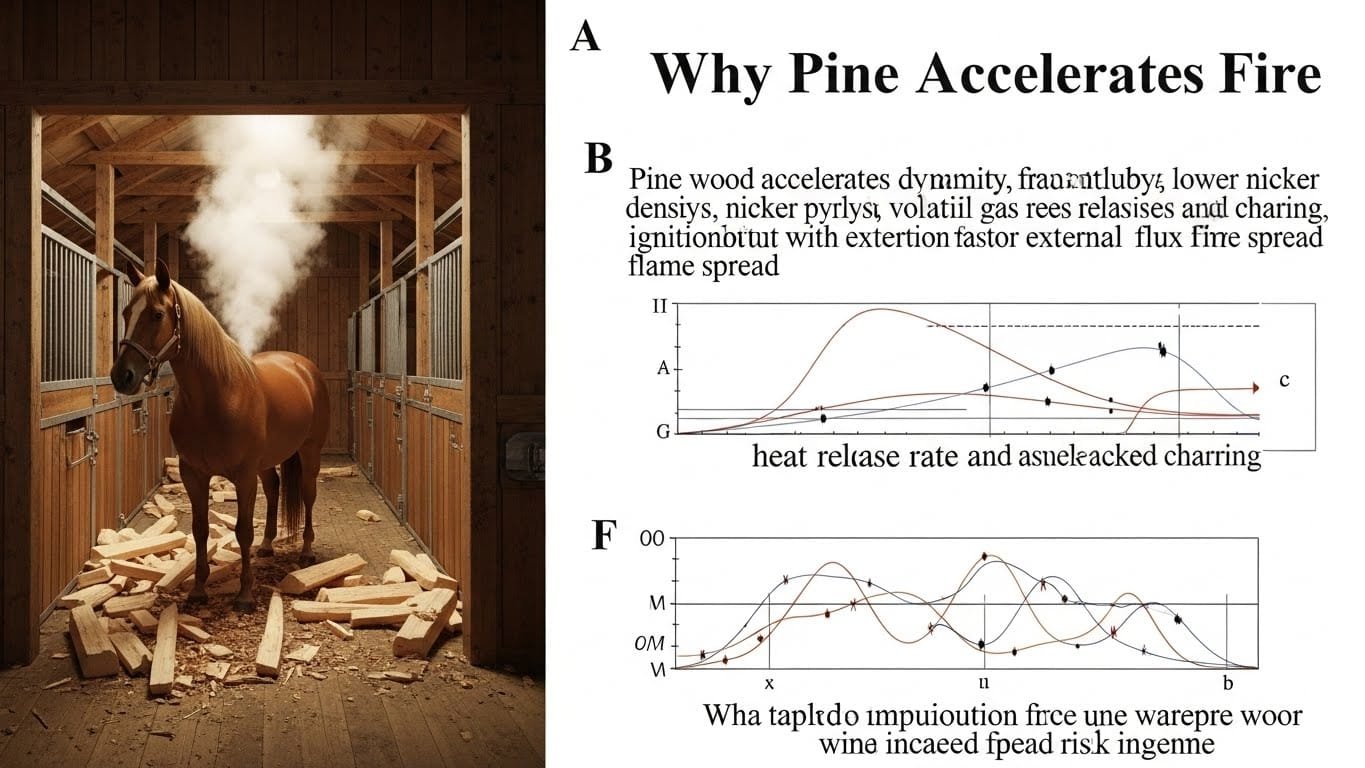
Pine wood accelerates fire due to its lower density, facilitating quicker pyrolysis and volatile gas release. Its combustion dynamics, including heat release rate and charring, scale linearly with external heat flux, resulting in faster ignition and flame spread compared to denser woods. This rapid burning is a key factor in its increased fire risk.
Pine’s Unique Composition and Rapid Pyrolysis
Lower density and specific thermal inertia (kρc) in Southern Pine promote significantly faster ignition and pyrolysis compared to denser woods like red oak or basswood.
Pine exhibits a higher burning velocity than redwood or red oak when exposed to the same heat flux.
The material’s cellular structure facilitates a quicker release of volatile organic compounds, acting as readily available fuel for rapid flame propagation.
Quantified Heat Release and Charring Dynamics
Heat Release Rate (HRR), Mass Loss Rate (MLR), and charring rate in Southern Pine scale linearly with external heat flux in the 15-55 kW/m² range, indicating a direct relationship between exposure and combustion intensity.
Effective heat of combustion (Δh_c,eff) for pine assemblies typically ranges from 12.4-16.1 MJ/kg, contributing to peak HRRs up to 3.7 MW in practical fire scenarios.
Engineering standards, including the AWC Fire Design Specification, incorporate specific char rate constants (β_n, β_t) to accurately model pine’s rapid surface regression and predict burn-through times in structural applications.
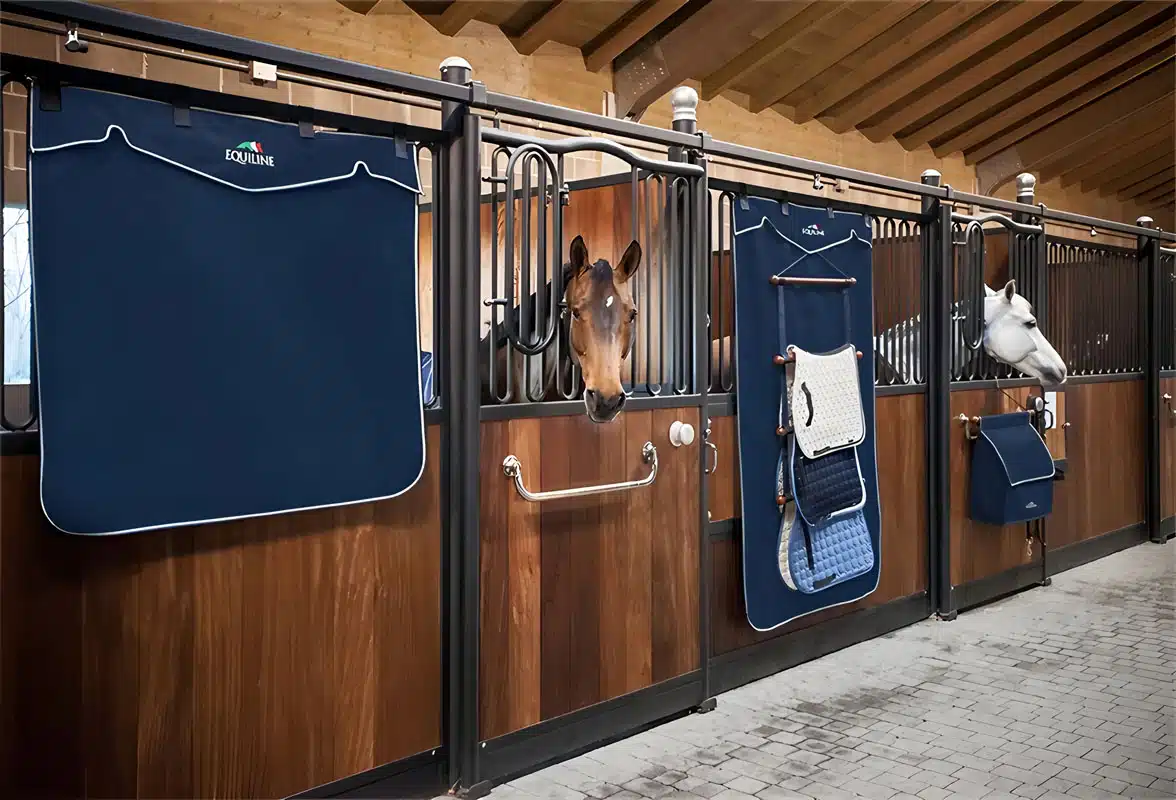
Global Horse Stables: Engineered for Every Climate, Designed for Comfort.
Why Bamboo is Self-Extinguishing
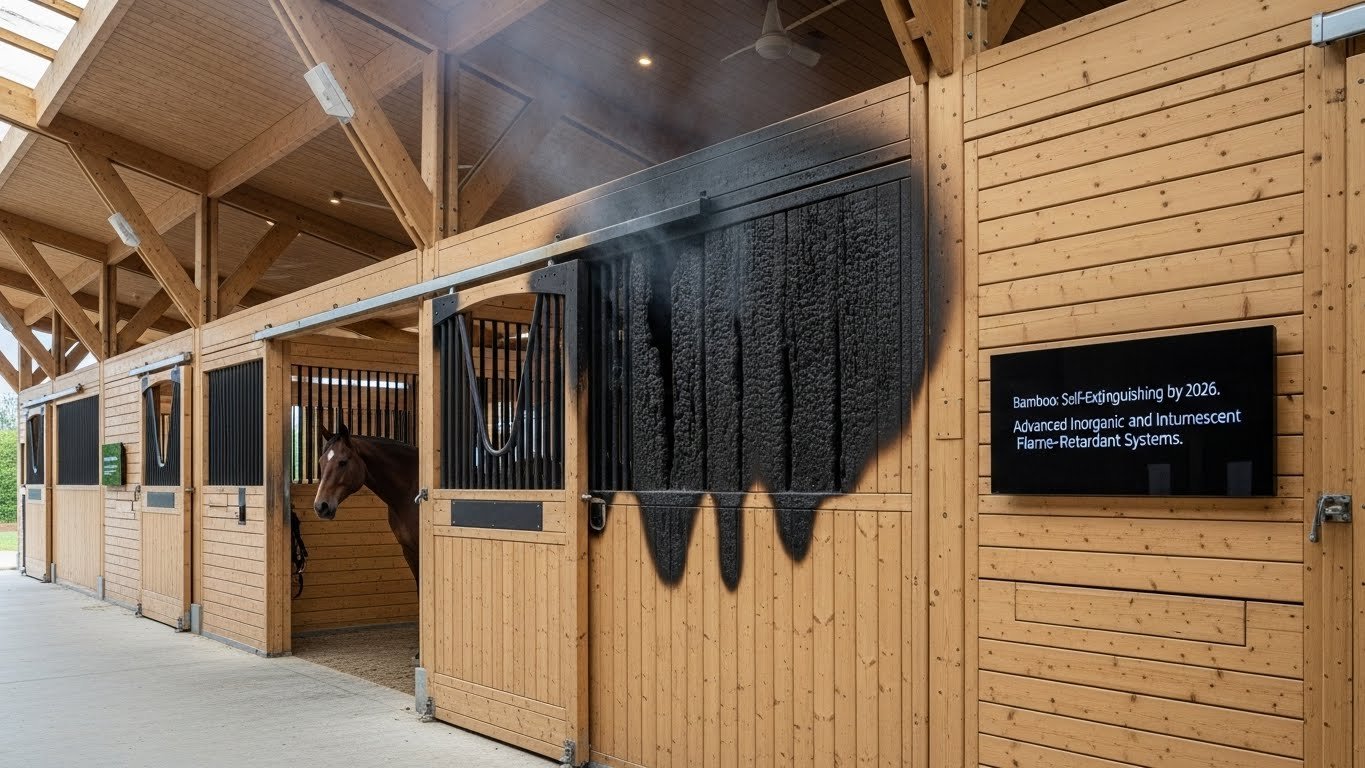
By 2026, advanced flame-retardant systems, primarily inorganic and intumescent, enable bamboo to become self-extinguishing. These treatments form a protective char barrier that insulates the material, blocks oxygen, and traps flammable gases, preventing sustained combustion and significantly reducing heat and smoke generation.
| Performance Metric | Untreated Bamboo | Treated Bamboo (Improvement) |
|---|---|---|
| Time to Ignition (ISO 5660-2) | ~20 s | 116 s (6x delay) |
| Total Heat Release (THR) | ~13 MJ/m² | 0.7 MJ/m² (18.6x reduction) |
| Total Smoke Production (TSP) | 1.0 m² | 0.063 m² (≈15x reduction) |
| Mean Specific Extinction Area (MSEA) | 110 m²·kg⁻¹ | 8.6 m²·kg⁻¹ |
| Bamboo Scrimber pHRR (2wt% PCaAl-LDH) | Baseline | 34.46% reduction |
| Bamboo Scrimber TSR (2wt% PCaAl-LDH) | Baseline | 65.97% reduction |
| Mass Loss Rate Peak Delay (FRBS) | N/A | 120–236 s longer |
Engineered Fire Resistance: Mechanisms of Suppression
Self-extinguishing behavior in bamboo is an engineered outcome, not an inherent property of raw culms. This is achieved by combining bamboo with specific inorganic and intumescent flame-retardant systems. These treatments work by interrupting the feedback loop of heat release, volatile fuel generation, and flame spread, which prevents sustained combustion.
The primary mechanism involves the formation of a continuous, porous silicate or silica char. This char layer acts as thermal insulation, protecting the underlying material. It also blocks oxygen diffusion to the flame and traps pyrolysis gases. By starving the flame of oxygen and fuel, the char layer causes it to die out rather than propagate.
Performance Metrics and Treatment Innovations
Under ISO 5660-2 cone calorimeter exposure, untreated bamboo ignites rapidly, typically in about 20 seconds, and releases high levels of heat and smoke. In contrast, bamboo treated with a three-layer Si-based barrier, consisting of a sodium silicate inner layer, a silica middle layer, and a PFTS-TMCS silane outer layer, shows significantly improved fire resistance. This treated bamboo exhibits a six times longer time to ignition, at 116 seconds. It also achieves an approximate 18.6 times lower total heat release and about 15 times lower smoke output.
Similar self-limiting combustion behavior is observed in bamboo scrimber when impregnated with 2 wt% phospho-calcium-aluminum hydrotalcite (PCaAl-LDH). This treatment reduces the peak heat release rate by 34.46%, total smoke release by 65.97%, and specific extinction area by 85.96%. Additionally, the mass loss rate peak is delayed by up to 236 seconds, indicating significantly slower burning. Coatings using ammonium polyphosphate and melamine formaldehyde resins on bamboo slices also reduce peak heat release rate and total heat release by over 28% and 30% respectively.
These fire-engineered bamboo assemblies, validated by ISO 5660-2 cone calorimetry, demonstrate that when a local ignition source is removed, the reduced heat release rate, delayed mass loss, and robust insulating char effectively prevent sustained flaming. This provides a technical basis for describing advanced, treated bamboo systems as functionally self-extinguishing in design fire scenarios, provided the specified flame-retardant formulations and tested build-ups are used and properly maintained.
Réflexions finales
This review highlights the stark differences in fire safety between common building materials. While pine accelerates fire due to its rapid combustion characteristics, engineered bamboo and non-combustible steel stand out for their superior fire performance. Modern treatments allow bamboo to achieve Class A ratings by creating a self-extinguishing char barrier. Steel, while not burning, needs fire protection to keep its structural integrity under extreme heat.
Ces insights underscore how material choices profoundly impact building safety and code adherence. For architects and builders aiming for the highest fire normes de sécurité, selecting materials like specially engineered bamboo and properly protected steel makes a critical difference. Their ability to resist flame spread and maintain integrity longer creates safer environments and provides more time for occupants to evacuate and for emergency services to respond.
![horse stall Solid vs. Grille Partitions Balancing [Privacy and Airflow] (1)](https://dbhorsestable.com/wp-content/uploads/2025/12/horse-stall-Solid-vs.-Grille-Partitions-Balancing-Privacy-and-Airflow-1.jpeg)
Questions fréquemment posées
Is bamboo flooring fireproof?
No, bamboo flooring is not fireproof; it is a combustible product. However, many commercial bamboo floors are tested and rated as fire‑resistant under standards like EN 13501‑1 or Class A/B deck ratings. Typical reaction‑to‑fire classifications are Cfl‑s1 or Bfl‑s1 under EN 13501‑1, indicating limited combustibility and low flame spread.
How do you fireproof a horse barn?
To meet fire safety expectations for horse barns, design facilities according to NFPA 150 standards. This includes using noncombustible or fire‑retardant-rated construction (e.g., 1‑hour assemblies, firewalls extending ≥18 in above the roof), installing quick‑response automatic sprinklers per NFPA 13 in all Class A barns and Class B barns with sleeping quarters, and providing ABC or ≥2‑A:10‑B:C fire extinguishers at all entrances and within 50 ft travel distance. Additionally, separate high‑fuel loads like hay and bedding from étals and ensure compliant access for fire apparatus.
What is the fire rating of pine versus bamboo?
Untreated pine typically achieves only Class C–D flame spread ratings (ASTM E84 / EN 13501-1 equivalents) unless it’s pressure‑impregnated with fire retardant. Engineered bamboo products, such as MOSO® Bamboo, can reach Class A (ASTM E84) and Class B‑s1,d0 (EN 13501‑1), representing the highest or near‑highest fire performance classes without added fire retardants.
What are safe materials for barn aisles?
For barn aisles, use noncombustible or fire‑resistant flooring and interior finishes like sealed concrete or concrete with tapis en caoutchouc. Any exposed wood or composites in the aisle should meet at least a 1‑hour fire‑resistance rating (e.g., plywood sheathed with 1‑hour fire‑rated gypsum) or be treated with tested fire‑retardant coatings. Aisle materials should also be dry, durable, and nonslip.
Does steel burn?
Steel is classified as a non-combustible material, meaning it does not burn. However, steel will lose strength and fail structurally when heated to approximately 500–600 °C (932–1112 °F) in a fire. Therefore, it must be fire-protected to meet required fire-resistance ratings.
How can fire risk be reduced in stables?
Reduce fire risk in stables by combining noncombustible or fire‑retardant construction, NFPA‑compliant protection systems, and proper spacing, venting, and egress requirements. Use masonry, heavy timber, or fire‑retardant‑treated wood conforming to American Wood Protection Association standards. Provide 1 ft² of ceiling vent per 100 ft² of floor area (or 1 ft² per 30–50 ft² where hay is stored). Install NFPA 13–compliant quick‑response sprinklers and NFPA 10–compliant 2‑A:10–B:C extinguishers. Design two exits per stall and at least 12‑ft‑wide access lanes capable of supporting a 40,000‑lb fire truck. Construct true firewalls with ≥60 minutes fire resistance, extending ≥18 in above the roof, ensuring all penetrations are sealed and doors are fire‑rated and self‑closing.

 French
  English
  Spanish
  Arabic
  German
0 commentaires