Value engineering in barn construction is a direct response to project budgets that spiral out of control. Without a systematic approach, architects lose bids and owners are forced to make unsafe compromises, eroding both profit and long-term asset value.
This analysis breaks down specific cost-saving methods that protect structural integrity. We show how to combine premium Royal Series fronts with functional Economy partitions, strategically use bamboo and HDPE infills, and why standardizing on 304 stainless steel hardware is non-negotiable for lifecycle cost.
What is Value Engineering in Equestrian Construction?
Value engineering analyzes a structure’s functions against its costs. The goal is to get the best performance, safety, and durability for the lowest total lifecycle cost—not just the lowest initial price.
The Core Principle: Function Over Initial Cost
Value engineering operates on a simple formula: Value = Function / Cost. It’s an organized way to look at a project’s essential functions and find smarter, more cost-effective ways to achieve them without sacrificing performance. This isn’t just about cutting the initial purchase price.
The analysis focuses on the lowest possible lifecycle cost, which includes the initial purchase, shipping, installation, and long-term maintenance. This is a strategic process to improve overall value, not a cheap cost-cutting exercise that compromises quality or safety down the line.
Practical Application: Flat-Pack Design for Freight Savings
A clear example of value engineering in action is the DB Stable Flat-Pack System. It directly tackles the massive expense of international shipping for equestrian distributors. Traditional, fully welded stable sets are bulky and inefficient to ship; a standard 40HQ container can only fit about 12-15 sets.
By re-engineering the structure for efficient packing, the same 40HQ container can hold 30-45 flat-pack stable sets. This change reduces freight costs by over 60% for distributors. The function of the stable remains identical—it’s just as strong and safe once assembled—but the total landed cost is drastically lower. This is a textbook case of improving value by reducing a major lifecycle cost without touching the product’s core performance.
The Hybrid Strategy: Royal Fronts + Economy Partitions
Composant
Key Features & Finish
Primary Role
Royal Series Front
Dual-protection Powder Coat over Galvanized finish, European arches, optional brass finials.
Maximum visual impact; sets the aesthetic tone for the entire barn aisle.
Functional and safe horse separation; ensures durability and longevity.
Allocating Budget for Maximum Visual Impact
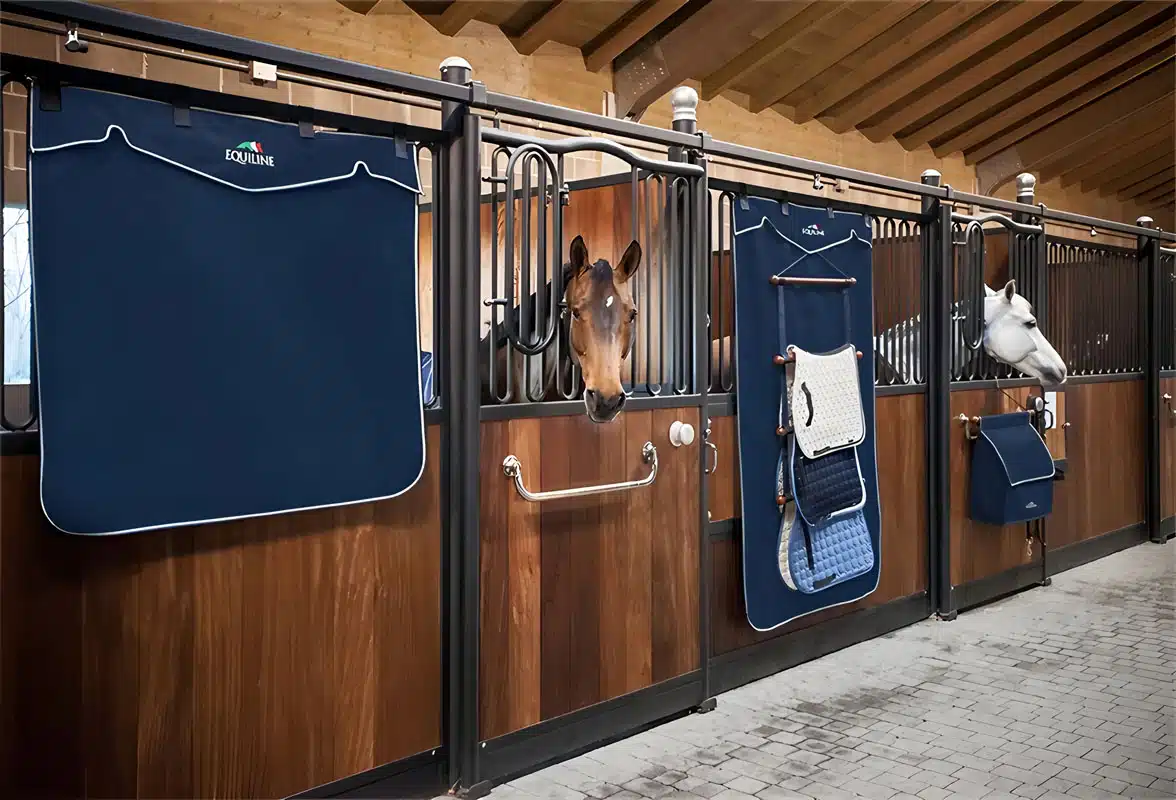
The stable front is the first thing people see in a barn aisle. It defines the look and feel of the facility. This is where you should focus your investment for aesthetic appeal.
Side and back partitions, on the other hand, are purely functional. Their job is to be safe, durable, and easy to maintain, not to be decorative. By channeling the budget toward the highly visible front panels, you can create the impression of a completely high-end stable at a much lower overall cost.
Combining Royal Series Fronts with Economy Partitions
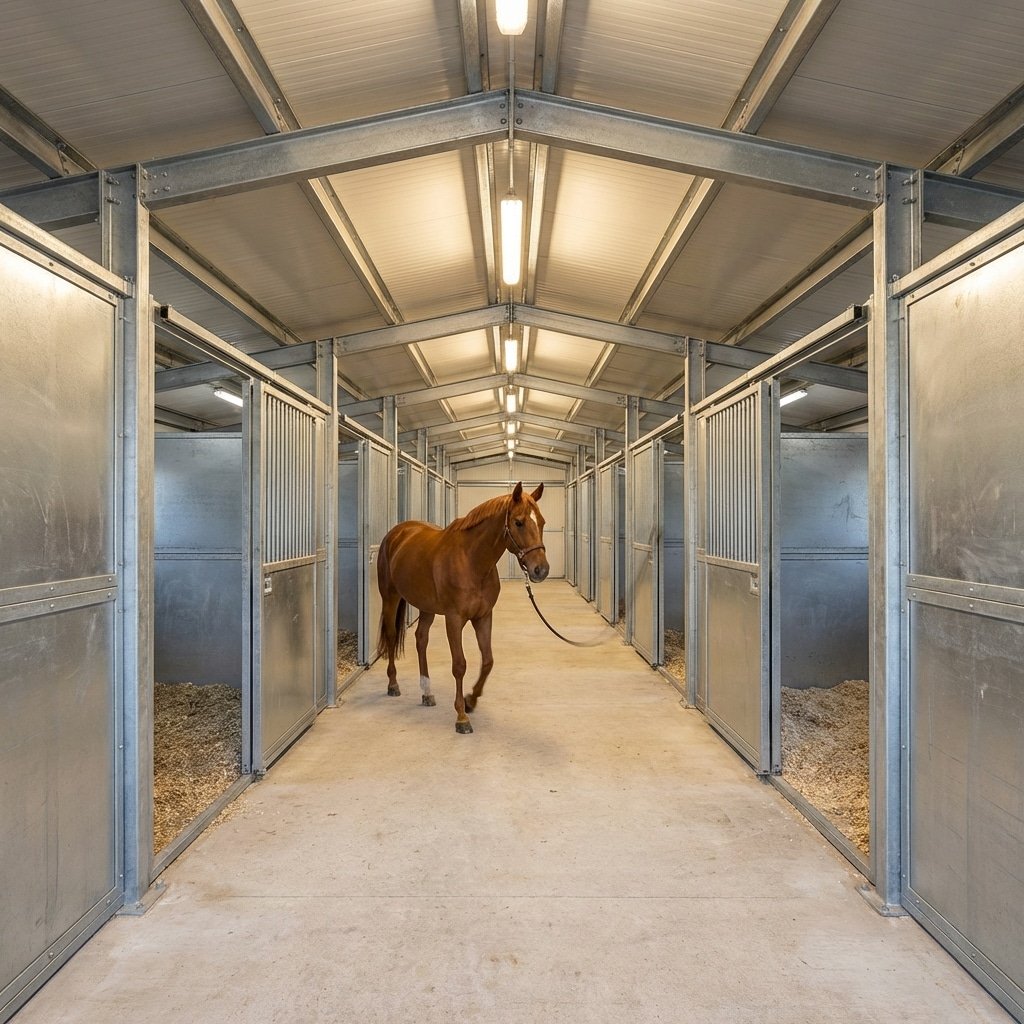
This value engineering approach directly combines our specialized product lines. You use the Royal Series fronts, which offer premium features like a dual-protection Powder Coat over Galvanized finish, elegant European arches, and decorative brass finials.
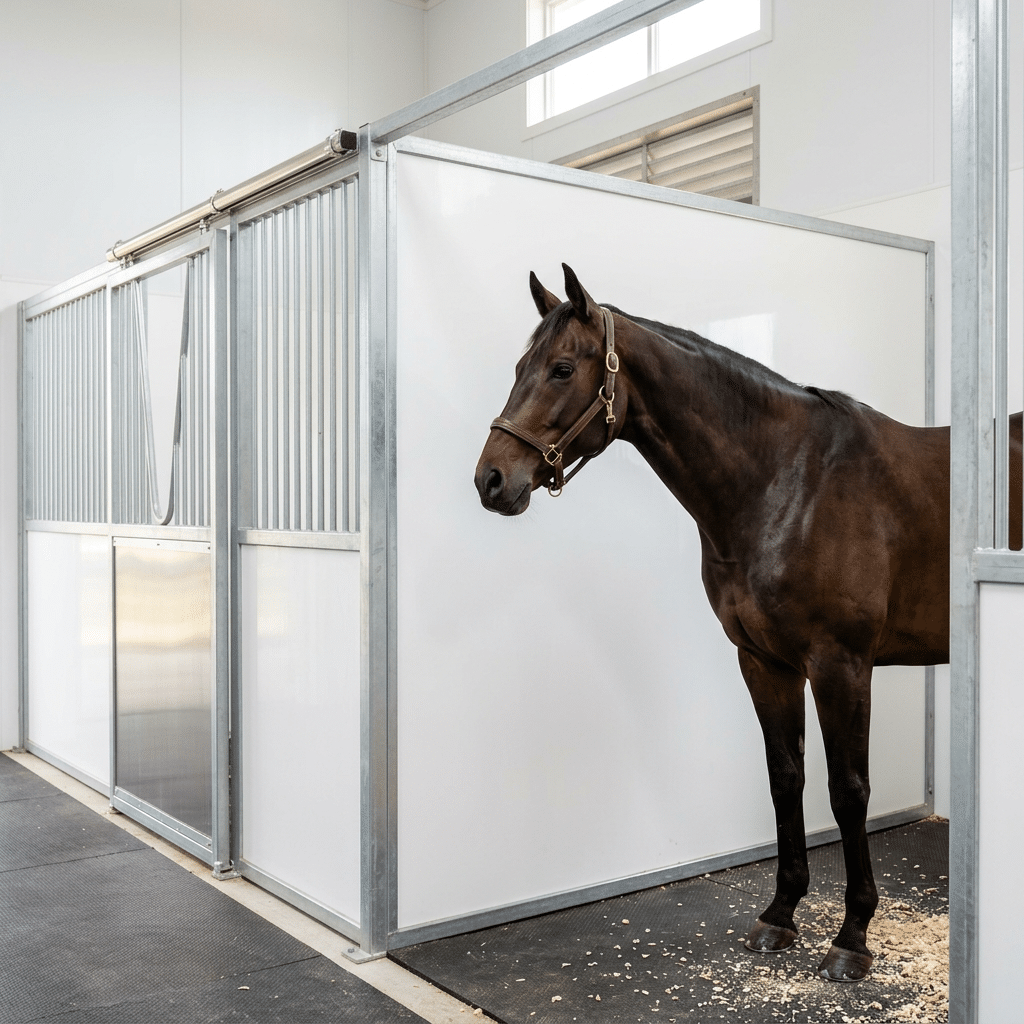
For the dividing walls, you use Economy Series partitions. These panels have a fully hot-dip galvanized frame for rust protection and a zero-maintenance HDPE infill that absorbs impacts and is easy to clean. This combination provides a custom-built feel for the facility without paying the full custom price tag.
Global Horse Stables with 20-Year Durability
Our precision-engineered stables offer a 20-year lifespan with rust-proof steel, designed to meet global compliance standards. Maximize your investment with our high production capacity and 30% faster installation time.
Opting for open grill partitions over solid ones cuts steel costs. This design saves money, boosts barn airflow through Stack Effect Ventilation, and simplifies horse monitoring.
The Material Cost Advantage of Open Grill Designs
Open grill partitions require substantially less steel compared to fully solid or boarded partitions. This isn’t just a minor detail; it’s a fundamental cost driver. A reduction in raw material directly lowers manufacturing expenses, which translates into a more budget-friendly price for the stable components you buy.
Balancing Savings with Airflow and Safety
The savings don’t come at the cost of animal welfare. Our stable partitions are engineered with an open top grill to promote what we call ‘Stack Effect Ventilation.’ This process naturally pulls stale air up and out, improving air quality and reducing moisture buildup inside the stall. The open design also improves safety by allowing for constant visual monitoring of your horses and encourages healthy socialization between them.
Infill Optimization: Bamboo for Fronts, HDPE for Sides
This strategy puts dense bamboo on high-impact fronts and HDPE on side partitions. It optimizes performance and manages costs by putting strength where it matters most.
Strategic Material Placement
for Performance
This approach is a core value engineering principle: concentrate premium materials where they deliver the most value. Stall fronts face the most abuse from kicks and are the most visible part of the stable. Using high-density bamboo here provides maximum durability and aesthetic appeal.
Side and back partitions serve a simpler function—containment. For these panels, a practical and cost-effective material like HDPE is a smarter choice. The goal is to avoid over-engineering parts of the stable that don’t require premium features, which helps control the total project budget without compromising safety.
Bamboo vs. HDPE: A Functional Comparison
The two materials are selected for very different, but complementary, properties.
Bamboo for Fronts: High-density strand-woven bamboo offers extreme hardness, with a Janka rating over 3000 lbf. This makes it exceptionally resistant to damage from kicks and impacts in high-traffic areas. It provides the strength needed to protect both the horse and the structure.
HDPE for Sides: UV-stabilized High-Density Polyethylene provides a zero-maintenance, impact-absorbing solution. It won’t crack or rot, and it flexes slightly under impact, which can reduce stress on the horse. It’s the ideal functional material for internal partition walls.
Hardware Consistency: Never Compromise on 304 Stainless
Small hardware like bolts are constant stress points. Using 304 stainless steel for all components prevents these ‘weakest links’ from failing, ensuring structural longevity and safety.
The ‘Weakest Link’ Problem in Stable Hardware
Inside a stable, the combination of moisture and ammonia creates a uniquely corrosive environment. Standard steel hardware simply can’t hold up. This isn’t just a cosmetic issue; it’s a structural failure waiting to happen. A single rusted bolt or a weakened connector can compromise an entire stall door or partition, turning a premium product into a safety liability.
True value engineering isn’t about finding the cheapest part. It’s about eliminating hidden points of failure. Spending a bit more on the right hardware from the start prevents costly replacements, repairs, and reputational damage down the line.
The Included Kit: 304 Stainless Steel for All Components
Every DB Stable system ships with a complete hardware kit. We made the decision to standardize every single component—anchor bolts, connectors, and screws—to 304 stainless steel. There are no exceptions.
This material provides predictable corrosion resistance and reliable mechanical strength. It won’t fail from environmental exposure or physical stress. Using a single, high-quality material for all hardware eliminates performance variance and protects the long-term structural integrity of the entire investment. It’s a simple guarantee of quality that you can pass on to your clients.
Questions fréquemment posées
What is Value Engineering in equestrian construction?
Value engineering is an organized method for analyzing a barn’s essential functions, such as structural integrity and weather protection. It helps identify alternative designs, materials, and construction methods that achieve these functions at a lower total cost without compromising quality or performance.
How can I reduce the cost of building a horse barn?
Significant cost savings can be achieved by choosing prefab barn kits, which are cheaper per square foot than traditional builds. You can also select more economical styles, like a shed row barn over a center-aisle design, and perform some of the work yourself, such as installing stalls and interior fixtures.
What is the difference between ‘Economy’ and ‘Professional’ horse stalls?
The key differences are in engineering complexity, material quality, and customization. Economy stalls feature simpler, functional designs with standard materials. Professional stalls involve more advanced engineering, such as fully welded frames with custom arches, higher-grade steel, and integrated features like specialized feeding systems.
Where are the most effective places to save money on a barn build?
The largest savings come from simplifying the design and taking on some of the labor. A simple rectangular barn is cheaper to build than a complex one. Using pre-cut DIY kits saves on labor costs, and strategic planning—like designing with standard lumber dimensions to reduce waste—also lowers material expenses.
Réflexions finales
Value engineering targets unnecessary costs, not critical safety components like hardware. While cheaper alternatives exist, our mandatory 304 stainless steel standard is what protects your reputation from rust claims and structural failures. This small investment in quality is your safeguard against costly client callbacks.
See the engineering for yourself. A trial order lets you confirm our weld quality, galvanization, and the freight savings of our flat-pack system. Contact our team to configure your sample shipment and discuss your next project.
Bonjour, je suis Frank Zhang, fondateur de DB Stable, entreprise familiale, spécialiste des écuries. Au cours des 15 dernières années, nous avons aidé 55 pays et plus de 120 clients, comme le ranch, à protéger leurs chevaux. L'objectif de cet article est de partager les connaissances relatives à l'écurie pour assurer la sécurité de votre cheval.





 French
  English
  Spanish
  Arabic
  German
0 commentaires