


Frost heaved fence posts are rarely the fault of the steel. The lift happens in the ground below them. As a freezing front moves down through soil in a cold spell, water collects at its edge and turns to ice, and anything standing in that zone — a post, an anchor shoe, a corner brace — rises with the surface. The thaw is not symmetrical, and a lifted post seldom returns to the height it started at.
What is published about these fencing lines: economical galvanized horse panels and UV-resistant PVC arena rail, a stated 20-year rust-resistance figure on hot-dip galvanized steel, a stated 15-year life on the PVC, and a published minimum of 50 panels. What no factory can publish for you is the part that decides a cold-site line: embedment depth, backfill, anchor detail and drainage gradient. Those belong to your ground, and settling them on paper is cheaper than fixing them in March.
Points clés à retenir
- Heave needs three things at once: sub-freezing ground, available water, and a soil susceptible to it. Remove one and the lift gets smaller.
- Depth is your document, not ours. Design frost depth comes from a site or geotechnical report or from local code, never from a factory figure.
- The coating claim is a corrosion claim. The stated 20-year rust resistance on hot-dip galvanized steel does not describe behavior under heave.
- Water is the fuel. Ask where a wet month goes along the fence corridor, as you would about a yard apron.
- Settle it in the order, not in a claim. A change made before production is one email; after it, it is a new configuration.
What heave does to a line, and what it does not

Heave does two jobs to a fence line, and only one is dramatic. The obvious job is vertical lift: a post embedded in soil that freezes below its own base gets pushed, and the rail spanned between two posts follows. The quieter job is uneven lift. A run crossing a former ditch or the shaded side of a hedge does not freeze evenly, so posts down one stretch can move by different amounts in one winter. That is what makes a new line look tired early. Gate gaps change, rails bind where they meet a bracket, and hardware set once starts getting set twice a year.
Soil type changes the question rather than removing it. Silty and fine-grained ground is where heave is usually worst; clean sand and gravel drain and typically heave far less, which is why one neighbor’s line stays true and another’s does not. Ground changes over short distances, and walking a paddock does not classify it. Freeze-thaw lifts stabling anchoring too, covered separately for Nordic sites in frost-resistant anchoring; this article stays on the fence corridor, where nobody is meant to notice a post climbing. What heave does not do is corrode steel. That question belongs to the coating figures, not to the ground.
Questions your site plan has to answer
Buyers normally ask how tall and how long. On cold ground the useful questions come earlier and sit with the site. Four of them decide most of what happens to a line, and each has a document that should already answer it.
| Ask this | Why it decides the line | Answered looks like |
|---|---|---|
| What design frost depth applies here? | Embedment, not panel height, is what heave acts on | A depth from a geotechnical report or local code, on the drawing |
| What soil is each run in? | Fine ground and old ditches hold the water that does the lifting | A soil note per run, not one label for the property |
| Where does water go in a wet month? | Water left near the freezing front is the fuel for heave | A gradient and an outlet drawn for the fence corridor |
| Cut, fill or undisturbed ground? | Placed fill settles and can move a post with no frost at all | A note on which side of the boundary each corner and gate sits |
Then name who signs the embedment detail; if that line is blank on your drawing, the question lands on whoever quoted the panels. Drainage is the same problem you meet in the yard: runoff grade, a curb and an outlet are set out for a stable apron in apron and runoff grades, and a fence corridor needs the same treatment written down. Confirm current requirements with your engineer or the local authority before treating these answers as settled, since thresholds vary by site and by country.
Anchors, shoes and the ground line
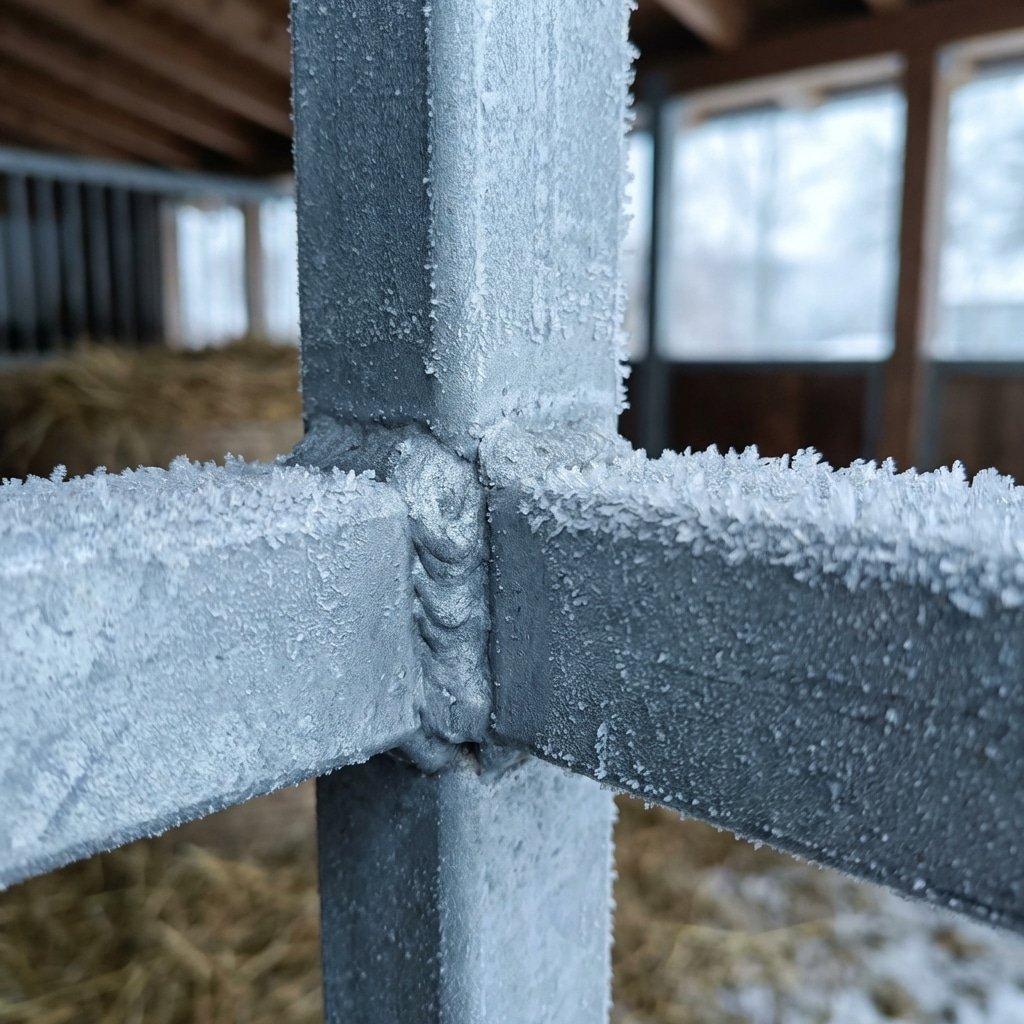
Three ways of getting a post into the ground are in common use: driven, set in a poured foundation, or bolted to a base or shoe. Each changes the load path a freezing front has to follow. Driven posts can be lifted along their whole embedded length. A poured foundation is only as good as its depth and its drainage. An anchor shoe keeps steel out of wet soil and puts the same movement into bolts, a plate and whatever that plate stands on. None of those is a decision this factory can make for you.
What is settled at the order is narrower, and worth writing precisely: which posts in your layout are corners, braces and gates rather than line posts; what hardware comes with each panel type and the service assumption stated for it; whether a bolted connection is intended for ground contact or for a drained, raised base. One more question gets blurred elsewhere in this industry. The 20-year figure sits with hot-dip galvanized steel, and the gap between a hot-dip coating and a pre-galvanized one is exactly what a spec sheet can hide, so ask which process your line is run to and get it named. Coating answers corrosion; it does not answer lift.
Writing it into the order before the panels are cut
By the time a below-zero week arrives, a fence order is already a production slot. Lead time on these lines is 4-6 weeks for global production and delivery, with 1-2 weeks expedited from the Sydney and Warsaw regional warehouses. An expedited item helps a date, not a specification: change the cold-site detail after the drawing is fixed and you have a new configuration.
- Quantities per run, in the unit that gets counted. The fencing minimum is 50 panels and stabling starts at 10 stall sets; nothing published adds the two together.
- Post roles, not just post counts. Corners, braces and gates carry the movement; line posts carry the span between them.
- Your own drainage crossings. Mark wherever the line meets a grade change, a culvert or an apron edge.
- The hardware and process question, per panel type, in the same document as the price.
- The date the ground will be ready, beside the delivery date, because a 4-6 week window against a half-finished paddock can push a line into the next grazing season.
Adjustable sizes are published for the stabling systems, so ask in writing whether the panel and post configuration you need can be adjusted; matching a configuration that already exists costs less than inventing one that accounts for heave at every post. Panel heights, connection hardware and the rail options that change with discipline sit under panneaux de clôture pour chevaux. The 5%-15% volume band is published without quantity thresholds, and dedicated regional account management starts at 20 sets — both worth asking in the same email.
Questions fréquemment posées
Does going deeper below the frost line stop heave?
It shortens the soil that can push on the post, which is why depth is specified against a design frost depth. It removes no water, so depth and drainage are asked together rather than traded against each other.
Are anchor shoes better than embedded posts on heaving sites?
Neither is a general answer. A raised, drained base moves the load into bolts and whatever the plate stands on; an embedded post takes lift along its length. The choice belongs to your site documents, not to a catalog.
Does heave affect the 20-year rust-resistance statement?
The published figure is a corrosion statement on hot-dip galvanized steel, and movement at the ground line is a separate question. If warranty text matters to you, ask what it covers and what it excludes, in writing.
Does this apply to PVC arena rail as well as steel panels?
The ground does not sort by rail material, so any post, base or sleeve in lifting soil is subject to the same lift. The published PVC statement is a 15-year UV life, which is about sunlight rather than soil movement.
Conclusion
A fence line that stays true in cold ground is usually a drainage and embedment decision made before anyone ordered panels. The published facts here — a 20-year rust-resistance statement, a 15-year PVC life and a published 50-panel minimum — answer questions about the product. They do not answer questions about your soil.
Take those four site questions to your engineer or local authority first, then put the answers, the post roles and the drainage crossings into the order as documents. That is the version of a cold-site project that gets quoted properly the first time.


 French
 English
 Spanish
 Arabic
 German
0 commentaires