


Selecting competent Horse Walker Suppliers is the primary defense against catastrophic infrastructure failure in high-volume training yards. While economy panels may reduce initial capital expenditure, they often buckle under impact, creating liability risks that erode facility profit margins through expensive veterinary claims and premature equipment replacement.
This analysis benchmarks global manufacturers against the strict 14-gauge structural steel standard required for professional safety. We evaluate fabrication quality based on Galvanisation à chaud après fabrication to eliminate rust, while assessing logistical capabilities like flat-pack co-loading to help you secure a scalable, high-ROI partnership.
Essential Infrastructure for Professional Training Yards
Comparaison rapide
| Manufacturer | Location | Core Strength | Verdict |
|---|---|---|---|
| ProWalk Horse Walkers | ÉTATS-UNIS | High efficiency (98%) belt drive design | Best for professional racetracks seeking high-performance durability. |
| Centaur Horse Walkers | ÉTATS-UNIS | Lease-to-own financing & 60 years experience | Ideal for US buyers needing flexible financing and proven designs. |
| Vitafloor | Non spécifié | Silent operation & advanced rehab controls | The safest choice for sensitive horses and rehabilitation centers. |
| Molenkoning | Netherlands | Rapid stock availability & DIY options | Europe’s leader, perfect for quick installation and DIY projects. |
| KRAFT Horse Walker | Mondial | Integrated round stable designs & ceiling mounts | Excellent for large-scale, custom architectural stable projects. |
ProWalk Horse Walkers
ProWalk stands out for its **unique belt drive design** that retains over 98% efficiency, making it a top choice for professional racetracks.
Operating since 1983, this USA-based manufacturer has built a strong reputation serving professional racetracks and high-end show facilities. They focus on delivering robust, American-made infrastructure designed for heavy commercial use.
Their engineering emphasizes mechanical efficiency through specialized belt drive systems. Pricing reflects their premium positioning, with standard 6-horse models ranging between $27,000 and $43,000.
📊 At a Glance:
- 📍 Location: ÉTATS-UNIS
- 🏭 Core Strength: Leadshank systems, Panel walker systems
- 🌍 Key Markets: North America
Why We Picked Them:
| ✅ The Wins | ⚠️ Trade-offs |
|---|---|
|
|
Centaur Horse Walkers
A veteran US manufacturer ideal for facilities needing flexibility, offering **lease-to-own financing** and over 60 years of proven reliability.
Centaur Horse Walkers brings over 60 years of industry experience to the table, having manufactured more than 6,000 standard hot walkers. This extensive track record establishes them as a highly experienced producer within the American equestrian market.
They specialize in customizable models designed to accommodate various herd sizes, specifically ranging from two to six horses. Their unique financing model sets them apart, making professional-grade equipment accessible through flexible lease-to-own plans.
📊 At a Glance:
- 📍 Location: ÉTATS-UNIS
- 🏭 Core Strength: Standard hot walkers, Equine exercisers
- 🌍 Key Markets: ÉTATS-UNIS
Why We Picked Them:
| ✅ The Wins | ⚠️ Trade-offs |
|---|---|
|
|
Vitafloor
A premium choice for therapeutic needs, offering **silent operation and advanced safety** features designed for rehabilitation.
Vitafloor specializes in the Q-Line HE Professional Horse Exerciser, a system engineered specifically for safety and rehabilitation. Their designs prioritize quiet mechanics, making them suitable for high-end professional facilities where noise reduction is critical.
Their units feature advanced controls for walk and trot intervals alongside robust weather protection options like wind screens. While production times are slower than competitors, the specialized focus on recovering and sensitive horses distinguishes their engineering.
📊 At a Glance:
- 📍 Location: Non spécifié
- 🏭 Core Strength: Q-Line HE Professional Horse Exerciser
- 🌍 Key Markets: Professional Training Facilities
Why We Picked Them:
| ✅ The Wins | ⚠️ Trade-offs |
|---|---|
|
|
Molenkoning
As Europe’s largest manufacturer, they are the go-to choice for **rapid stock availability** and flexible DIY installation options.
Recognized as the “King of Horse Walkers,” Molenkoning holds the title of Europe’s largest manufacturer in this niche sector. Based in the Netherlands, they have built a massive operational footprint designed to maintain high inventory levels for immediate client needs.
Their diverse catalog ranges from standard MK Horse Walkers to complex covered Skywalker models and rail-gliding systems. They distinguish themselves by offering robust self-assembly packages, allowing facility owners to reduce costs through DIY installation.
📊 At a Glance:
- 📍 Location: Netherlands
- 🏭 Core Strength: MK Horse Walkers, Skywalker model, Rail-gliding systems
- 🌍 Key Markets: Europe, Global
Why We Picked Them:
| ✅ The Wins | ⚠️ Trade-offs |
|---|---|
|
|
KRAFT Horse Walker
This family-owned manufacturer excels by offering **diverse mounting options and integrated round stable designs** for global facilities.
KRAFT is a prominent family-owned manufacturer with an extensive footprint, serving over 2,000 clients across five continents. Their massive global reach extends to more than 60 countries, establishing them as a reliable partner for professional training yards.
Their engineering portfolio is highly versatile, featuring both ground-standing walkers and advanced ceiling-mounted systems. Beyond standard exercisers, they provide comprehensive integrated round stable designs for cohesive facility planning.
📊 At a Glance:
- 📍 Location: Mondial
- 🏭 Core Strength: Ground-standing walkers, Ceiling-mounted systems, Round stable designs
- 🌍 Key Markets: Global (60+ countries)
Why We Picked Them:
| ✅ The Wins | ⚠️ Trade-offs |
|---|---|
|
|
20-Year Rust-Proof Custom Horse Stables

Essential Infrastructure for Professional Training Yards
High-volume training facilities demand infrastructure engineered for resilience and safety. We strictly utilize 14-gauge structural steel and hot-dip galvanization after fabrication to ensure our systems withstand the daily rigors of professional equine athletes while minimizing long-term maintenance costs.
Material Specifications for High-Traffic Facilities
Professional yards demand infrastructure that survives daily impact without compromising safety. We strictly use 14-gauge (2.0mm – 2.5mm) structural steel for all posts and framework to prevent bending or failure under heavy use. This adheres to our “Kick-Proof Guarantee,” ensuring that stalls and partitions remain rigid even when subjected to the force of aggressive stallions or high-energy sport horses.
For facilities located in regions with severe winters, standard steel can become brittle. Our Cold Climate Option utilizes Q345B Low Alloy High Strength Steel (equivalent to ASTM Grade 50), which maintains superior impact toughness in freezing temperatures. This material selection is critical for preventing brittle fractures from kicks during winter months, a common failure point in inferior steel grades.
Long-term value depends entirely on effective rust protection. All our structural components undergo Hot-Dip Galvanization after fabrication to BS EN ISO 1461 standards. Unlike pre-galvanized tubing that leaves weld seams exposed, our process dips the entire welded structure into molten zinc, achieving a coating thickness greater than 85 microns on structural parts. This creates a metallurgical bond that withstands the corrosive ammonia environment of active stables.

Optimizing Workflow with Specialized Equipment
Efficient training centers integrate specialized infrastructure to manage exercise routines and rehabilitation without significantly increasing labor costs. We recommend the Professional Series for these high-use areas, as it balances durability with aesthetic value. This series features high-density bamboo infill, which is three times harder than oak and naturally resistant to mold and rot, ensuring the facility maintains a professional appearance despite heavy daily traffic.
Safety remains the priority for unsupervised exercise areas. Our “Cast-Proof Design” minimizes bottom gaps to approximately 50mm, significantly reducing the risk of a horse getting a leg stuck while rolling. By combining this safety engineering with our heavy-duty steel framework, we provide a secure environment that protects both the animal and the facility’s profit margins by reducing veterinary claims and equipment replacement costs.
Lunging Pens: Why 14-Gauge Steel is Mandatory for Round Yards
We define 14-gauge (2.0mm – 2.5mm) wall thickness as the absolute minimum engineering standard for round yard panels. Unlike passive paddock fencing, lunging pens must absorb high-energy impacts and constant physical pressure. Thinner materials risk catastrophic failure, creating sharp edges that endanger horses, while our robust specification ensures structural rigidity and effective galvanization for long-term safety.
The “Kick-Proof” Standard for Equine Safety
We enforce a strict 14-gauge minimum because lunging pens function as high-stress training environments rather than simple c
ontainment. Economy options frequently utilize 16-gauge or even 18-gauge tubing, which lacks the mass to absorb a direct kick. When these lighter tubes fail, they buckle and crimp, creating jagged metal edges that can severely injure a horse’s leg. We engineer our systems to prevent this specific failure mode completely.
Our approach utilizes Q235B structural steel as the baseline, with Q345B Low Alloy High Strength Steel available for cold climates to prevent brittle fractures. This material choice allows the frame to absorb shock energy without snapping. Furthermore, a robust 14-gauge frame provides the necessary tensile strength to support heavy, solid infills like our high-density bamboo or UV-stabilized HDPE without sagging, maintaining a secure barrier during intense training sessions.
Preventing Structural Deformation and Corrosion
Round yards endure constant outdoor exposure and the physical strain of animals leaning against the perimeter walls. Lighter panels often suffer from “ovaling,” where round tubes warp out of shape over time, making gates impossible to latch and compromising the enclosure’s integrity. Heavier 14-gauge steel resists this distortion, maintaining its geometric profile and functionality despite years of daily abuse.
This specific steel thickness plays a critical role in our rust protection strategy. Effective Hot-Dip Galvanization requires sufficient steel mass to bond properly with the molten zinc. Our 14-gauge tubing allows us to achieve a zinc coating thickness greater than 70 microns (μm) on tubing and over 85 microns on structural parts. This creates a true “Lifetime” barrier against rust, unlike thin-walled competitors that cannot withstand the heat of the galvanizing kettle or hold a thick protective layer.
The HDG Rust-Proof Guarantee for Outdoor Equipment
We eliminate the risk of corrosion by strictly adhering to the Hot-Dip Galvanization After Fabrication process. By submerging the fully welded steel framework into molten zinc, we create a metallurgical bond that seals every joint, internal surface, and seam, delivering a maintenance-free lifespan that significantly outperforms pre-galvanized or painted alternatives.
The Critical Difference: Post-Fabrication vs. Pre-Galvanized
We strictly utilize the Galvanisation à chaud après fabrication process for every DB Stable system. Our engineers weld the black steel structure first, and only then do we submerge the entire unit into molten zinc. This method allows liquid zinc to flow through the interior of the tubes and completely seal all weld points. In contrast, “Pre-Galv” competitors weld tubes that were galvanized at the mill, leaving the welded seams exposed and prone to rusting within months.
Our process conforms to BS EN ISO 1461 standards, creating a robust metallurgical bond that resists peeling even under heavy impact from horses. The zinc layer functions as a sacrificial anode. If the surface sustains deep scratches from hooves or equipment, the surrounding zinc chemically reacts to protect the underlying steel, preventing the spread of rust.
Technical Metrics: Coating Thickness and Salt Spray Performance
To guarantee longevity in coastal regions and wet climates, we enforce coating density standards that exceed industry averages. Our structural parts (steel thicker than 6mm) feature an average zinc coating of > 85 microns (μm), while our tubing profiles maintain an average of > 70 microns (μm). This thick barrier ensures the framework withstands the corrosive effects of ammonia and moisture common in stable environments.
We validate this protection through rigorous testing. Our materials pass the ASTM B117 Salt Spray Test for over 96 hours with zero red rust. This specification supports a lifespan exceeding 40 years with zero maintenance, offering our B2B partners and distributors a superior ROI compared to labor-intensive painted or powder-coated options.
The “Profit Protection” Hack: Co-Loading Pens with Stalls
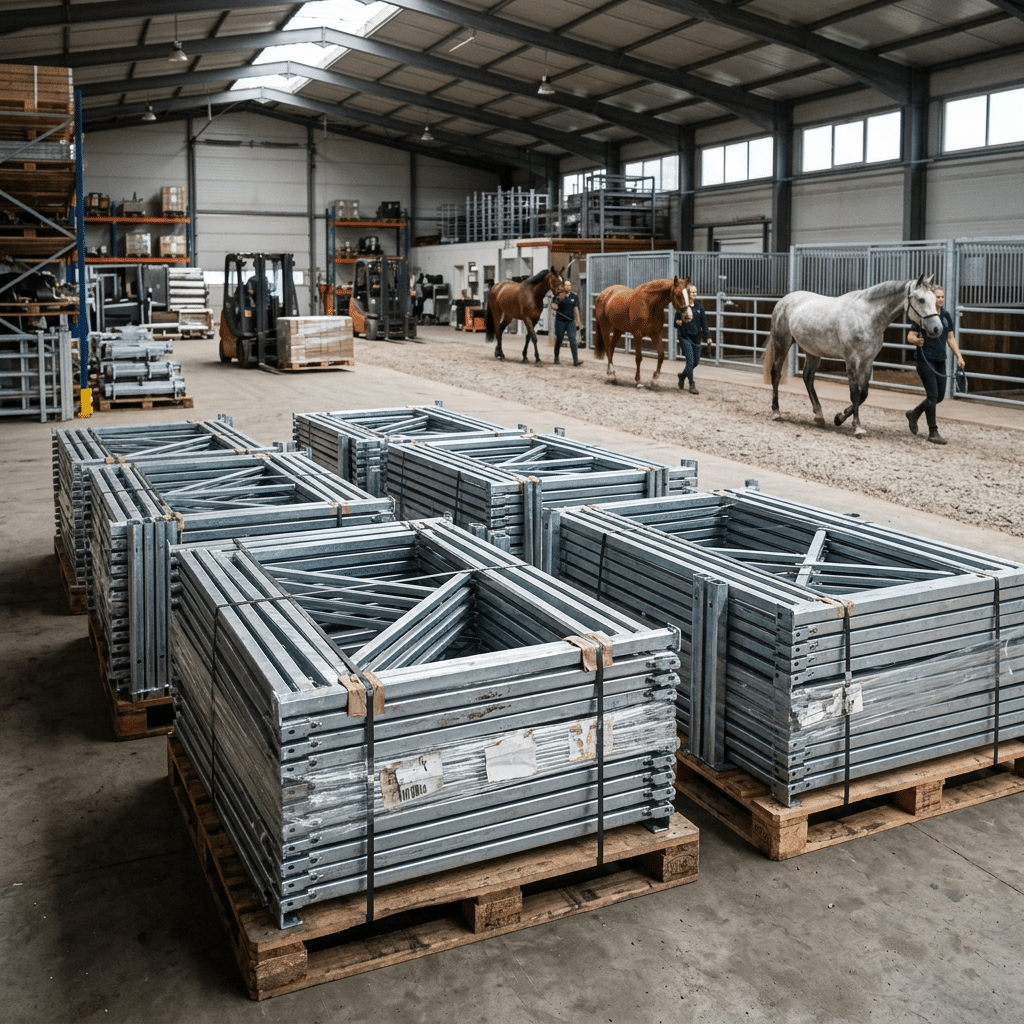
Standard logistics strategies often bleed profit through “dead freight”—shipping empty air in containers restricted by volume rather than weight. By utilizing our specialized flat-pack engineering, distributors can co-load modular round pen panels alongside horse stalls. This approach maximizes the 40HQ weight allowance, effectively reducing the per-unit shipping cost of a complete facility setup by over 60%.
The Flat-Pack Advantage: Eliminating “Dead Freight” Costs
In the global heavy equipment trade, shipping fully welded structures is financially inefficient. A standard 40HQ container typically accommodates only 12 to 15 sets of fully welded stalls before reaching volume capacity. This limitation forces importers to pay full freight rates for a container that
is essentially half-empty in terms of weight potential. This “shipping air” scenario destroys margins for B2B distributors.
We engineered the DB Stable Flat-Pack System to solve this volume constraint. By designing fronts and partitions that assemble on-site using high-strength Q235B or Q345B steel connections, we increase load density significantly. A single 40HQ container can hold between 30 and 45 complete stable sets. This optimization drastically lowers the landed cost per unit, serving as the primary layer of what we call “Profit Protection” for our partners.
Strategic Logistics: Optimizing 40HQ Volume with Mixed Loads
The most successful distributors leverage the “Profit Protection” hack by balancing the container’s weight limit against its cubic capacity. While bamboo-infilled stalls are dense, HDPE-infilled stalls are lighter, leaving unused weight allowance in the container. The strategic solution is co-loading round pen panels or “Economy Series” field shelters. These items act as high-value ballast, filling the remaining weight quota without displacing premium inventory.
Safety during transit is paramount when mixing heavy steel components. We utilize a strict steel pallet packaging standard rather than loose loading. Each bundle of panels is secured on a custom steel skid, ensuring that heavy stable fronts do not crush lighter round pen gates. This consolidation allows project managers to import a turnkey facility package—including “Professional Series” stabling and a dedicated training ring—in a single, cost-optimized shipment.
Réflexions finales
Choosing lightweight 16-gauge panels creates a safety liability the moment a horse strikes. Our strict adherence to 14-gauge structural steel and Hot-Dip Galvanization After Fabrication ensures your equipment survives daily impact without failure. This investment safeguards your reputation against rust claims and protects the animals under your care.
Maximize your ROI by leveraging our “Profit Protection” strategy to co-load flat-pack round pens with your next stable order. We recommend requesting a volumetric load plan to see exactly how much dead freight you can eliminate. Contact our engineering team today to configure a mixed container that optimizes your landed cost.
Questions fréquemment posées
Best manufacturer for horse walkers?
While many brands exist, we focus on professional training facilities that require heavy-duty, hot-dip galvanized infrastructure. As a B2B OEM source factory, we prioritize engineering safety standards over retail marketing. We supply robust, kick-proof systems directly to distributors and large global projects, ensuring commercial longevity.
Steel vs wood for lunging pens?
Steel is the only viable option for commercial longevity and safety. Wood rots, splinters, and demands constant upkeep. Our hot-dip galvanized steel panels (BS EN ISO 1461) offer a “Lifetime” rust-proof standard. We combine this frame with UV-stabilized HDPE or high-density Bamboo infills to ensure zero maintenance, unlike traditional timber structures.
How thick should a round pen panel be?
For professional safety, panels must use at least 14-gauge (2.0mm to 2.5mm) steel. Thinner materials risk bending or buckling under impact. We strictly adhere to this standard, using Q235B structural steel—or Q345B for cold climates—to ensure the frame withstands kick impacts without structural failure.
Can you import a horse walker from China?
Yes, importing directly from a source factory offers significant cost advantages. We handle production and logistics, utilizing HS Code 7308.90 to avoid complex tariff classifications. Our standard lead time is 35-45 days to allow for proper hot-dip galvanizing after fabrication, providing distributors with high-margin, professional-grade equipment.
Shipping round pens with horse stalls?
Absolutely. This is our “Profit Protection” strategy. By co-loading flat-packed round pen panels with stable fronts in a 40HQ container, we maximize space utilization. This method drastically reduces the freight cost per unit compared to shipping loose, fully welded panels, effectively protecting your margins on the total project.

 French
  English
  Spanish
  Arabic
  German
0 commentaires