


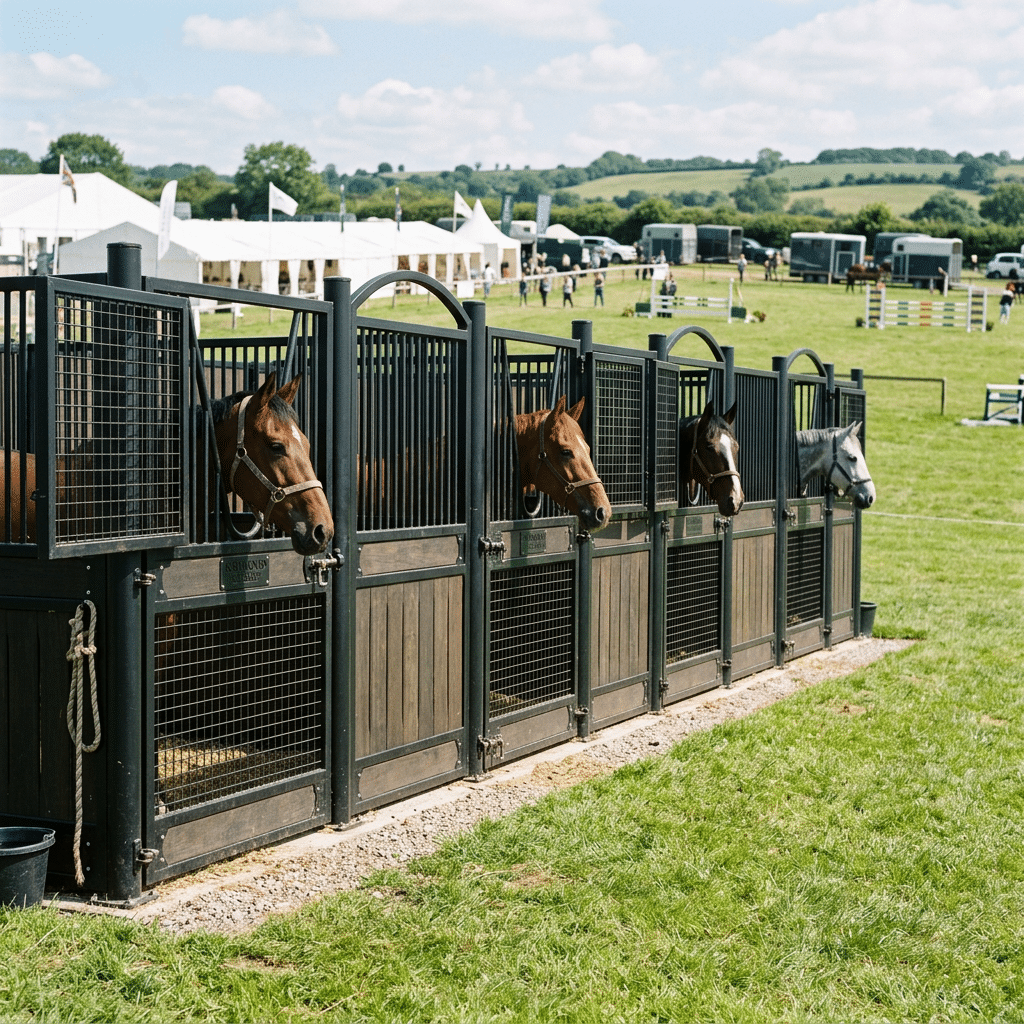
State Fairgrounds that rely on rental stabling contracts inadvertently create a permanent drain on event budgets. This cycle of dead money strips venues of residual asset value, while the inconsistent safety standards of aging rental inventory significantly increase liability exposure during high-traffic expos.
This report benchmarks bulk manufacturers against the Q235B structural steel and ISO 1461 hot-dip galvanization standards required for heavy use. We focus on suppliers capable of delivering flat-pack logistics that reduce freight costs by over 60%, allowing organizers to convert rental fees into a durable capital asset.
The Economics of Mega-Events: Renting vs. Owning Stalls
Comparaison rapide
| Name | Location | Core Strength | Verdict |
|---|---|---|---|
| Iowa State Fair | Iowa, USA | Major economic driver ($629.2M impact) | Top-tier event platform with over 1M visitors. |
| Indiana State Fairgrounds | Indiana, USA | $330M statewide economic ecosystem | Established infrastructure for consistent vendor demand. |
| U.S. Fairgrounds Ecosystem | United States | $51.9B national market value | Massive addressable market reaching 64.8% of US population. |
Iowa State Fair
This event stands out as a high-volume economic engine, offering vendors **guaranteed foot traffic** and massive exposure through its established recurring revenue model.
The Iowa State Fair serves as a massive economic driver, contributing a staggering $629.2 million to the state economy in 2024 alone. It operates as a premier commerce platform, drawing sustained annual attendance of over one million visitors.
This venue creates a concentrated recurring revenue opportunity for stall owners by leveraging high consumer density. It provides immediate, high-volume access to the Midwest consumer base, making it a critical anchor for event-based retail strategies.
📊 En bref :
- 📍 Lieu : Iowa, USA
- 🏭 Renforcement musculaire : Mega-Event Platform, Consumer Access
- 🌍 Principaux marchés : Midwest United States
Pourquoi nous les avons choisis :
| ✅ Les victoires | ⚠️ Compromis |
|---|---|
|
|
Indiana State Fairgrounds
This venue stands out as a **proven economic powerhouse**, generating $330 million in impact to ensure high vendor traffic.
The Indiana State Fairgrounds operates as a significant economic ecosystem, driving over $330 million in statewide impact. It exemplifies the macro-level vitality necessary to create a solid demand foundation for vendor participation.
By establishing a massive regional draw, the fairgrounds provide a high-traffic environment essential for stall profitability. This infrastructure supports a thriving marketplace for vendors looking to tap into the Midwest consumer base.
📊 En bref :
- 📍 Lieu : Indiana, USA
- 🏭 Renforcement musculaire : Event Facilities, Economic Impact
- 🌍 Principaux marchés : Midwest United States
Pourquoi nous les avons choisis :
| ✅ Les victoires | ⚠️ Compromis |
|---|---|
|
|
U.S. Fairgrounds Ecosystem
This massive ecosystem creates a **$51.9 billion economic footprint**, granting vendors direct access to nearly two-thirds of the American population.
The U.S. Fairgrounds Ecosystem acts as a collective economic powerhouse, sustaining 393,000 jobs nationwide. It functions not just as a venue network, but as a critical financial engine that drives significant local and state economic activity throughout the year.
Offering a vast addressable market, this sector attracts 64.8% of the U.S. population to events annually. This high consumer penetration creates a fertile environment for vendors seeking broad exposure and diversified revenue streams across North America.
📊 En bref :
- 📍 Lieu : United States
- 🏭 Renforcement musculaire : National Event Infrastructure
- 🌍 Principaux marchés : North America
Pourquoi nous les avons choisis :
| ✅ Les victoires | ⚠️ Compromis |
|---|---|
|
|
Des écuries conçues avec précision et garantissant une durée de vie de 20 ans

The Economics of Mega-Events: Renting vs. Owning Stalls
Relying on rental inventory creates a permanent drain on event budgets while offering inconsistent safety standards. Shifting to ownership of our Economy Series converts operational expense into long-term asset value, with ROI secured by our flat-pack logistics that slash shipping costs by over 60% compared to traditional welded systems.
The Rental Liability: Recurring Costs and Quality Risks
Event organizers often default to rental contracts to avoid upfront capital expenditure, but this strategy creates a cycle of “dead money.” Funds leave the venue’s ecosystem immediately after the event concludes, providing zero residual value. Over just a few event cycles, the cumulative cost of renting often exceeds the purchase price of a permanent fleet, yet the venue retains no physical assets to show for the expenditure.
Beyond the financial drain, rental inventory fluctuates wildly in condition and safety. Many rental providers utilize older, painted steel stalls that hide structural fatigue under fresh coats of paint. These units frequently fail to meet modern impact standards. Without the assurance of structural steel grades like our Q235B or Q345B, organizers risk stabling high-value horses in enclosures that may not withstand a direct kick, increasing liability exposure for the venue.
The Ownership Advantage: ROI Through Flat-Pack Engineering
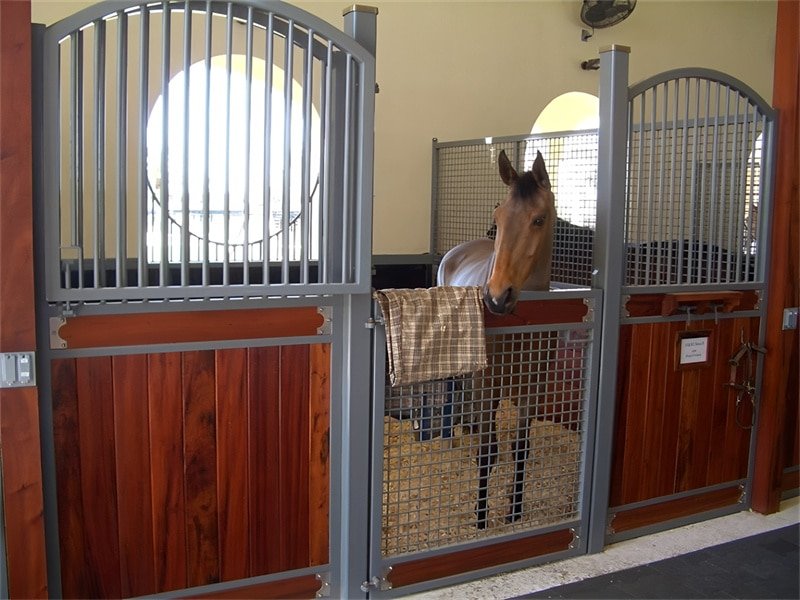
Investing in the DB Stable Economy Series shifts spending from operational expenses (OpEx) to capital expenditures (CapEx), building a durable asset base. We engineered the Economy Series specifically for this high-volume application, utilizing hot-dip galvanized frames and HDPE infill. This combination delivers a “Kick-Proof Guarantee” while ensuring zero maintenance, as the HDPE planks resist moisture, rot, and impact far better than the plywood often found in rental units.
The real driver of this ROI is our proprietary flat-pack technology. Traditional fully welded stalls limit container loading to just 12-15 sets, making ownership prohibitively expensive due to ocean freight. Our system loads 30-45 sets into a single 40HQ container. This efficiency protects your profit margins by reducing per-unit shipping costs significantly. We allow venues to acquire large-scale infrastructure without the logistic penalties usually associated with steel imports.
Durability underpins this ownership model. Event infrastructure faces aggressive handling during repeated assembly, disassembly, and storage. We protect every component with Hot-Dip Galvanization after fabrication, conforming to BS EN ISO 1461 standards. This process bonds zinc to the steel at a molecular level, preventing the rust and corrosion that plague painted alternatives. Your investment remains visually professional and structurally sound for decades, ready for the next season without costly refurbishment.
Manufacturing Capacity: Who Can Deliver 500 Sets in 60 Days?
Delivering 500 stable sets within a 60-day window requires a manufacturer capable of sustaining a Takt time of approximately 8.3 sets per day while managing the strict schedules of hot-dip galvanization. Success depends on validating effective runtime rather than theoretical capacity and ensuring the factory maintains high first-pass yield rates to prevent bottlenecks during the critical ISO 1461 coating phase.
Analyzing Takt Time vs. Effective Daily Output
Meeting a strict 60-day deadline for 500 sets requires a precise calculation of Takt time—sp
ecifically, the production line must complete roughly 8.3 sets every single day. When vetting manufacturers for large projects, we focus on their effective runtime rather than theoretical 24/7 capacity. Reliable engineering teams subtract non-productive intervals, such as tool changes, material handling, and equipment maintenance, to determine the true daily output. We recommend requesting historical capacity utilization data; a supplier operating at 80% utilization retains the flexibility needed to absorb the pressure of large-scale event orders, whereas a factory maxed out at 95% lacks the buffer to handle unexpected disruptions without missing the delivery date.
Critical Bottlenecks: Galvanization and Quality Control
The Hot-Dip Galvanization process (ISO 1461) often defines the ultimate production speed, as steel frames must be transported, dipped, and cured in specialized facilities. Our standard production lead time accounts for rigid scheduling with galvanizing plants, ensuring that a 500-set volume flows smoothly through the coating phase without stalling. Additionally, high first-pass yield rates, supported by our ISO 9001 quality management system, are essential for maintaining this pace. Reworking defective frames after they have been dipped causes significant delays, making a 60-day delivery impossible if strict quality controls are not enforced at the welding stage.
The Assembly Speed Requirement (Pin Connectors)
For large-scale event stabling and time-critical project sites, assembly speed dictates operational margins. We utilize gravity-fed pin connectors within our Economy and Professional Series to eliminate the need for power tools during structural erection, allowing general labor crews to install complex layouts rapidly while maintaining strict safety tolerances.
Drop-Pin Mechanics and Manufacturing Tolerances
The core advantage of a drop-pin system is the ability to utilize gravity rather than torque for structural rigidity. We engineer our Q235B structural steel framework with strict laser-cut tolerances to ensure that connector pins slide effortlessly through the mounting lugs. This precision eliminates the friction and binding often found in lower-grade alternatives, where installers waste valuable time hammering misaligned pins into place. For temporary stalls used at fairgrounds or expos, this mechanical simplicity allows for rapid deployment and disassembly without specialized equipment.
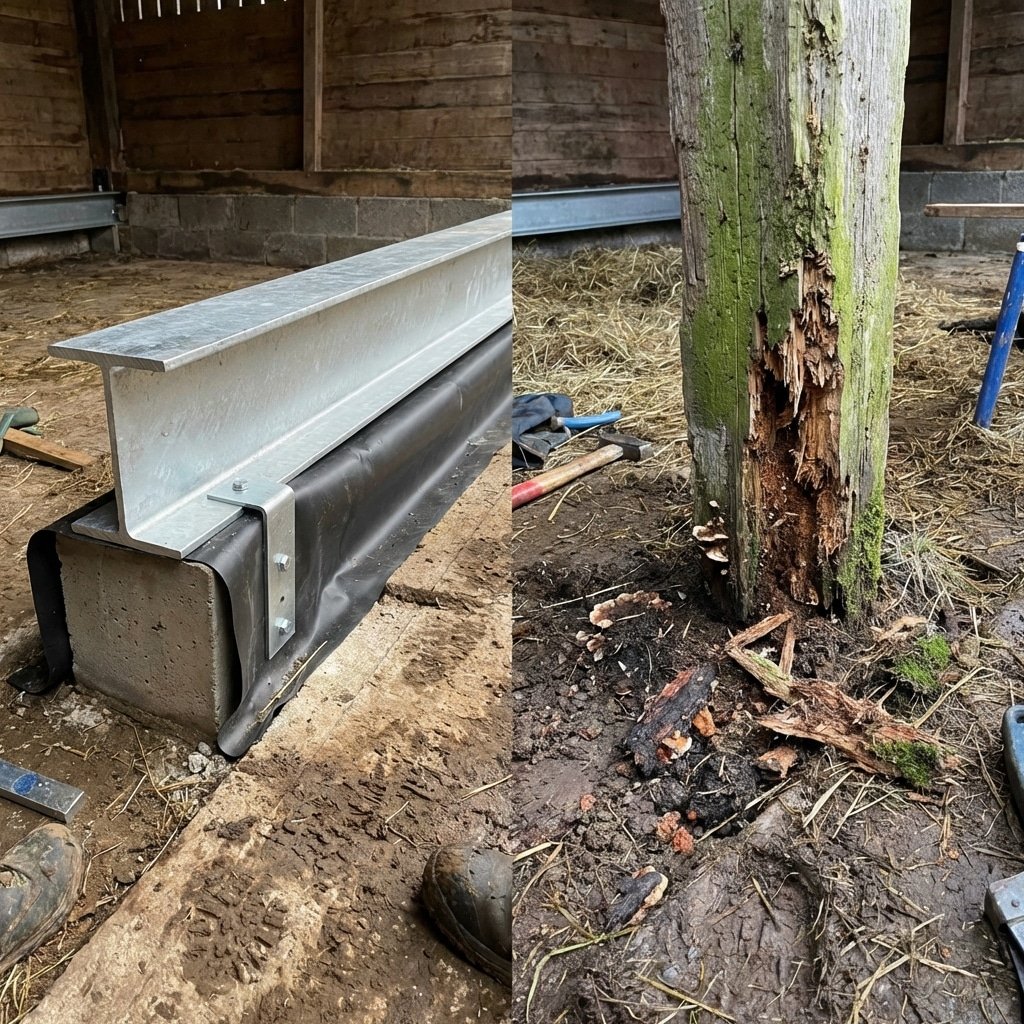
Rust is the primary enemy of pin connector efficiency. If a connector lug corrodes, the diameter changes, causing the pin to seize. To prevent this, we apply our standard “Hot-Dip After Fabrication” process, conforming to BS EN ISO 1461, which coats the steel in over 70 microns of zinc. This ensures that the internal surfaces of the connector lugs remain smooth and rust-free for the product’s lifetime. Additionally, we supply 304 Stainless Steel hardware kits to ensure that even after years of exposure to ammonia and moisture, the moving parts remain functional and easy to manipulate.
Maximizing Setup Throughput for Tight Deadlines
In high-pressure scenarios, such as setting up 500 stalls for a weekend championship, reducing installation time per unit is critical. Our Economy Event Series is designed to achieve an average setup time of under 10 minutes per stall. This speed is achieved not just through the pin connectors, but through our “Profit Protection” logistics. By utilizing our Steel Pallet Flat-Pack system, we ensure that panels are unloaded in an organized, upright manner. This allows installation crews to move immediately from the container to the assembly line without sorting through loose-loaded chaos.
While speed is a priority, animal safety remains the standard. We maintain a “Cast-Proof Design” across all our connector placements, ensuring that the bottom gap remains approximately 50mm regardless of how quickly the stall is assembled. This engineering control prevents horses from getting a hoof or leg trapped if they roll, a common risk in hastily assembled temporary stabling. By combining rapid pin-lock technology with pre-calculated safety gaps, we provide a solution that meets the demands of event organizers without compromising the welfare of the animals.
DB’s Economy Event Series and Flat-Pack Logistics
Our Economy Series combines Q235B structural steel with zero-maintenance HDPE infill to withstand high-volume event traffic, while our proprietary flat-pack logistics system increases container capacity to 30-45 sets, reducing freight costs by over 60% for large-scale projects.
Engineered for Mass Deployment: The Economy Series
We engineered the Economy Series specifically to meet the rigorous demands of high-volume rental operations, fairgrounds, and quarantine units. Unlike standard temporary stalls that often compromise on material quality, we utilize a Q235B structural steel frame that strictly adheres to BS EN ISO 1461 hot-dip galvanization standards. This “Hot-Dip After Fabrication” process ensures that every weld and joint is sealed against rust, extending the equipment’s lifespan even in humid or outdoor event conditions.
Logistics costs often dictate the viability of large-scale stall projects. Traditional fully welded stalls typically restrict shipping capacity to just 12-15 sets per 40HQ container, driving up the landed cost per unit considerably. We address this inefficiency through our proprietary steel pallet flat-pack technology.
By optimizing packaging density, we load between 30 and 45 sets into a single 40HQ container. This efficiency reduces shipping expenses by over 60%, serving as a “Profit Protection” mechanism for our distributors and project managers. Furthermore, we avoid loose loading entirely; every set arrives secured on steel pallets, ensuring safe, rapid unloading at the venue and reducing labor costs during the setup phase.
Réflexions finales
Relying on rental contracts drains event budgets without building equity, while owning a fleet converts that operational expense into a permanent asset. We secure this investment with Q235B structural steel and ISO 1461 hot-dip galvanization, ensuring your infrastructure withstands decades of high-volume traffic without corrosion. Furthermore, our proprietary flat-pack logistics slash per-unit freight costs by over 60%, protecting your margins right from the loading dock.
Delivering 500 sets in 60 days requires proven manufacturing capacity, not just theoretical promises. We invite you to review our production data or request a sample of our zero-maintenance HDPE infill to validate our “Kick-Proof Guarantee” firsthand. Contact our engineering team today to configure a layout that maximizes your venue’s throughput and profitability.
Questions fréquemment posées
Who manufactures temporary stalls for State Fairs?
As a dedicated OEM/ODM source factory, we engineer temporary stall systems specifically for large-scale event infrastructure. Unlike retailers who simply resell, we control the entire manufacturing process, prioritizing Q235B structural steel and hot-dip galvanization to ensure durability against high visitor traffic. Our focus is on providing standardized, safety-certified infrastructure directly to fairgrounds and event organizers.
How fast can you build 100 horse stalls?
Our production lead time is typically 35-45 days. We refuse to rush this process because we adhere to strict hot-dip galvanizing schedules (ISO 1461) to guarantee longevity. Logistically, our flat-pack design enables us to ship 30-45 sets per 40HQ container, ensuring that once production finishes, deployment is rapid and efficient.
Best bulk horse stabling suppliers?
For distributors and large projects, the most reliable partners are certified source factories like DB Stable. We focus exclusively on B2B partnerships, providing ISO 9001 quality management and ISO 1461 zinc coating standards. This ensures you receive container-load quantities that balance B2B profit margins with strict safety standards, rather than paying retail markups.
Cost to outfit an equestrian expo center?
Material choices and logistics drive the stalling budget. Our Economy Series, featuring HDPE infill and hot-dip galvanized frames, offers the optimal balance of cost and impact resistance. By utilizing our flat-pack technology, we reduce shipping volume significantly—saving over 60% on freight costs compared to welded alternatives—which directly protects your project’s bottom line.
Storage for portable horse stables?
Storage efficiency is engineered into our design. We use a steel pallet flat-pack system that allows panels to be safely stacked and stored compactly. This minimizes the warehouse footprint required when the stalls are disassembled between events and protects the finish from handling damage.

 French
  English
  Spanish
  Arabic
  German
0 commentaires