



Managing busy barns often means constantly battling maintenance issues like rot, splintering, and endless cleaning for infill materials. These traditional problems can eat into budgets and demand precious time, distracting from the core business of equine care.
This article details how HDPE plastic infill provides a durable alternative for equine facilities. We’ll explore its resistance to moisture and decay, its extensive color customization options, and how it addresses common concerns about plastic’s strength and hygiene. You’ll learn how this material can withstand temperatures as low as -60°F and why, despite a higher upfront cost, it typically lasts 2-3 times longer outdoors than wood, leading to significant économies à long terme.

First, What is HDPE Lumber?
HDPE Lumber is a structural-grade plastic lumber (SGPL) primarily composed of high-density polyethylene resins, often recycled, and extruded into durable profiles. Defined by ASTM D7568-17, it offers exceptional resistance to rot, insects, and moisture, making it ideal for outdoor and hygienic applications like horse stalls, while possessing specific mechanical properties for load-bearing use.
Composition and Official Classification
Composed of high-density polyethylene (HDPE) resins, typically containing ≥50% polyethylene by weight and often ≥80% recycled HDPE.
Classified as structural-grade plastic lumber (SGPL) under the ASTM D7568-17 standard.
Manufactured through extrusion into rectangular profiles specifically for outdoor structural framing, such as joists, beams, and planking.
Key Mechanical Properties and Performance
Exhibits a Tensile Strength of 4000 psi and a Flexural Modulus between 225–325 ksi at 70°F.
Provides a Modulus of Elasticity (MOE) of 325,000 psi, crucial for accurate deflection calculations in structural designs.
Delivers superior resistance to rot, splinters, and decay from moisture, fungi, termites, and insects, requiring only simple soap and water nettoyage.
Possesses a higher coefficient of thermal expansion (0.000021 in/in/°F) compared to traditional wood, necessitating design considerations.
Benefit 1: Waterproof & Rot Proof
HDPE lumber is completely waterproof due to its non-porous nature and rot-proof as it lacks organic fibers susceptible to decay. This makes it resistant to moisture, mold, insects, and acids, ensuring durable and sanitary installations équestres through 2026 and beyond.
Intrinsic Material Resistance
HDPE is a non-porous thermoplastic, lacking capillaries or grain, making it completely moisture resistant and waterproof.
It contains no organic fibers or cellulose, rendering it impervious to rot, mold, mildew, bacteria, and insects.
Robust Performance in Equine Settings
Designed for constant wash-down and sanitation, it resists aggressive cleaning agents, detergents, and disinfectants.
Impervious to acids found in animal waste, preventing decay and contamination of soil or water.
Maintains functionality from -60 °F and includes UV stabilizers, ensuring stability through wet/dry and freeze/thaw cycles by 2026.
Used as kickboards, stall walls, and barn interiors, providing a virtually maintenance-free solution.
Benefit 2: Easy to Sanitize (Pressure Wash)
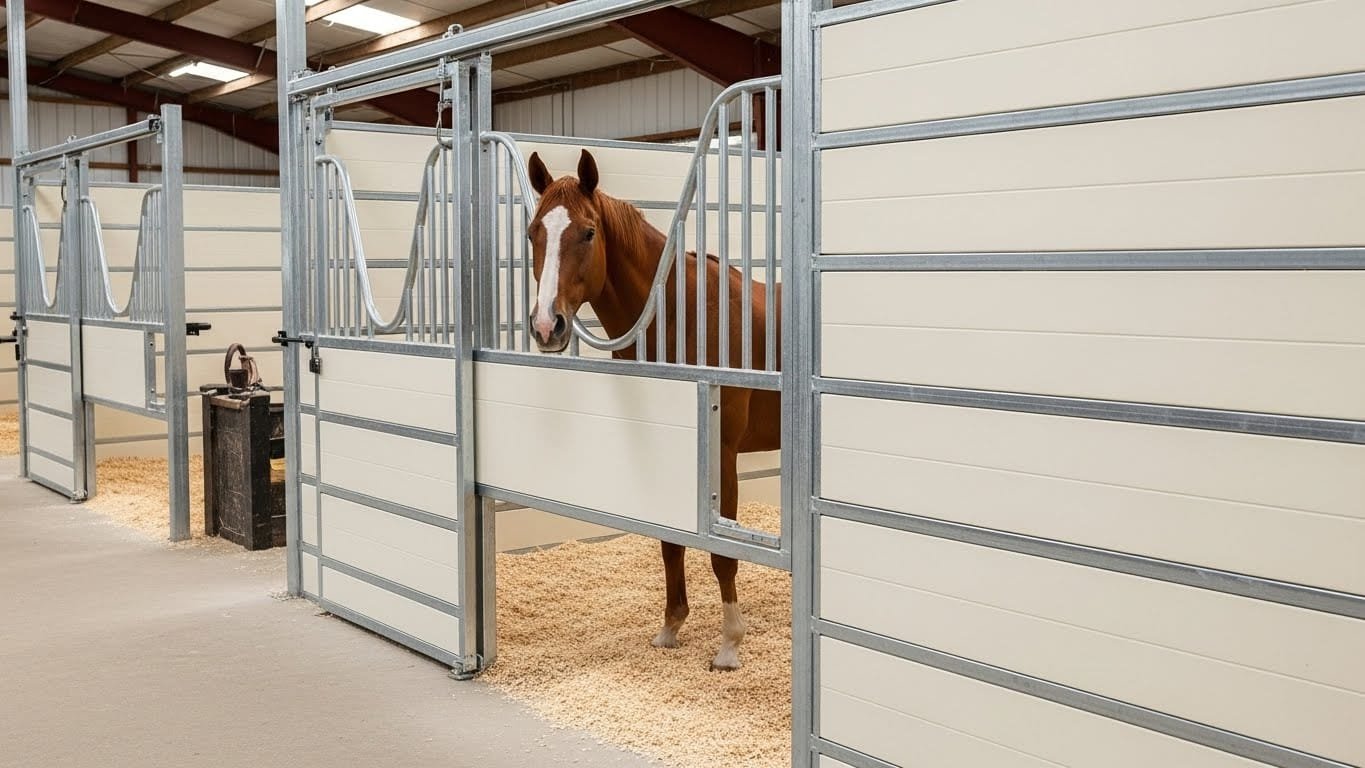
HDPE plastic lumber offers superior sanitation due to its non-porous, seamless surface, resisting moisture and bacterial growth. It can be safely deep-cleaned with pressure washers up to 1,500 PSI and common disinfectants, ensuring a hygienic environment for horses.
| Fonctionnalité | Key Characteristics / Benefits | Specific Parameters / Comparison |
|---|---|---|
| HDPE Plastic Lumber | Non-porous, seamless surface. Repels moisture, bacteria, and waste buildup. Resists mold, mildew, and chemical leaching. Maintains hygiene. | Withstands pressure washing up to 1,500 PSI. Superior to absorbent wood or rust-prone metal. |
| Cleaning Protocols | Enables effective deep cleaning. Supports optimal horse health. Uses less water than continuous hosing. | Initial wash (≤1,500 PSI). Mild dish soap or 1/3 bleach + 2/3 water mixture, thorough rinse. Frequency: Every 3-6 months. |
| Pressure Washing | Safely removes embedded grime. Preserves structural integrity without degradation. | Up to 1,500 PSI for HDPE. Avoids damage to powder coatings (steel) or material absorption (wood). Use medium-to-high pressure with a gentle nozzle. |
| Drainage | Prevents water pooling during and after washes. Maintains footing safety for horses. | Slopes of 1-2% (or 1 inch per 6 feet) recommended. |
Inherent Cleanliness: HDPE’s Non-Porous Advantage
HDPE plastic lumber is non-porous and seamless, repelling moisture, bacteria, and waste buildup effectively.
This inherent resistance to mold and mildew helps maintain a hygienic environment, meeting critical vet and breeder standards.
Unlike absorbent wood or rust-prone metal, HDPE does not degrade or leach chemicals when exposed to moisture or disinfectants.
Effective Cleaning Protocols and Durability
HDPE can withstand pressure washing up to 1,500 PSI for effective deep cleaning without structural damage.
A typical cleaning protocol involves an initial high-pressure wash, followed by mild dish soap or a 1/3 bleach + 2/3 water mixture, and a thorough rinse.
Cleaning every 3-6 months supports optimal horse health and uses less water than continuous hosing.
Proper drainage, such as slopes of 1-2% (or 1 inch per 6 feet), helps prevent water pooling during and after washes.
Global-Ready Horse Stables: Built for Every Climate

Benefit 3: Color Customization
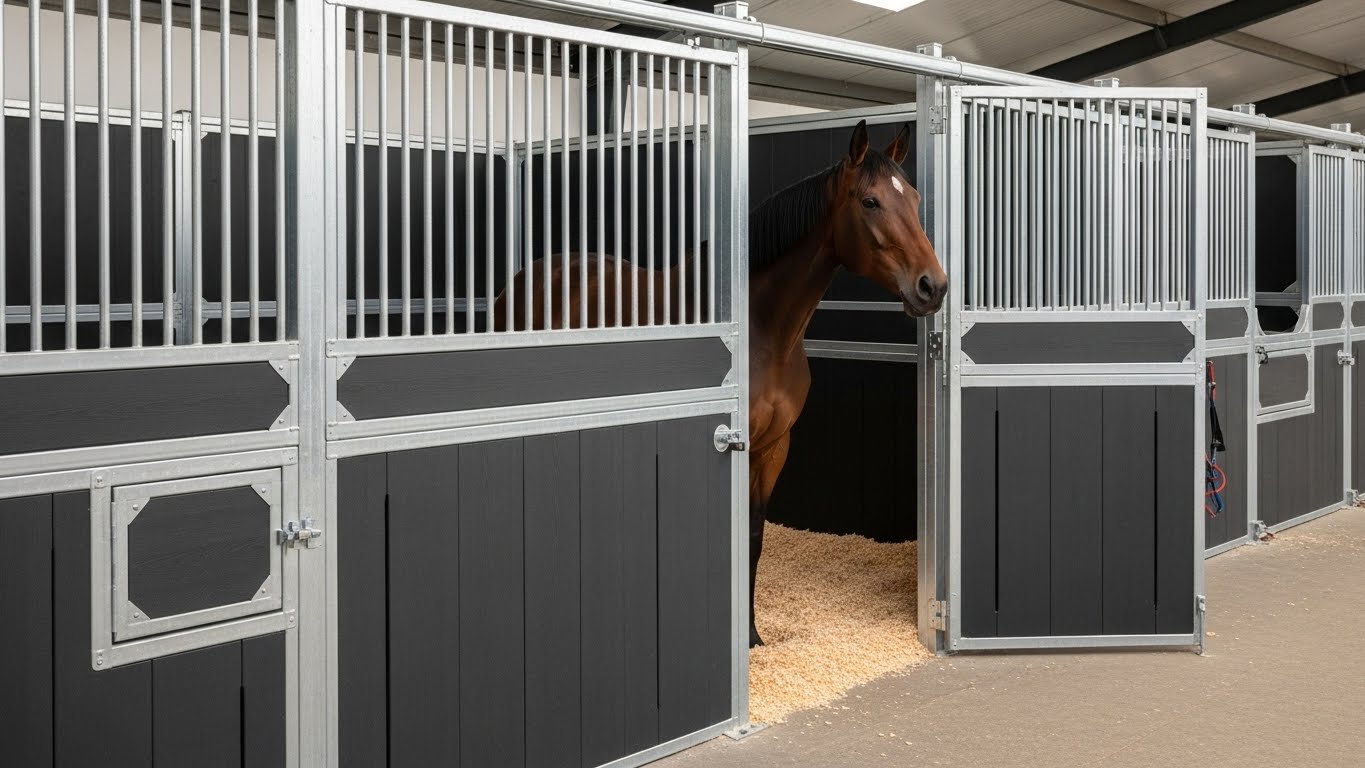
HDPE lumber offers robust color customization through integral pigmentation and continuous UV stabilization, ensuring vibrant, fade-resistant colors throughout the material. This allows for diverse aesthetic choices, functional color-coding in facilities, and matching with powder-coated cadres en acier for a cohesive design, while also considering practical aspects like thermal performance.
Integral Color & UV Protection
HDPE lumber features integral pigments, embedding color throughout the entire cross-section rather than as a surface film.
Continuous UV stabilizers are incorporated into the HDPE to protect colors from fading and weathering long-term.
This ensures color consistency, even if panneaux are scratched or chewed, which is crucial for hygienic vet/breeder environments.
Diverse Palettes & Application
HDPE panels are available in a broad palette, such as 8 standard colors from American Stalls (white, black, dark brown, cedar, gray, redwood, hunter green, weathered wood) and options like black, gray, white, blue, green from JHorse.
Acier stall frames are powder-coated to precisely match specified HDPE infill colors, allowing for unified facility-wide design schemes.
Modular systems enable mixing different HDPE panel colors (e.g., for isolation stalls vs. foaling stalls) to assist with wayfinding and biosecurity zoning.
Lighter HDPE colors visibly mask thermal sag better in intense heat compared to darker colors, a practical detail for high-sun exposure.
Custom branding, including logos and nameplates, can be integrated into colored façades de box and doors for personalized facilities.
Common Misconceptions
Many believe HDPE plastic lumber lacks the strength or longevity of wood, or that it’s less hygienic. In 2026, HDPE is recognized for superior impact resistance, non-absorbent properties preventing rot and bacterial growth, and requiring minimal maintenance, directly challenging these long-held beliefs.
Durability and Strength Compared to Wood
The notion that plastic lumber is weak or brittle is incorrect; 100% virgin HDPE naturally flexes to absorb full leg kicks from horses without splintering, a common issue with softwoods.
Unlike wood, HDPE does not warp, twist, shrink, or splinter, maintaining structural integrity over time.
Internal reinforcing ribs in HDPE 2×6 rails and thick sidewalls, like those in 6×6 posts weighing almost twice standard PVC, provide significant strength and impact resistance.
HDPE is resistant to extreme temperatures, withstanding -60°F without becoming brittle, ensuring reliability in diverse climates.
Hygiene, Maintenance, and Environmental Impact
HDPE’s non-absorptive, non-porous surface prevents the absorption of moisture, animal wastes, and acids, directly countering the misconception that it fosters bacteria or rot.
Easy to clean with a pressure washer, HDPE eliminates the need for painting, staining, or sealing, reducing long-term coûts de maintenance and effort.
Contrary to concerns about toxins, HDPE is free from chlorides and arsenic found in some treated woods, and includes UV stabilizers for longevity.
While lighter (approximately 25% the weight of equivalent solid wood), its robust construction with thick walls ensures stability and safety, outperforming wood in longevity and disease prevention for equine environments.
Réflexions finales
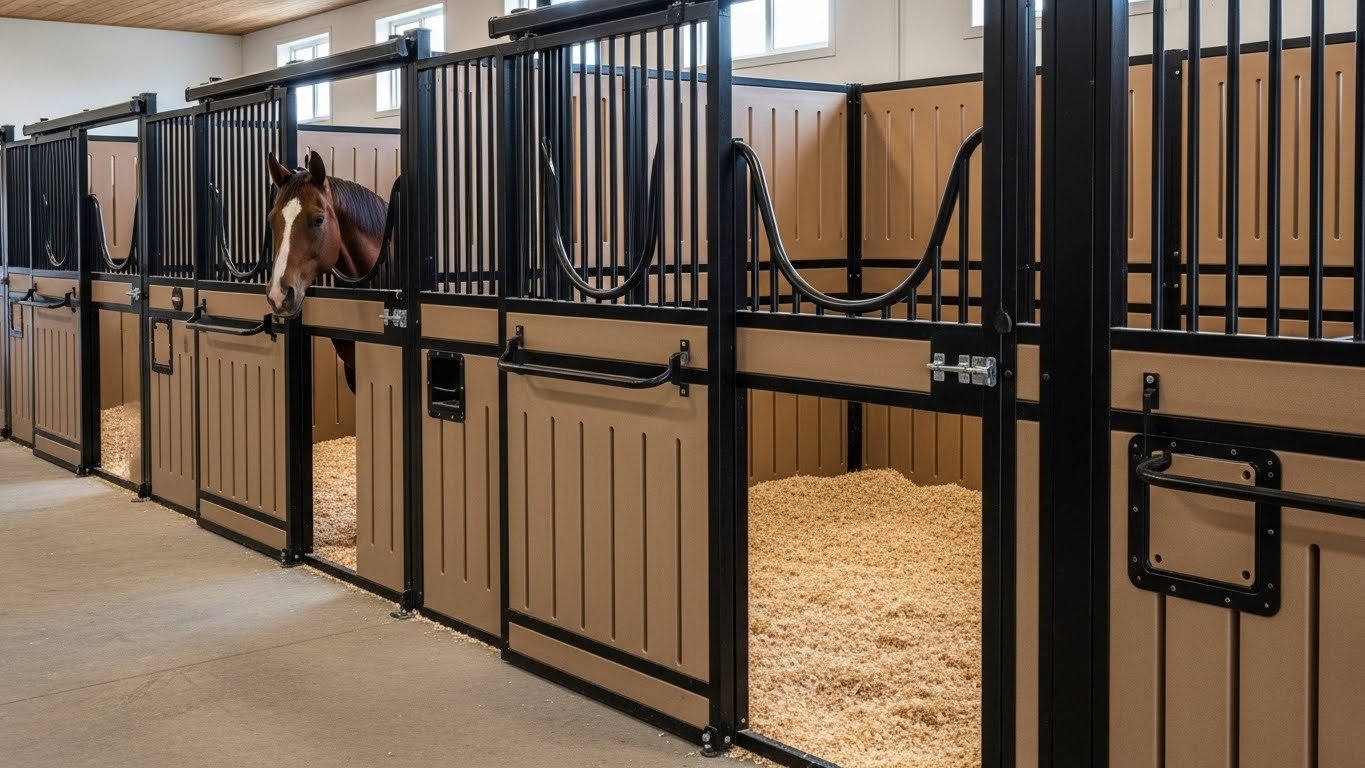
HDPE plastic infill provides a genuinely practical material choice for busy barn owners. It reliably withstands moisture, rot, and rigorous cleaning, keeping facilities sanitary and sound. Horse owners also value its safety, as it won’t splinter and offers a non-absorbent surface. With various colors and robust UV stability, it combines essential function with flexible design for any equine environment.
Although the initial investment might be higher than traditional wood, HDPE infill offers substantial valeur à long terme and peace of mind. Its resistance to decay and damage frees up time from repairs and directs focus back to horse care. Choosing HDPE creates a stable, healthy, and visually consistent barn environment that performs reliably for decades. It’s a smart decision for any barn seeking a dependable, low-upkeep solution.
Questions fréquemment posées
Is plastic lumber safe for horses?
Yes, horse-stall plastic lumber made from HDPE (high-density polyethylene) is considered safe for horses when properly installed. It does not splinter when kicked, is non-absorptive (allowing for regular disinfection), and does not require chemical sealants. Equine design sources recommend HDPE recycled plastic tongue-and-groove stall boards as a preferred material due to their safety, splinter resistance, non-absorptive nature, and low maintenance.
Does recycled plastic look like wood?
Yes, commercial recycled HDPE plastic lumber is specifically engineered to visually mimic wood. It utilizes multi-tone color systems and embossed deep wood grain surfaces to create a high-simulation natural wood texture and depth of tone similar to wood finishes. Products are available in standard wood tones like Cedar, Redwood, and Mahogany, often with non-repeating embossed grains or wood-like foam board finishes. These boards are also sold in standard lumber dimensions (e.g., a plastic 2×4 matches wood industry standard sizing) for direct substitution.
Can I pressure wash plastic stalls?
Yes, solid HDPE plastic stall panels can be pressure washed. Manufacturers explicitly list power washing and steam cleaning as acceptable cleaning methods for solid HDPE panels without risking delamination, water absorption, or finish loss. This is provided standard commercial cleaning pressures and compatible detergents are used. HDPE stall panels are waterproof, water-resistant, and unaffected by steam or high humidity, making them ideal for these routine cleaning methods.
Do plastic boards warp in heat?
No, HDPE plastic boards do not typically warp in heat conditions below their heat deflection temperature of 46-95°C (115-203°F) or continuous service temperature of 82°C (180°F). They are engineered for dimensional stability. While HDPE exhibits thermal expansion (approximately 0.12 mm/m/°C), significant warpage only occurs during thermoforming processes above 285°F if cooling is inadequate. Stall framing and fastener patterns account for this thermal movement.
Is HDPE cheaper than wood?
For structural plastic lumber and livestock applications, HDPE boards are typically more expensive than wood upfront, often 2–4 times the material price per board-foot. However, they become cheaper over their service life because they require virtually no painting, sealing, or rot/insect repairs, lasting roughly 2–3 times longer outdoors. For instance, a typical outdoor wood deck lasts 10–15 years, while an equivalent HDPE deck is expected to last 25 years or more, significantly reducing maintenance and replacement costs.
What are the pros and cons of plastic horse stalls?
Plastic horse stalls built with HDPE ‘stall lumber’ or infill boards offer superior hygiene, low maintenance, and impact/chew resistance compared to wood, despite a higher upfront material cost. They are smooth, non-porous, easier to clean, and impermeable to animal waste acids. They perform well in extreme temperatures (rated to –60 °F), resist impacts, and are UV-stabilized. However, HDPE is a combustible thermoplastic, so incendie codes must be checked. They can exhibit slight thermal movement and sag in extreme heat (more visible in darker colors), and while tough, they are softer than steel or hardwood, making them susceptible to scratches, though this doesn’t typically affect hygiene. Most plastic lumber serves as infill, with primary structural duties handled by steel or timber frames.

 French
  English
  Spanish
  Arabic
  German
0 commentaires