


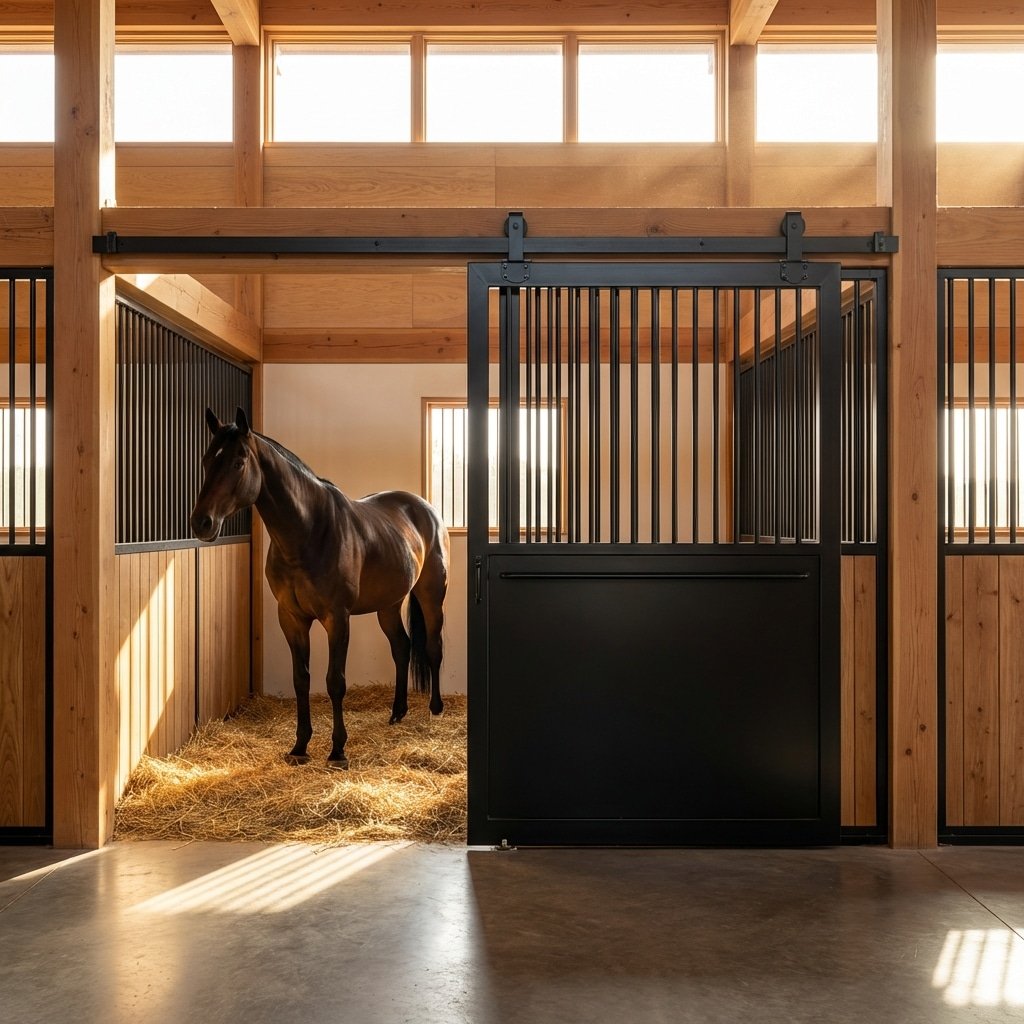
Floor Tracks Rust inevitably when exposed to the ammonia-rich slurry found in active horse stables. Installing bottom U-channels creates a drainage failure point that accelerates corrosion and seizes door mechanisms. For contractors, this design error guarantees expensive warranty callbacks and safety liabilities that damage long-term client relationships.
We engineered the solution by eliminating the threshold entirely through our Professional Series top-hung system. Utilizing Q345B structural headers and strict BS EN ISO 1461 galvanización en caliente, this design removes the steel from the wet zone. This approach ensures Cast-Proof safety and prevents the mechanical seizures common with ground-contact hardware.
The Mistake of the U-Channel Floor Track
U-channel floor tracks create dangerous trip hazards and unavoidable corrosion traps. Modern top-hung systems eliminate these liabilities by removing the threshold en
tirely.
The Trip Hazard: Creating Unnecessary Obstacles
Installing a metal bar across a stable doorway is a fundamental design error. A floor-mounted U-channel creates a rigid threshold, typically standing 20mm to 40mm above the ground. In a high-traffic equine environment, this fixed obstacle creates an immediate safety liability.
Horses often drag hooves when tired or rush when excited. A raised metal track increases the probability of a horse clipping the edge, leading to stumbles or hoof wall damage. This design directly violates the “Cast-Proof Design” principle we adhere to. By introducing sharp metal edges at ground level, you create a risk zone where a rolling horse can trap a leg or sustain lacerations against the track profile.

The Corrosion Trap: Undermining Zinc Protection
Gravity works against the U-channel design. The U-profile functions as a gutter, collecting a corrosive slurry of acidic urine, water, and manure. Because the track is bolted to the floor, there is no drainage, and the steel sits in a permanent state of submersion.
This environment defeats even the highest quality protection. While we hot-dip galvanize our steel to BS EN ISO 1461 standards, constant exposure to ammonia-rich standing water will eventually penetrate the zinc layer. The “wet zone” inside a U-channel accelerates oxidation significantly faster than vertical components.
To prevent this, our Professional Series utilizes a top-hung system. By suspending the door from above, we eliminate the need for a floor track entirely. This design choice removes the corrosion trap and ensures the galvanization remains intact for the lifespan of the stable.
The Dirt Trap: Manure, Mud, and Frozen Urine
Floor tracks collect organic waste that freezes into concrete-like barriers in winter, creating operational failures and accelerating corrosion through concentrated ammonia exposure.
Winter Compaction: When Manure and Urine Freeze
Standard floor tracks function as unintentional gutters within a stable. Gravity naturally directs bedding, manure, and fluids into these recessed channels. In temperate climates, this is a hygiene nuisance. In regions with harsh winters, however, this accumulation creates a critical mechanical failure point known as winter compaction.
- The “Concrete” Effect: During winter storage periods (often exceeding 180 days in colder zones), the mixture of concentrated urine and mud freezes solid. This creates a hard blockage in recessed tracks that prevents doors from sliding, often requiring manual chipping or heat to clear.
- Operational Impact: When these blockages eventually thaw, they release highly concentrated corrosive agents. This “slurry” is significantly more damaging to steel than fresh waste because the water content evaporates, leaving behind potent ammonia and uric acid salts.
- Hygiene Risk: Even when not frozen, accumulated organic matter in narrow channels becomes a breeding ground for bacteria. These areas are difficult to clean thoroughly without pressure washing, which introduces more moisture into the facility.
Combating Acidic Corrosion: The ISO 1461 Standard
The environment at floor level is chemically aggressive. Manure and urine contain ammonia and uric acid, which rapidly oxidize standard steel, leading to Red Rust. Many manufacturers use pre-galvanized tubing (zinc applied before welding), which leaves the weld seams vulnerable to this acidic attack. To counter this, we adhere to a stricter manufacturing protocol.
- Hot-Dip After Fabrication: We weld the black steel components first, then dip the entire structure into molten zinc. This ensures 100% coverage, including inside the tubes and over the weld seams.
- The DB Defense (ISO 1461): Our process conforms strictly to BS EN ISO 1461. This is not a generic “rust-proof” claim; it is a measurable industrial standard.
- Zinc Thickness: For structural parts (steel >6mm), we achieve an average coating of > 85 microns (μm). This exceeds the thickness of standard consumer-grade fencing, providing the necessary barrier against the chemical breakdown common in floor-level components.
Global Standard Stables With 20-Year Durability
The Jammed Door: When the Bottom Track Fills Up
Bottom tracks act as gutters for bedding and manure, creating a hardened paste that seizes rollers and renders doors immobile during emergencies.
The Gravity Trap: Bedding and Manure Accumulation
Standard U-channel designs fundamentally fight against the reality of a working stable. By positioning the track on the floor, you effectively install a gutter in a high-traffic zone. Gravity ensures that shavings, straw, and manure dust settle into this low-lying channel throughout the day.
The real failure happens when moisture enters the equation. Whether from urine splash or daily wash-downs, water mixes with the accumulated organic debris. This combination binds the loose dust into a hardened, cement-like paste inside the track. Once this material dries, it blocks the roller path completely, turning a sliding door into a fixed wall.
Mechanical Seizure: The Impact of Rust Flakes
Beyond organic blockage, internal corrosion creates a secondary friction point. Because the U-channel structure traps water, rust forms on the inner walls of the track where it is difficult to inspect or clean. Over time, this
rust flakes off into small, jagged metal particles.
These metallic flakes mix with the bedding paste to form an abrasive grinding compound. This mixture eats away at the roller bearings and jams the mechanism. In a fire or medical emergency, you need a door that slides instantly. A bottom-track system filled with this corrosive debris requires significant force to open, creating a severe safety liability.
The DB Solution: Top-Hung Box Tracks with Zero Thresholds
We engineered the floor track out of existence. By shifting the load to a heavy-duty overhead header, we eliminate the primary cause of mechanical failure in horse stables.
| Característica | Traditional Floor Track | DB Top-Hung System |
|---|---|---|
| Load Bearing | Floor rollers (High Friction) | Overhead Header (Gravity Assist) |
| Obstruction | Raised metal lip (Trip Hazard) | Zero Threshold (Barrier-Free) |
| Winter Performance | Prone to freezing urine jams | Unaffected by ground ice |
| Mantenimiento | Weekly clean-out required | Sealed / Maintenance-Free |

Operational Mechanics of Suspended Sliding Systems
The concept is simple but changes the daily workflow in a stable: remove the hardware from the dirt. In a top-hung system, the door’s weight hangs entirely from the top lintel. This eliminates the bottom U-channel, which acts as a magnet for manure, bedding, and urine. Without this channel, you remove the risk of “frozen lock” in winter, where liquid pools in the track and freezes the door shut.
This engineering shift creates a “Zero Threshold” entry. Horses pass through without lifting their hooves over a metal lip, and staff can drive tractors or feed carts into the stall without jarring bumps that damage wheel axles. Gravity naturally aligns the door vertically, reducing the friction that typically grinds down ground-contact rollers.
Professional Series Specs: The Enclosed Hidden Track
We do not use exposed barn door hardware found in residential lofts. In an equestrian environment, open rollers gum up with dust and cobwebs immediately. The DB Stable Professional Series utilizes a specialized “Hidden Track” design.
- Enclosed Box Profile: The steel track wraps around the rollers, shielding the mechanism from falling hay dust, rain, and nesting birds.
- Q345B High Strength Steel Header: We upgrade the load-bearing header from standard Q235 to Q345B. This increased tensile strength prevents the track from sagging over time under the 100kg+ weight of a hardwood-infilled door.
- 304 Stainless Steel Rollers: Unlike carbon steel bearings that rust and seize from stall humidity, we use 304-grade stainless steel for the carriage wheels to ensure smooth operation for the lifespan of the stable.
- Cast-Proof Guide System: While we remove the track, we retain a small, wall-mounted bottom guide. This prevents the door from swinging out (kick-through) while maintaining a safe 50mm clearance gap to prevent hoof casting.
Reflexiones finales
Eliminating floor tracks isn’t just a design preference; it is a liability shield for your dealership. By adopting our Professional Series top-hung system, you remove the primary cause of injury claims and warranty calls driven by urine-induced corrosion. Stick to BS EN ISO 1461 standards to ensure your installations protect both the horse and your long-term reputation.
Your clients demand safety, and your margins depend on zero-defect hardware that survives the stable environment. Request our Technical Specification Catalog today to review the load ratings of our Q345B overhead headers. Contact our engineering team directly to configure a Trial Order and prove the mechanical superiority in your own facility.

 Spanish
  English
  French
  Arabic
  German
0 comentarios