


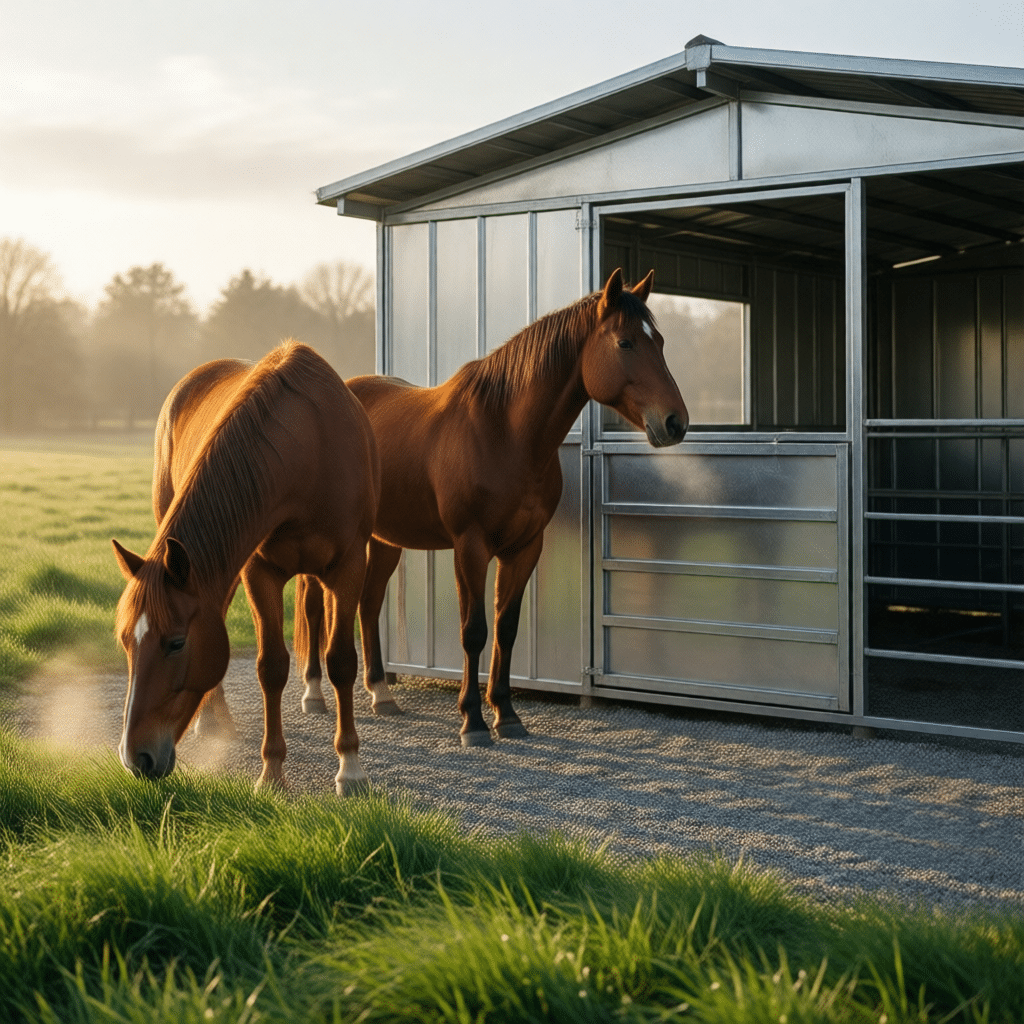
Paddock Footing selection determines whether your shelter investment lasts decades or fails within a single winter. Neglecting proper base layers accelerates soil structure collapse, turning high-traffic entrances into unstable sinkholes that compromise animal safety and undermine the shelter foundation.
This technical analysis compares crushed stone dust and interlocking grids against the corrosive reality of deep bedding systems. We demonstrate how pairing a stabilized 1–2% drainage slope with our Galvanizado en caliente Q235B steel frames—coated to exceed 70 microns—prevents the structural rot common in standard painted alternatives.
The “Shelter Sinkhole” Problem During Winter
Concentrated hoof traffic destroys soil structure while roof runoff saturates the base. Freeze-thaw cycles exacerbate this, turning shelter entrances into unstable, dangerous mud traps.
Horses naturally congregate in run-in sheds and shelters for protection during inclement weather. This behavior creates a localized zone of intense impact. The repetitive force of hooves on wet ground mechanically destroys the soil structure, a process industry experts refer to as “pugging.”
Once the soil structure fails, the sub-soil compacts into an impermeable layer. This hardpan prevents vertical drainage, trapping water on the surface. The result is a viscous slurry that deepens with every step, risking tendon injuries and making access difficult for both animals and handlers.

Roof Runoff and Hydraulic Erosion Channels
Structural design flaws often accelerate this deterioration. Many standard field shelters lack gutter systems, which directs all roof water straight to the structure’s perimeter. This concentrated volume of water acts like a hydraulic drill, creating “dripline” erosion channels that physically excavate the footing and undermine the shelter’s base.
The problem peaks during winter. Excess moisture trapped in the ground accelerates the freeze-thaw cycle. When the ground freezes, it expands and heaves; when it thaws, it loses cohesion entirely. This cycle destabilizes the base, turning the shelter entrance into a sinkhole exactly where the footing needs to be most secure.
Excavating and Laying Geotextile Fabric
A stable foundation requires removing all organic topsoil and establishing a 1–2% drainage slope. Taut fabric placement with 30–60cm overlaps prevents mud migration and safeguards structural integrity.
Site Preparation and Excavation Standards
Most foundation failures start with lazy excavation. You cannot build a stable heavy-use area on top of organic material. We strip the site down to the subsoil, removing soft organic matter that holds water and compresses under hoof traffic. Skipping this step guarantees sinking and shifting later.
- Clear Debris: Remove roots, vegetation, and sharp rocks. These objects create pressure points that puncture the fabric, reducing its lifespan and durability by 15–20%.
- Establish Drainage Grade: Level the subgrade to remove undulations and grade the surface with a 1–2% slope. This directs subsurface water away from the stable rather than letting it pool underneath.
- Compaction: Use a vibratory roller to compact the soil to a minimum density of 95% Proctor. Loose soil settles unevenly once heavy horses enter the shelter.
Proper Placement and Seaming Techniques
Geotextile fabric functions as a separation layer, preventing your expensive footing from disappearing into the clay subsoil. Installation quality dictates performance; folds or loose sections compromise the fabric’s ability to distribute weight effectively.
- Tensioning: Lay the fabric horizontally and pull it taut. Wrinkles and folds act as failure points, reducing load distribution performance by up to 20%.
- Seam Overlap: Overlap adjacent rolls by 30–60cm. Softer subgrades require the wider 60cm overlap to prevent the layers from separating under pressure and allowing mud to migrate up.
- Securing: Pin the fabric with landscape staples every 1–2 meters. This prevents movement during the dumping and spreading of the aggregate base layer.
Premium Global Horse Stables Direct Manufacturer

Crushed Stone Dust vs Sand vs Wood Chips
Crushed stone dust provides superior stability and drainage if clay-free, while wood chips offer cushioning but trap moisture that rots timber, making hot-dip galvanized steel the only viable structural choice.
| Material | Drainage Profile | Structural Impact | El mejor caso de uso |
|---|---|---|---|
| Crushed Stone Dust | Excellent (if clay-free) | Low Risk (Stable base) | Permanent bases & high-traffic zones |
| Sand | Fast / Moderate | Budget options & dry climates | |
| Wood Chips | Retains Moisture | High Risk (Acidic rot/rust) | Cushioning layers over a hard base |
Analyzing Drainage and Stability: Material Pros and Cons
Selecting footing is about balancing hoof health with maintenance reality. Each material behaves differently under load and moisture, and picking the wrong one for your climate creates an expensive maintenance sinkhole. We synthesized the performance data into three categories:
- Crushed Stone Dust (Quarter-Minus): This is the industry standard for a reason. It offers superior compaction and hoof support, creating a firm surface that doesn’t shift. Warning: You must verify the fines content. If the mix contains clay, it will harden into concrete in summer and turn into a slick, non-draining slurry in winter.
- Sand: While this is the most economical option initially, the long-term costs hide in veterinary bills and top-ups. Sand is abrasive on hooves and creates instability for ligaments. More critically, if you feed directly on this surface, the risk of sand colic (ingestion) increases significantly.
- Wood Chips: Owners choose this for shock absorption and aesthetics. The trade-off is degradation. Wood chips are organic; they break down, turn to mush, and hold water like a sponge. This requires frequent top-ups to maintain any semblance of drainage.
Corrosion Resistance in Deep Bedding: The Galvanization Advantage
The interaction between your footing and the stable structure is often overlooked until the rust appears. Deep bedding systems, particularly those using moisture-retentive materials like wood chips or wet sand, create a “corrosion zone” at the base of your stable frames.
- The Moisture Trap: As organic materials like wood chips decompose, they become acidic and retain moisture against the bottom 6 inches of your stable front. This environment rots timber posts rapidly and eats through standard painted steel or pre-galvanized welds within seasons.
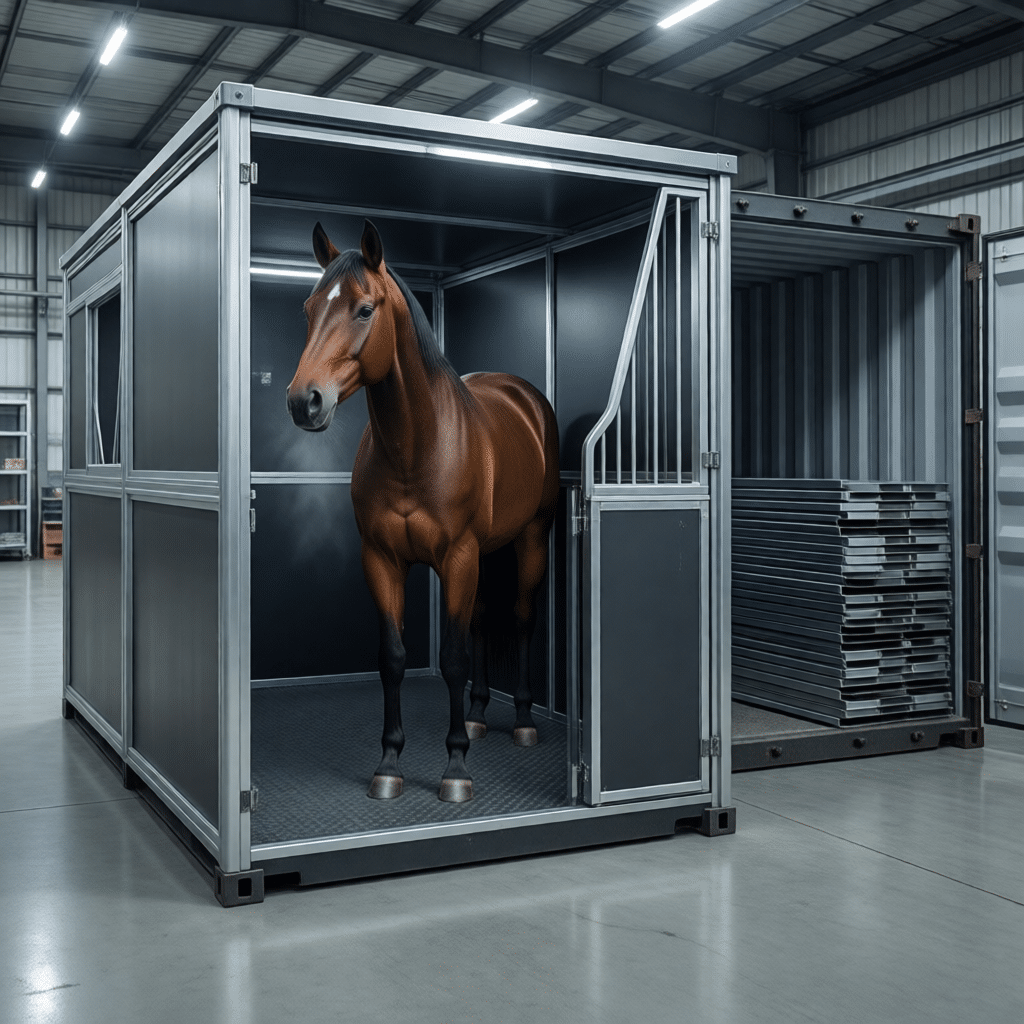
- DB Spec Solution: We engineer for this specific abuse. Our frames undergo Galvanización en caliente después de la fabricación (BS EN ISO 1461). This deposits a zinc coating thicker than 70 micras on the tubing, sealing the steel inside and out. This barrier is the only thing that stops the “deep bedding acid” from compromising the structure.
- Integridad estructural: Footing layers shift. Sand displaces and wood chips compress. We use Q235B Structural Steel to ensure the frame remains rigid and the doors operate smoothly, even if the ground footing compacts unevenly over time.
Installing Mud-Control Grids Under the DB Shelter
Install grids in a staggered brick pattern with a strict 5cm expansion gap around DB Shelter posts to prevent buckling, then backfill with coarse sand for stability.
Laying the Interlocking Grid System
Correct installation starts with the layout pattern. You must lay the grids in a staggered “brick-style” formation rather than a linear grid pattern. This offset arrangement significantly increases structural integrity and prevents the surface from shifting under the weight of horses. Start the first row across the full length of the shelter area to establish a straight line.
- Interlocking Tabs: Connect the tabs securely, but avoid jamming them too tightly. The plastic requires slight room for thermal adaptation.
- Sub-Base Requirements: On soft ground, these grids act as both the base and sub-base. Extensive excavation is usually unnecessary unless the ground is completely compromised.
- Row Alignment: Ensure the first row is perfectly square with the shelter entrance before proceeding to subsequent rows.
Expansion Gaps and Surface Finishing
The interaction between plastic grids and our rigid Q235B hot-dip galvanized steel frame requires specific clearance. Plastic expands significantly during hot weather, while the steel frame remains static. If you install the grids flush against the posts or kickboards, the floor will buckle and lift.
- Expansion Gap: Maintain a strict 5cm (2-inch) gap between the grids and any fixed object, including shelter posts and walls.
- Backfill Material: Fill the grid cells with coarse sharp sand or pea gravel. This locks the grids in place and aids drainage.
- Top Layer: Apply a 3cm layer of wood chips or riding sand over the filled grids. This provides a comfortable, non-slip bedding layer that protects the plastic from direct hoof impact.
Preguntas frecuentes
What is the best flooring for a run-in shed?
The ideal flooring balances drainage and comfort. A compacted crushed stone base topped with stone dust (screenings) works best because it firms up over time and allows for easy cleaning. Sand drains well but carries colic risks if horses eat hay directly off the surface. Avoid plain dirt, as it lacks structural support and quickly turns to mud under hoof traffic.
How do I stop my paddock shelter from getting muddy?
Mud control starts with water management—install gutters to divert roof runoff away from the shelter entrance immediately. For the ground, use a multi-layer foundation: a compacted subgrade, a geotextile fabric to separate layers, and a crushed stone base. For the best long-term results in high-traffic zones, install mud-control grids under the top layer to lock the aggregate in place and prevent displacement.
What is the best footing for outdoor horse stables?
Angular sand is the top choice because the particles interlock for stability, unlike round sand which rolls and creates unstable footing. For high-traffic commercial areas, mixing angular sand with synthetic fibers or rubber improves cushioning and moisture retention. Always ensure you have a proper base layer that extends at least two feet beyond the fence line to prevent edge collapse.
Reflexiones finales
Your customers might compromise on footing materials, but you cannot afford to supply stables that fail in the inevitable “corrosion zone.” Deep bedding environments act like acid baths on standard steel, making our Galvanización en caliente después de la fabricación (BS EN ISO 1461) the only viable commercial standard. Selling frames with anything less than a 70-micron zinc coating invites warranty claims that destroy your margins and dealer reputation.
Stop guessing on steel quality and verify our corrosion resistance firsthand. Request a technical sample kit today to test our galvanization thickness against your current supplier. Contact our engineering team to secure your Q3 production slots and lock in competitive pricing for your next container load.

 Spanish
  English
  French
  Arabic
  German
0 comentarios