


Outdoor weathering dictates the actual lifespan of any free-standing equestrian structure. While generic painted panels offer lower upfront costs, they fail rapidly under UV and moisture exposure, forcing owners to replace rusted frames within just a few seasons.
This guide examines the engineering required to convert portable panels into permanent shelters using Q235B structural steel. We analyze pitch angles for effective snow shedding and ISO 1461 hot-dip galvanization standards to ensure your setup withstands environmental stress without structural degradation.
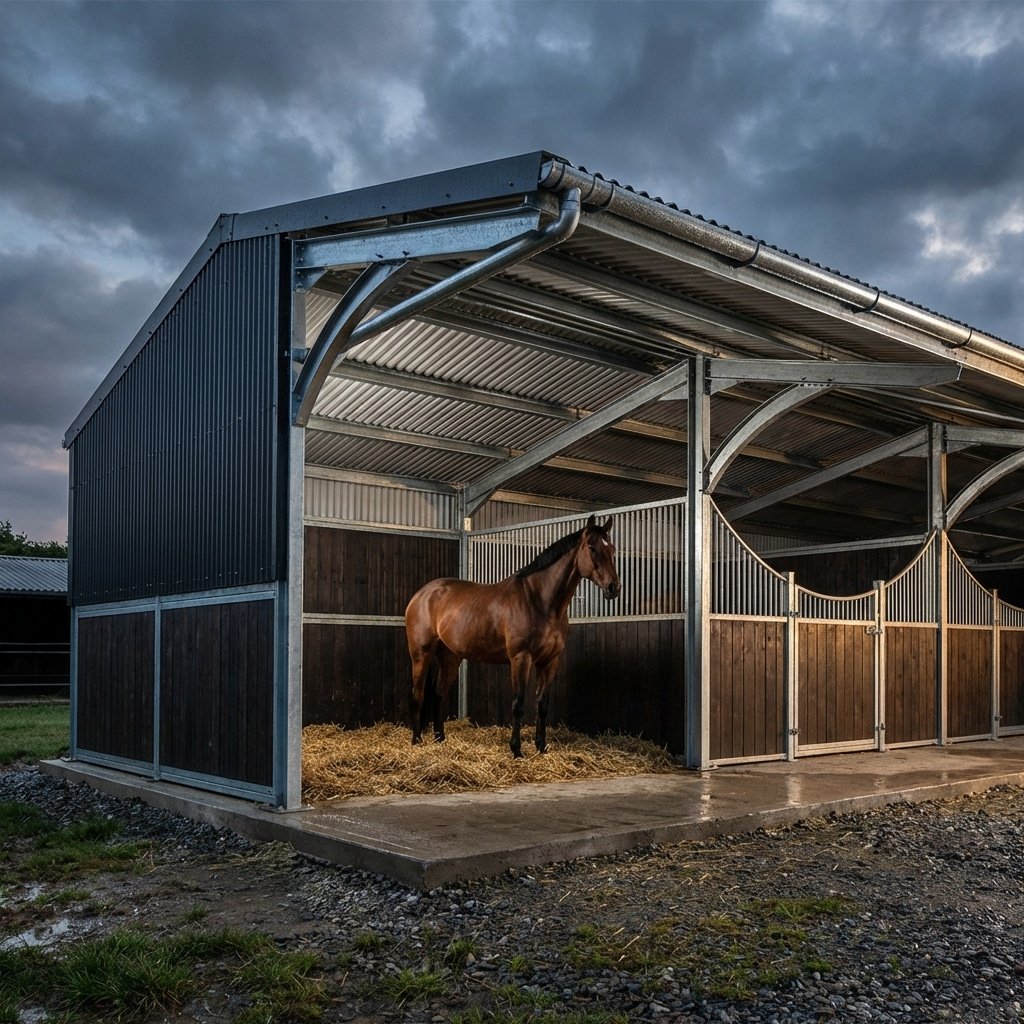
Converting Portable Panels into Permanent Shelters
Portable panels become permanent assets when you anchor 50mm RHS frames to concrete using heavy-duty bolts, utilizing hot-dip galvanized steel to withstand decades of weather and livestock impact.
Foundation Anchoring: Utilizing the 304 Stainless Steel Hardware Kit
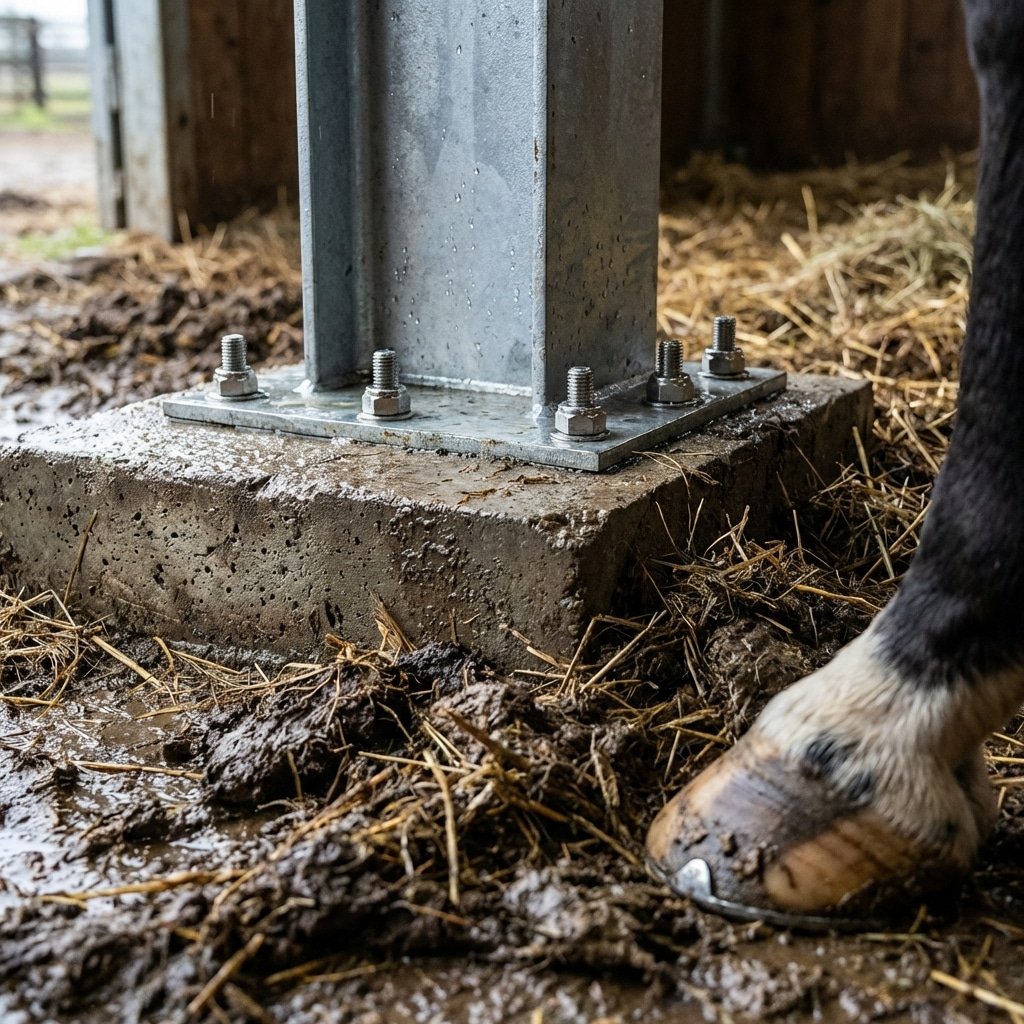
Most portable panels rely on loose ground pins for temporary holding. This works for a weekend show, but for a permanent shelter, you need a solid mechanical connection to a concrete footing. Wind loads and livestock pressure will shift any structure not bolted down. You must ensure the 50mm x 50mm RHS posts are plumb and rigid against these forces.
We supply a dedicated 304 Stainless Steel hardware kit for this exact transition. Ground-level connections face the harshest environment—wet bedding, urine, and mud. Standard zinc-plated anchors rot out in a few years under these conditions. Stainless steel ensures the anchor bolts survive as long as the galvanized frame, preventing failure at the base.
Structural Longevity: The Q235B Hot-Dip Galvanized Framework
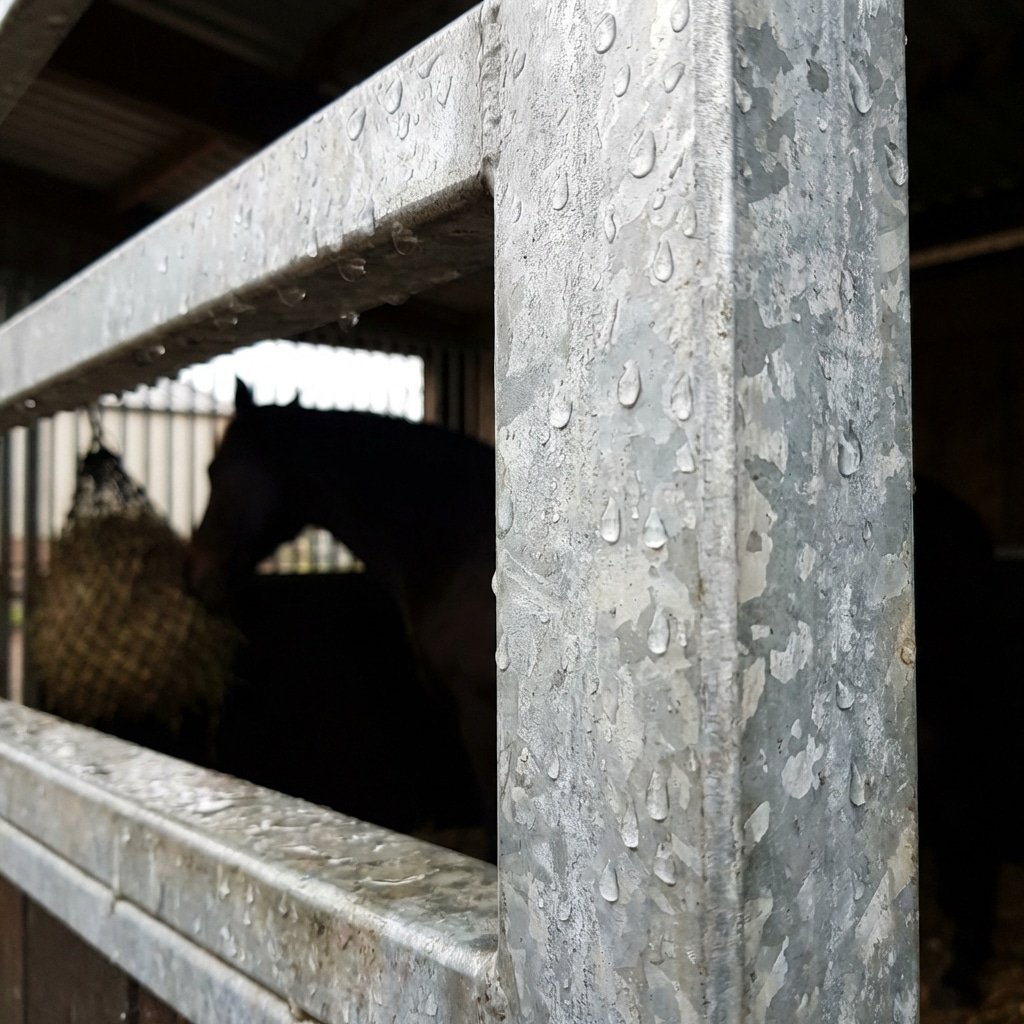
The difference between a temporary tent and a permanent building lies in the steel specification. Many portable shelters use thin 1.5mm tubing with a cosmetic powder coat. We strictly use Q235B structural steel engineered for permanent loads, differentiating our panels from light-duty competitors.
- Espesor de pared: 14-Gauge (2.0mm – 2.5mm) to prevent buckling under snow or wind load.
- Galvanization Standard: BS EN ISO 1461 (Hot-Dip After Fabrication).
- Espesor del revestimiento: >85 microns on structural parts, exceeding the < 40 microns found on pre-galvanized tube.
For outdoor exposure, paint or simple spray-on coatings are not enough. Hot-dip galvanization bonds zinc to the steel at a molecular level. Unlike fabric shelters or powder-coated alternatives that peel and rust within seasons, this framework withstands decades of rain and UV exposure without structural degradation.
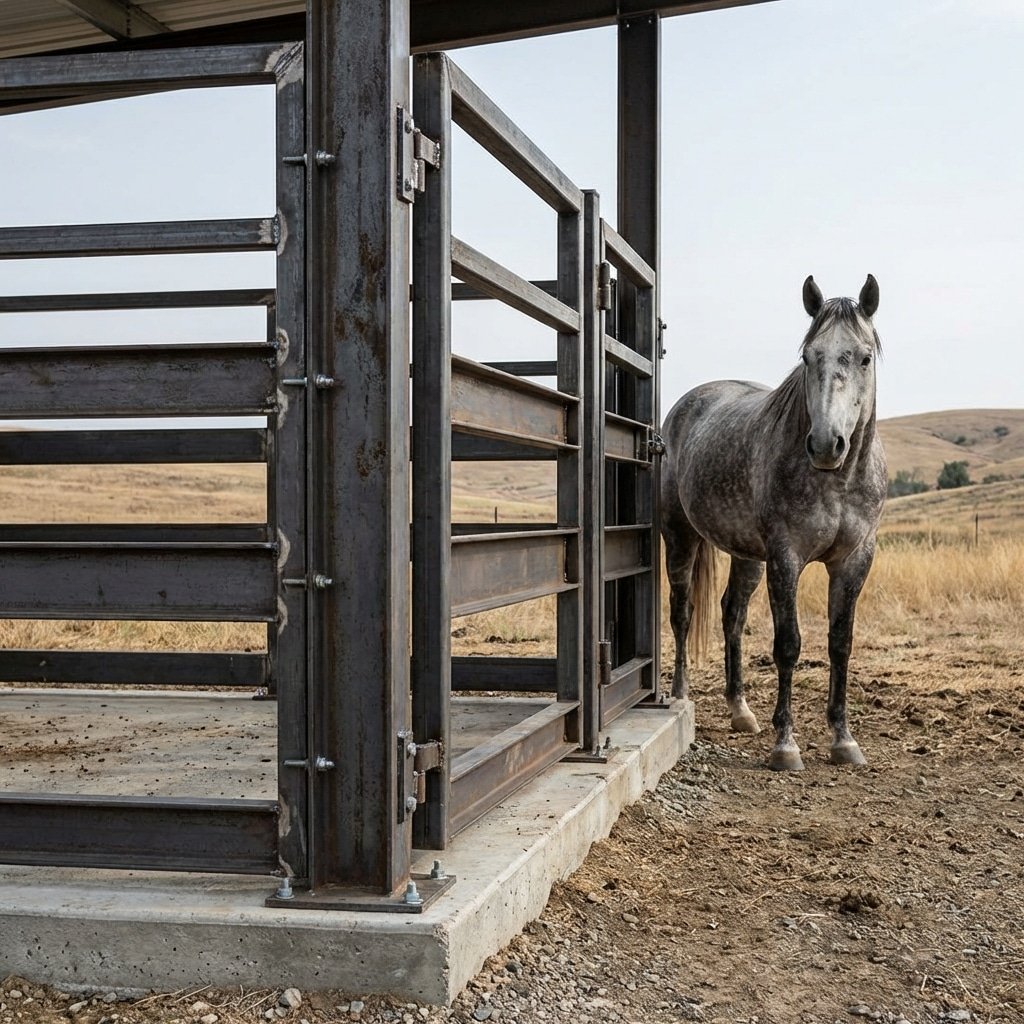
The Integrated Roof Truss System for Free-Standing Stalls
This system utilizes 50mm stable posts as primary load-bearing columns, supporting galvanized trusses directly to create a weather-tight structure without an external pole barn shell.
| Component Spec | Material Standard | Engineering Function |
|---|---|---|
| Vertical Columns | 50x50mm RHS or 114mm Round (min 2.0mm wall) | Primary vertical load transfer |
| Truss Steel Grade | Q235B (Std) or Q345B (Cold Climate) | Snow load and tensile strength |
| Corrosion Protection | Hot-Dip Galvanized (ISO 1461) >70μm | Rust prevention from overhead condensation |
| Roofing Compatibility | 0.4mm – 0.8mm Steel Profiles | Universal weather sealing |
Structural Integration and Vertical Load Support
Standard stable construction often requires building a large exterior shell (pole barn) first, then installing stalls inside. The Integrated Roof Truss System removes this redundancy by utilizing the stall panels themselves as the structural skeleton. We engineer the vertical posts of the stable fronts and partitions—typically 50mm x 50mm RHS or 114mm round tubes—to serve as the primary load-bearing columns.
The geometric layout of the stalls provides inherent stability. When a stall front connects to a partition panel, it creates a rigid structural “box” or “T” intersection. This configuration offers superior lateral stiffness compared to standalone poles, resisting wind shear effectively. We align these load-bearing intersections on standard centers (typically 3.0m, 3.5m, or 4.0m) to ensure roof weight distributes evenly through the framework down to the ground anchors.
Galvanized Truss Specifications and Purlin Connections
Roof structures in equestrian environments face aggressive corrosion due to rising ammonia and condensation. To counter this, we fabricate trusses using Q235B structural steel for standard regions, upgrading to Q345B (equivalent to ASTM Grade 50) for areas requiring high impact toughness against snow loads. Unlike competitors who weld pre-galvanized tubes (leaving welds exposed), we process the entire truss assembly through hot-dip galvanization after fabrication.
- ISO 1461 Compliance: The post-weld dip ensures a zinc coating average exceeding 70 microns on all tubular surfaces, sealing joints against rust.
- Welded Purlin Clips: We pre-weld angle brackets to the truss chords, allowing for rapid bolt-on assembly of C-section or Z-section purlins without on-site welding.
- Profile Compatibility: The purlin spacing accommodates standard 0.4mm to 0.8mm steel roofing boards, ensuring a seamless fit for locally sourced roofing sheets.
Rust-Proof Horse Stables With 20-Year Durability
Pitch Angles: Shedding Snow Loads vs Rain Runoff
For effective snow shedding, roofs require steep 6:12 to 12:12 pitches to utilize gravity, whereas rain runoff works efficiently at 3:12, allowing for lower profile designs in warmer climates.
Structural Pitch Requirements for Snow Zones
Snow load management is about physics, not aesthetics. Wet snow can weigh over 20 pounds per cubic foot, turning a flat roof into a collapse risk. In moderate climates, the engineering minimum is a 6:12 pitch (26.57°). Any angle lower than this threshold allows snow to bond to the roof surface, accumulating faster than it can melt or slide.
- Moderate Climate Threshold: We strictly advise a 6:12 pitch as the baseline to ensure gravity breaks the snow’s static friction.
- Heavy Snow Strategy: For high-snowfall regions, we increase the pitch to between 8:12 and 12:12 (45°). At 45 degrees, gravity dominates, forcing the roof to self-clear immediately.
- Load Mitigation: Steeper angles prevent accumulation. This stops heavy live loads from piling up and exerting prolonged stress on the structural steel framework.
Runoff Efficiency of Steel Board Roofing
Material friction coefficients dictate how steep a roof must be to drain effectively. Traditional asphalt shingles have high friction, trapping water and snow. DB Stable utilizes 0.4mm and 0.8mm Steel Board Roofing, which provides a slick, non-porous surface. This low-friction profile allows water and snow to slide off with minimal resistance, even at lower angles.
- Material Advantage: Unlike asphalt, our 0.4mm/0.8mm steel boards prevent ice dams by shedding precipitation before it freezes.
- Rain Drainage: The metal profile allows for efficient water evacuation at a moderate 4:12 pitch, reducing height requirements in non-snow zones.
- Structural Backup: If snow temporarily accumulates before shedding, our Q345B Low Alloy frame provides the high-strength support needed to hold the load without deformation.
8mm Colorbond Roofing vs Standard Tin
Standard residential tin uses 0.42mm base metal. We specify 0.8mm structural grade—often mislabeled as “8mm”—providing double the density for hail and wind resistance.
Limitations of Standard 0.4mm Residential Sheeting
Most competitors quote “standard tin” to keep initial project costs artificially low. In the industry, this usually refers to 0.42mm BMT (Base Metal Thickness). While acceptable for a backyard garden shed or temporary fencing, this gauge lacks the structural integrity required for permanent equestrian facilities.
- Vulnerability to Hail: A 0.42mm sheet dents significantly under moderate hail. Once the profile is dented, water pools in the depressions, leading to premature corrosion.
- Oil-Canning Effect: Thinner metals distort under thermal expansion. On hot days, 0.42mm roofs often display visible waviness or buckling (oil-canning), which degrades the visual quality of professional stables.
- Reduced Span Capacity: Thinner steel sags if support beams are spaced too widely. This forces you to install rafters at tighter intervals, increasing your timber or steel framework costs.
The DB Stable 0.8mm Heavy-Duty Advantage
We frequently encounter inquiries for “8mm roofing.” In engineering terms, 8mm is steel plate used for tanks, not roofing. The actual heavy-duty specification is 0.8mm, which effectively offers double the material density of standard residential sheets. Aligning with our “Engineering Safety” core principle, we utilize this heavier gauge to extend the lifespan of the structure.
- Double Thickness: At nearly twice the thickness of standard 0.42mm tin, our 0.8mm profile resists impact damage from falling branches and severe hail that would puncture lighter materials.
- Extreme Weather Rating: This gauge is engineered for high-load environments. It withstands heavy snow accumulation without buckling and offers superior resistance to wind uplift in open paddock environments.
- Protective Finish: We apply a standard grey powder coat over the galvanized substrate. This dual-layer approach mirrors our “Royal Series” stable finishes, ensuring corrosion resistance in coastal or high-humidity zones.

Earth Anchors for High-Wind Paddock Stables
Portable stables on soft ground require deep-set helical piles to prevent wind uplift. Reliance on frame weight alone causes catastrophic failure during storms.
Wind Load Dynamics on Free-Standing Structures
Many distributors assume that the static weight of a steel stable—often exceeding 400kg—is sufficient to hold it in place. This is a dangerous misconception. In high-wind events, open-front stables function aerodynamically like a parachute. Wind enters the open side, pressurizes the underside of the roof, and creates massive uplift forces that easily overcome the pull of gravity. If the structure is not mechanically bonded to the earth, it will flip.
Lateral drift presents a secondary, equally destructive risk. A steel frame sitting on dry grass or compacted dirt has a low coefficient of friction. Strong crosswinds can push the entire unit across the paddock like a sled. Once the structure gains momentum, it risks colliding with fences or livestock. For B2B clients in regions like Australia or the UK, selling a portable stable without an engineered anchoring protocol is a liability risk.
Implementing Galvanized Helical Piles for Stability
Simple straight stakes or “tent pegs” offer zero security for heavy structural steel. They rely entirely on friction against the steel shaft, which fails instantly when the ground softens from rain. The only professional solution for soft surfaces is the use of Helical Piles (screw anchors). Unlike stakes, the helix plate at the bottom of the shaft engages a cone of undisturbed soil, using the weight of the earth itself to resist pull-out forces.
- Soil Engagement: Helical designs screw into the ground rather than driving through it, maintaining soil density around the anchor point.
- Corrosion Resistance (ISO 1461): Anchors live in the most corrosive environment possible: wet soil. We strictly use Hot-Dip Galvanized steel (not black steel or pre-galv) to match the lifespan of our Q235B frames.
- Mechanical Connection: The anchor head must bolt directly to the 50mm x 50mm RHS uprights using 304 Stainless Steel hardware, creating a continuous load path from roof to ground.
Preguntas frecuentes
Can I add a roof to standard portable horse stall panels?
Yes. Most portable systems are modular and support add-on roof kits. These kits attach directly to the vertical connectors of existing panels, allowing you to install trusses and metal sheeting. This upgrade turns temporary panels into a functional, weather-resistant outdoor shelter.
What is the best foundation for a free-standing stable?
A level, well-draining base is non-negotiable. For permanent installations, pour a concrete slab with a 1-2% slope to handle runoff. For portable setups, a raised pad of compacted road base or crushed rock works well to prevent mud accumulation. Always elevate the site above the surrounding grade to avoid flooding.
What roof pitch angle is required for snow versus rain?
For general rain runoff, a 3/12 pitch (approximately 15 degrees) is standard and cost-effective. In regions with heavy snowfall, you need a steeper pitch of 20 to 30 degrees. Shallow angles in snow zones fail to shed the weight efficiently and invite structural damage.
How do I anchor a portable stable in high-wind areas?
Anchoring method dictates safety. On dirt or grass, use screw-type ground anchors (like Hellankers) or heavy-duty rebar stakes driven through the base brackets. For permanent security—especially in windy zones—bolting the frame to concrete piers or a perimeter footing is the only reliable method.
Reflexiones finales
Relying on lightweight 1.5mm tubing for permanent shelter invites liability risks when snow loads or wind uplift strikes. By standardizing on Q235B hot-dip galvanized steel and 0.8mm structural roofing, you deliver an asset engineered for decades of safety, not just seasons. This specification secures your reputation against warranty claims and separates your brand from competitors selling disposable, light-duty kits.
Secure your inventory by verifying our truss engineering and connection quality firsthand. We recommend initiating a trial LCL order of 3-5 sets to test assembly speed and finish durability before committing to full container volumes. Contact our team today to define your local wind load requirements and receive a precise OEM proposal.


 Spanish
  English
  French
  Arabic
  German
0 comentarios