


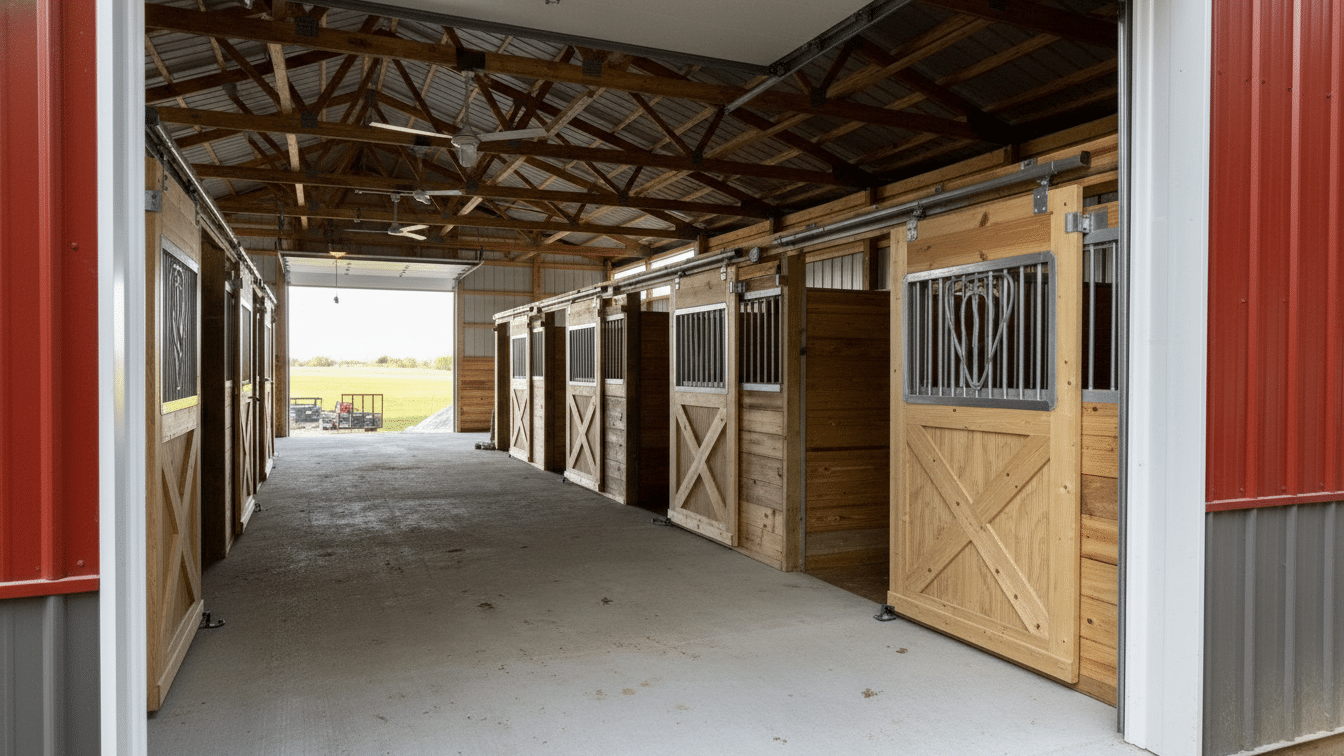
Sourcing equipment through intermediaries often inflates landed costs by hiding a 15-30% service margin behind opaque supply chains. For wholesalers, this erodes profitability while risking components that miss critical safety standards.
This analysis contrasts Direct Factory economics against Trading Company flexibility. We examine how 42-micron galvanization protocols ensure longevity, why 10mm HDPE prevents thermal warping, and how strictly defined ASCE 7 load calculations protect your infrastructure investment.
Horse Stable Factory vs. Trading Company: What is the Core Difference?
The core difference lies in ownership of production. A factory manufactures the horse stables directly, controlling raw materials and offering lower base costs. A trading company acts as a middleman, sourcing products from multiple factories, which adds a markup but offers product variety beyond a single category.
| Comparison Factor | Direct Factory (e.g., DB Estable) | Trading Company |
|---|---|---|
| Production Assets | Owns machinery, welders, and tooling | No physical manufacturing assets |
| Cost Structure | Lowest base price (No markup) | Higher (Includes sales commission) |
| Quality Control | Direct oversight of material specs | Relies on third-party inspections |
| Transparency | Full production visibility | Source often hidden to protect margin |

Operational Structure: Manufacturers vs. Intermediaries
Understanding who you are buying from is the first step in securing a reliable supply chain. The distinction comes down to who actually touches the metal.
- Factory Model: These entities own the production lines, welding robots, and employ the technical staff directly. They focus on deep vertical integration. This means they control every step of creating a specific product type, such as equine infrastructure.
- Trading Company Model: These operate primarily as sales organizations. They do not possess physical manufacturing assets like laser cutters or galvanization tanks. Instead, they act as aggregators who buy products from various suppliers and often rebrand them before selling to you.
- Supply Chain Visibility: When you work with a factory, you can usually see the production schedule. Trading companies often shield the actual source of the goods. They do this to protect their commission and prevent you from going direct to the manufacturer in the future.
Impact on Pricing and Minimum Order Quantities (MOQ)
The business model you choose directly impacts your bottom line and your purchasing flexibility. Here is how the money flows in each scenario.
- Direct Cost Savings: Sourcing directly from a factory eliminates the middleman’s margin. In the trading model, the intermediary adds a percentage on top of the factory price to cover their operations. Cutting this out commonly results in the lowest price for bulk orders.
- MOQ Flexibility: Factories have to set up heavy machinery for production runs. To make this efficient, they often require higher Minimum Order Quantities (MOQs). Trading companies, however, may buy large stocks and split them for smaller buyers, offering better flexibility for small orders.
- Negotiation Power: Dealing with the factory allows you to negotiate the actual material costs. For example, if you have a strict budget, you can discuss adjusting the steel gauge slightly to meet that price point. With a trader, you are usually negotiating a fixed retail price with little room to move on engineering costs.
Technical Control: Managing Material Specs and Customization
Engineering quality relies on strict adherence to specifications. A direct manufacturer has the ability to verify these inputs, whereas a trader relies on promises from their suppliers.
- Material Verification: Factories directly control input specifications. For instance, they can ensure hot-dip galvanization exceeds 42 microns. Think of this as the thickness of the protective zinc skin that stops rust. A factory verifies this daily, while a trader might not check every batch.
- Custom Engineering: Manufacturers employ product experts, often with over 5 years of experience. These designers can modify blueprints for specific needs, such as increasing wind ratings or snow loads. Traders often lack the in-house engineering staff to make these structural calculations safely.
- Quality Consistency: A factory maintains consistent tooling. This ensures components like 10mm HDPE boards fit perfectly every time. A trading company might switch suppliers between batches to save money, which can result in slightly different colors or dimensions in your order.
How DB Stable Maximizes Value as a Direct Factory
DB Stable operates as a direct manufacturer, which allows for specific advantages regarding durability and customization that intermediaries typically cannot match.
- Direct Export since 2013: By exporting directly to Australia and New Zealand for over a decade, DB Stable bypasses intermediaries. This structure maintains competitive pricing while ensuring accountability is held by the people actually building the product.
- Durabilidad del material: Because they control the manufacturing process, DB Stable ensures frames utilize 40*40mm square metal tubes. These are fully welded with 6mm steel plates. This is distinct from cheaper bolted connections often found in traded goods, which can loosen over time due to horse movement.
- Client-Centric Customization: The factory model allows for rapid changes based on direct buyer feedback. Whether you need single, double, or quadruple units, or specific finishes like 0.4mm to 0.8mm roof thickness, the production line can be adjusted to meet these exact requirements without a game of “telephone” through a middleman.
How Do Cost Structures and Profit Margins Differ for Stalls?
Cost structures for stalls vary significantly between manufacturers and resellers. Manufacturers incur heavy fixed costs for raw materials (steel, HDPE) and production, typically operating with industrial margins of 5-24%. Conversely, traders face lower fixed costs but higher variable costs due to purchasing markups, often resulting in tighter retail margins of 2-10% unless they specialize in high-end luxury fittings.
Factory Cost Structure: Raw Materials and Production
The financial foundation of a manufacturer relies heavily on the physical creation of the product. The biggest expense category is raw materials. For a stable builder, this means purchasing large quantities of hot-dip galvanized steel and HDPE pellets. Think of this like a chef buying ingredients in bulk; the initial cost is high, but it allows for creating the final dish at a lower cost per plate.
Production overhead is the second major factor. This includes the cost of maintaining heavy machinery, paying for skilled welding labor, and managing chemical processes like galvanization. Achieving a specific standard, such as a 42-micron protective coating, requires precise control over these industrial processes. Manufacturers generally operate with profit margins ranging from 5% to 24%. These margins rely on volume; as the factory produces more stalls, the cost to make each single unit decreases.
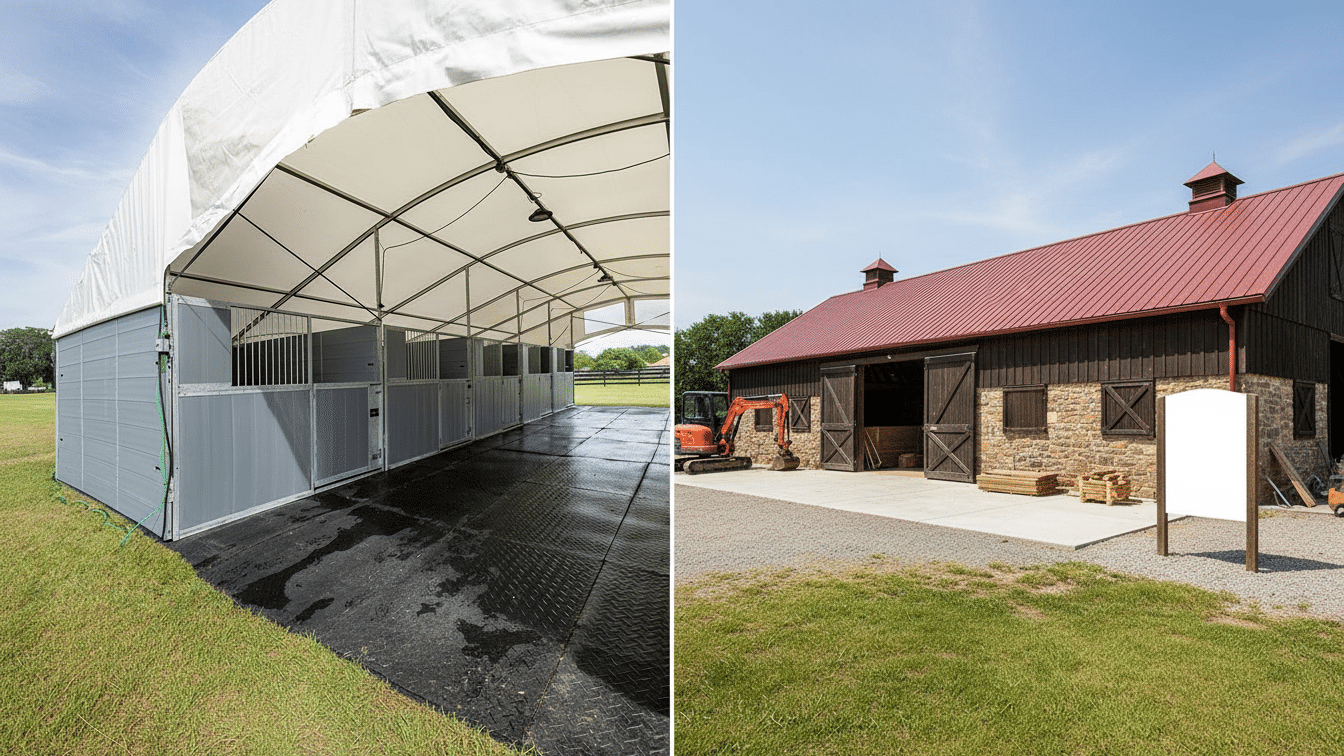
Trader Cost Structure: Acquisition and Logistics
A reseller or trading company operates on a different economic model. Their primary expense is the “Landed Cost,” which is the total price they pay to purchase the finished stall from the factory and get it to their warehouse. Unlike the manufacturer who pays for raw steel, the trader pays for the completed product, which already includes the factory’s labor and profit.
Traders must then add their own operational costs. These include import duties, shipping logistics, local storage fees, and marketing expenses. To sustain their business, they add a markup to the landed cost. In general retail trade, net profit margins can be quite slim, often hovering between 2% and 10%. This necessitates a high volume of sales to remain profitable. The final price a buyer sees reflects the factory’s original profit stacked with the trader’s operational markup.
How DB Stable Optimizes Cost as a Direct Factory
DB Estable utilizes a direct-to-consumer manufacturing model to influence the final cost for buyers. Since 2013, the company has operated as a direct factory, which removes the “middleman” layer typically found in the supply chain for Australia and New Zealand. This absence of a reseller markup allows the pricing strategy to leverage the manufacturing margin directly.
This control extends to material quality. Specifications such as 10mm thick HDPE boards and 42-micron galvanization are managed internally. In a trading model, ensuring this level of quality often requires third-party inspections that raise costs. By selling direct, these standards are met without price inflation. The model also allows for value-added services, such as access to design experts with years of experience, to be included as part of the service rather than billed as an extra consultation fee.
Which Option Offers Better Engineering for Custom Barns?
Custom post-frame designs offer superior engineering by utilizing site-specific load data (ASCE 7) to size trusses and columns based on local soil reports and wind speeds. In contrast, standard kits rely on generalized stock assumptions that often fail to meet local códigos de construcción without costly post-purchase upgrades.
Site-Specific Engineering vs. Stock Assumptions
The primary difference between a custom design and a standard kit lies in how they handle local environmental stresses. Custom engineering starts with the specific conditions of your building site. Engineers calculate the ground snow load and wind speed exposure categories unique to your location. This ensures the structure can withstand actual weather patterns rather than theoretical averages.
Think of ASCE 7 as a safety rulebook that tells engineers exactly how much force nature might apply to a building. Custom designs use these rules to generate stamped drawings, which are often required for obtaining building permits. Standard kits, on the other hand, usually rely on “stock assumptions.” These are generalized estimates that cover broad regions but may ignore the high wind speeds or heavy snow common in specific local areas.
- ✅ Load Calculations: Custom plans factor in specific roof snow loads and wind exposure to prevent structural failure.
- ✅ Permit Readiness: Engineers reference ASCE 7 standards to create stamped drawings that pass inspection.
- ✅ Risk Factors: Stock kits often fail inspections in regions with strict codes because they lack site-specific data.
- ✅ Design Flexibility: Engineered plans allow for taller eave heights (over 16 feet) and wider open spaces that pre-packaged kits cannot support.
Critical Structural Specifications: Concrete and Steel
Engineered designs dictate the quality of materials to ensure long-term stability. The foundation is the anchor of the entire structure. Professional designs typically specify concrete with a compressive strength of 4,000 psi. This measures how much weight the concrete can hold before it cracks. A rating of 4,000 psi is roughly equivalent to having a large pickup truck parked on every square inch of the concrete without it breaking.
Steel reinforcement is equally important. Engineered plans call for Grade 60 rebar, which has a yield strength of 60,000 pounds per square inch. This provides the tensile strength needed to keep concrete from pulling apart under tension. Bracing schemes are also tailored to the building’s shape to handle shear forces, which are the sideways pressures caused by wind pushing against the walls.
- ✅ Concrete Strength: Foundations use 4,000 psi concrete to handle heavy loads and prevent shifting.
- ✅ Soil Capacity: Designs account for soil bearing capacity (2,000 psf) with a safety factor to stop sliding.
- ✅ Reinforcement: Grade 60 rebar is used for superior strength compared to generic low-grade steel.
- ✅ Bracing: Specific bracing patterns are chosen to resist wind forces based on the building geometry.
Permitting and Compliance Challenges
Using a non-engineered kit for a permanent structure often leads to administrative headaches. Permitting offices frequently reject drawings from generic kits because they do not reference site-specific ASCE 7 codes. If a kit is rejected, the owner must often hire an engineer to design upgrades, such as stronger bracing or deeper foundations, to bring the structure up to code. This erases the initial cost savings of buying a stock kit.
Custom layouts also offer practical advantages beyond compliance. While standard pole barns use rigid 8-foot spacing between columns, custom designs allow for flexible spacing. This is crucial if you need wide doors for machinery or specific stall layouts for animals. Engineered roof systems can also be designed to support heavier loads, allowing for unique styles like gambrel attics or scissor trusses that create more vertical space.

How DB Stable Ensures Structural Integrity
To meet these rigorous engineering standards, DB Stable utilizes a factory-direct manufacturing process that allows for strict quality control over every component. Instead of reselling static kits with unknown material origins, the in-house design team tailors solutions to specific requirements. This approach ensures that the physical materials match the engineering needs of the site.
For example, to combat rust and environmental wear, steel components undergo hot-dip galvanization with a coating thickness exceeding 42 microns. This process creates a thick protective shield, similar to dipping a strawberry in hard chocolate, sealing the steel away from moisture and oxygen. Durability is further enhanced by using fully welded connections with 6mm steel plates, rather than relying on weaker mechanical fasteners that can loosen over time.
- ✅ Material Control: Direct factory oversight ensures steel is hot-dip galvanized to over 42 microns for rust protection.
- ✅ Expert Design: A team of product experts tailors the structure rather than relying on generic kit blueprints.
- ✅ Thermal Stability: The use of 10mm UV-resistant HDPE boards prevents warping and thermal expansion issues.
- ✅ Robust Connections: Fully welded 6mm steel plates provide long-term structural integrity that outlasts standard bolts.
Build Premium Stables Engineered for Any Climate
Create high-performance instalaciones ecuestres tailored to your specific regional requirements. From rust-proof galvanized marcos de acero to UV-resistant bamboo infills, our modular designs ensure long-term durability and horse safety. Experience 30% faster installation times with precision-welded components that meet international standards.

Head-to-Head: Communication Efficiency and QC Control?
Trading companies typically excel in linguistic fluency and service orientation, often handling small MOQs efficiently. Conversely, factories provide direct technical answers and lower costs by eliminating the 15-30% middleman margin, though they traditionally prioritize production volume over extensive client correspondence.
Communication Dynamics: Service vs. Technical Depth
The difference between a trading company and a factory is often like the difference between a travel agent and a pilot. The agent arranges the trip and speaks your language, while the pilot knows exactly how the plane flies but is busy flying it. Trading companies rank highest in communication efficiency because they hire staff specifically to facilitate transactions in English.
Factories usually prioritize manufacturing objectives over correspondence. They often view extensive emails as a distraction from their main goal of hitting production targets. However, this impacts response time. When you ask a technical question, a trading company must pause to ask the factory, creating delays. In contrast, a factory technical team can give an immediate answer regarding equipment limitations because they are standing right next to the machine.
Quality Control Infrastructure and Cost Implications
Your choice of partner heavily influences both the price you pay and how defects are handled. Trading companies often maintain in-house design departments to trace defects, which is useful for complex products. However, this service comes at a premium. Trading companies typically add a 15-30% margin on top of the factory price to cover their overhead.
Factories offer superior control for standardized, high-volume runs. While they eliminate the middleman markup, they typically require higher minimum order quantities to justify the setup cost of their production lines. Trading companies are more flexible here, efficiently handling small orders between 1 and 100 units.
How DB Stable Bridges the Factory-Service Gap
DB Stable operates as a hybrid solution for buyers in Australia and New Zealand. Since 2013, the company has functioned as a direct manufacturer. This model eliminates the typical 15-30% trading company margin, allowing for factory-direct pricing.
Unlike traditional factories that may lack support staff, DB Stable employs over five product experts with design experience. This team assists with setup and installation, bridging the gap between technical authority and customer service. Because there is direct control over production, specific quality guarantees are possible without third-party verification delays. For example, the hot-dip galvanization is applied at over 42 microns, acting like a heavy-duty shield against rust, and the 10mm HDPE boards are UV-resistant to withstand harsh sun exposure.
The Verdict: Which Supplier Fits Your Horse Business?
For novice importers requiring small quantities and diverse product mixes, trading companies offer convenience despite a 10-30% price premium. Conversely, established wholesalers and stable builders seeking custom specifications and maximum profit margins should source from direct manufacturers to secure factory-gate pricing and engineering control.
The Case for Trading Companies: Variety Over Value
Choosing a trading company is similar to shopping at a supermarket rather than visiting individual farms. You get everything in one place, but you pay for that convenience. This model suits businesses that need to buy small amounts of many different things at once.
- Low MOQ Requirements: ✅ Perfect for new importers who cannot meet the high minimum order quantities factories often demand for raw materials.
- Product Diversity: ✅ Allows you to combine unrelated items like saddles, buckets, and fencing into a single shipping container.
- Cost Implications: ⚠️ You must accept a price premium of 10-30% to cover the middleman’s service and flexibility.
- Engineering Limits: ⚠️ You have limited control over technical details, making it hard to enforce strict standards like specific steel coating thicknesses.
The Case for Manufacturers: Margin and Customization
Working directly with a manufacturer is like hiring a private chef instead of ordering takeout. You control the ingredients and the cost structure. This path is essential for established wholesalers who need to maximize profit margins and ensure consistent quality.
- Profit Maximization: ✅ Eliminating the middleman gives you access to factory-gate pricing, removing standard trading markups.
- Technical Control: ✅ You can mandate engineering standards, such as specifying exact hot-dip galvanization thickness to prevent rust.
- Customization Capabilities: ✅ Factories can adjust production lines to create custom designs, such as changing roof thickness from standard 0.4mm to a heavy-duty 0.8mm.
- Long-term Stability: ✅ Direct relationships stop supply chain surprises that happen when trading companies switch their sub-suppliers to save money.

How DB Stable Delivers Factory-Direct Advantages
DB Stable operates as a dedicated manufacturer rather than a middleman. We combine the technical precision of an engineering firm with the cost benefits of a direct factory. This ensures you get high-specification stables without the extra markup found in trading models.
- Direct Manufacturing Pedigree: ✅ Operating since 2013, we remove trading markups to offer the lowest price for comparable quality in the Australia and New Zealand markets.
- Verified Material Specs: ✅ We guarantee 42-micron hot-dip galvanization on frames. Think of this as a thick zinc shield that prevents rust for over a decade.
- Design Expertise: ✅ Our in-house team helps you customize features, such as choosing between sliding or swing doors, without communication errors.
- Proven Durability: ✅ We use 10mm UV-resistant HDPE infill boards. This material acts like a high-density bumper that resists sun damage and horse kicks.
Preguntas frecuentes
Buying directly from a factory typically reduces costs by 5-20% compared to trading companies, though it requires meeting Minimum Order Quantities (MOQs) to cover production setup. Verifying a supplier’s status involves checking their 18-digit business registration number and confirming that bank account details match the business license. Manufacturers also hold direct responsibility for Quality Management Systems (QMS) and issuing authentic Mill Test Reports.
Is It Cheaper to Buy Stables Directly From a Factory?
Direct factory sourcing typically offers prices 5-20% lower than trading companies because it removes the middleman’s margin. When you buy from a trader, you are paying for their service fee on top of the product cost.
Factories operate on margin-based economics where direct access minimizes the markup on raw materials like steel and HDPE. While trading companies may occasionally negotiate volume discounts, individual buyers rarely benefit from these savings on custom stable orders.
How Do I Verify If a Supplier Is a Middleman?
You can locate the supplier’s 18-digit business registration number and verify it on official databases like qixin.com. This number serves as a unique ID for the company and reveals their registered business scope.
Confirm that the bank account name matches the business license exactly. Inconsistencies here often indicate a trading agent. You should also request to see the business license to cross-reference the legal person’s name and registered address. Manufacturers can provide specific production details that traders often lack.
Do Factories Accept Small Stable Orders?
Factories generally enforce Minimum Order Quantities (MOQs) to cover fixed setup costs like machine configuration and material procurement. Think of this like printing a book; setting up the press costs the same whether you print one copy or a thousand.
Small orders often result in negative profit for manufacturers unless the item is pre-stocked. Standard industry MOQs can range from 50 units for simple components to higher volumes for custom manufacturing, though large stable structures may have lower specific unit counts due to their physical size.
Who Handles Quality Issues and Safety Standards?
Manufacturers implement Quality Management Systems (QMS) and use Statistical Process Control (SPC) to catch defects directly on the line. This allows them to instantly correct deviations from standards like ISO 9001 during the production phase.
Traders lack direct control over production and must relay complaints to third parties, which delays resolution. Safety compliance, such as ensuring 4ft fence heights and smooth welds, is best managed by the entity physically building the product.
Can a Trader Provide Mill Test Reports?
Traders cannot generate or certify Mill Test Reports (MTRs); they can only pass along copies. Authentic MTRs are issued solely by the manufacturer or an authorized third-party inspection company.
You should look for EN10204 3.1 certificates issued by the manufacturer or EN10204 3.2 certificates issued by independent inspectors to ensure steel quality. Relying on a trader for this critical documentation adds a layer of risk if the original source is not verified.
How Does DB Stable Ensure Factory-Direct Quality?
DB Stable has operated as a direct factory since 2013, serving Australia and New Zealand without middleman markups. We control the entire process to ensure hot-dip galvanization meets the 42-micron standard, which provides rust protection for over 10 years.
We use specific 10mm UV-resistant HDPE boards to prevent thermal expansion issues that are common in outsourced production. Additionally, we provide direct support for installation, leveraging over 5 years of design expertise to ensure structural safety.
The Verdict: Which Supplier Fits Your Horse Business?
While trading companies suit small, mixed orders, they often drain profit margins through hidden markups and lack technical accountability. True scalability requires direct factory access to control costs and enforce rigorous engineering standards on critical materials.
By sourcing directly, you ensure every dollar pays for 42-micron galvanization and robust welds, not a middleman’s fee. This strategy secures the durability needed for long-term safety and delivers the best return on investment for your infrastructure.

 Spanish
  English
  French
  Arabic
  German
0 comentarios