


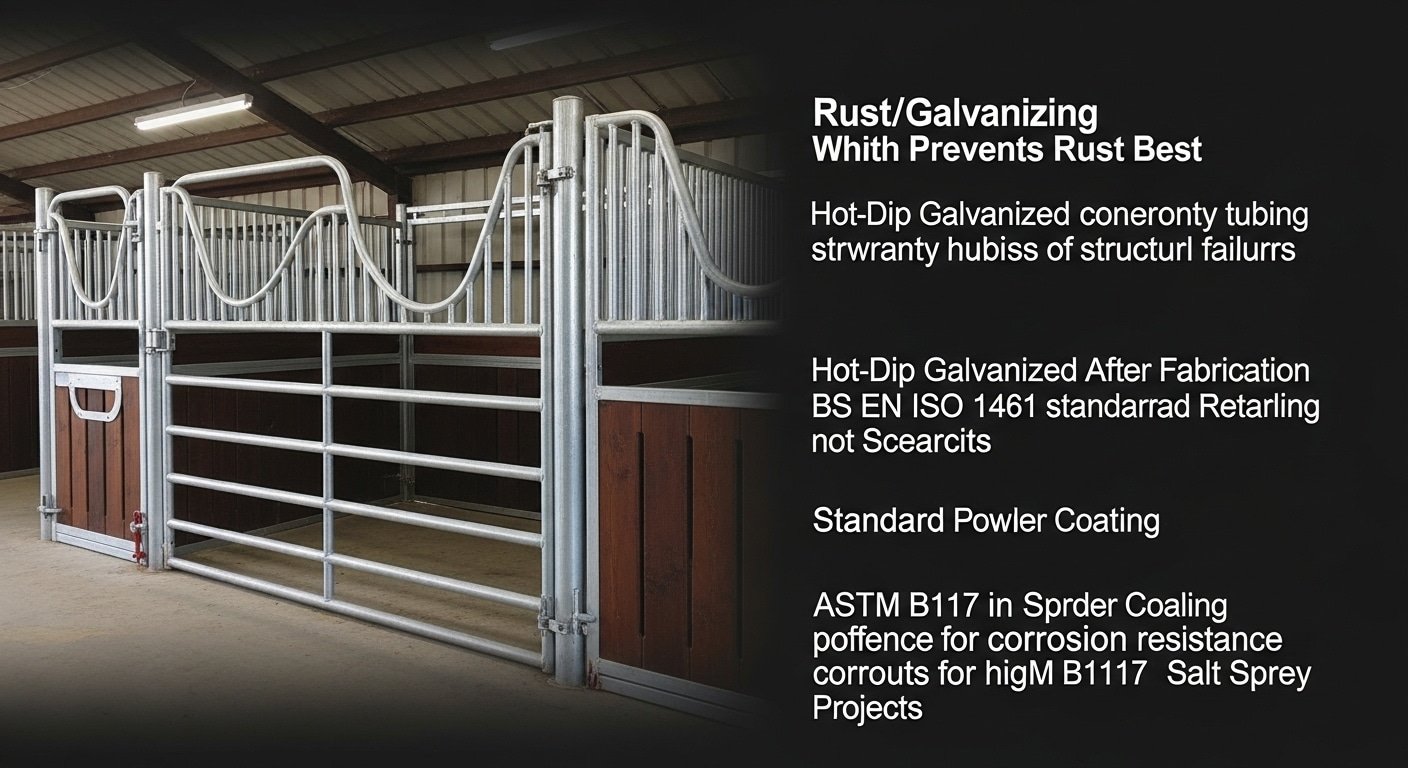
Understanding Rust/Galvanizinghorse stall gates is critical to preventing costly warranty claims and structural failures. Stalls made from pre-galvanized tubing commonly rust at the welds, a frequent point of failure in coastal or high-humidity environments. This defect undermines product lifespan and erodes a distributor’s reputation, turning a sale into a long-term liability.
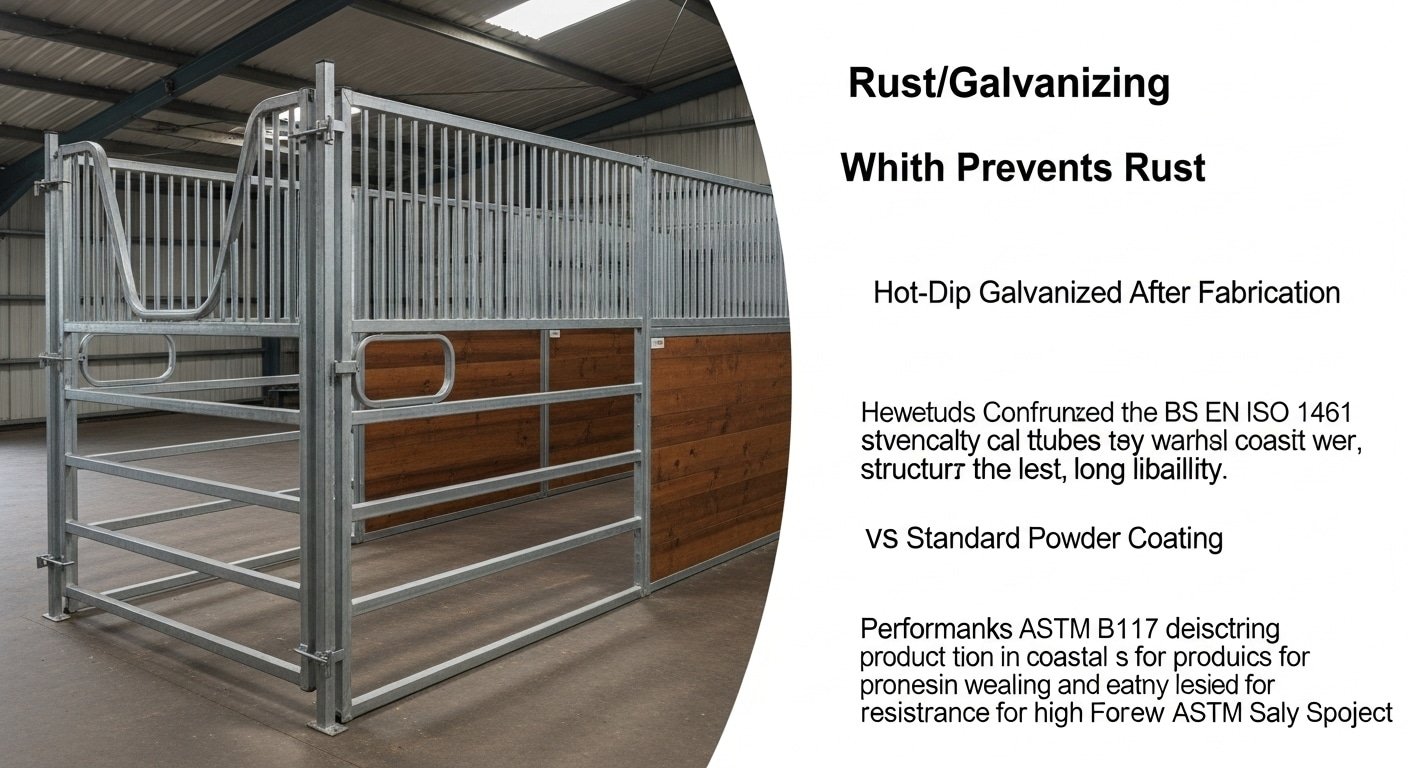
This analysis benchmarks finishes using empirical data, not marketing claims. We evaluate Hot-Dip Galvanization After Fabrication, which conforms to the BS EN ISO 1461 standard, against standard powder coating. The deciding factor is performance in the ASTM B117 salt spray test, a verifiable measure of corrosion resistance for high-value equestrian projects.
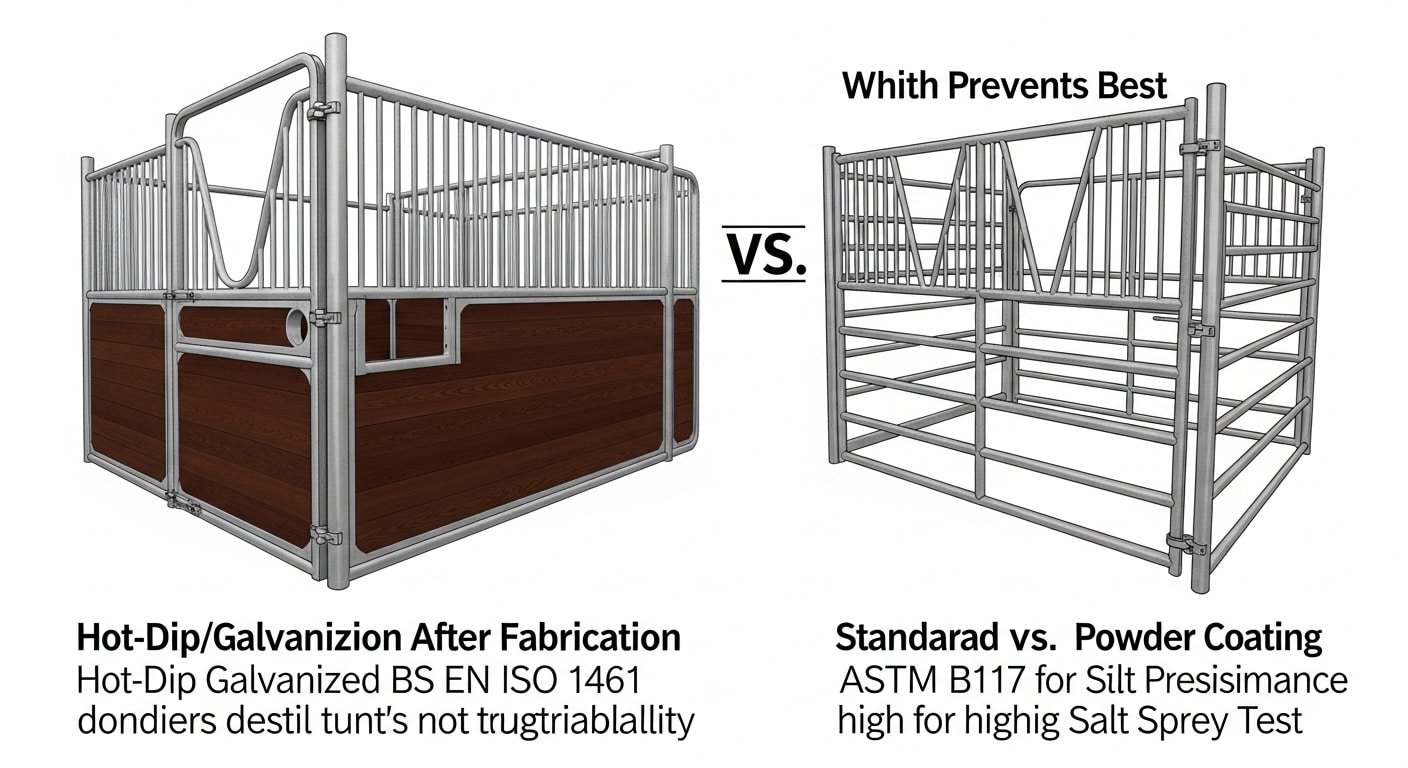
Hot-Dip vs. Powder Coat: Which Wins the Rust Battle?
Hot-dip galvanizing offers sacrificial protection, protecting steel even when scratched. Powder coating is a simple barrier; once breached by a kick or scrape, rust creeps underneath.
Barrier Protection vs. Sacrificial Protection
The two methods protect steel in fundamentally different ways. Powder coating acts like a layer of paint. It creates a physical barrier between the steel and the elements. If a horse kicks the puesto and chips this barrier, moisture immediately reaches the steel and starts the corrosion process.
Hot-dip galvanizing is a chemical solution, not just a surface layer. The zinc coating is metallurgically bonded to the steel. When scratched, the zinc sacrifices itself and corrodes first, actively protecting the steel base. This “sacrificial protection” is why galvanizing is superior for long-term durability in a tough barn environment.
Why ‘Hot-Dip After Fabrication’ is the Deciding Factor
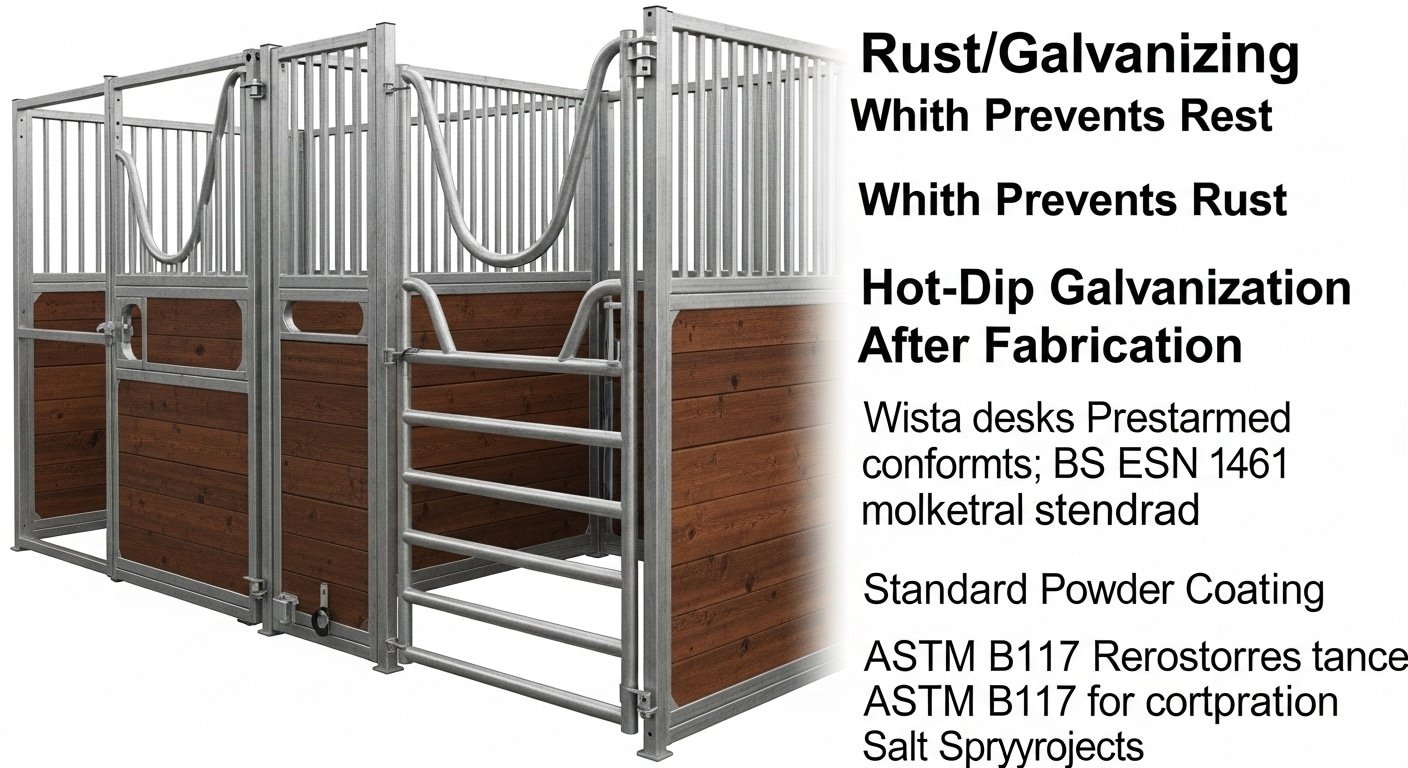
The timing of the galvanizing process is critical. We build the entire steel frame—including all welds—first. Then, we dip the completed structure into molten zinc. This “Hot-Dip After Fabrication” process ensures that every single corner, edge, and weld is completely sealed in a protective zinc coating.
This method isn’t just a general practice; it conforms to strict international standards for corrosion protection. Our process guarantees:
- Governing Standard: Full compliance with BS EN ISO 1461.
- Espesor del revestimiento: An average zinc coating greater than 70 microns on all steel tubing.
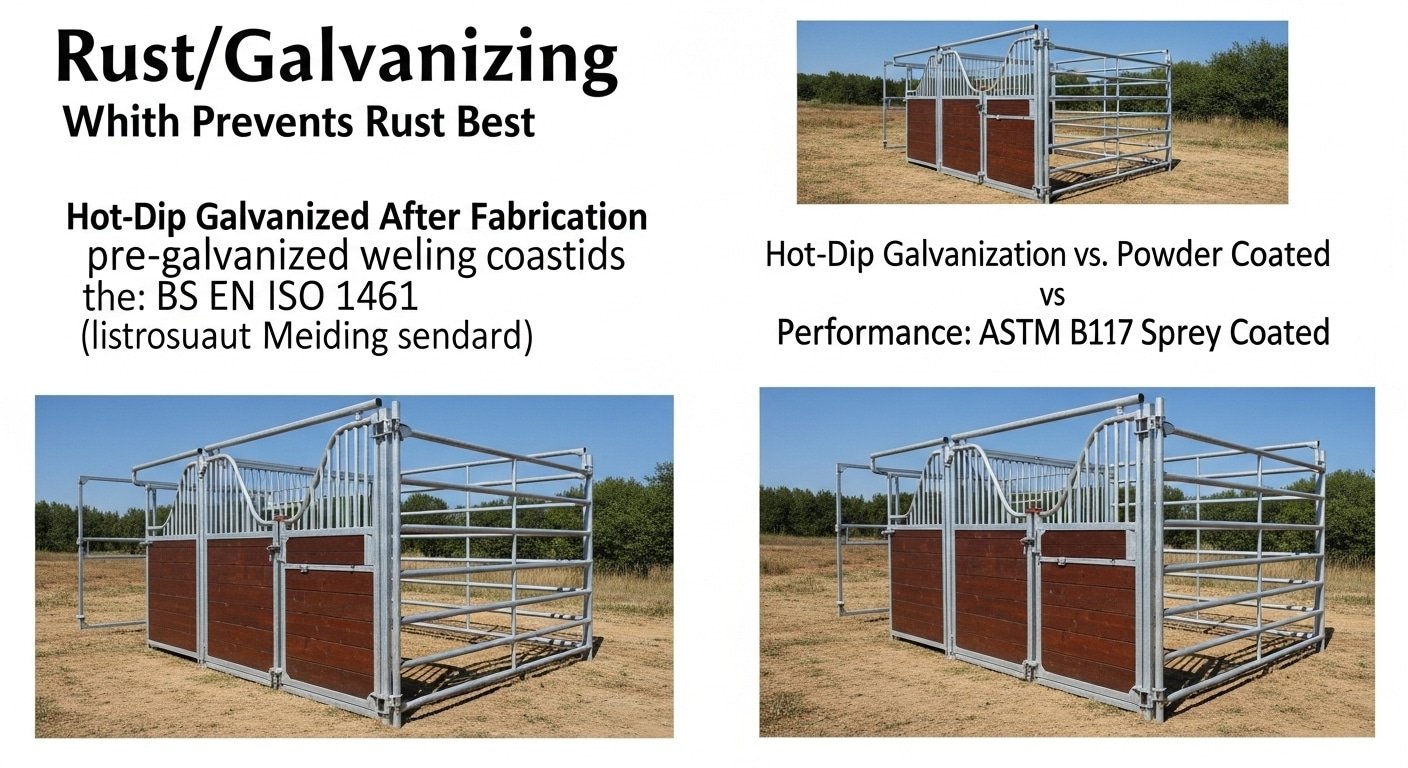
What Does “Hot-Dip After Fabrication” Actually Mean?
It means we build the entire panel estable first, then dip the finished structure in molten zinc. This coats every weld, corner, and hidden surface for total rust protection.
The Critical Step: Coating After Welding
The process starts with raw, black structural steel. We cut, bend, and fully weld every component into its final form, whether it’s a door or a partición wall. Only after all fabrication is complete is the entire piece submerged in a bath of molten zinc. This method completely encases the structure, sealing the welds—the primary point where rust begins on competing pre-galvanized products.
Meeting the ISO 1461 Standard for Zinc Coverage
This process isn’t just a general guideline; it conforms to the strict BS EN ISO 1461 standard. This guarantees a specific, measurable level of protection that withstands harsh barn environments. The result is a bonded metallic layer with verifiable performance.
- Coating on Tubing (3-6mm steel): Averages over 70 microns (μm).
- Coating on Structural Parts (>6mm steel): Averages over 85 microns (μm).
- Corrosion Resistance: Passes the 96-hour ASTM B117 salt spray test with no red rust.
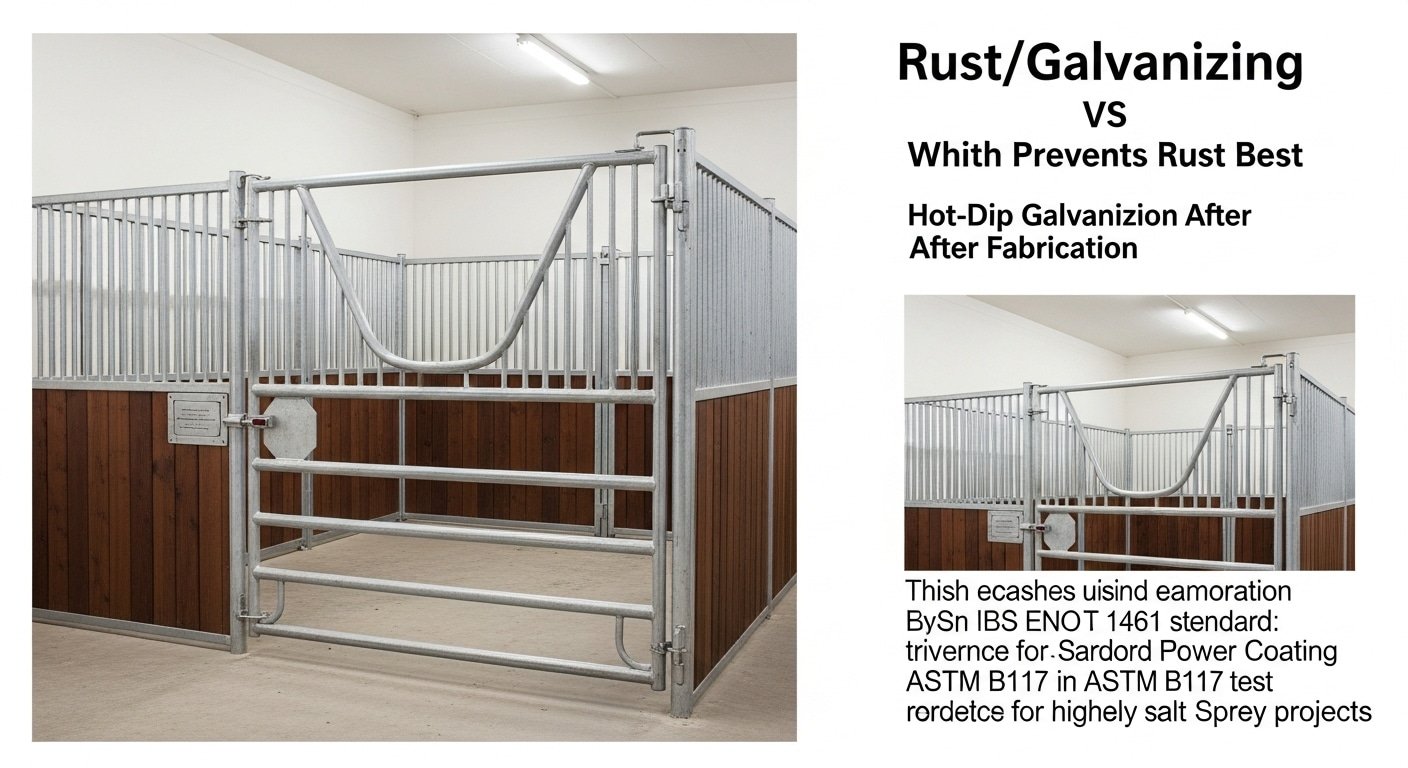
Does Powder Coating Offer Any Advantage Besides Aesthetics?
Yes. Powder coating is a functional polymer finish that provides superior resistance to chipping, scratching, and UV fading, directly extending the service life of the steel.
A Tough Barrier Against Wear and Tear
Powder coating is far more than just a color choice; it’s a functional, protective layer. It creates a hard, uniform polymer finish that is significantly tougher than liquid paint, resisting chips and scratches from horse kicks or equipment. This sealed barrier also shields the underlying steel from constant exposure to moisture, ammonia from urine, and harsh cleaning agents. Its superior UV resistance prevents color fade and material breakdown, crucial for any part of a estable exposed to sunlight.
The Dual-Protection System for Premier Stables
For the highest standard of longevity, we use a dual-protection system in our Royal Series. This ‘Powder Coat over Galvanized’ finish creates a two-layer defense. First, the steel is hot-dip galvanized to ISO 1461 standards, creating the primary sacrificial shield against rust. Then, the powder coat is applied over the zinc, protecting the galvanization itself from wear and adding the final aesthetic. This duplex system can extend the coating’s total lifespan by 1.5 to 2.3 times, making it the definitive choice for premier equestrian estates.
Durable, Compliant Stables for Any Climate.
Can Your Stables Survive 96 Hours of Salt Spray?
Passing the 96-hour ASTM B117 salt spray test requires a zinc coating over 70 microns thick. This is achieved only through Hot-Dip Galvanization After Fabrication.
| Performance Metric | Common Competitor Method | DB Stable Engineering Standard |
|---|---|---|
| Corrosion Test | No data or fails test | ASTM B117 (Pass > 96 Hours) |
| Galvanizing Process | Pre-Galvanized (Welds rust) | Hot-Dip After Fabrication |
| Governing Standard | Unspecified | BS EN ISO 1461 |
| Zinc Coating Thickness | < 45 microns (μm) | > 70 microns (μm) |
What is the 96-Hour Salt Spray Test?
The ASTM B117 test is an accelerated corrosion benchmark for the industrial coatings industry. It exposes steel components to a continuous, dense salt fog inside a sealed chamber for 96 hours. This process simulates years of exposure to corrosive environments, like coastal regions with salt air or barns with high humidity and ammonia levels.
Passing this test means a steel finish can effectively shield the base metal from rust. For a establo de caballos, it confirms the structural integrity won’t be compromised by corrosion from constant exposure to moisture and animal waste.
Meeting the Standard: ISO 1461 Galvanization
Our stables pass the salt spray test because they undergo Hot-Dip Galvanization After Fabrication. This entire process conforms to the BS EN ISO 1461 standard, a strict protocol for zinc coating quality and thickness. After the stable paneles are fully welded, we dip them in molten zinc.
This method creates a metallurgically bonded zinc coating that is, on average, over 70-85 microns thick. This thickness is the key factor that allows our steel components to withstand the 96-hour salt spray test with no signs of red rust, guaranteeing long-term performance.
Which Finish Should You Choose for Coastal Areas?
For coastal areas, hot-dip galvanizing to ISO 1461 is the minimum. A dual system of powder coating over galvanizing offers maximum corrosion resistance and longevity.
| Característica | Hot-Dip Galvanizing (Standard) | Dual-Layer System (Premium) |
|---|---|---|
| Protection Mechanism | Sacrificial zinc coating. | Sacrificial zinc base + durable powder coat barrier. |
| Aesthetics | Functional metallic finish that dulls to a matte grey. | Full range of colors with a smooth, high-quality finish. |
| Performance Standard | Conforms to BS EN ISO 1461. | Exceeds ISO 1461 and passes ASTM B117 salt spray tests. |
| Lo mejor para | High-durability applications where function is the priority. | Premier facilities requiring maximum lifespan and aesthetics. |
Why Salt-Laden Air Accelerates Rust
Coastal air is loaded with salt and moisture. This combination creates a powerful electrolyte on steel surfaces, which dramatically speeds up the corrosion process. Standard paint or thin coatings break down quickly under this constant chemical assault, exposing the steel and compromising its structural integrity.
The Galvanized and Dual-Layer Defense System
To combat high-salinity environments, you need a system engineered for the job, not just a surface-level coating. There are two tiers of effective protection.
- The Standard: Hot-Dip Galvanization After Fabrication is the baseline for any serious coastal installation. This process creates a metallurgically bonded zinc coating that conforms to BS EN ISO 1461, with a thickness exceeding 70 microns on all tubing.
- Maximum Defense: The Royal Series uses a dual-layer system. We apply a durable, protective powder coat over the already-galvanized steel. This combines the sacrificial protection of zinc with the barrier protection of a high-performance polymer.
- Verified Performance: This dual-layer system is verified to withstand over 96 hours in an ASTM B117 Salt Spray Test without any red rust appearing, confirming its suitability for the harshest marine conditions.
Reflexiones finales
While pre-galvanized steel lowers the initial quote, our Hot-Dip After Fabrication process is the only way to protect your business from rust claims at the welds. Conforming to the ISO 1461 standard isn’t just a technical detail; it’s long-term asset protection for your inventory and your clients’ investment.
Don’t guess on durability—verify our engineering firsthand. The logical next step is a small trial order to confirm the coating thickness and build quality on your own terms. Contact our team to configure a shipment or to discuss your OEM project requirements.
Preguntas frecuentes
Can you powder coat over galvanized steel?
Yes, this process is called a duplex system and creates a highly durable, dual-layer finish. It combines the rust protection of zinc with the aesthetic appeal of a powder coat. Our Royal Series stables feature this premium finish, which requires precise surface preparation to ensure a perfect bond.
How long does hot-dip galvanizing last in coastal areas?
Our hot-dip galvanized stables are engineered for longevity, even in coastal markets like Australia. The thick zinc coating, which conforms to ISO 1461 standards, can protect the steel for decades by forming a protective patina. While direct and constant salt spray can accelerate wear, our system offers superior resistance compared to simple paint or pre-galvanized steel.
Why do the welds on my old stables have rust?
Rust on welds is common when stables are built using pre-galvanized tubes. The welding process burns off the thin zinc layer at the joint, leaving the raw steel exposed. We solve this problem by performing hot-dip galvanization *after* all welding is complete. This ensures the entire structure, including every weld, receives a full protective zinc coating.
What is ‘White Rust’ and is it a problem?
White rust is a chalky, superficial deposit that can form on newly acero galvanizado if it’s stored in damp, poorly ventilated conditions. It is primarily an aesthetic issue and does not typically compromise the underlying protective zinc layer. Once installed with proper airflow, it often weathers away naturally.
What is the thickness of your zinc coating?
Our galvanizing process meets the BS EN ISO 1461 standard. We achieve an average coating thickness of over 70 microns (μm) on steel tubing and over 85 microns on thicker structural parts. This robust coating provides long-term protection that is significantly more durable than the minimal layer found on pre-galvanized alternatives.


 Español
  English
  Français
  العربية
  Deutsch
0 comentarios