


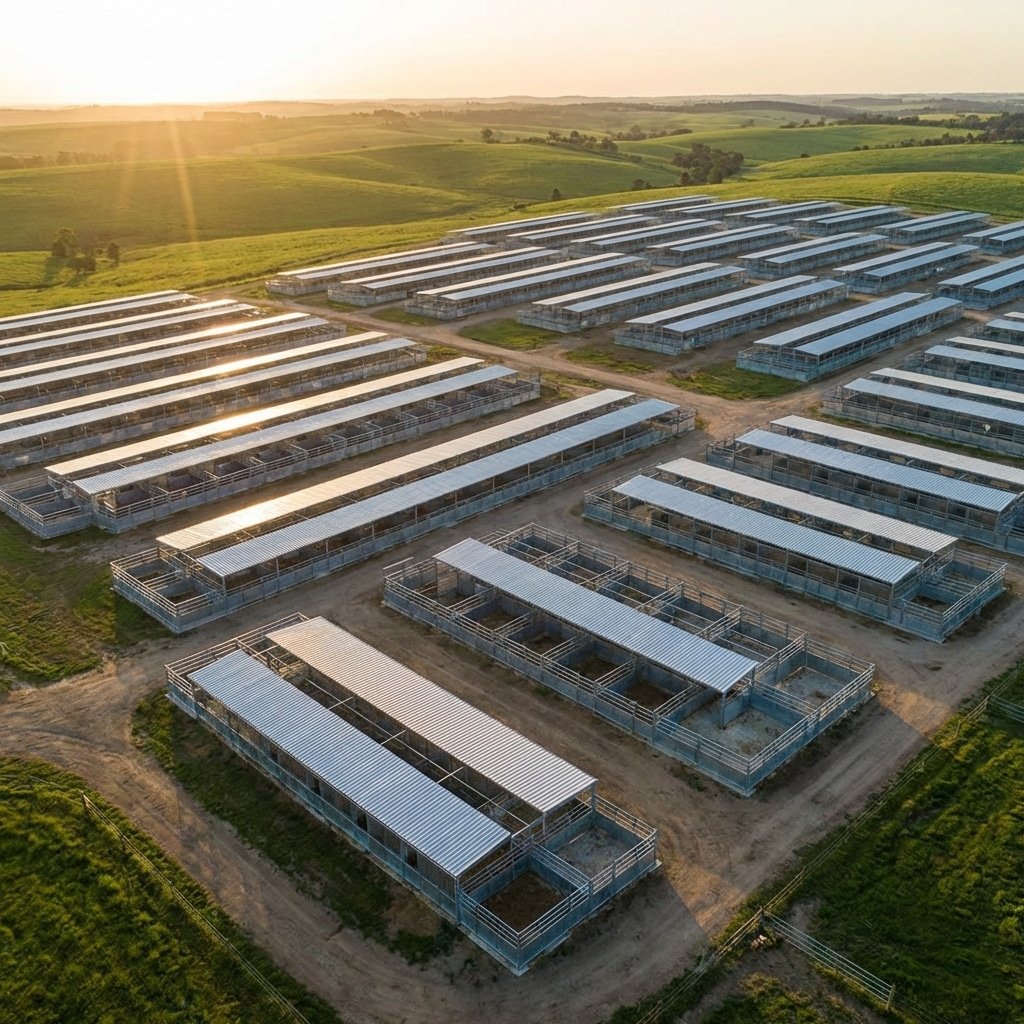
Fleet financing for a 500-stall rental inventory determines whether your deployment is a scalable asset or a rusting liability. Lenders increasingly scrutinize asset durability, meaning standard painted frames often fail to meet the depreciation schedules required for favorable capital terms. If your infrastructure degrades before the loan matures, your operational margins collapse.
This analysis benchmarks procurement strategies against the ISO 1461 Hot-Dip Galvanization standard to ensure asset longevity exceeds amortization periods. We examine how flat-pack logistics maximize container yield to 45 sets, reducing landed costs and improving the loan-to-value ratio for institutional buyers.
The Rise of ESG (Environmental, Social, Governance) in Construction
By 2026, ESG reporting is a fundamental lic
ense to operate. With construction driving 34% of global CO2, developers now mandate low-carbon materials and optimized logistics to secure green financing.
Decarbonization Mandates and Green Financing Access
Regulators and investors have shifted their stance from encouragement to requirement. Access to capital for large-scale developments is now directly linked to ESG performance metrics. Banks and private equity firms increasingly view non-compliant projects as high-risk assets, making sustainability a hard prerequisite for funding rather than a “nice-to-have” add-on.
To secure these investments, the industry is aggressively moving toward circular economy solutions. The construction sector is responsible for approximately 34% of global CO2 emissions, forcing a crackdown on embodied carbon. Developers must now prove that their chosen assets offer long lifecycles and high recyclability to lower this footprint. Simply put, if the materials don’t meet the carbon budget, the project doesn’t get built.
Reducing Embodied Carbon via Flat-Pack Logistics and Bamboo
Meeting strict ESG standards requires looking beyond the building site to the manufacturing and shipping processes. We address this through specific material choices and logistical engineering that drastically reduce the embodied carbon of every stable stall installed.
- High-Density Bamboo: We use Strand Woven Bamboo as a rapidly renewable alternative to slow-growth hardwoods like Oak. It sequesters carbon during its fast 3-5 year growth cycle and sacrifices no durability, boasting a Janka Hardness rating > 3000 lbf.
- Logistical Efficiency: Transport emissions are often overlooked in ESG reports. Our DB Flat-Pack system fits 30-45 sets per 40HQ container, compared to just 12-15 sets for fully welded alternatives.
- Carbon Reduction: By tripling the shipping density, we reduce transport-related carbon emissions by over 60% per unit.
Moving Away from Old-Growth Timber (Oak/Pine)
The industry is shifting from slow-growth hardwoods to engineered bamboo and HDPE to eliminate maintenance costs, resist rot, and reduce environmental impact.
The Ecological and Practical Limits of Traditional Hardwoods
Traditional oak and pine are becoming liabilities in modern stable design. From an ecological standpoint, old-growth hardwoods require 30 to 50 years to reach maturity. Harvesting them faster than they regenerate drives up costs and creates sustainability issues that many large-scale projects can no longer justify. In contrast, bamboo acts as a rapid carbon sink, renewing itself in just 3-5 years.
Practically, wood fails in the stable environment. Softwoods like pine are susceptible to cribbing (chewing), creating splinter hazards for the horse and structural damage for the facility. Wood is also porous; it absorbs moisture, ammonia, and bacteria, leading to rot and distinct hygiene challenges. Maintaining timber requires annual varnishing or the use of toxic preservatives, which adds long-term labor costs and health risks.
Engineered Solutions: High-Density Bamboo and HDPE Infills
To solve the durability issues of wood, we use engineered alternatives that withstand the abuse of a 1,200 lb animal. These materials maintain the aesthetic of a traditional stable but utilize modern manufacturing to ensure longevity.
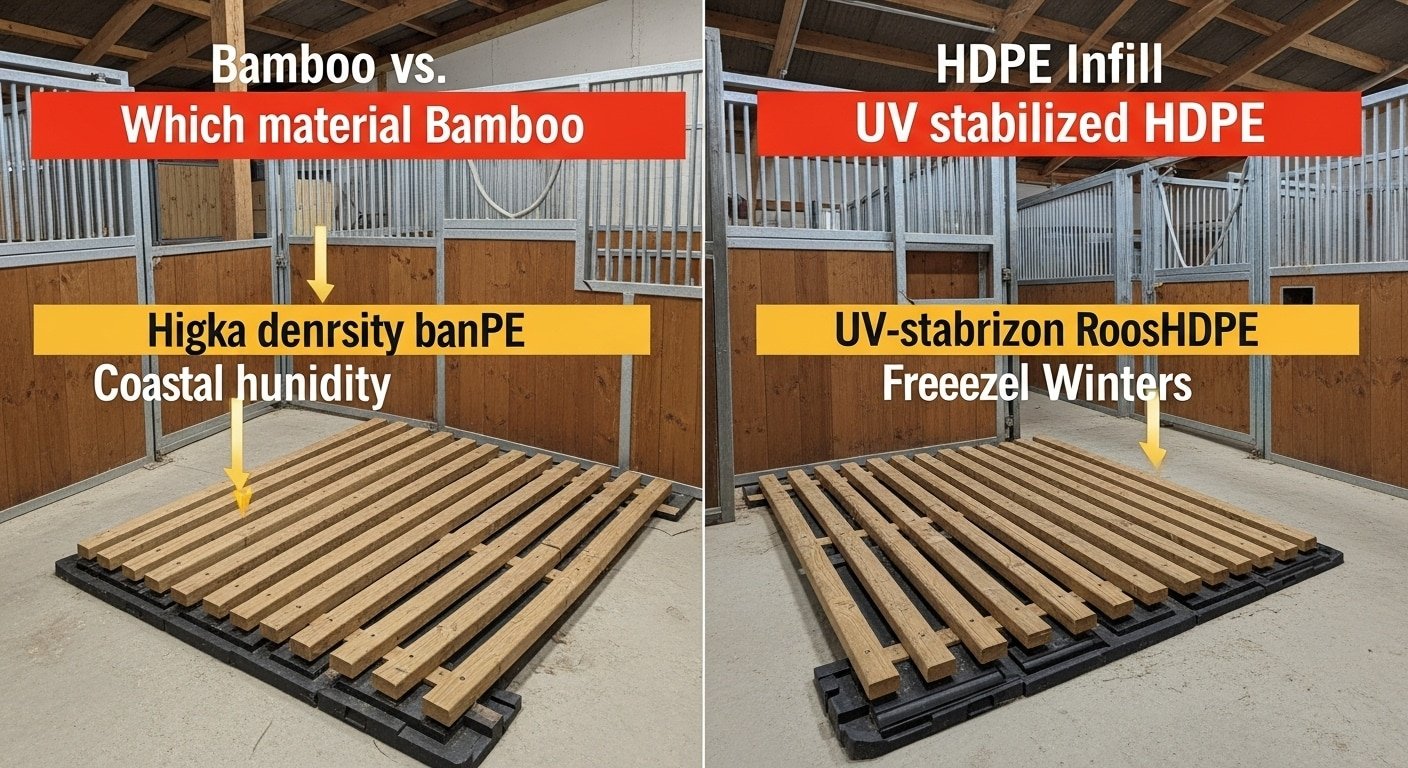
- High-Density Strand Woven Bamboo: We compress bamboo fibers to achieve a Janka Hardness rating over 3000 lbf. This makes our bamboo infill 3x harder than oak, rendering it highly resistant to kicks and cribbing.
- UV-Stabilized HDPE: Our recycled plastic lumber offers a “Zero Maintenance” solution. It is impact-absorbing, impervious to rot, and does not retain bacteria.
- Chemical-Free Maintenance: Both options eliminate the need for varnishing or chemical treatments, removing toxic substances from the horse’s living environment.
Preguntas frecuentes
How to build an ESG compliant equestrian center?
Building an ESG (Environmental, Social, and Governance) compliant center requires a three-pillar approach. First, address Environmental impact by integrating renewable energy (solar) and closed-loop water systems for wash bays. Use durable materials like Hot-Dip Galvanized steel and bamboo to minimize replacement waste. Second, ensure Social responsibility by designing for staff safety and horse welfare—features like proper ventilation and safe hardware are critical. Finally, handle Governance by documenting your supply chain transparency and establishing clear waste management protocols.
Is bamboo a sustainable building material?
Yes, bamboo is one of the most sustainable construction materials available. It is a grass that reaches maturity in 3-5 years, compared to the 30-50 years required for hardwoods like oak. It regenerates from its own root system after harvesting, eliminating the need for replanting and soil tillage. Furthermore, bamboo forests sequester significantly more carbon dioxide than equivalent timber forests. For stables, we use strand-woven bamboo, which processes this raw material into high-density boards that resist rot and insect damage.
Environmental impact of steel vs wood barns?
Wood has lower embodied carbon during initial production but suffers from a shorter lifespan and higher maintenance requirements in wet, abusive stable environments. Rotting wood often ends up in landfills and releases methane. Steel requires more energy to produce initially but is 100% recyclable without loss of quality. Our Q235B steel structures are designed to last decades with hot-dip galvanization. Over a 50-year lifecycle, steel often proves more environmentally efficient because it does not require frequent replacement or chemical treatments like pressure-treated lumber.
Green certifications for horse stables?
There is no specific global certification dedicated solely to horse stables, but facilities often adapt broader standards. You can pursue **LEED** (Leadership in Energy and Environmental Design) certification by treating the stable as a commercial agricultural building. Key factors for certification include site selection (avoiding wetlands), water efficiency (rainwater harvesting), energy performance (natural ventilation/lighting), and materials and resources (using recycled steel or rapidly renewable bamboo). Local codes, like California’s **CalGreen**, also provide frameworks for sustainable agricultural construction.
Eco-friendly horse barn manufacturers?
Eco-friendly manufacturing in this sector is defined by material sourcing and logistics. Manufacturers like DB Stable focus on high-yield, renewable materials (Bamboo) and recyclable inputs (Steel, HDPE) rather than deforestation-prone timber. We also utilize flat-pack logistics which allows us to fit 30-45 stable sets in a single container, reducing shipping carbon emissions by over 60% compared to fully welded competitors. When selecting a manufacturer, ask about their galvanization process (longevity equals sustainability) and the recyclability of their infill materials.
Precision-Engineered Stables Built for 20+ Years

Top Factories Embracing Sustainable Materials
Executive Summary: ESG compliance has shifted from a marketing bonus to a strategic necessity. Leading manufacturers now secure their market position by integrating carbon-negative materials like strand-woven bamboo and infinitely recyclable steel.
| Core Material Strategy | Impacto medioambiental | Strategic Advantage |
|---|---|---|
| Strand-Woven Bamboo | High-yield carbon sink (Negative footprint) | Regenerates in 3-5 years; 3x harder than oak. |
| Q235B Recycled Stee
l | 100% Recyclable; Closed-loop lifecycle | Reduces landfill waste; infinite reuse without degradation. |
| Thin-Film Photovoltaics | 40% lower lifecycle carbon emissions | Energy independence and reduced operational costs. |
The Strategic Shift: From Compliance to Competitiveness
ESG (Environmental, Social, and Governance) reporting has transitioned from an optional PR exercise to a fundamental “license to operate.” The construction and manufacturing sectors, responsible for roughly 34% of global CO₂ emissions, face intense pressure from regulators and investors. By 2026, carbon budgets and embodied carbon limits will dictate which factories win contracts. Companies that integrate sustainable materials early in the design phase secure lower cost structures and stronger relationships with stakeholders who demand transparency.
The Bamboo Revolution: Carbon Negative Manufacturing
Factories moving away from old-growth timber (oak/pine) are standardizing on Strand-Woven Bamboo. This material offers a dual advantage: superior durability and massive carbon sequestration. Unlike traditional hardwoods that take decades to mature, Moso bamboo reaches maturity in just 3 to 5 years and regenerates from its own root system, eliminating the need for replanting.
From a manufacturing perspective, strand-woven bamboo is an engineering powerhouse. It creates a “durable products pool” for long-term carbon storage, with density averaging 900 kg/m³—significantly higher than conventional wood.
- Carbon Sequestration: Moso forests sequester 20-40 tons of carbon per acre annually.
- Industrial Performance: High resin content (up to 6.2% for outdoor use) ensures resistance to mold and rot.
- Lifecycle Credit: Industrial bamboo products can achieve a negative carbon footprint over their full lifecycle.
The Steel Backbone: Q235B and Circular Economy
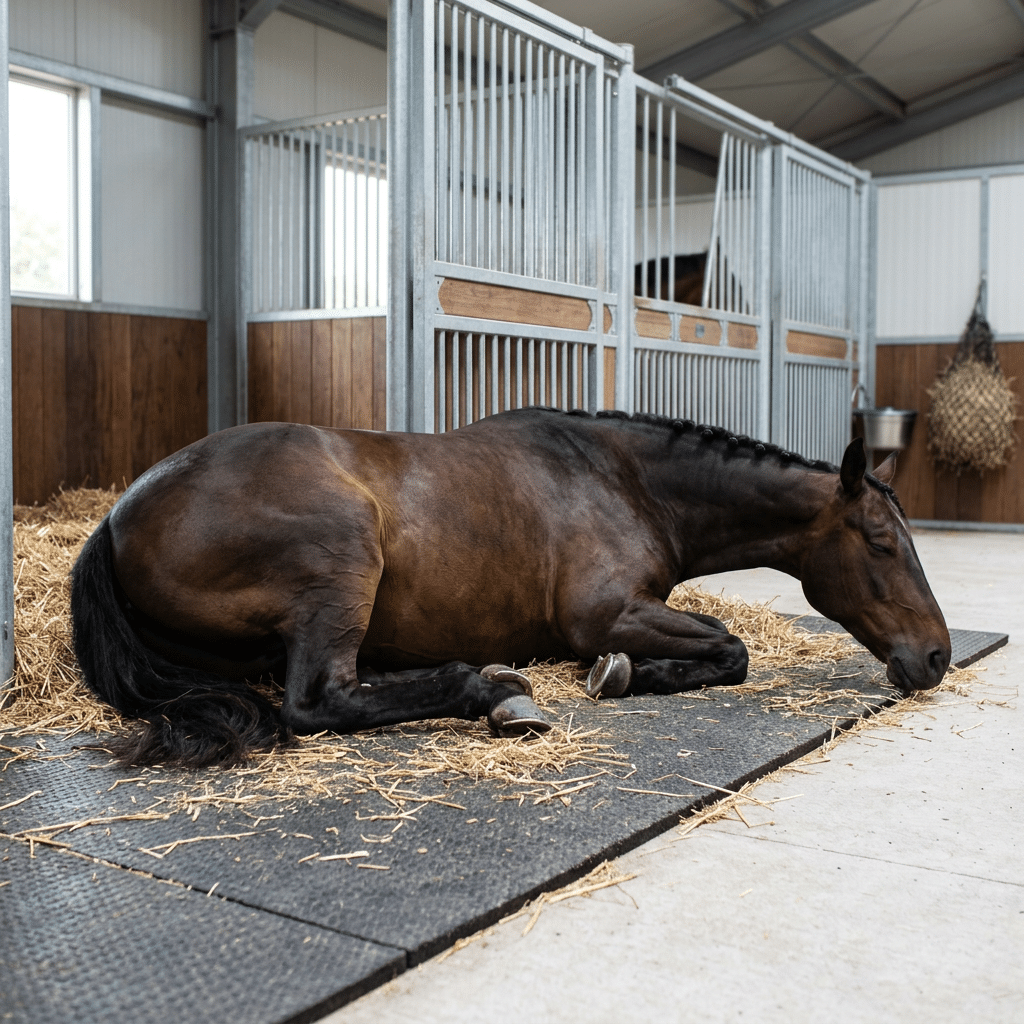
Sustainable manufacturing isn’t just about plant-based materials; it is about the lifecycle of structural components. Q235B Steel (and the cold-climate specific Q345B used in our Professional Series) represents the standard for circular economy principles in heavy industry.
Steel is unique because it is 100% recyclable without losing material properties. A steel beam from a demolished factory can be re-smelted into a new stable frame indefinitely. Current data shows that approximately 70% of steel produced in the US is already recycled.
- Zero-Waste Lifecycle: Prefabricated steel structures minimize onsite waste and transport emissions.
- Longevity: Hot-dip galvanization (ISO 1461) extends asset life to 30-50 years, drastically reducing replacement frequency compared to painted or raw steel.
- Efficiency: Lightweight profiles reduce transportation fuel consumption compared to concrete alternatives.
Global Benchmarks: Leaders in Green Manufacturing
While we focus on equestrian infrastructure, the shift is industry-wide. Major global players are setting the pace for what a “Top Sustainable Factory” looks like:
- First Solar: Uses thin-film cadmium telluride modules that generate 40% lower lifecycle carbon emissions than silicon panels, supported by a 90% recovery rate recycling program.
- Metso Outotec: A leader in sustainable technology for mineral processing, with strict targets to limit global warming to 1.5°C.
- Mahindra & Mahindra: Setting benchmarks in sustainable automotive production through waste reduction and energy efficiency.
Strand-Woven Bamboo: A High-Yield Carbon Sink
Strand-woven bamboo acts as a dual-phase carbon sink: it rapidly captures CO2 during growth and permanently locks it into high-density boards that exceed steel in tensile strength.
Rapid Sequestration: The Biological Advantage
Most timber discussions miss the critical variable: time. Hardwoods like Oak or Maple require 40 to 60 years to reach harvest maturity. Moso bamboo achieves this in three to five years. This accelerated growth cycle allows for annual harvesting without depleting the resource, turning the plantation into a continuous carbon vacuum rather than a static storage unit.
The biological efficiency here is measurable. A single bamboo culm absorbs approximately 50–60kg of CO2 over its short lifespan. Because the root system is regenerative—meaning it survives harvest and sends up new shoots immediately—the soil carbon remains undisturbed. This prevents the significant CO2 release associated with the heavy machinery and soil disruption required to replant traditional timber forests.
- Sequestration Rate: 12 tons of carbon per hectare/year (vs. 6-8 tons for standard forests).
- Maturity Cycle: 3-7 years to structural grade.
- Regeneration: Zero replanting required; roots remain intact.
Locking Carbon via High-Density Strand Weaving
Raw bamboo is hollow and structurally inconsistent. To make it viable for our Professional Series stables, we process it through strand weaving. This involves crushing the bamboo fibers, drying them, and compressing them under extreme pressure (2,500+ tons) with an eco-friendly resin. This process transforms a temporary biomass into a permanent, high-density building component.
The resulting board locks the sequestered carbon into a material that resists the high-impact environment of an equine facility. Unlike concrete, which emits CO2 during production, strand-woven bamboo maintains a negative lifecycle eco-cost. It effectively traps the carbon captured during the plant’s growth phase for the duration of the stable’s life.
- Janka Hardness: > 3000 lbf (Over 3x harder than Oak).
- Tensile Strength: 28,000 kgf/in² (Exceeds structural steel).
- Density: Approx. 1.15 g/cm³ (Sinks in water).
- Durability: Highly resistant to hoof impact and cribbing (biting).
Q235B Steel: The 100% Recyclable Framework
Q235B is a low-carbon structural steel (ASTM A36 equivalent) that balances 235 MPa yield strength with high ductility, ensuring frames absorb impact without fracturing while remaining 100% recyclable.
Material Science: Yield Strength and Sustainability
In the equestrian industry, “strength” is often misunderstood as “hardness.” Hard steel is brittle; if a 600kg warmblood kicks a brittle frame, it snaps, creating jagged edges that can sever tendons. We use Q235B (equivalent to ASTM A36) because its yield strength of 235 MPa provides the necessary ductility. When impact exceeds its limit, the steel deforms rather than shattering, keeping the animal safe.
From an environmental perspective, Q235B supports a true circular economy. Unlike chemically treated timber which often ends up in landfills due to toxicity concerns, this structural steel is 100% recyclable. A retired stable frame can be melted down and repurposed without degrading the material’s core properties, reducing the need for virgin iron ore extraction.
- Impact Absorption: Designed to bend under extreme stress to prevent catastrophic brittle fracture.
- Circular Economy: Fully recyclable material stream that retains value at end-of-life.
- Galvanizing Adhesion: Specific chemical composition ensures zinc bonds effectively during hot-dip galvanizing.
- Extended Lifespan: 30-50 year structural life significantly lowers the carbon footprint compared to replacing rotted timber every decade.
Manufacturing Specs: ASTM A36 Equivalence and 14-Gauge Tubing
Many manufacturers cut costs by using 1.5mm or 1.6mm wall thickness, banking on the fact that most buyers won’t bring calipers to the inspection. We reject this practice. Our Q235B frames are strictly formed into 50mm x 50mm RHS profiles with a minimum 14-Gauge (2.0mm) wall thickness. This mass is non-negotiable for maintaining integrity under the stress of 450kg+ stall fronts and aggressive equine behavior.
- Standard Compliance: Direct equivalent to American Standard ASTM A36 and European EN S235JR.
- Espesor de pared: Strict minimum 2.0mm (14-Gauge) on all structural tubing.
- Zinc Coating: Surface characteristics allow for hot-dip galvanizing thickness exceeding 85 microns on structural parts.
- Safety Factor: Heavier gauge steel prevents “oil canning” or denting from daily kicks.
Preguntas frecuentes
How to build an ESG compliant equestrian center?
Building an ESG-compliant facility requires a shift from aesthetic-focused design to performance-based engineering across three pillars:
- Environmental: Stop guessing and start measuring. Implement renewable energy (solar often covers 80% of needs) and closed-loop water systems for wash bays. Waste management must be documented—”zero waste” is a marketing claim; a year-over-year diversion plan is a strategy.
- Social: This industry is notorious for burnout. Compliance means safe working conditions (risk assessments for machinery and horses) and decent facilities for staff, not just clients.
- Governance: You need a formal strategy, not good intentions. Establish board-level oversight for sustainability metrics and verify your supply chain. Don’t assume vendors are compliant; demand their data.
Is bamboo a sustainable building material?
Yes, but the type of bamboo matters. In its raw form, bamboo rots quickly. However, High-Density Strand Woven Bamboo is a legitimate sustainable alternative to hardwoods. It reaches maturity in 3-5 years (versus 30-50 years for oak) and self-regenerates without replanting. It sequesters massive amounts of carbon during growth.
For equestrian use, we strictly use strand-woven bamboo with a Janka hardness exceeding 3000 lbf—making it 3x harder than oak and resistant to hoof impact. This solves the natural durability issue while maintaining the carbon-negative benefits of the crop.
Environmental impact of steel vs wood barns?
This is a trade-off between upfront embodied carbon and long-term lifecycle costs:
- Wood: Lower initial carbon footprint during production. However, horses chew wood, and moisture causes rot. This leads to frequent repairs and replacements, increasing the long-term environmental cost.
- Steel: Higher energy required for initial production, but it lasts 30-50 years with hot-dip galvanization. It is 100% recyclable without losing strength.
If you want a structure that returns to the earth quickly, choose wood. If you want a circular economy asset that won’t need replacement for decades, steel is the superior operational choice.
Green certifications for horse stables?
There is no specific “Green Stable” certification. However, you can apply broader commercial standards to your facility:
- LEED: While usually for commercial buildings, you can apply LEED credits for site planning, water efficiency (rainwater harvesting), and materials (recycled steel).
- CalGreen (California): Even if you aren’t in California, their agricultural code is a solid framework. It mandates construction waste reduction and specific water conservation measures.
Focus on stormwater management (permeable pavers), on-site composting, and energy audits rather than chasing a plaque for the wall.
Eco-friendly horse barn manufacturers?
Several manufacturers are pushing sustainable practices beyond standard building codes. Based on industry data, notable names include:
- DB Stable (Us): We focus on 100% recyclable hot-dip galvanized steel and renewable strand-woven bamboo infill, utilizing flat-pack logistics to cut shipping emissions by 60%.
- DC Structures: Known for using responsibly sourced heavy timbers from the Pacific Northwest.
- MD Barnmaster: A pioneer in modular construction, which significantly reduces construction waste compared to stick-built barns.
- WYO Custom Builders: Specializes in metal barns that avoid the chemical treatments required for wood preservation.
When vetting a manufacturer, ask for their material sourcing specs and waste management protocols. If they can’t tell you where their steel or timber comes from, they aren’t managing their environmental impact.
Preguntas frecuentes
How to build an ESG compliant equestrian center?
Building an ESG-compliant facility requires a three-pillar approach. Environmental: Focus on energy and durability. Installing solar panels covers the energy side, but choosing Hot-Dip Galvanized steel (ISO 1461) ensures your infrastructure lasts 20+ years, reducing the carbon footprint of replacement. Social: Prioritize safety. We use strictly controlled 50mm bottom gaps (“Cast-Proof”) and heavy-duty connectors to prevent injury to staff and horses. Governance: Document your supply chain. Ensure your steel and bamboo are sourced from factories with ISO 9001 certification to guarantee ethical production standards.
Is bamboo a sustainable building material?
Yes, but the grade matters significantly. Bamboo regenerates in 3-5 years compared to 30-50 years for hardwoods like oak, making it a superior carbon sink. However, standard hollow bamboo rots quickly. We use High-Density Strand Woven Bamboo with a Janka Hardness rating >3000 lbf (3x harder than oak). This engineered process compresses the fibers to create a dense, rot-resistant board that withstands commercial abuse while maintaining its carbon-negative credentials.
Environmental impact of steel vs wood barns?
Wood has lower embodied carbon during initial production, but steel wins on lifecycle analysis and recyclability. Wood in a stable environment is prone to cribbing (chewing), rot, and warping, often requiring replacement within a decade. Our Q235B/Q345B structural steel is 100% recyclable and, when Hot-Dip Galvanized, provides decades of service without toxic chemical treatments. For commercial projects, steel minimizes long-term waste and maintenance overhead.
Green certifications for horse stables?
There is no specific global “Green Stable” certification. However, facilities often adapt LEED (Leadership in Energy and Environmental Design) or local codes like CalGreen. To align with these standards, focus on ventilation efficiency (our open-grill designs promote the “stack effect” for natural cooling) and materials with low VOC emissions. Using modular, pre-fabricated components also contributes points toward waste reduction credits in green building frameworks.
Eco-friendly horse barn manufacturers?
In the B2B sector, “eco-friendly” is defined by logistics efficiency y product longevity rather than brand marketing. Many manufacturers ship fully welded frames, which means shipping mostly air—limiting a container to 12-15 sets. A truly sustainable manufacturer uses a flat-pack system (like ours) that fits 30-45 sets in a 40HQ container, reducing freight emissions by over 60%. Always verify the factory uses Hot-Dip Galvanization after fabrication; if the steel rusts and needs replacing in 5 years, it is not an eco-friendly solution.
Reflexiones finales
Capital access now hinges on verifiable ESG performance, making traditional timber and raw steel high-risk liabilities for institutional buyers. Deploying our ISO 1461 Hot-Dip Galvanized frames and carbon-negative Strand Woven Bamboo secures your project’s green financing eligibility while maximizing asset longevity. This strategic choice ensures you meet strict 2026 carbon mandates without sacrificing the structural durability required for a 500-stall fleet.
Efficiency is the definitive metric for large-scale procurement. Contact our project team today to calculate the precise freight savings of our 40HQ Flat-Pack logistics compared to standard welded alternatives. We advise initiating a 3-5 stall trial order to validate our “Kick-Proof” engineering and finish quality before finalizing your commercial rollout.

 Spanish
  English
  French
  Arabic
  German
0 comentarios