


Sourcing specific Mini Donkey Grills is the only way to eliminate the entrapment risks inherent in standard equine infrastructure. Standard 3-inch vertical bars create dangerous one-way traps for tapered snouts and horns, turning a standard safety feature into a liability for mixed-species facilities. Ignoring this geometric mismatch exposes facility owners to severe injury claims and catastrophic livestock loss.
This analysis benchmarks safe containment using the 50mm x 50mm heavy-duty mesh standard against common vertical tubing. We evaluate structural resilience using Q235B steel and ISO 1461 Galvanización en caliente to ensure flush-bottom modifications withstand corrosive manure environments. These specifications provide a blueprint for adapting standard bays into secure zones for smaller companions.

Mixed-Species Barns: The Rise of Equine Companions
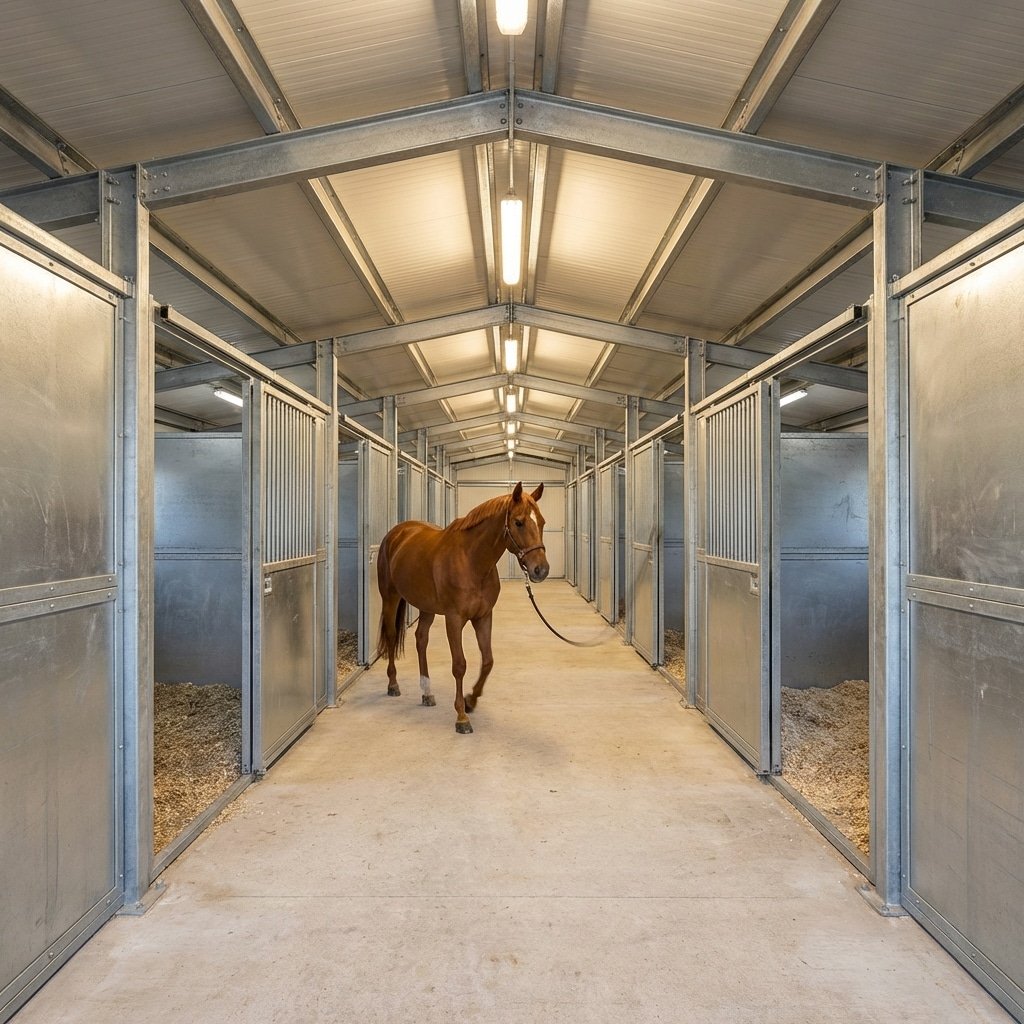
Integrating companions like miniature donkeys reduces herd anxiety but requires adapting standard 12’x12′ stalls into safer, smaller 10’x8′ configurations using modular partitions.
The Strategic Value of Companion Stabling
High-end facilities are moving away from isolation and toward mixed-species stabling for practical management reasons. Miniature donkeys and goats serve as natural calming agents for high-strung Thoroughbreds or isolated stallions. This “social buffering” reduces stable vices like weaving or stall walking, protecting the value of the performance horse without the risks of putting two large horses in the same paddock.
Beyond behavioral management, this approach maximizes facility density. A standard 12’x12′ (3.6m x 3.6m) stall is an inefficient use of square footage for a goat or miniature donkey. By redesigning the internal layout, facility owners can house companion animals in smaller footprints, often converting one standard bay into two dedicated companion units. This separation is critical for dietary control; goats and horses have different nutritional needs, and physical barriers allow for individualized feeding while maintaining the visual contact necessary for herd dynamics.
Utilizing Modular Partitions for Flexible Layouts
Standard fully welded stalls fail in mixed-species barns because they lock you into a single, unchangeable footprint. Adapting a barn for smaller companions requires the flexibility to divide bays. DB Stable’s modular Side/Partition Panels allow builders to split standard bays into custom sizes, such as 10’x8′ or even 6’x6′, specifically for smaller stock.
- Flat-Pack Adaptability: Nuestro Steel Pallet Flat-Pack system allows on-site adjustments. Installers can shift partition anchor points before final bolting to create exact dimensions for companion zones.
- Resistencia estructural: Different species exert different forces. We use Acero estructural Q235B (or Q345B for cold climates) with 14-gauge (2.0mm-2.5mm) wall thickness. This ensures the frame withstands both the impact of a horse kick and the abrasive behavior of goats.
- Resistencia química: Mixed species produce varied manure acidity. Our Galvanización en caliente después de la fabricación (to BS EN ISO 1461 standards) coats the entire welded assembly in 70+ microns of zinc, preventing rust points that pre-galvanized competitors cannot stop.
Using these modular components, you can configure a “Kick-Proof” environment that keeps the peace between species while optimizing every square meter of the barn.
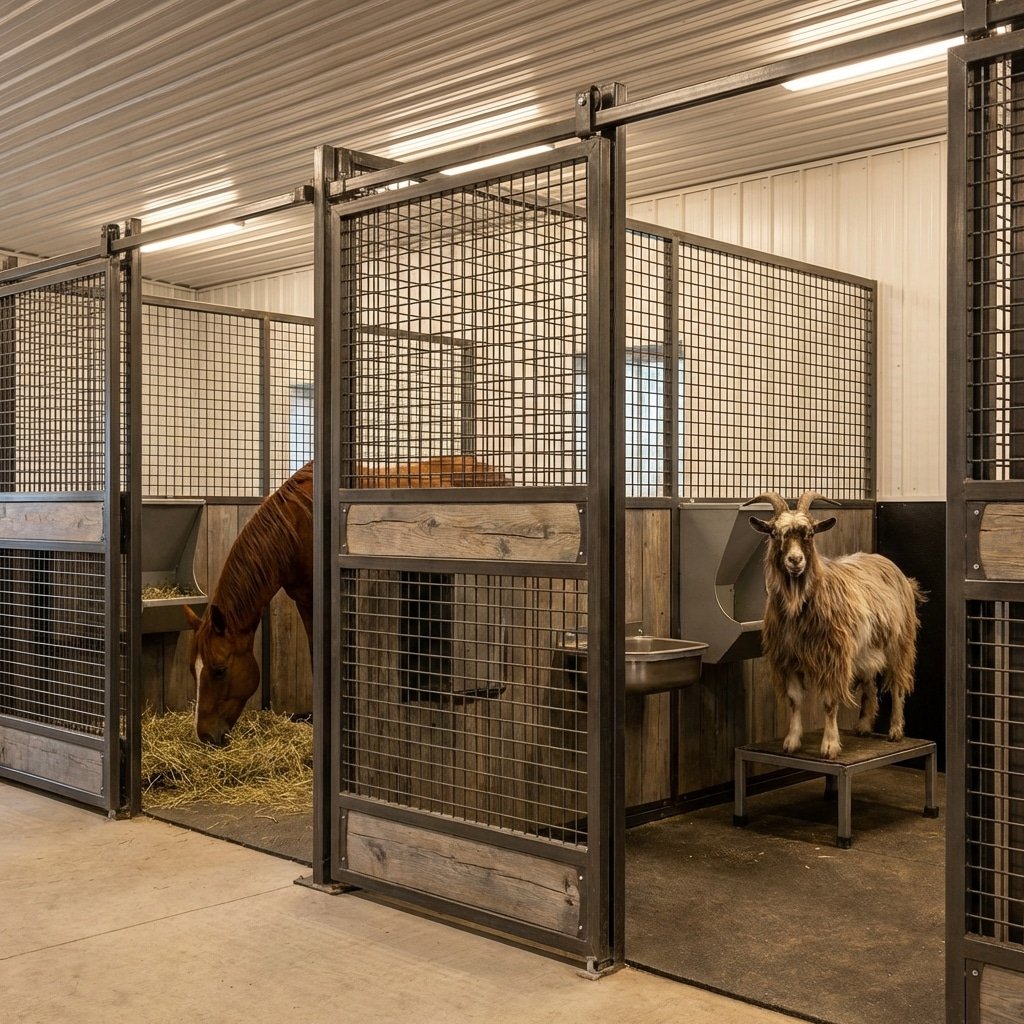
The Danger of the 50mm Bottom Gap for Tiny Hooves
Standard 50mm anti-cast gaps protect adult horses but act as hoof traps for miniature breeds. Mixed-species facilities require flush-bottom customization to eliminate this entrapment vector.
The Trapping Mechanism: Standard Clearances vs. Miniature Hooves
Most commercial stable manufacturers engineer a standard 50mm (approx. 2-inch) gap at the bottom of stall fronts and partitions. For a 17-hand Warmblood, this clearance is a critical safety feature; it allows a cast horse to get a hoof purchase on the floor to roll back over without getting a leg trapped against the steel. However, when you place a miniature donkey, Shetland pony, or foal in that same stall, the safety feature becomes a liability.
- The Wedge Effect: A miniature equine’s hoof is often smaller than 50mm. Unlike an adult horse, their hoof can slide fully under the bottom rail.
- Panic Response: Once the hoof slides under, the coronet band often catches on the steel rail when the animal tries to pull back. This panic induces thrashing, which drives the leg deeper into the gap.
- Soft Tissue Trauma: Even if the bone doesn’t break, the steel edge acts as a fulcrum, causing severe tendon damage or degloving injuries to the lower leg.
Adapting the ‘Cast-Proof Design’ for Mixed-Species Safety
For distributors supplying mixed-use barns or veterinary clinics, stock standard panels are insufficient. We modify our production line to eliminate the bottom gap entirely for these specific orders. This requires shifting from our standard “Cast-Proof” spacing to a flush-bottom configuration where the steel frame sits directly on the concrete or matting.
- Zero-Gap Profiling: We adjust the welding jigs to lower the infill channel, ensuring the bottom rail sits flush with the floor level, removing the entry point for tiny hooves.
- Structural Rigidity: A flush bottom subjects the frame to more moisture and manure contact. We counter this by maintaining our strict Galvanizado en caliente (ISO 1461) standard after fabrication, ensuring the bottom rail doesn’t rot out.
- Frame Integrity: Utilizamos Q235B structural steel with a minimum 2.0mm wall thickness. Lighter gauge steel (commonly used by budget competitors) can bend or bow at floor level over time, inadvertently creating new gaps that reintroduce the safety risk.
Cuadras de primera calidad diseñadas para ofrecer una gran durabilidad

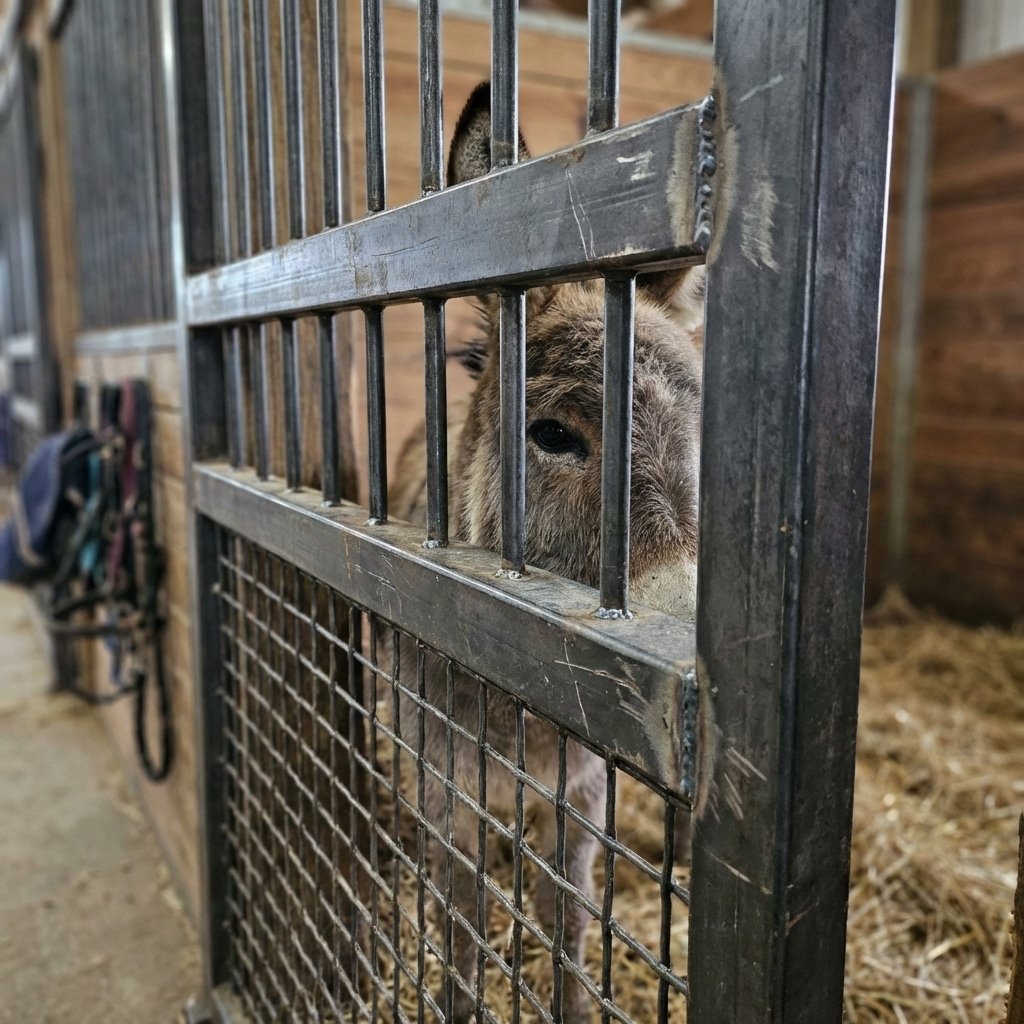
The Threat of 3-Inch Standard Grills for Horns and Snouts
Standard 3-inch (75mm) vertical bar spacing creates a dangerous entrapment zone for mini donkeys and goats. Their tapered snouts or curved horns pass through easily but wedge tight upon withdrawal.
The “One-Way” Trap: How Snouts and Horns Get Wedged
Most injuries in mixed-species stables occur because the physical infrastructure ignores the wedge-shaped anatomy of smaller livestock. A standard vertical grill operates as a one-way valve for these animals. They investigate an opening with the narrowest part of their face, but the geometry prevents them from backing out.
- The Mandible Lock: A mini donkey’s snout tapers significantly. They push through the 75mm gap to reach feed or sniff the aisle. When they attempt to pull back, the wider jawbones (mandible) catch against the rigid steel bars, locking the head in place.
- The Horn Rotation: Goats often twist their heads sideways to fit curved horns through vertical bars. Once the head passes through and straightens, the horns hook around the bars. The animal cannot replicate the complex twist-and-tilt motion required to free itself.
- The Panic Response: Unlike horses, which may freeze, entrapped smaller prey animals thrash violently. This panic often fractures cervical vertebrae or causes suffocation before handlers can intervene.
Why Standard Open Top Grills Are Unsafe for Mini Donkeys
We engineer our standard “Economy Series” Open Top Grills specifically for adult equine head sizes. The design assumes a head width significantly larger than the 3-inch (approx. 75mm) spacing between tubes. Applying this same specification to miniature breeds invites disaster.
Material rigidity exacerbates the danger. We manufacture these grills using Q235B Structural Steel (equivalent to ASTM A36) with a 2.0mm wall thickness. We build them to withstand the kick of a 1,200lb warmblood. This means the bars have zero flex. If a 300lb mini donkey gets its head wedged, the steel will not yield to release them. The animal breaks before the bar does.
For facilities housing miniatures or mixed herds, the standard vertical bar configuration is negligent. You must opt for mesh-based designs or significantly narrower spacing (below 50mm) to physically prevent the snout from entering the gap in the first place.
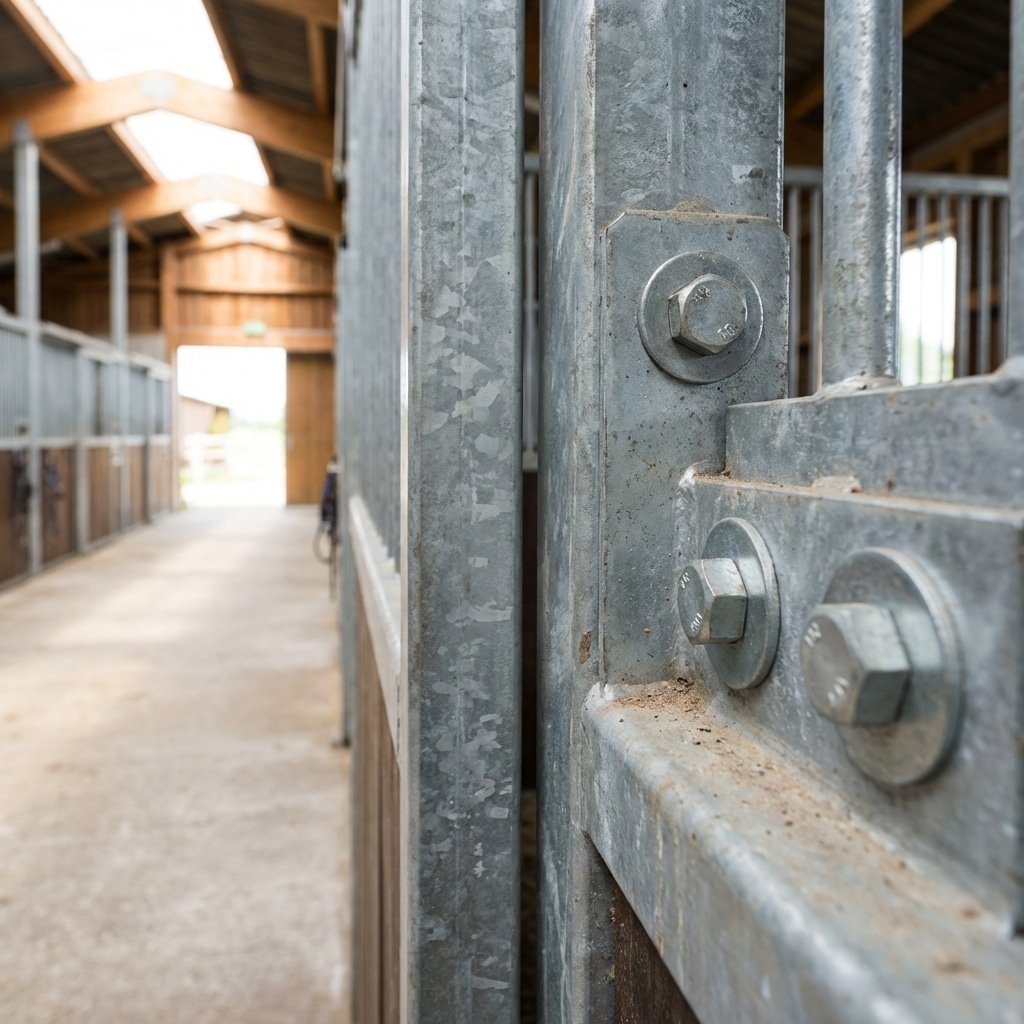
Ordering Full-Length 2-Inch Mesh Panels from DB
Custom 50mm mesh panels require a 35-45 day lead time for hot-dip galvanization and utilize flat-pack loading to prevent transit damage.
| Technical Spec | Standard Configuration | Commercial Implication |
|---|---|---|
| Mesh Aperture | 50mm x 50mm (2-Inch) | Prevents atrapamiento de pezuñas for foals/donkeys. |
| Wire Gauge | 4mm – 5mm Heavy Duty | Resists impact; not standard retail fencing. |
| Rust Protection | Hot-Dip Galv. After Fabrication | Zero rust at weld points (ISO 1461). |
| MOQ Efficiency | 1x 20GP (10-15 Sets) | Optimizes freight cost per unit. |
The 50mm x 50mm (2-Inch) Mesh Construction Standard
Standard stable bars often leave gaps too wide for small equines, creating entrapment risks for foal hooves or donkey snouts. We replace these bars with a heavy-duty 50mm x 50mm mesh grid. Unlike light-gauge agricultural fencing found in retail stores, we utilize 4mm to 5mm steel wire. This gauge resists high-impact kicks from larger horses that may share the facility, ensuring the barrier remains intact under stress.
Durability usually fails at the weld points on cheaper mesh products. We solve this by adhering to our “Hot-Dip After Fabrication” process. We weld the raw black steel mesh first, then submerge the entire panel into molten zinc. This guarantees zinc coverage on every wire intersection, preventing the rust bleed commonly seen in pre-galvanized alternatives. The full-length mesh design maximizes ventilation while maintaining a secure, climb-proof barrier.
Production Schedules and Minimum Order Requirements
Ordering non-standard mesh panels impacts the production timeline. Since we manufacture these from raw materials rather than cutting down stock inventory, you must plan for a 35-45 day lead time. This window accounts for the fabrication and the scheduling required at the galvanizing plant. We do not rush this stage, as proper zinc adhesion defines the product’s lifespan.
- Minimum Order Quantity (MOQ): We accept trial orders of 3-5 sets for LCL (Less than Container Load) shipments to support new distributors.
- Freight Efficiency: LCL shipping creates high per-unit costs. We strongly recommend ordering a 1x 20GP container (approx. 10-15 sets) to maximize your margin.
- Packaging Protection: We load all mesh panels onto flat-pack steel pallets. This prevents the bending and deformation often caused by loose loading.
Preguntas frecuentes
Can goats and horses be housed in the same stable block?
Yes, goats are excellent companions for horses and help reduce separation anxiety. But standard horse stalls usually require modification to be safe. Goats are escape artists and require secure latching mechanisms that a horse cannot operate but a dexterous goat might. More importantly, standard grill openings pose a risk of head entrapment for smaller animals. We recommend using our 50mm x 50mm (2-inch) mesh partitions rather than standard vertical bars for any shared facilities to ensure containment and safety.
Why are standard 3-inch grills considered dangerous for Miniature Donkeys?
Standard 3-inch (approx. 75mm) vertical bars are engineered specifically for adult horse hooves. A miniature donkey possesses a much smaller hoof capable of slipping through these gaps. If they kick out or rear, the hoof can easily become trapped between the bars, leading to panic, severe soft tissue damage, or leg fractures. For miniature stock, we strictly advise against standard bars and specify our heavy-duty 2-inch wire mesh option to ensure zero chance of entrapment.
Does the 50mm bottom “Cast-Proof” gap work for all animals?
Our standard 50mm (2-inch) bottom clearance is designed to prevent adult horses from getting “cast” (trapped) while rolling. But for very small species like pygmy goats or foal-sized donkeys, this gap is large enough for a hoof or leg to slide under, creating a new injury risk. In these specific mixed-barn scenarios, we provide extended Relleno de HDPE or floor-mounted U-channels to close the gap completely, sitting flush with the floor.
Do I need different infill materials for mixed-species barns?
We strongly recommend our 28mm-32mm HDPE infill for mixed barns. Wood is problematic here because donkeys and goats are notorious for chewing (cribbing) on softer materials, which damages the stall and can cause digestive issues for the animal. HDPE is impact-resistant, non-toxic, and virtually maintenance-free. It provides a hygienic, chew-proof surface that withstands the diverse habits of mixed herds better than traditional bamboo or pine.
Reflexiones finales
Stocking standard vertical bars for mixed-species applications invites injury liability and inevitable customer attrition. Investing in our Hot-Dip Galvanized 50mm Mesh system eliminates entrapment risks while preserving the structural integrity required for larger equine companions. This specific focus on safety positions your inventory as the premium, responsible choice for serious hobby farmers.
Because custom mesh requires a 35-45 day fabrication lead time, strategic planning determines your market readiness. We recommend securing a 1x 20GP trial order now to evaluate our zero-rust weld points and flush-bottom engineering before the season peaks. Contact our technical team today to configure your mixed-species solution.

 Spanish
  English
  French
  Arabic
  German
0 comentarios