


Improperly designed Slanted Rain Shelters turn open-front barns into wind tunnels that destroy up to 50% of your bedding inventory. This moisture ingress forces facility managers to constantly replace expensive shavings and exposes standard pre-galvanized frames to rapid corrosion.
This analysis establishes a weather-proofing standard using Galvanización en caliente después de la fabricación to BS EN ISO 1461 specifications. We examine how Q235B structural steel and UV-stabilized HDPE panels eliminate rot, ensuring your infrastructure withstands decades of wet weather exposure without maintenance.
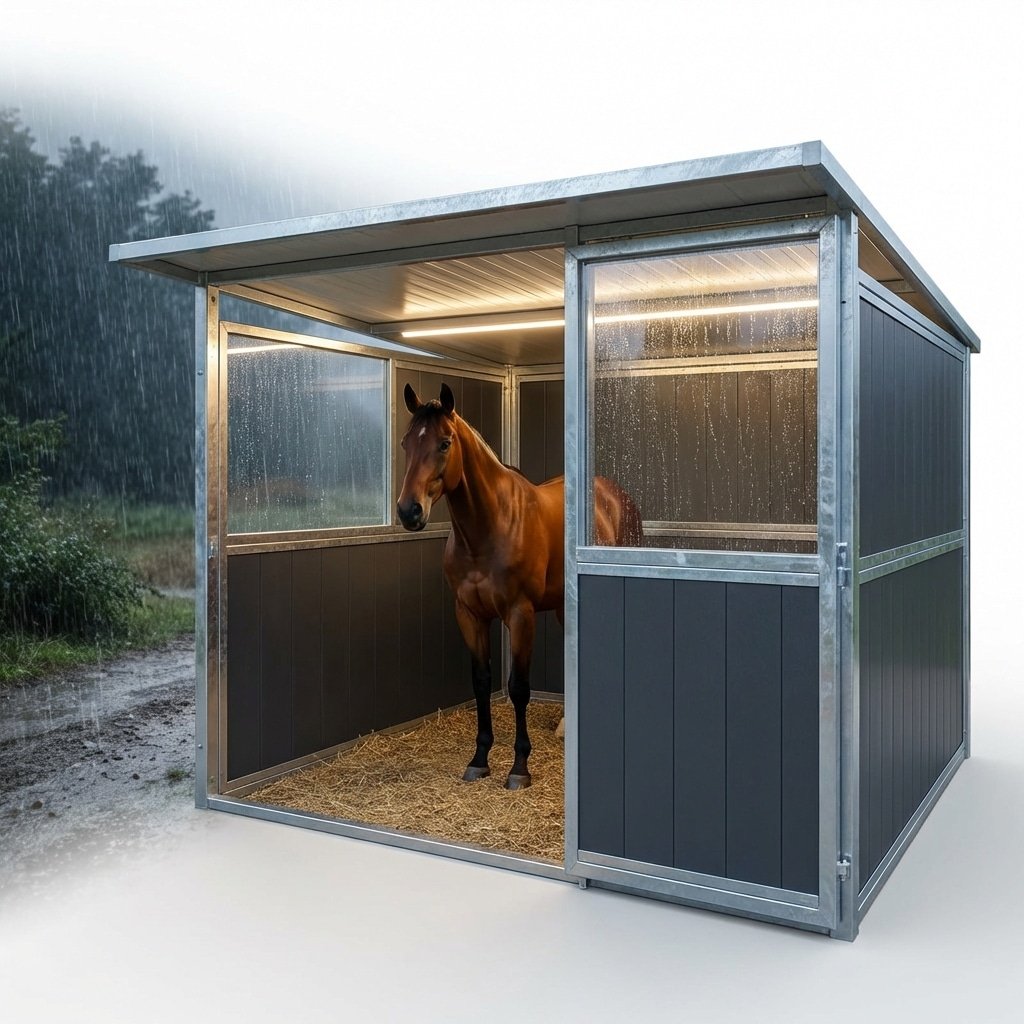
The Vulnerability of the Open-Front 3-Sided Shed
Open-front sheds act as wind tunnels, allowing slanted rain to soak up to 50% of the bedding. This constant moisture destroys standard steel, which is why we strictly use Hot-Dip Galvanization After Fabrication.
The Mechanics of Wind-Driven Rain Ingress
A common misconception in stable design is that a roof alone guarantees a dry interior. In reality, rain rarely falls vertically. Wind forces precipitation into open-front structures at acute angles, effectively turning the shelter into a wind scoop. We call this the “slanted rain” effect.
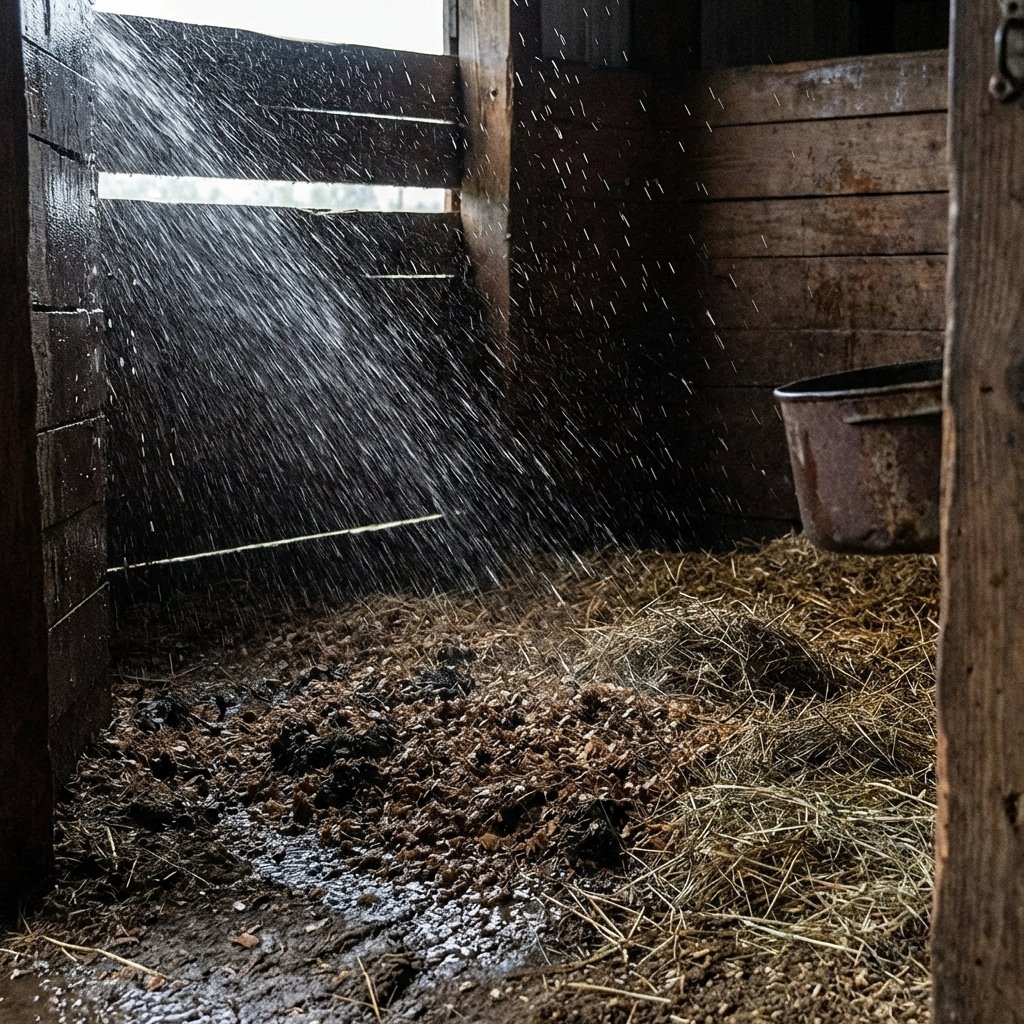
Without a front barrier, wind-driven rain penetrates deep into the shelter, often soaking the front 30% to 50% of the floor area. This significantly reduces the usable square footage for the horse and ruins expensive hay and bedding. Worse, the constant presence of wet bedding creates an ideal breeding ground for bacteria, leading to hoof health issues like thrush.
Preventing Corrosion with Hot-Dip Galvanization After Fabrication
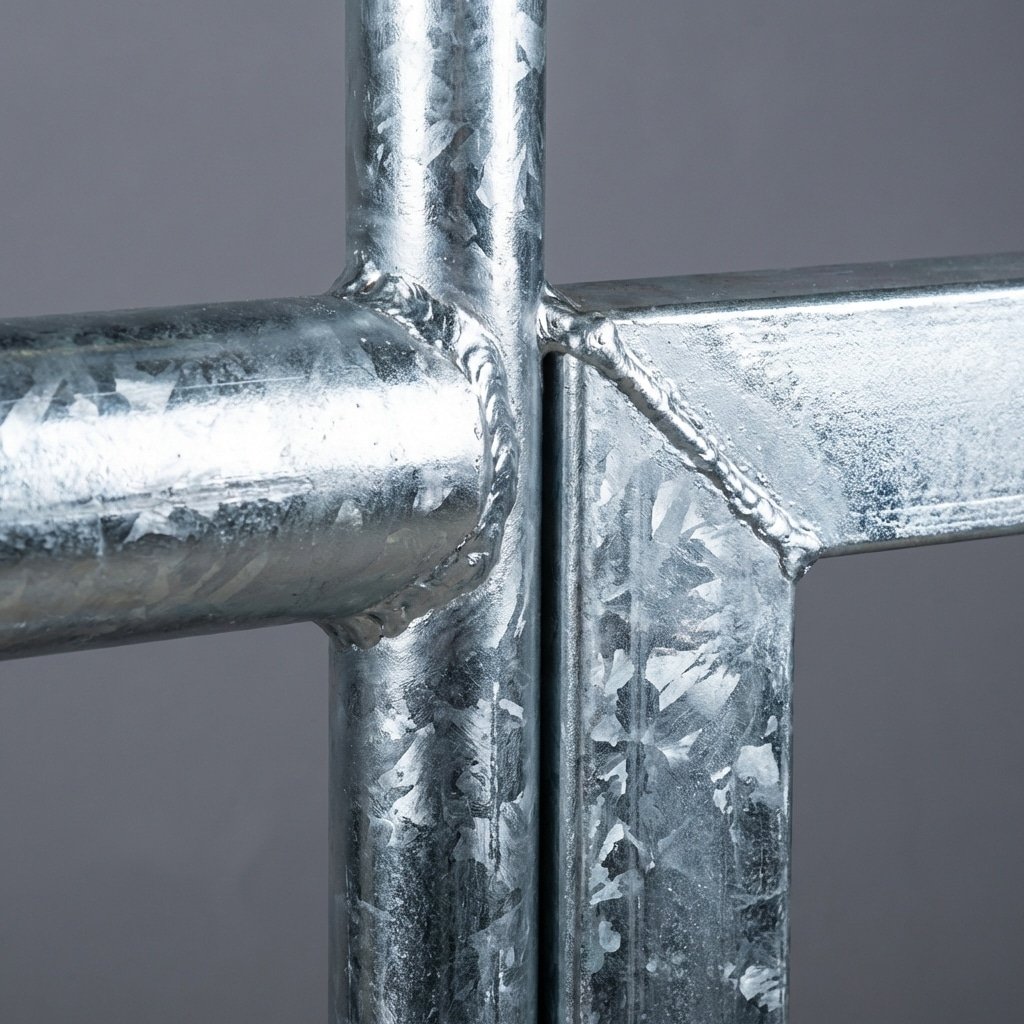
The ingress of moisture in an open-front shed exposes the steel frame to a high-corrosion environment. Standard “pre-galvanized” steel tubes—used by many budget competitors—fail here. When pre-galvanized tubes are welded, the heat burns off the zinc protection at the joints. Manufacturers often try to hide this with a quick spray of silver paint, but red rust inevitably appears within months.
DB Stable eliminates this risk by using Galvanización en caliente después de la fabricación. We build the entire frame from raw Q235B steel first, then submerge the completed structure into a bath of molten zinc. This process, conforming to BS EN ISO 1461 standards, ensures total protection:
- Sealed Joints: The liquid zinc flows over welds, sealing them completely against moisture.
- Internal Coverage: The zinc coats the inside of the tubes, preventing rot from within.
- Thickness: We achieve an average coating thickness of > 70 micras, far exceeding the industry norm.

Calculating Prevailing Wind and Slanted Rain Direction
Decomposing wind data into vectors rather than simple averaging ensures accurate rain angles, allowing builders to optimize roof overhangs and wall placement for maximum dryness.
The Vector Decomposition Method for Wind Direction
Simple arithmetic averaging fails with wind direction data. For example, averaging 350° and 10° mathematically yields 180° (South), even though the actual prevailing wind is North. To prevent these circular errors, engineers must treat wind as a vector quantity rather than a scalar number.
- Component Decomposition: Break raw wind observations into East/West and North/South components using trigonometric functions to ensure mathematical accuracy.
- Independent Averaging: Average each component independently to eliminate the distortion caused by the 0-360° compass circle.
- Vector Recombination: Apply the Pythagorean theorem and ATAN2 functions to the averaged components to calculate the true prevailing direction and speed.
Calculating Effective Rain Impact Angles for Shelter Design
Rain rarely falls vertically in open environments. To design effective stable overhangs, we model the “slanted” trajectory of rain by combining the calculated wind vectors with vertical rainfall intensity. This reveals the actual angle at which precipitation strikes the structure.
- Trajectory Modeling: Combine prevailing wind vectors with rainfall speed to map the physical path of wind-driven rain.
- Polar Coordinate Transformation: Convert Cartesian wind components into polar coordinates to determine the effective strike angle on vertical surfaces.
- Structural Optimization: Use the calculated impact angle to dictate the depth of roof overhangs and the orientation of solid sidewalls to keep the interior dry.
Engineered For Safety And 20-Year Durability

Adding DB Solid Wall Panels to the Open Front
Transform exposed open-front structures instantly with DB Stable’s solid partition panels. The modular hot-dip galvanized system provides a rot-proof, kick-resistant barrier against slanted rain without complex construction.
| Característica | Standard Wood Retrofit | DB Stable Solid Panel |
|---|---|---|
| Installation Method | Permanent framing & nailing | Modular Connector Pins |
| Moisture Resistance | Absorbe agua, se deforma, se pudre | 100% Water Repellent (HDPE) |
| Material Thickness | Variable (usually 18mm ply) | 28mm – 32mm Solid Infill |
| Frame Protection | Painted or Pre-Galvanized | Hot-Dip Galv After Fabrication |
Modular Installation for Partial Front Closures
You do not need a general contractor to weather-proof an open shed. We engineered our partition panels for modularity using a simple connector pin system. You position the panels to block the prevailing wind direction, align the brackets, and drop the pins to lock the wall in place. This method allows you to rapidly retrofit existing structures, creating an immediate windbreak that stops slanted rain from soaking feed or bedding.
- Hardware Included: Every panel ships with a complete installation kit featuring exclusively 304 Stainless Steel anchors and screws.
- Flexible Layouts: The modular design lets you extend or move the barrier as weather patterns or storage needs change.
- Structural Steel: Frames utilize Q235B or Q345B steel, ensuring rigidity without permanent foundations.
Weather Resistance of UV-Stabilized HDPE Infill
Traditional plywood walls act like sponges in open-front scenarios, absorbing wind-driven rain until they rot or mold. Our system solves this by using 28mm-32mm UV Stabilized HDPE infill. This material repels moisture completely and withstands direct sunlight without becoming brittle or discolored. You get a zero-maintenance surface that cleans with a pressure washer and requires no painting or sealing.
The durability extends beyond weatherproofing. We back these panels with a Kick-Proof Guarantee. The HDPE absorbs impact energy rather than shattering, while the hot-dip galvanized steel frame (coated to ISO 1461 standards) prevents rust even in high-moisture environments. This combination ensures your retrofit lasts decades, not just a few seasons.
Creating a True Weather-Proof Paddock Bunk
A weather-proof bunk requires a slanted overhang to deflect wind-driven rain and a raised, multi-layer aggregate foundation to ensure drainage and stability.
Designing Slanted Overhangs and Drainage Bases
Rain rarely falls vertically in open paddocks. To keep the interior dry, you need a slanted roof overhang designed specifically to deflect wind-driven rain and snow. If the geometry ignores prevailing wind vectors, moisture will penetrate the shelter regardless of the wall material. The overhang must extend far enough to push precipitation away from the bedding area.
Beneath the structure, drainage defines longevity. A shelter placed directly on topsoil will sink and create mud traps. You need a multi-layer foundation starting with a compacted subgrade, topped with at least 6 inches of aggregate. This facilitates immediate water runoff and prevents pooling around the frame.
- Foundation Depth: Minimum 6 inches of aggregate over compacted subgrade.
- Perimeter Extension: Extend the base 1 to 2 feet beyond the structure to distribute weight and prevent edge collapse from livestock pawing.
Selecting Hot-Dip Galvanized Steel and HDPE Infill
Standard painted steel or pre-galvanized tubing fails quickly in wet, outdoor environments due to rust at the weld points. At DB Stable, we strictly use Galvanización en caliente después de la fabricación conforming to BS EN ISO 1461. By welding the black steel first and then dipping the entire frame, we achieve a zinc coating exceeding 70 micras (often >85 microns on structural parts). This seals every connection against corrosion.
For the walls, wood is a liability in wet weather as it absorbs moisture and rots. We utilize 28mm-32mm UV-stabilized HDPE infill planks. These are chemically impervious to water, mold, and rot, offering a true zero-maintenance solution compared to timber.
- Steel Standard: BS EN ISO 1461 Hot-Dip Galvanization (>70μm coating).
- Infill Spec: 28mm-32mm HDPE (High-Density Polyethylene).
- Cold Climate Upgrade: Use Q345B Acero de baja aleación y alta resistencia to maintain impact toughness and prevent brittle fractures from kicks in freezing temperatures.
Preguntas frecuentes
What is the most effective way to stop wind entering a 3-sided run-in shed?
The primary strategy is proper orientation; position the open side away from prevailing winds to prevent rain and snow from blowing directly in. Also, seal all small gaps with weatherstripping or caulk, as draft points can compromise the structure during high winds. Planting natural windbreaks like trees nearby can also significantly reduce wind impact.
Can I enclose an open portable stable to make it a fully weather-proof barn?
Yes, this is easily done using modular interlocking panels. Systems like DB Stable’s allow you to add a ‘Stable Front’ or solid wall panel to an existing open structure. These panels use Hot-Dip Galvanized steel frames (minimum 2.0mm thickness) and UV-resistant HDPE infill that pin together without requiring permanent foundations or complex tools.
How does roof slope (pitch) protect my stable from heavy rain?
A slanted roof utilizes gravity to channel water away from the structure immediately, preventing pooling that leads to leaks. A steeper pitch sheds debris and snow effectively. Ensure your roof system includes proper gutters and downspouts to carry runoff away from the stable’s foundation to prevent soil erosion.
What snow load capacity should my stable roof have?
For areas with winter weather, industrial-grade corrugated metal roofs are recommended. A standard target is a snow load capacity of up to 20 lbs per square foot to prevent collapse or deformation under heavy accumulation.
Reflexiones finales
Selling temporary fixes damages your brand equity, while stocking permanent solutions builds it. Offering DB Stable’s Hot-Dip Galvanized frames (ISO 1461 compliant) with rot-proof HDPE ensures your clients never face rust claims or structural failure. This durability turns a simple retrofit sale into a lifetime testimonial for your inventory quality.
Stop guessing on import quality and verify the engineering yourself. We recommend securing a trial LCL order to test our modular connector system and >70 micron zinc finish firsthand. Contact our team today to configure a private-label solution that fits your market’s specific wind load requirements.

 Spanish
  English
  French
  Arabic
  German
0 comentarios