


Deploying cuadras portátiles in Australia demands materials that withstand 40°C heat and aggressive subterranean termites. Standard timber splits under these conditions, forcing facility managers to absorb high replacement costs and safety liabilities within months of installation.
This analysis benchmarks UV-stabilized 28mm Rellenos de HDPE against traditional softwood to eliminate maintenance overhead. We examine the structural integrity of hot-dip galvanized steel frames to ISO 1461 standards, ensuring your infrastructure resists rust and impact without toxic chemical treatments.
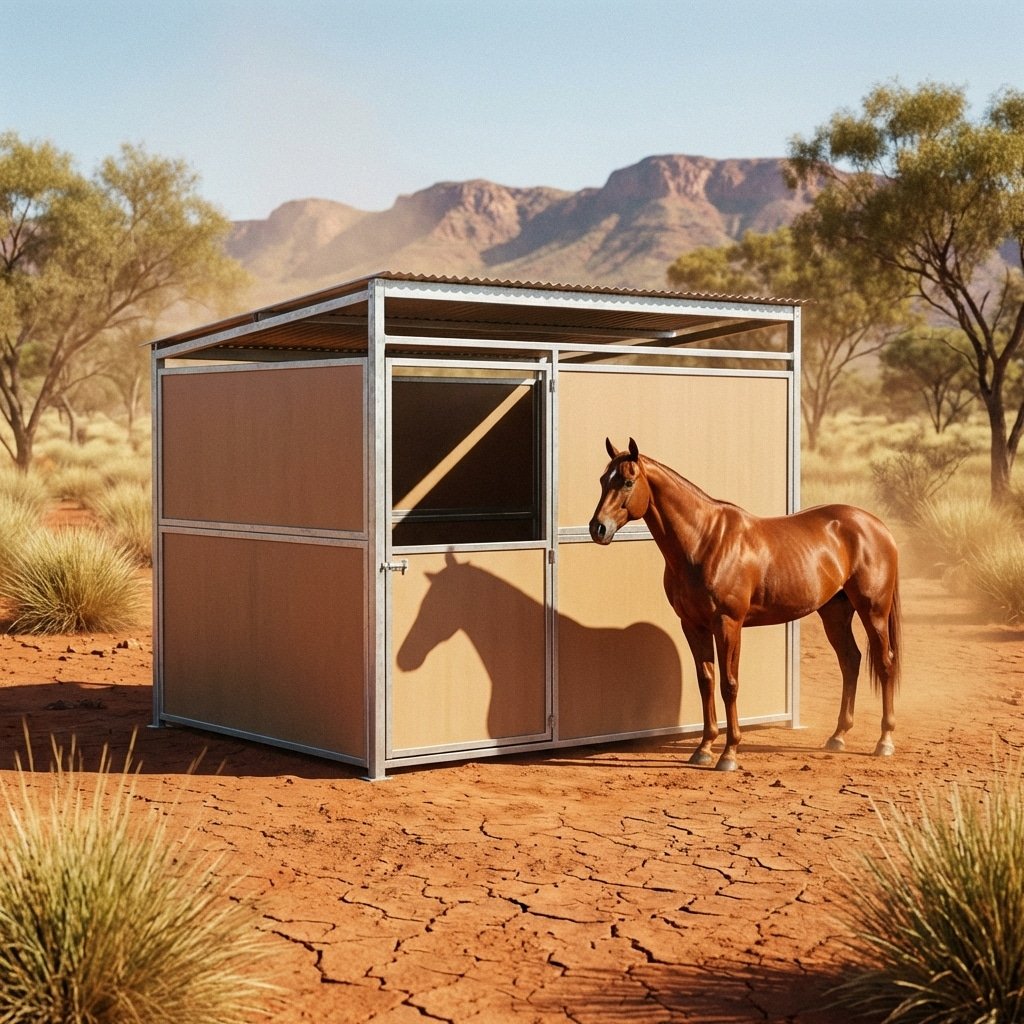
The Harsh Australian Climate: Wood Splitting and Termites
Australia’s extreme UV and subterranean termites destroy softwoods rapidly. We replace vulnerable timber with high-density bamboo and hot-dip galvanized steel to ensure structural integrity without toxic chemicals.
Why Traditional Timber Fails: Splitting and Termite Risks
Australian conditions are uniquely hostile to organic building materials. In regions where temperatures routinely breach 40°C, traditional timber stables face accelerated degradation. The intense arid heat strips moisture from softwoods (like Pine) and even some native hardwoods at an aggressive rate. This rapid drying process causes the wood fibers to shrink unevenly, leading to “checking”—deep, structural splits that run along the grain.
These splits do more than look bad. They compromise the load-bearing capacity of the post and create perfect hygiene traps. Bacteria, moisture, and mold accumulate in these crevices, creating health risks that are impossible to clean out. Beyond the heat, the biological threat is just as severe.
- Structural Checking: Rapid moisture loss causes timber to split, weakening the frame and creating injury risks for horses rubbing against the wood.
- Termite Vulnerability: Subterranean termites are a primary threat to pine and untreated hardwood stables across the continent.
- Toxic Treatments: To combat termites, timber requires heavy chemical treatments like CCA (Chromated Copper Arsenate). This poses a severe toxicity risk if horses crib or chew on the wood.
High-Density Bamboo: The Termite-Resistant Alternative
We engineered the DB Stable system to eliminate these risks by replacing softwood with High Density Strand Woven Bamboo. This material is not the hollow bamboo used in garden furniture. It is crushed, compressed under extreme pressure, and bonded to create a board with a density that rivals steel components.
This manufacturing process creates a material that is naturally impervious to the environmental threats that destroy pine. The density is so high that termites cannot penetrate the surface, and the material does not require toxic chemical preservatives to maintain its integrity underground or in humid conditions.
- Especificaciones del material: We use 28mm-38mm High Density Strand Woven Bamboo exclusively.
- Extreme Hardness: With a Janka Hardness rating > 3000 lbf, this material is 3x harder than Oak. It is physically impossible for a horse to crib or chew through it.
- Pest Resistance: The dense fiber construction naturally resists termite penetration and mold growth without dangerous additives.
- Aesthetics: It maintains the classic, warm aesthetic of wood but performs with the longevity of a composite material.
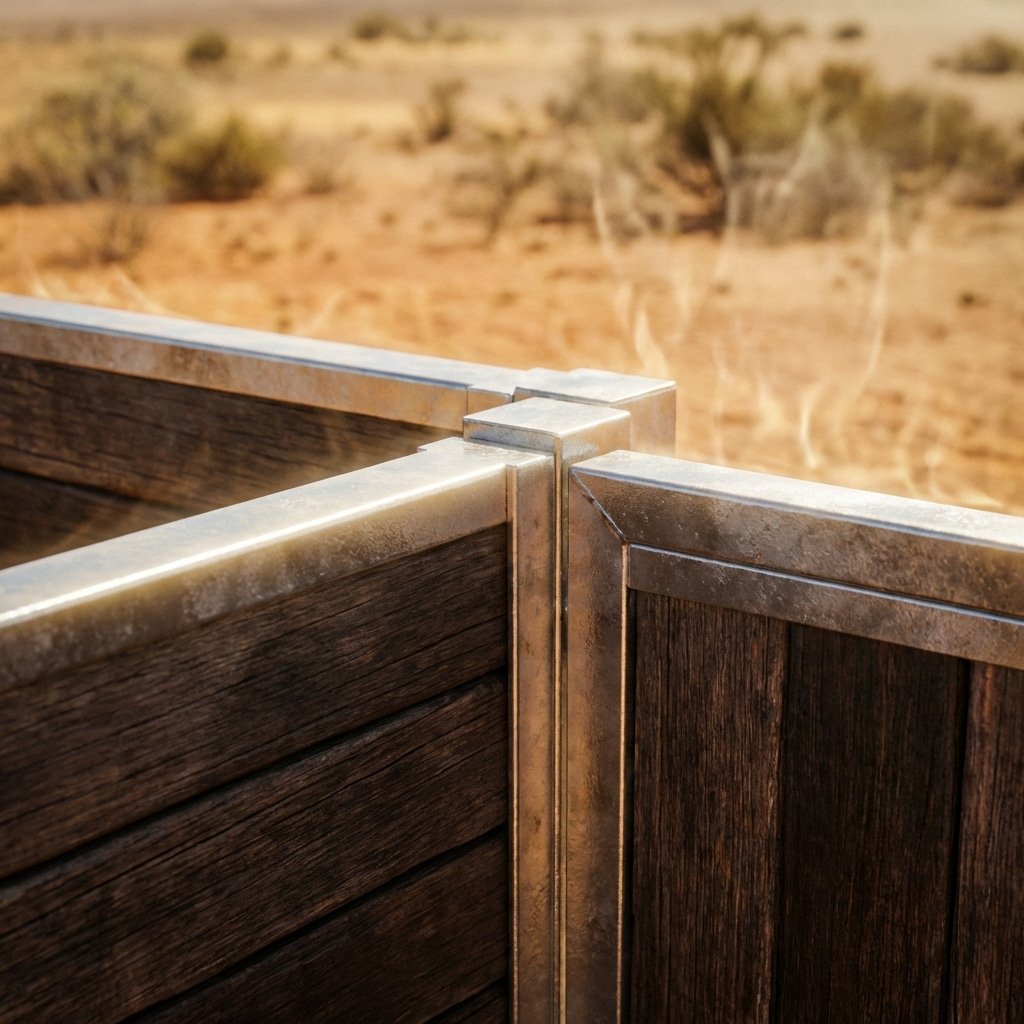
What is HDPE? The Ultimate Horse Stall Material
High-Density Polyethylene (HDPE) is a high-impact polymer engineered to absorb kicks without splintering. We use a heavy-duty 28mm-32mm UV-stabilized profile that eliminates maintenance and resists rot specifically for professional equine facilities.
| Característica | DB Stable HDPE (28-32mm) | Traditional Softwood | Standard PVC Fencing |
|---|---|---|---|
| Impact Reaction | Flexes & Absorbs Energy | Splinters or Snaps | Shatters (Brittle) |
| Moisture Resistance | 100% Impervious | Absorbs Urine & Water | High Resistance |
| Mantenimiento | Zero (Rinse Only) | High (Paint/Seal Annually) | Bajo |
The Science of Safety: Impact Absorption and Hygiene
Standard stable materials often fail under the specific physics of a horse kick. Wood is rigid and fibrous; when a 500kg animal strikes it, the energy has nowhere to go, causing the board to snap and create dangerous splinters. Rigid PVC is often too brittle, shattering into sharp shards that can cause catastrophic injury.
HDPE handles this energy differently. It possesses high tensile strength combined with a slight flexibility. When impacted, the material flexes microscopically to dissipate the kinetic energy rather than resisting it until failure. This prevents the board from breaking and keeps the horse’s leg safe from lacerations.
- Sanitary Properties: The surface is completely non-porous. It rejects moisture, urine, and bacteria, which eliminates the “ammonia smell” common in wood stalls and prevents rot from the inside out.
- Chew Resistance: The dense polymer structure is difficult for horses to bite into. Unlike soft pine, which encourages cribbing, HDPE creates a smooth, hard surface that protects both the stall aesthetics and the horse’s dental health.
Technical Specs: 28mm-32mm UV-Stabilized Profiles
Many suppliers cut costs by using thin, hollow, or residential-grade plastics that warp in the heat and crack in the cold. At DB Stable, we strictly adhere to a commercial-grade specification designed for longevity in harsh export markets like Australia and North America.
- Heavy-Duty Thickness: We utilize **28mm-32mm thick boards**. This significant mass provides the structural integrity needed to withstand heavy impact, surpassing the industry standard for lightweight fencing.
- Australian Climate Ready: Every board contains integrated **UV Stabilizers**. This prevents the polymer chains from breaking down under intense solar radiation, ensuring the material does not become brittle or fade even in 40°C+ summers.
- Zero Maintenance Guarantee: This material requires no painting, staining, or sealing for its entire lifespan. For facility managers, this translates to a massive reduction in operational labor costs compared to bamboo or pine infills.
Cuadras diseñadas con precisión y 20 años de durabilidad
UV Resistance: Preventing Fading in 40°C Summers
In 40°C Australian heat, standard timber and plastic fail quickly. We use UV-stabilized HDPE that resists fading and brittleness, eliminating the need for painting or oiling.
How High UV Index and Heat Degrade Standard Materials
Australia presents a unique challenge for stable materials. The UV radiation levels here are significantly higher than in Europe or North America, acting as a catalyst for material failure. UV radiation attacks the chemical bonds in natural wood, leading to rapid bleaching, surface graying, and structural splitting (“checking”).
The heat creates a secondary mechanical issue. When temperatures exceed 40°C, materials undergo intense thermal expansion. As they cool at night, they contract. This repeated cycle causes standard plastics and rubbers to lose elasticity and become brittle if they lack specific UV inhibitors. Dark-colored materials are particularly vulnerable because they absorb more heat, accelerating degradation if not properly treated.
The UV-Stabilized HDPE Advantage
We counter these environmental factors by using engineered HDPE (High-Density Polyethylene). Unlike generic plastics that chalk and crack, our infill boards are specifically compounded with UV stabilizers to block radiation damage at a molecular level.
- Specified Thickness: We use 28mm-32mm boards to ensure structural rigidity even under high thermal load.
- Sin mantenimiento: Unlike timber, this material never needs painting, staining, or oiling to maintain its integrity.
- Impact & Brittleness Resistance: The molecular structure retains flexibility, preventing the shattering often seen in cheaper plastics exposed to direct sunlight.
- Thermal Engineering: Our design accounts for expansion tolerances, preventing warping during peak summer temperatures.
The Drop-Pin System for Portable Horse Stables
The drop-pin system uses heavy-duty steel pins to interlock stable panels, eliminating complex bolting. This design allows for rapid setup while maintaining the structural rigidity needed to withstand horse impacts.
The Mechanics of Secure Drop-Pin Connections
Most temporary stables suffer from “rattle fatigue.” If a connection point is loose, a bored horse will worry at it until the structural integrity fails. We replace permanent welding with a modular interlocking system that mimics the rigidity of a fixed barn without the permanence. The pin acts as the central anchor, pulling the Q235B (or Q345B) structural steel frames together under tension.
- Flexibilidad modular: Replaces permanent welding with interlocking points, allowing you to reconfigure layouts instantly.
- Impact Rigidity: Ensures panels remain upright and rigid even when subjected to kicking force, preventing the “accordion effect” seen in cheaper lightweight panels.
- Tool-Free Assembly: Vital for temporary events or emergency relocation, allowing setup without power tools or specialized crews.
Galvanized Durability: Preventing Rust-Seized Joints
The biggest failure point in portable stables isn’t the steel tube—it is the connector pin. Standard steel pins often rust within six months, fusing to the connector loops. Once that happens, your “portable” stable requires a sledgehammer or an angle grinder to disassemble. This is a nightmare for rental companies and event organizers.
We solve this by applying our “Lifetime” standard to the hardware, not just the fence panels.
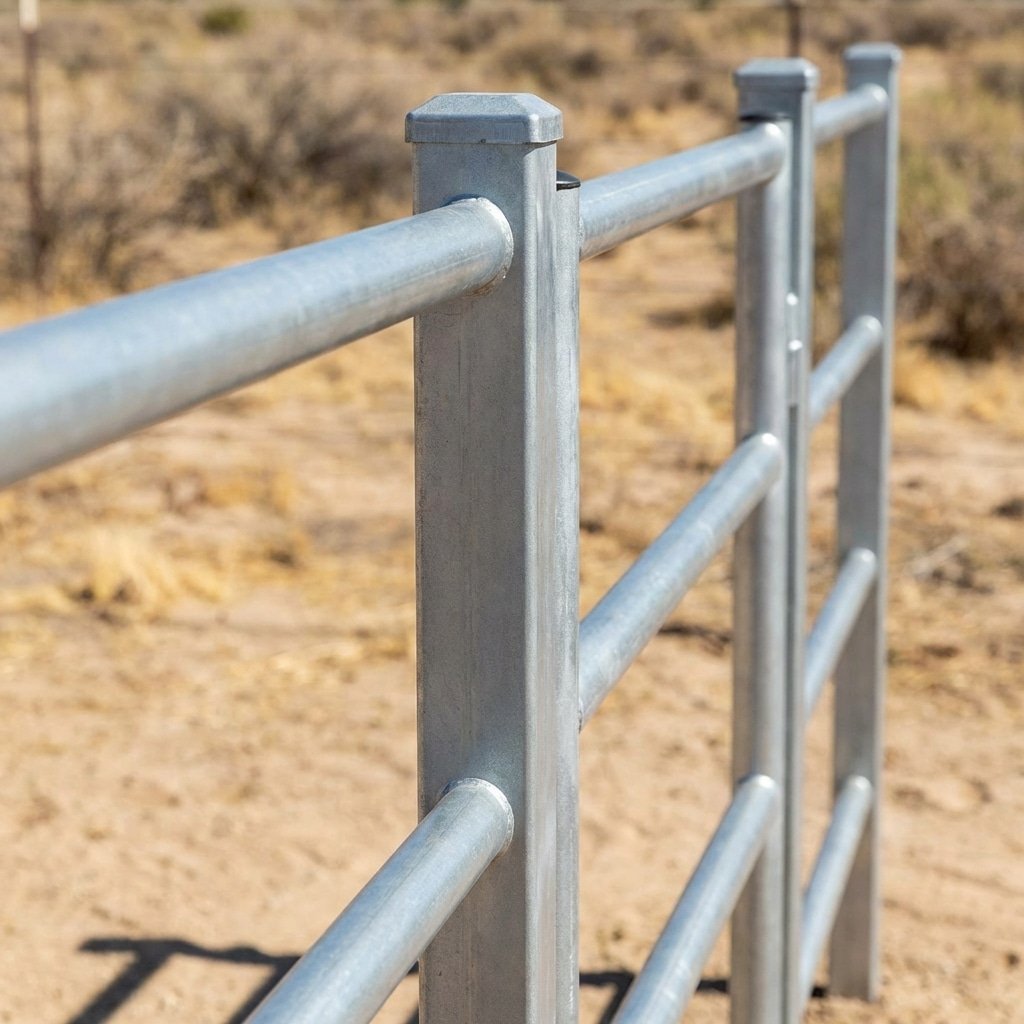
- Hot-Dip Galvanized Pins: Unlike competitors who use electro-plated hardware, our pins undergo Hot-Dip Galvanization to BS EN ISO 1461 standards.
- Micron Thickness: We coat connecting hardware to exceed 70 microns, far surpassing the industry average of 42 microns.
- Coastal Resilience: This protection is non-negotiable for Australian coastal areas, where salt spray will seize non-galvanized hardware in weeks.
Anchoring Free-Standing Stalls in the Outback
Securing stables in the Outback requires heavy-duty anchoring systems that penetrate compacted soil to counteract high wind shear, ensuring the structure remains immobile during storms or heavy animal impact.
Managing Wind Loads on Compacted Soil
The Australian Outback presents a deceptive challenge for structural installers: the ground is often harder than the materials trying to penetrate it. This compacted earth, often baked clay or ironstone, resists standard driving methods. If you attempt to secure a stable using generic tent pegs or light-gauge rebar, the ground will bend the steel before it gains any significant hold. This creates a false sense of security where the unit looks stable but has zero uplift resistance.
Wind shear is the real enemy here. A free-standing stable with solid HDPE or bamboo infill acts as a massive sail. On open plains, wind speeds can escalate rapidly, exerting thousands of newtons of force against the vertical surface. Without a specialized ground connection, the rigidity of the steel frame works against you—the entire structure will tip or slide as a single unit.
- Compacted Terrain: Outback soil density often requires pre-drilling with masonry bits rather than impact driving.
- Wind Shear Factor: Solid wall panels generate significant lateral load; the anchor must resist uplift, not just lateral movement.
- Structural Rigidity: The frame’s stiffness must be matched by the ground anchor’s hold-down force to prevent toppling.
Utilizing the 304 Stainless Steel Anchor Kit
We do not leave anchoring to chance or local hardware store runs. Every DB Stable unit ships with a dedicated Kit de hardware designed specifically for these conditions. We rely on 304 Stainless Steel Anchor Bolts rather than standard zinc-plated alternatives. The base of a stable is a high-corrosion zone, subjected to ground moisture, soil acidity, and ammonia from animal waste. Standard galvanized bolts will rust at the shear point within a few seasons, snapping under load when you need them most.
The connection relies on heavy-duty friction and mechanical locking. The anchor bolts secure the 6mm thick steel plates located at the base of our hot-dip galvanized posts directly to the foundation. This creates a continuous load path from the roof structure down to the earth, ensuring the stable can withstand the harsh environmental realities of the Outback.
- Included Hardware: Every DB Stable unit comes with a specific 304 Stainless Steel Anchor Kit.
- Plate Thickness: Bolts connect through heavy-duty 6mm steel base plates for maximum torque retention.
- Resistencia a la corrosión: 304 Grade Stainless Steel prevents structural failure at the ground level caused by soil acidity and moisture.
Preguntas frecuentes
Will HDPE infill boards fade in the intense Australian sun?
Standard plastic degrades under high UV, but quality HDPE is engineered specifically for this environment. Research indicates that HDPE with proper UV stabilizers (specifically carbon black additives) withstands decades of exposure without becoming brittle or losing structural integrity. We use UV-stabilized HDPE designed to handle 40°C+ summers without fading or cracking.
Are these stables termite-proof?
Yes. Unlike traditional timber structures which are vulnerable to white ants and borers, our hot-dip galvanized steel frames and synthetic HDPE infills are completely immune to termite attack. This eliminates the need for toxic chemical treatments or annual pest inspections, ensuring the structure remains safe and hygienic with zero food source for pests.
How do I anchor a portable stable without a concrete slab?
For installations on dirt, grass, or sand, we recommend using heavy-duty screw-in ground anchors (auger style). These twist deep into the soil to create a strong mechanical hold against wind. While concrete footings are standard for permanent barns, ground anchors provide a secure, engineer-approved solution that maintains the portability of the stable.
Is HDPE better than treated pine for stable walls?
HDPE offers significantly lower maintenance and higher safety. While pine provides natural insulation, it is prone to cribbing (chewing), rotting, and splintering over time. HDPE is impact-absorbing to reduce kick injuries, easy to wash down for biosecurity, and will never rot or splinter, making it a more durable long-term investment for commercial facilities.
What is the difference between ‘Hot-Dip After Fabrication’ and standard galvanized steel?
This is our core quality standard. “Hot-Dip After Fabrication” means we weld the black steel frame first, and then dip the entire structure into molten zinc (conforming to ISO 1461). This ensures that every weld point and seam is fully coated with over 85 microns of zinc. Many competitors use “Pre-Galvanized” tubes (welded after galvanizing), which leaves the welded seams exposed to rust immediately.
Reflexiones finales
Sourcing portable stables for the Australian climate requires balancing initial cost against inevitable environmental degradation. While timber creates liability through splintering and termite damage, our UV-stabilized HDPE and Hot-Dip Galvanized frames ensure zero-maintenance longevity. Investing in this “Lifetime” standard safeguards your dealership’s reputation against warranty claims and structural failures.
Verify the structural integrity of our Q235B steel and high-density infills directly before committing to a full container. We recommend requesting a technical specification sheet or a trial sample to validate our “Hot-Dip After Fabrication” quality. Contact our engineering team today to optimize your shipping logic for a high-margin 40HQ distribution order.

 Spanish
  English
  French
  Arabic
  German
0 comentarios