


Building Container Barns requires navigating the strict 8-foot width limit that renders standard equestrian equipment obsolete. Attempting to retrofit stock stall fronts into these 2.34m spaces forces on-site cutting, destroying the protective zinc seal. This misalignment leads to rapid corrosion and dangerous modifications that jeopardize equine safety.
Our approach eliminates these risks through precision ODM fabrication using Q235B Structural Steel. By resizing frames before the Galvanización en caliente después de la fabricación process, we ensure every edge is sealed against humidity. This analysis benchmarks how custom-fitted systems maximize the limited footprint of shipping containers without sacrificing durability.

The Shipping Container Barn Trend (Cargotecture)
Cargotecture transforms retired shipping containers into durable equestrian structures. This mainstream agricultural shift prioritizes sustainability, modularity, and rapid deployment over traditional, high-maintenance lumber construction.
The Shift to Sustainable Modular Agriculture
Once considered an experimental architectural niche, container barns are now a standard choice for ranchers and farmers. The driving force behind this shift is not just aesthetics, but the volatile cost of traditional lumber construction compared to the ready availability of retired steel shipping containers. By repurposing these units, agricultural projects eliminate scrap waste and bypass the long lead times associated with stick-built structures.
The inherent modularity allows for diverse layouts that traditional barns cannot easily match. Ranchers can configure L-shaped designs or place parallel units with a covered breezeway in days rather than months. Crucially, because these structures often sit on piers rather than poured concrete slabs, they avoid the sunk costs of permanent foundations. This allows the asset to be relocated if operational needs change, offering a level of flexibility that pole barns simply cannot provide.
Synergizing with Hot-Dip Galvanized Steel Interiors
Placing a wood-framed stall inside a steel shipping container creates a fundamental mismatch in lifespan. The container is built from marine-grade steel designed to survive ocean salt spray; the interior stabling must meet the same standard. We utilize **Hot-Dip Galvanization After Fabrication** (conforming to BS EN ISO 1461) for all stall fronts. This ensures the interior resists the high humidity and condensation often found in metal enclosures just as effectively as the exterior shell.
Structural integrity is equally critical in these compact spaces. While wood framing flexes and deteriorates over time, our systems use **Q235B or Q345B Structural Steel** frameworks. This adds a necessary “Kick-Proof” resilience that reinforces the container walls, which can be prone to denting from the inside. The industrial aesthetic of the container pairs seamlessly with our **Professional Series** heavy-duty profiles, creating a cohesive, low-maintenance facility that withstands the abuse of daily equine activity.
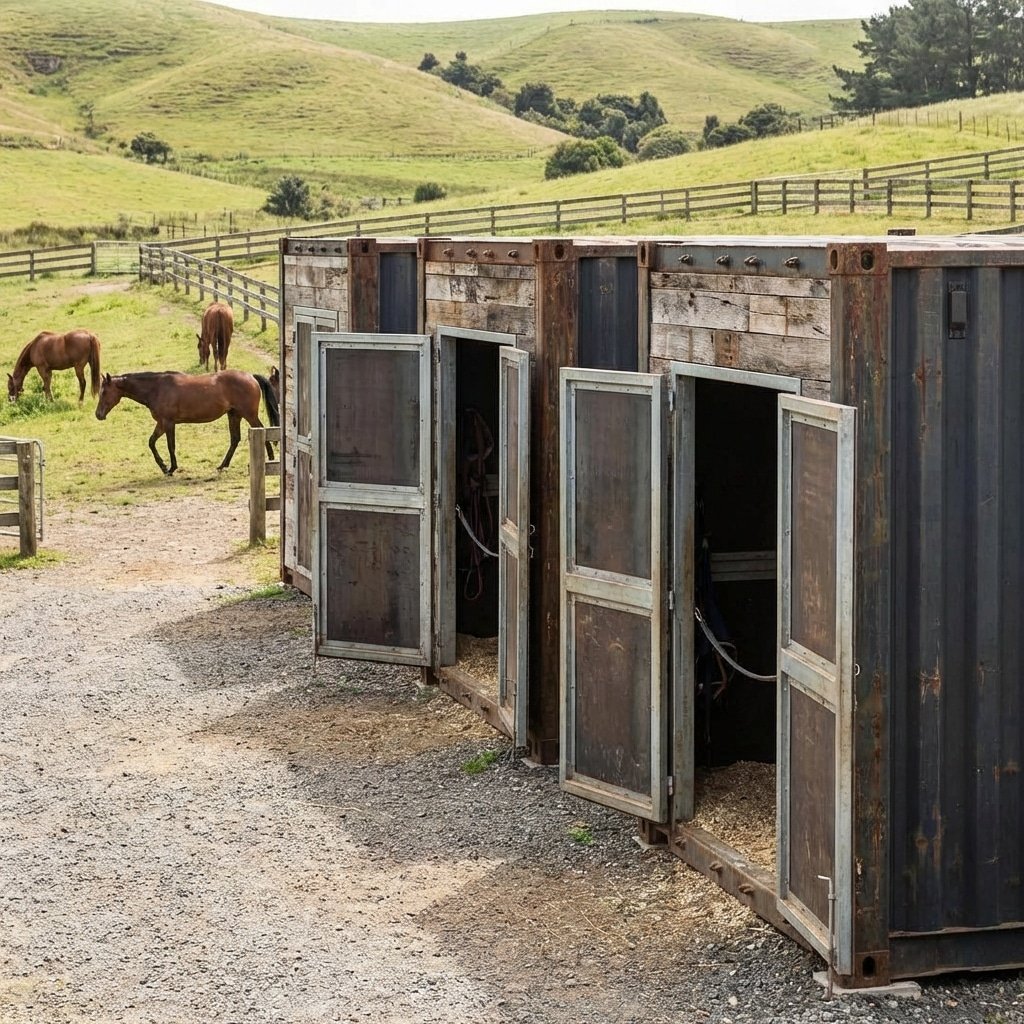
The Narrow 8-Foot Width Constraint
Standard ISO containers are fixed at 8 feet (2.44m) wide. To accommodate standard 12×12 requirements, builders must orient stalls longitudinally or arrange containers in parallel with a roofed gap.
The Impact on Stall Depth and Equine Safety
The fundamental engineering challenge with container barns is the ISO standard dimension. A shipping container has a fixed exterior width of 8 feet (2.44m). Once you account for framing, insulation, and kick-boards, the interior usable width shrinks to approximately 7’8″ (2.35m). This creates a direct conflict with the equine industry standard of 12 feet (3.6m) for stall depth.
This dimensional restriction creates safety risks if not managed correctly:
- Restricted Movement: Large horses cannot turn comfortably or lie down safely in a 7’8″ space, leading to increased stress and stable vices.
- Casting Risk: The narrow width significantly increases the chance of a horse getting “cast” (trapping legs against the wall while rolling).
- Impact Intensity: In tighter spaces, kicks impact the walls with greater frequency and force, making the durability of the infill and steel frame critical.
Longitudinal Layouts with Modular Partitions
To bypass the width constraint without compromising welfare, builders utilize the container’s length (20ft or 40ft) rather than its width for the primary stall dimension. This allows for the creation of rectangular stalls, typically 12 feet wide by 8 feet deep. This orientation provides the necessary lateral space for the horse to move, even if the depth remains fixed by the container walls.
We engineer DB Stable Hot-Dip Galvanized Partitions specifically for these layouts. Installing partitions at specific intervals along the container walls segments the space securely while maintaining structural rigidity. Given the tighter confines, standard steel often fails under the increased contact. We strictly use Acero estructural Q235B or Acero de alta resistencia Q345B (for cold climates) with a 14-gauge (2.0mm) wall thickness. This ensures the partition withstands the immediate impact of a kick, which is more likely to occur in narrow container conversions.
Premium Stables Engineered For Extreme Durability
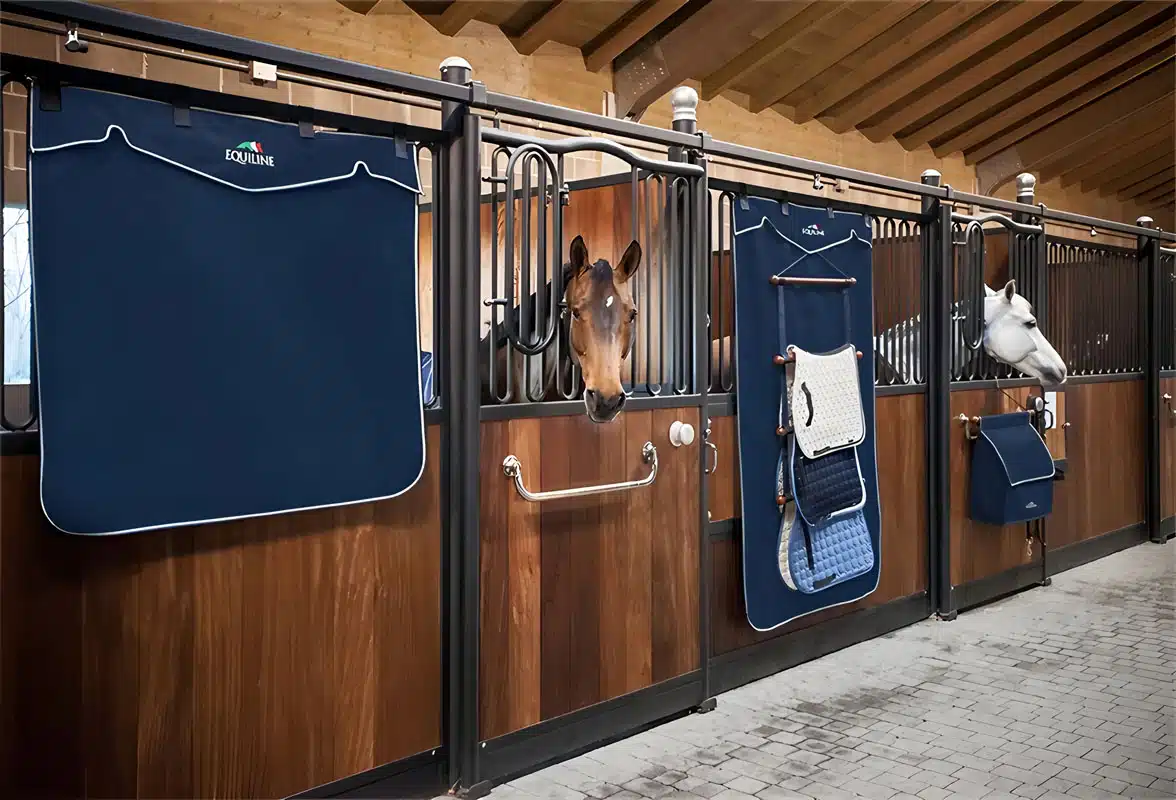

Custom Cutting DB Horse Stall Fronts to Fit
Standard 3.0m stalls do not fit the 2.34m width of shipping containers. We fabricate custom 14-gauge steel frames antes de galvanization to ensure a perfect, rust-proof fit.
| Método | Zinc Protection | Integridad estructural | Long-Term Risk |
|---|---|---|---|
| On-Site Cutting | Compromised (Exposed Steel) | Weakened Welds | Rapid Edge Rust |
| DB Factory Customization | Full Seal (>85 microns) | Certified 14-Gauge Welds | Maintains ASTM B117 Compliance |
Navigating the 2.34m Internal Container Width
Repurposing shipping containers for equine housing presents a hard physical limit: the internal width. A standard ISO shipping container offers a usable internal width of approximately 2.34m (7’8″). This dimension clashes with the global standard for horse stall fronts, which typically start at 3.0m (10′) or 3.5m (12′).
Stock stall fronts simply cannot fit perpendicular to the container walls without severe modification. Attempting to force a standard 3.0m front into a 2.34m space usually requires cutting the frame on-site. This creates structural weak points and often ruins the locking mechanism geometry. Even in designs where stalls run parallel to the length of the container, tight aisles in 8-foot wide units require precise clearance calculations to ensure safe handler egress.
Factory Fabrication: Custom Sizing Before Hot-Dip Galvanization
The only professional way to address this size discrepancy is through ODM/OEM fabrication. We do not cut finished products. Instead, we adjust the raw steel dimensions during the initial manufacturing stage. Every cut and weld happens on the raw 14-gauge Q235B Structural Steel frame before it ever touches a zinc bath.
- Precision Engineering: We resize the frame to exact container specifications, ensuring the sliding door tracks and latches remain centered and functional.
- Process Sequence: Welding occurs first. The Galvanización en caliente después de la fabricación (BS EN ISO 1461) happens last.
- Sealed Edges: Because the unit is dipped after sizing, even the custom-cut edges receive the full > 85 microns zinc coating.
- Testing Compliance: The custom unit maintains full resistance against corrosion, passing Pruebas de niebla salina ASTM B117 (96+ hours) exactly like our standard catalog items.
Modifying a galvanized panel on-site with an angle grinder exposes raw steel to the atmosphere immediately. No amount of “cold galv” spray can match the bond of a hot-dip factory finish. Factory-level customization protects the structural integrity of the steel and ensures the longevity of the installation in humid or coastal container barn environments.

Sliding Doors vs Hinged Doors in Tight Container Aisles
In 8-foot wide containers, hinged doors create dangerous dead ends. Puertas correderas are the only technical solution that preserves aisle flow and handler safety.
The Swing Radius Challenge in 8-Foot Containers
The geometry of a standard ISO shipping container creates an immediate conflict with traditional stable design. You are working with a total internal width of just under 8 feet (2.44m). Installing a standard 4-foot (1.2m) hinged door in this space is an operational mistake. The swing arc of the door consumes nearly the entire remaining aisle width during operation.
This creates a “dead end” effect. When a handler opens the door to exit a stall, the door swings out and blocks the escape route. If a horse panics or pushes forward, the handler is trapped between the swinging steel frame and the opposite container wall. There is simply no room to maneuver safely.
Environmental factors make this worse. Open-ended container layouts often function as wind tunnels. A hinged door in this breezeway acts like a sail. A sudden gust can slam a heavy steel door shut on a horse’s flank or rip the latch out of a handler’s hand. Sliding doors eliminate this variable entirely.
Maximizing Aisle Safety with Heavy-Duty Sliding Tracks
Sliding doors are the engineered answer to the 8-foot constraint. By moving laterally along the stall front, they require zero swing clearance. This ensures the central walkway remains open for wheelbarrows, equipment, and safe horse passage at all times.
We specifically recommend the **DB Stable Professional Series** for container conversions because of its hardware configuration:
- Hidden Track System: In narrow aisles, bedding and dirt accumulate quickly near the door lines. Our enclosed track design prevents debris buildup that typically jams open rollers.
- Zero Intrusion: The door slides flush, ensuring no hardware protrudes into the limited walking space.
- Safety Consistency: The door cannot be blown shut by wind or nudged closed by a horse, preventing impact injuries during leading.
Preguntas frecuentes
Can shipping containers really serve as safe, permanent horse stables?
Yes. Built from Corten steel, shipping containers are engineered to withstand harsh ocean environments, making them inherently weather-resistant and rot-proof. However, a raw steel box is not a stable. You must modify it with proper ventilation windows and line the interior with kick-proof materials—such as our heavy-duty HDPE planks—to prevent injury. When properly fitted, they provide a durable structure that often costs significantly less than traditional wooden barns.
What is the most efficient layout for a container barn?
The “breezeway” configuration is the industry standard for efficiency. This design places two 40-foot containers parallel to each other, spaced 10 to 12 feet apart, with a roof spanning the gap. This setup creates a sheltered central aisle for grooming and shoeing, while the containers themselves house the stalls and tack rooms. This method maximizes your usable footprint without the expense of a full clear-span steel building.
Do standard horse stall fronts fit inside a shipping container?
Generally, no. A standard ISO shipping container has an internal width of approximately 7’8″ (2.35m), which is too narrow for standard 10ft or 12ft stall fronts. To utilize the full width of the container for a stall, you typically require custom-fabricated fronts sized specifically for the 7-foot opening. DB Stable provides custom-width manufacturing to address this exact constraint, ensuring the steel frame fits perfectly without on-site cutting or welding.
How do I prevent a steel container stable from overheating?
Ventilation is critical because steel conducts heat. You must cut windows into the container walls and utilize open-grill stall fronts to force cross-breezes through the unit. Additionally, using “High-Cube” containers (which are 9.5 feet tall instead of the standard 8.5 feet) allows hot air to rise well above the horse’s head, significantly improving thermal comfort.
Reflexiones finales
Forcing standard retail stalls into 2.35m wide containers compromises structural integrity and destroys the protective zinc coating. Our ODM fabrication resizes raw Q235B steel antes de hot-dip galvanization, ensuring every custom edge remains rust-proof even in humid, enclosed environments. This factory-level precision eliminates on-site cutting and protects your project against rapid corrosion claims.
Stop risking your reputation on DIY modifications that fail under equine pressure. Send our engineering team your specific container floor plan to receive a precision-fit CAD layout and an optimized flat-pack logistics quote. We recommend validating our sliding track performance and heavy-duty finish with a trial sample before scaling your order.

 Spanish
  English
  French
  Arabic
  German
0 comentarios