


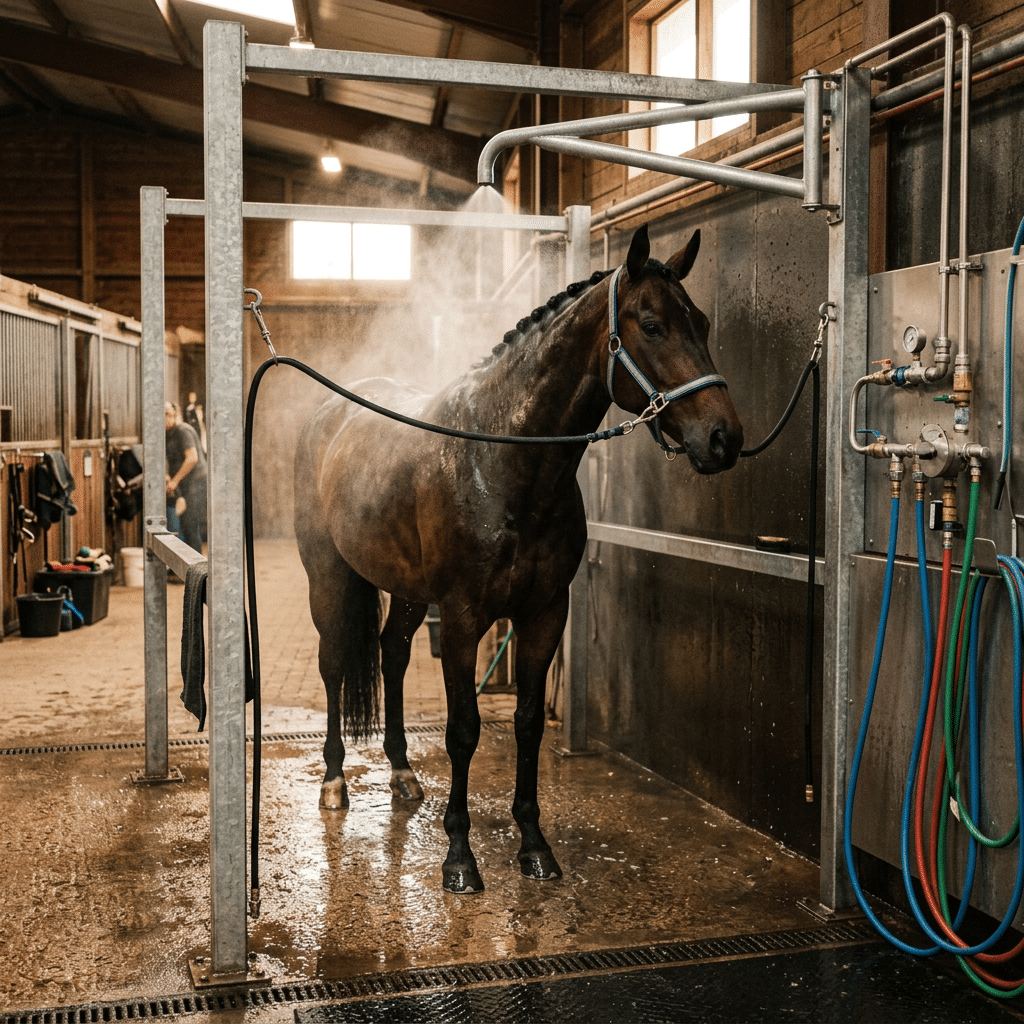
Maximizing Rental Fleet ROI is the only way for event organizers to stop bleeding capital on temporary infrastructure. While renting portable stables offers short-term flexibility, the cumulative cost of recurring leases often surpasses the price of ownership within just three events. Relying on third-party suppliers also exposes organizers to variable quality and scheduling risks that directly impact attendee satisfaction and event profitability.
This analysis benchmarks the financial performance of owning a hot-dip galvanized inventory against perpetual renting. We examine how specific engineering choices, such as Q235B structural steel and logística de paquetes planos that fit 45 sets per container, transform a depreciating expense into a long-term asset. Understanding these material lifecycles ensures your infrastructure builds equity rather than just overhead.
El auge de la gobernanza ambiental y social en la construcción
Perspectiva ejecutiva: By 2026, ESG is no longer a marketing buzzword but a strict operational requirement. Construction projects now face rigorous scrutiny regarding embodied carbon, material lifecycles, and supply chain ethics, forcing a shift from disposable solutions to durable, modular infrastructure.
The Shift to Low-Carbon and Circular Construction
The construction industry is currently responsible for approximately 34% of global CO2 emissions, a statistic that has forced regulators to intervene with aggressive mandates. In 2026, the focus has moved beyond simple operational energy efficiency—like LED lighting—to the “embodied carbon” of the structure itself. Investors and planning councils now prioritize projects that demonstrate a reduction in carbon footprint starting from the manufacturing floor.
This regulatory pressure signals the end of the “throw-away” culture in facility management. Traditional construction methods that rely on permanent welding and single-use materials are becoming liabilities due to their high waste profile during demolition. The industry is pivoting toward circular economy practices, where facilities are built with modular, reusable components that can be disassembled and repurposed rather than bulldozed.
Sustainable Material Choices: Bamboo and Galvanized Steel
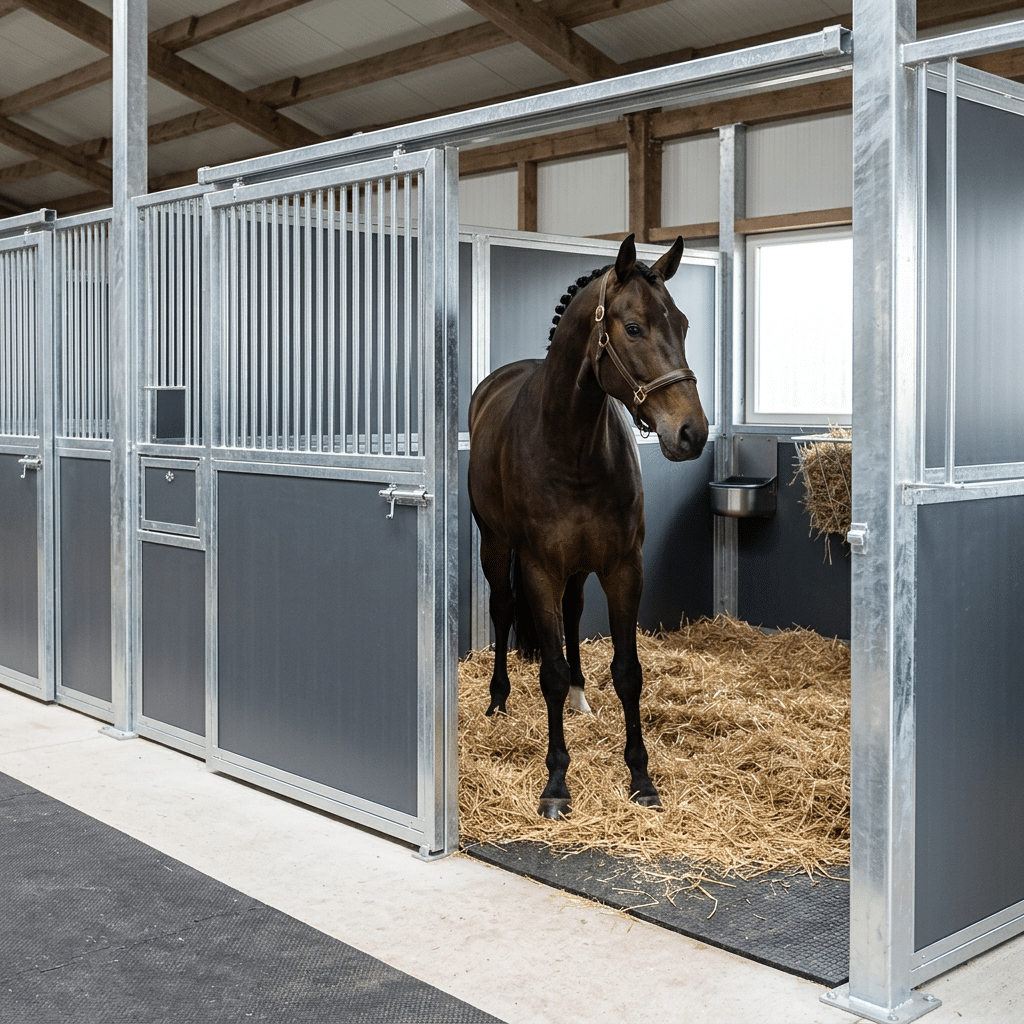
Aligning with modern ESG standards requires a strict re-evaluation of material specifications. For equestrian infrastructure, we utilize specific materials that balance animal safety with verified environmental performance.
- High-Density Bamboo Infill: Unlike traditional hardwoods (Oak/Pine) which take 30-50 years to regenerate, our strand woven bamboo matures in just 3-5 years. It acts as a rapid carbon sink while providing a Janka Hardness rating >3000 lbf—three times harder than Oak—ensuring longevity without contributing to deforestation.
- Galvanización en caliente (ISO 1461): Durability is the most effective form of sustainability. We use Q235B and Q345B structural steel treated with hot-dip galvanization después de fabrication. With a zinc coating exceeding 85 microns, these frames resist corrosion for decades. This eliminates the environmental cost of manufacturing, shipping, and installing replacement parts every few years, which is common with painted or pre-galvanized alternatives.
- Scope 3 Logistics Reduction: Transportation emissions are a critical metric in ESG reporting. Our flat-pack mechanical design allows us to load 30-45 sets per 40HQ container, compared to just 12 sets for traditional fully welded frames. This efficiency reduces the carbon footprint per unit by over 60%, directly lowering the project’s Scope 3 emissions.
Alejarse de la madera antigua (roble/pino)
Rental fleets are abandoning new-growth pine for High-Density Bamboo and HDPE. These alternatives eliminate resurfacing labor and offer impact resistance 3x harder than oak.
The Operational Liabilities of Traditional Softwood
Reliance on traditional timber infills creates a hidden drain on profitability. Most commercially available wood today is “new-growth” plantation timber, which lacks the density and
structural integrity of historical old-growth hardwood. For a B2B rental fleet or large facility, this material choice translates directly into higher operating costs and increased liability.
- New-Growth Weakness: Modern plantation timber is less dense than its predecessors. It is prone to snapping and splintering under kick loads, creating immediate safety hazards for horses and replacement costs for operators.
- Maintenance Deficit: Wood demands an annual cycle of stripping, sanding, and staining to maintain a professional appearance. Every labor hour spent resurfacing wood reduces the overall rental margin.
- Riesgos higiénicos: Softwood is porous by nature. It absorbs moisture, urine, and bacteria, creating biosecurity concerns in high-turnover environments like quarantine units or fairgrounds where sterilization is critical.
Specifying High-Density Bamboo and HDPE Alternatives
To eliminate these maintenance liabilities, we engineer our stables using materials that decouple aesthetics from labor. We specifically replace soft pine with High-Density Bamboo and UV-stabilized HDPE to ensure long-term asset value.
- Bamboo Specs: Utilizamos Bambú trenzado de alta densidad with a Janka Hardness rating > 3000 lbf. This material is 3x harder than Red Oak, making it highly resistant to cribbing (chewing) and impact damage.
- HDPE Specs: Our 28mm-32mm UV-stabilized synthetic planks offer a true “Zero Maintenance” surface. The material absorbs kick energy without fracturing and can be pressure washed for instant sterilization.
- Lifecycle ROI: Unlike wood, which degrades visually and structurally over time, these materials retain their condition for years. This ensures the facility looks new for every client without the recurring capital expenditure of board replacement.
20-Year Rust-Proof Stables Direct From Manufacturer
Las mejores fábricas adoptan materiales sostenibles
Manufacturing giants like Siemens and First Solar prove sustainability drives profitability. This global shift validates the widespread adoption of recyclable steel and bamboo in modern industrial infrastructure.
| Industry Sector | Core Material Strategy | Measurable Impact |
|---|---|---|
| Solar Manufacturing (e.g., First Solar) | Cadmium Telluride (CdTe) & Glass | 90% material recovery rate; 40% lower lifecycle carbon. |
| Equestrian Engineering (DB Stable) | Q235B Recyclable Steel & Moso Bamboo | 100% recyclable steel; Bamboo sequesters 20-40 tons carbon/acre. |
| Consumer Goods (e.g., Lego/Unilever) | Bio-PE & Renewable Energy Integration | Zero-waste-to-landfill status; carbon-neutral operations. |
The Shift to Circular Manufacturing
Top-tier factories are moving away from the “take-make-dispose” model. The construction sector alone accounts for roughly 34% of global CO₂ emissions, forcing manufacturers to rethink their supply chains. Leading facilities now treat energy choices as pragmatic project decisions rather than ideological stances. For instance, modular construction—building in controlled factory environments—reduces waste significantly compared to traditional on-site builds. This approach aligns with DB Stable’s manufacturing philosophy: precision engineering in the factory prevents material waste in the field.
Material Benchmarks: Steel and Bamboo
The most effective factories don’t just use “green” marketing; they use materials with verifiable data. We specifically utilize Q235B Steel and High-Density Bamboo because they outperform traditional options in both durability and environmental impact.
- Q235B Steel (The Infinite Cycle): Unlike concrete, steel is 100% recyclable without losing strength. Global recycling rates for structural steel exceed 90%. By using Q235B/Q345B, we ensure that every stable component can eventually be melted down and repurposed, creating a closed-loop lifecycle.
- Moso Bamboo (The Carbon Sink): Bamboo is not just a wood alternative; it is a grass that grows to maturity in 3-5 years. It sequesters 20-40 tons of carbon per acre annually—roughly 4x that of hardwood trees. Our strand-woven bamboo increases density (Janka Hardness > 3000 lbf), extending the product’s lifespan and keeping that carbon locked away longer.
- Hot-Dip Galvanization (ISO 1461): Sustainability means longevity. A product that rusts and needs replacement in 5 years is an environmental failure. Our post-fabrication galvanizing process ensures a 30-50 year lifespan, drastically reducing the manufacturing footprint over time.

Logistics as a Sustainability Metric
Factory sustainability extends beyond the production line to the shipping dock. Traditional fully-welded stable panels are notoriously inefficient to ship, often transporting more air than steel. This results in excessive fuel consumption per unit delivered.
We engineered our flat-pack system to solve this. While standard welded panels limit a container to 12-15 sets, our flat-pack design allows for 30-45 sets in the same 40HQ container. This efficiency slashes shipping emissions per stall by over 60%, proving that smart engineering benefits both the profit margin and the carbon footprint.
Bambú tejido en hebras: Un sumidero de carbono de alto rendimiento
Strand-woven bamboo combines rapid biological carbon capture with high-density compression, locking CO2 into a material three times harder than oak for decades of sustainable storage.
Accelerated Sequestration and Regenerative Harvesting
Bamboo functions as a biological carbon pump, outperforming traditional hardwood forests in speed and volume. Moso bamboo reaches maturity in just 3-5 years, absorbing substantial atmospheric CO2 during this rapid growth cycle. Unlike timber plantations that require decades to sequester comparable amounts of carbon, bamboo forests act as a fast-turnover sink, capturing up to 40 tons per acre annually in managed systems.
The harvesting methodology further distinguishes it from conventional logging. We practice selective harvesting of mature culms, which leaves the underground rhizome network completely intact. This allows the forest to regenerate naturally without replanting or significant soil disturbance. For the supply chain, this ensures a higher annual material yield per acre and maintains the land’s carbon capture potential without the “reset” period required after clear-cutting timber.
Raw bamboo is lightweight, but the strand-woven manufacturing process transforms it into a concentrated carbon vault. The process involves shredding bamboo fibers and compressing them under immense pressure to create a material significantly denser than the original plant. This method achieves a density exceeding 900 kg/m³, effectively locking the sequestered carbon into a solid state that resists decay and release.
- Total Biomass Utilization: The process utilizes nearly 100% of the harvested culm, including offcuts, to minimize waste and support a net-negative carbon footprint.
- Extreme Durability: With a Janka Hardness > 3000 lbf (three times harder than oak), the material resists wear that would degrade softer woods.
- Long-Term Storage: The high density prevents rot and insect damage, extending the product’s lifespan and keeping carbon locked away for decades before it re-enters the cycle.
Acero Q235B: La estructura reciclable 100%
Q235B structural steel provides a 100% recyclable, zero-waste lifecycle equivalent to ASTM A36, ensuring rental fleets maintain mechanical integrity and scrap value for decades.
Material Life Cycle: The Zero-Waste Advantage
Steel is one of the few construction materials you can recycle infinitely without losing potency. Unlike composite materials or treated lumber that eventually become landfill waste, Q235B steel can be re-smelted repeatedly. This creates a closed-loop system where end-of-life disposal returns monetary value rather than incurring strict disposal costs.
Current steel production already integrates roughly 70% recycled content. For a rental fleet with a 30 to 50-year lifecycle, this drastically reduces the long-term environmental footprint. You are effectively renting a material bank that retains value, aligning financial recovery with circular economy principles.
Technical Standards: ASTM A36 Equivalence & Safety Specs
We standardize on Q235B, which is the direct structural equivalent of ASTM A36. This grade offers the specific yield strength required for heavy-duty livestock containment. However, the material grade is only half the equation; the profile thickness dictates the real-world lifespan and safety.
- Profile Specification: We strictly utilize 50mm x 50mm RHS profiles for all structural posts.
- Espesor de pared: We mandate a minimum of 2.0mm (calibre 14). Many competitors skim with 1.5mm tubing to cut costs, but thin steel warps under the high heat of hot-dip galvanization.
- Cold Climate Upgrade: For markets like Northern Europe or Canada, we upgrade to Q345B (ASTM Grado 50). This alloy provides superior low-temperature impact toughness, preventing brittle fractures if a horse kicks the steel in sub-zero conditions.
- Corrosion Integration: Q235B’s chemistry ensures excellent weldability, allowing our Hot-Dip Galvanization After Fabrication process to bond zinc at an average coating thickness greater than 70 microns.
Preguntas frecuentes
¿Cómo construir un centro ecuestre que cumpla la ESG?
Building an ESG-compliant facility requires a three-pronged approach. Environmentally, you must tackle energy and waste; leading facilities generate up to 80% of their electricity via solar and implement closed-loop water systems for wash bays. Socially, you need documented safety protocols and fair labor practices, addressing the industry’s notorious work-life balance issues. Gobernanza involves establishing a formal strategy with measurable targets—don’t just claim “zero waste,” track your diversion rates year-over-year.
¿Es el bambú un material de construcción sostenible?
Yes, but the processing matters. Bamboo is highly renewable, reaching maturity in 3-5 years compared to decades for hardwoods, and it sequesters significantly more carbon. However, raw bamboo has poor durability. For stable construction, you must use Bambú trenzado de alta densidad (Janka Hardness > 3000 lbf) to ensure it withstands impact and resists rot. This engineered approach turns a fast-growing grass into a structural material harder than oak.
¿Impacto medioambiental de los graneros de acero frente a los de madera?
This is a trade-off between production emissions and lifecycle longevity. Wood has lower embodied carbon during the manufacturing phase. However, steel is 100% recyclable and offers a significantly longer operational lifespan without requiring toxic chemical treatments to prevent rot. A hot-dip galvanized steel barn can last 50+ years with zero maintenance, whereas wood often requires replacement and ongoing chemical preservation, complicating its end-of-life disposal.
¿Certificaciones ecológicas para establos de caballos?
There is no specific global “Horse Stable Certification.” Instead, facilities adapt broader standards. You can pursue LEED certification by classifying the stable as a commercial agricultural building, focusing on natural ventilation (stack effect) and stormwater management. In regions like California, the CalGreen Code applies mandatory standards for water and material efficiency. Most private projects focus on functional sustainability—site planning and waste management—rather than paying for the formal plaque.
¿Fabricantes de establos ecológicos?
The market is split between timber traditionalists and modern steel fabricators. Companies like DC Structures focus on responsibly sourced heavy timber. On the metal side, manufacturers like MD Barnmaster and DB Stable utilize modular prefabrication. Our specific approach focuses on logistics efficiency: by using a flat-pack steel pallet system, we fit 30-45 sets in a container compared to the standard 12-15 fully welded sets. This reduces shipping carbon emissions by over 60% per unit.
Preguntas frecuentes
¿Cómo construir un centro ecuestre que cumpla la ESG?
Building an ESG-compliant facility requires moving beyond simple “green” branding and implementing structural changes across three specific categories. You need to document these metrics, as vague claims of “sustainability” no longer satisfy investors or planning boards.
- Environmental (Energy & Water): Shift dependency to on-site renewables. Leading facilities now generate up to 80% of their electricity via solar panels. For water, implement closed-loop systems that capture rainwater for arena dust control and wash bays, rather than draining potable water reserves.
- Social (Safety & Labor): The veterinary and equestrian sectors struggle with work-life balance. An ESG-compliant center must provide safe working conditions—like “Cast-Proof” stall designs (50mm bottom gaps) to prevent injury—and transparent labor policies that address staff burnout.
- Governance (Data Tracking): Establish a baseline for your emissions and waste. You cannot manage what you do not measure. Track your utility usage and vendor sourcing policies year-over-year to demonstrate verifiable improvement.
¿Es el bambú un material de construcción sostenible?
Yes, but the specific type of bamboo matters. Standard hollow bamboo rots quickly and lacks structural density. For commercial stables, we strictly use Bambú tejido en hebras de alta densidad (28mm-38mm thick), which provides legitimate sustainability benefits over traditional hardwoods.
- Rapid Regeneration: Bamboo reaches maturity in 3-5 years. In contrast, oak and pine require 30-50 years. The root system remains intact after harvest, preventing soil erosion and eliminating the need for replanting.
- Carbon Sequestration: A bamboo grove absorbs up to four times more carbon dioxide than a comparable stand of trees.
- Extreme Durability: Strand woven bamboo has a Janka Hardness rating exceeding 3,000 lbf—making it 3x harder than oak. This longevity is critical for sustainability; replacing chewed or rotted wood planks every few years negates any initial environmental benefit.
¿Impacto medioambiental de los graneros de acero frente a los de madera?
The choice depends on whether you prioritize “embodied carbon” (production phase) or “lifecycle assessment” (long-term use). Wood wins on initial production emissions, but steel is superior for circular economy models and longevity.
- Production Phase: Wood grows naturally and requires less energy to process than smelting ore. Steel production is energy-intensive, though modern mills increasingly use electric arc furnaces powered by renewables.
- Recyclability: Steel is 100% recyclable without strength loss. Q235B structural steel can be melted down and repurposed indefinitely. Wood treated with preservatives often ends up in landfills as it cannot be easily recycled.
- Lifespan: A hot-dip galvanized steel frame (ISO 1461 standard) resists rust for decades and is impervious to cribbing (chewing). Wood requires frequent chemical staining and replacement. In a high-traffic commercial environment, the durability of steel reduces the total environmental footprint over 20 years.
¿Certificaciones ecológicas para establos de caballos?
There is no dedicated “Green Stable” certification currently recognized globally. However, commercial equestrian projects can apply broader agricultural and building standards to demonstrate compliance.
Facilities often use LEED (Leadership in Energy & Environmental Design) frameworks, even if they don’t pursue full certification. This involves designing for natural ventilation (“Stack Effect”) to reduce fan usage, implementing pervious paving for stormwater management, and using locally sourced materials. In specific regions like California, the CalGreen Code mandates water conservation and construction waste reduction for agricultural structures. Focus on meeting these practical engineering standards rather than chasing a plaque.
¿Fabricantes de establos ecológicos?
Identifying a truly eco-friendly manufacturer requires looking at their logistics and material sourcing, not just their marketing. The most sustainable manufacturers focus on transport efficiency and material longevity.
- Eficiencia logística: Manufacturers utilizing Steel Pallet Flat-Pack systems significantly reduce carbon footprints. A standard fully welded stable limits a container to 12-15 sets. Flat-packing allows 30-45 sets per 40HQ container, reducing ocean freight emissions by over 60%.
- Material Integrity: Look for manufacturers using 14-gauge (2.0mm) minimum steel thickness. Thinner materials (1.5mm) used by budget suppliers fail quickly under impact, leading to early replacement and waste.
- Low-Maintenance Infill: Manufacturers offering HDPE (High-Density Polyethylene) or Bamboo infills eliminate the need for annual chemical staining and varnishing, preventing toxic runoff into the soil.
Reflexiones finales
Owning your infrastructure transforms a recurring rental expense into a permanent, ESG-compliant asset on your balance sheet. While renting offers short-term flexibility, building a proprietary fleet with Hot-Dip Galvanized steel and High-Density Bamboo eliminates the cycle of repair costs and disposal fees associated with disposable timber. You secure a physical asset that retains mechanical integrity for decades, meeting strict environmental standards while protecting your bottom line.
Stop bleeding margin on inefficient logistics; our flat-pack system fits up to 45 sets per container, slashing your freight costs by over 60% compared to standard welded panels. We recommend initiating a trial order of the Professional Series to validate the fitment and assembly speed before committing to a full fleet upgrade. Contact our engineering team today to model the exact ROI and carbon reduction for your specific venue layout.

 Spanish
  English
  French
  Arabic
  German
0 comentarios