


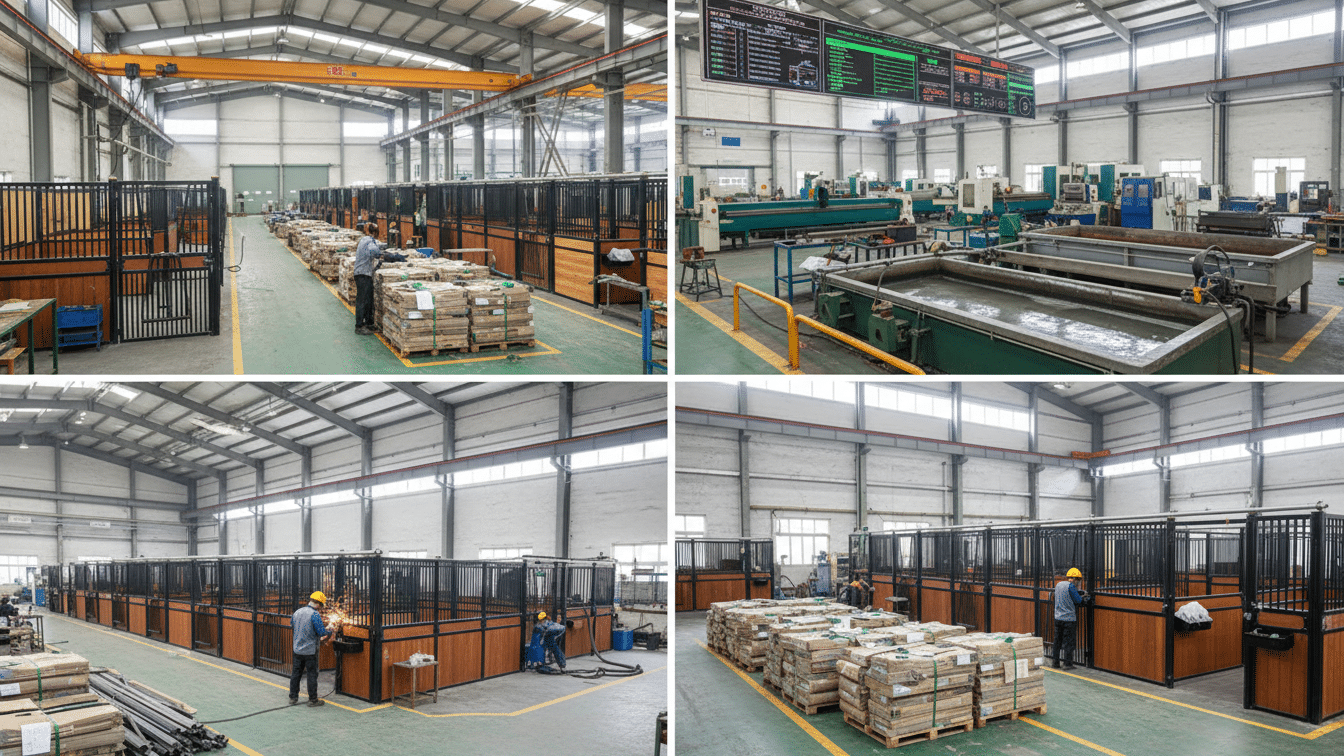
Sourcing directly lowers procurement costs by 30-40% by removing distributor markups, yet success hinges on verifying technical capabilities over superficial certifications. Failing to validate production realities often leads to receiving steel below the 42-micron galvanization threshold required for durability.
This guide details the financial mechanics of factory-direct sourcing and distinguishes OEM from ODM frameworks. It outlines vetting protocols using ISO 2859-1 inspection standards and defines material specifics, such as 10mm HDPE infill, to guarantee export-grade quality.
Factory Direct vs. Local Distributor: Cost Breakdown
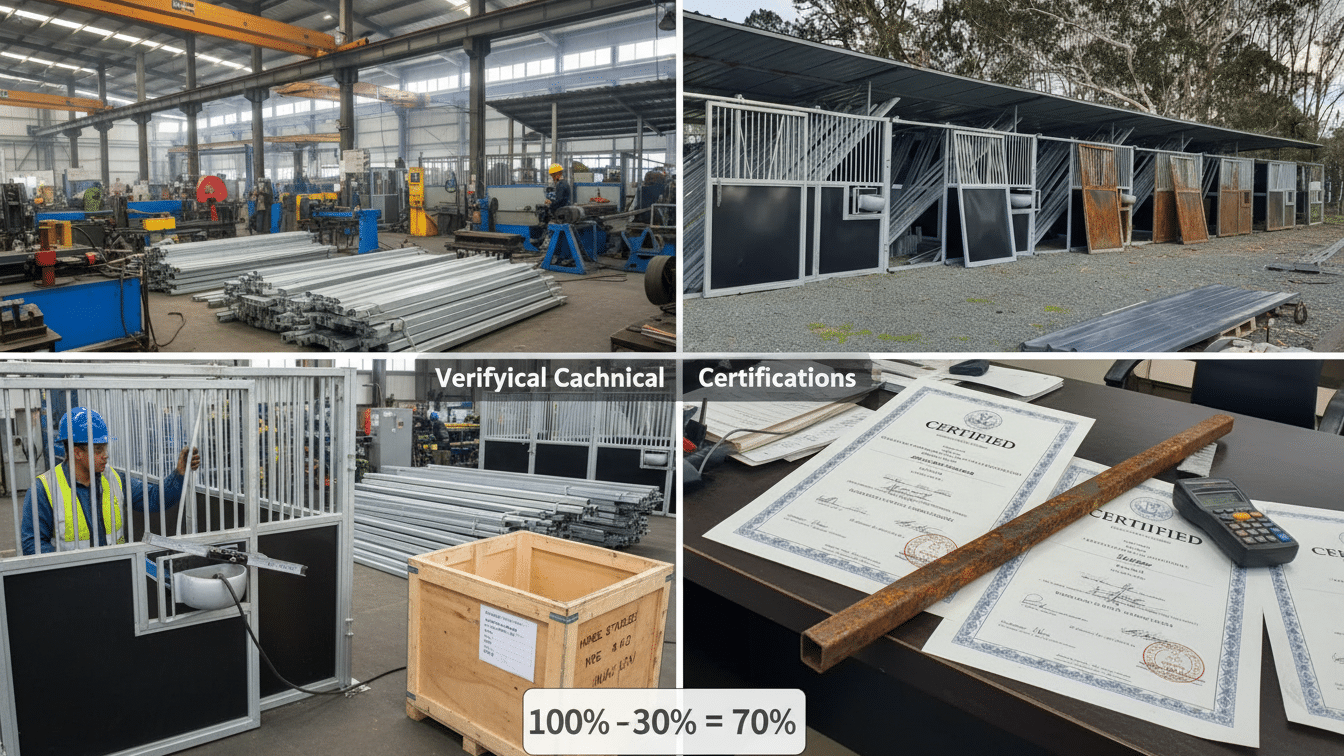
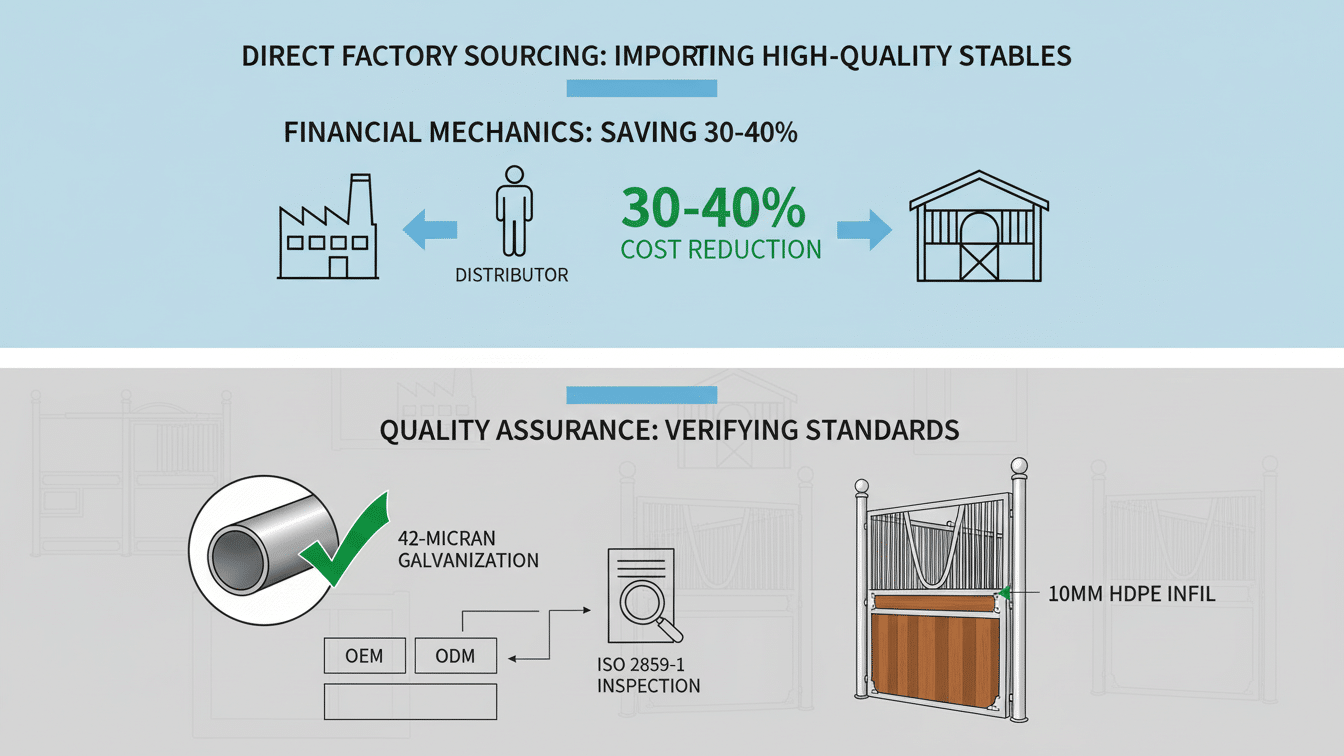
Sourcing directly from Chinese manufacturers typically yields a 30-40% reduction in total costs compared to local distributors by eliminating middleman markups. While local distributors offer speed and lower minimum order quantities (MOQs), factory-direct sourcing offers significant advantages in unit pricing—such as 23% savings on raw materials and 37% on processing expenses—making it the financially superior model for high-volume procurement in 2026.
| Cost Component | Factory Direct (China) | Local Distributor | Estimated Savings |
|---|---|---|---|
| Total Direct Cost | Low Base Cost | High Markup | 30-40% |
| Raw Materials (Per Unit) | $14.20 | $18.50 | 23% |
| Processing Expenses | $28.50 | $45.00 | 37% |
| Tooling & Molds | $8,500 | $12,000 | 29% |
Unit Price and Material Cost Analysis
Buying straight from the source removes the layers of price hikes added by middlemen. When you purchase from a local supplier, you pay for the product plus their rent, marketing, and profit. Direct sourcing cuts this out. Data shows that items like reading glasses drop from distributor rates of $2.50 to a factory price of $2.20 per unit.
The savings go deeper than just the final sticker price. Because manufacturers buy raw materials in massive bulk, they secure better rates. This often results in a 23% reduction in material costs alone. By integrating with the supply chain, factories can negotiate 10-15% lower prices on commodities like aluminum, passing those savings directly to the buyer.
Processing Expenses and Tooling Amortization
The most dramatic financial difference often lies in the processing expenses. Factory models show up to 37% savings here because overheads are absorbed by the facility rather than added as line items by a reseller. A unit costing $45.00 to process locally might drop to $28.50 at the origin.
Tooling amortization allows you to spread the cost of expensive molds over the total number of units produced. When negotiating directly, these setup costs are typically 29% lower. For example, a mold costing $12,000 through a distributor might only cost $8,500 at the factory. This happens because the factory owns the relationship with the mold maker, avoiding extra markup fees.
Evaluating Hidden Costs: Logistics and Reliability
While the unit price is lower, you must account for the journey the product takes to reach you. This is known as the landed cost. Shipping a container averages around $2,600, but when you add duties and land transport, the logistics bill can exceed $5,000. It is vital to calculate this against your volume savings.
Reliability is the other side of the coin. A low price means nothing if the product arrives late. Capable direct manufacturers maintain a 99.5% on-time delivery rate. A stable supply chain is usually indicated by a reorder rate of around 33%, which balances the risk of longer lead times inherent in international freight.
How DB Stable Maximizes Factory-Direct Value
We have operated as a direct factory since 2013, which gives us strict control over every material used. By removing intermediaries, we invest the savings back into product quality. For instance, we use hot-dip galvanized steel with a 42-micron coating. Think of this as a heavy-duty shield that protects the metal from rust for over 10 years, a standard that is hard to find in budget distributor models.
Our direct model also allows for premium inclusions without the premium price tag. We use 10mm HDPE infill boards designed to resist UV damage. Unlike standard plywood that might rot, these synthetic boards handle the sun and rain without degrading. Since we manufacture the units, we can also customize specifications, such as offering roof thicknesses of 0.4mm or 0.8mm, or swapping swing doors for sliding ones to fit your specific layout.
How to Vet a Chinese Manufacturer (ISO & QC)
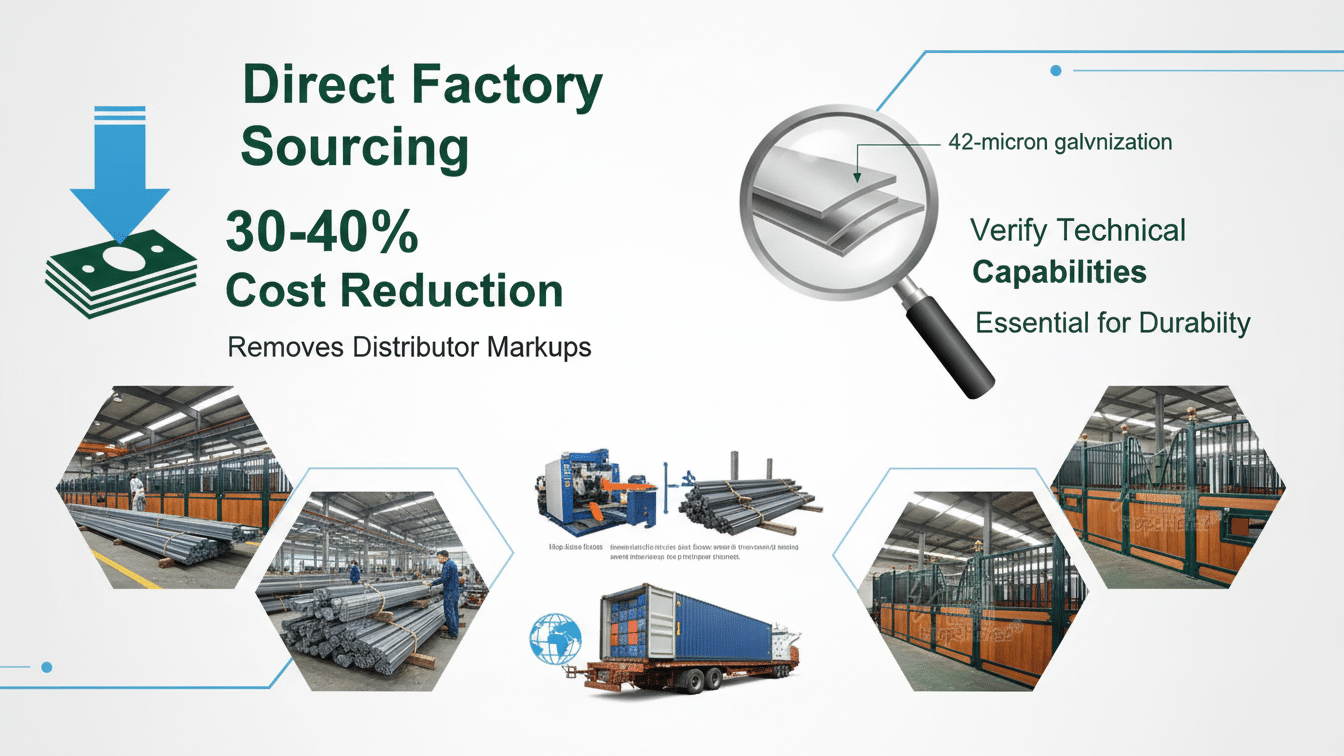
Vetting a manufacturer requires validating that their ISO 9001 certification translates into shop-floor reality. While a certificate proves a documented system exists, it does not guarantee low defect rates. Effective vetting involves three specific checks: verifying the 3-year certificate validity, reviewing the most recent annual surveillance audit report for non-conformities, and physically inspecting control points like instrument calibration records.
Understanding the Limits of ISO 9001 Certification
Many buyers mistakenly believe that an ISO 9001 certificate guarantees a perfect product. In reality, this certification only validates that a factory has a documented Quality Management System. Think of it like a restaurant having a health code license. It proves they wash their hands and store food correctly, but it does not promise that the food tastes good. A factory can technically hold a valid ISO certification while having high defect rates, sometimes as high as 30%, as long as they document those defects and follow their own procedures.
Certificates are issued on a three-year cycle, but the system relies on annual surveillance audits to remain active. These are mandatory check-ups to ensure the factory is still following the rules. You must verify that these annual audits have taken place. Additionally, the scope of the certificate is critical. You need to ensure it explicitly covers the manufacturing of your specific product line, rather than just sales or trading activities.
The Technical Vetting Protocol: 3 Layers of Verification
To truly assess a supplier, you need to look beyond the initial certificate. A robust auditing strategy involves checking documentation, reviewing audit history, and inspecting physical operations.
- ✅ Documentation Layer: Request the Quality Manual in both English and Mandarin. The presence of bilingual documents usually suggests a legitimate system designed for export, rather than a generic template purchased for appearances.
- ✅ Audit Layer: Ask for the most recent internal audit report or external surveillance report. You should look for Minor Non-Conformities in these documents. A report that is completely clean is often suspicious, as no factory is perfect.
- ✅ Operational Layer: Check the calibration schedule of measurement tools like calipers and tensile testers. If these tools have not been calibrated in over 12 months, any quality data they produce is technically invalid.
- ✅ Accreditation Check: Verify that the body issuing the certificate is accredited by CNAS or a similar authority. This ensures they are authorized to issue certificates under international standards.
How DB Stable Demonstrates Quality Assurance
We apply these rigorous standards to our own manufacturing process. Instead of relying solely on paper certificates, DB Stable validates quality through specific material specifications and structural engineering designed to withstand the harsh conditions of the Australian and New Zealand markets.
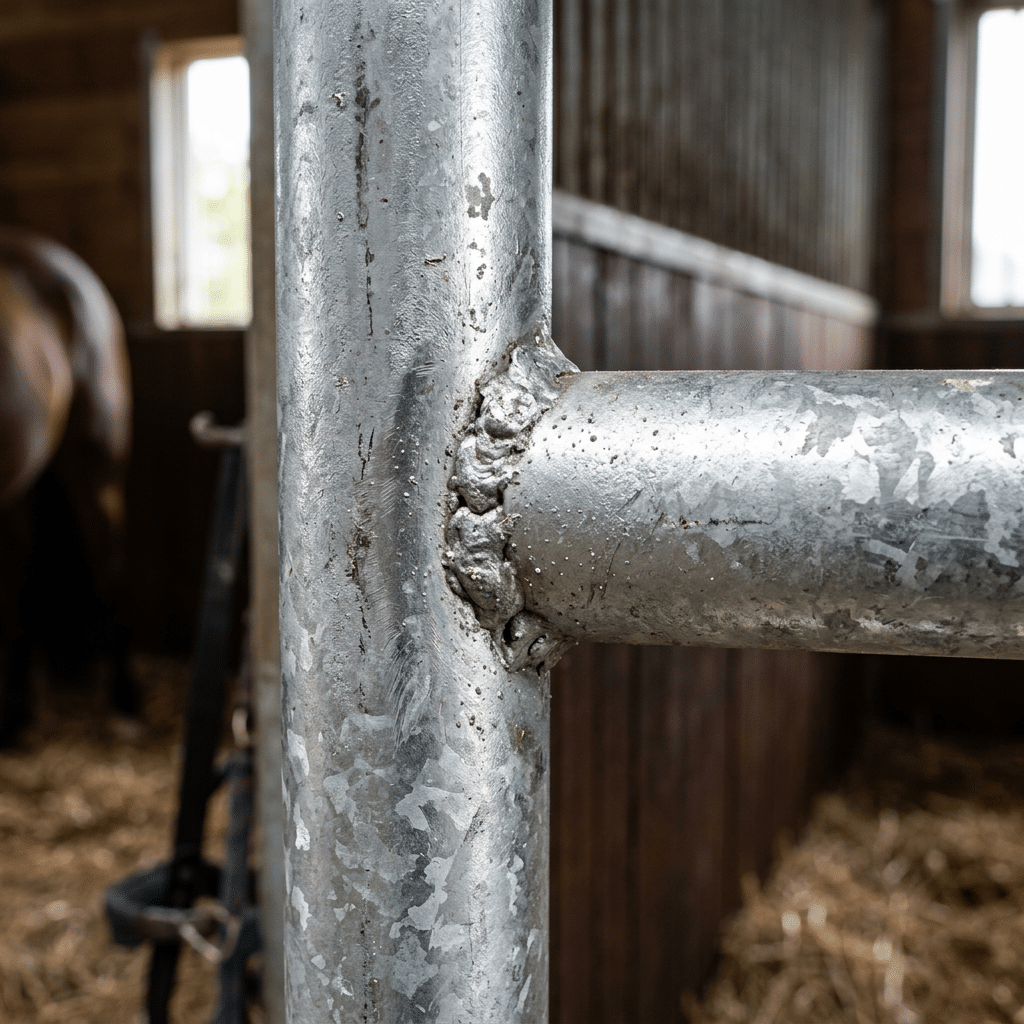
- ✅ Material Verification: We use hot-dip galvanized steel with a coating thickness exceeding 42 microns. This acts as a heavy-duty shield against corrosion, ensuring the frame resists rust for over 10 years.
- ✅ Component Durability: Our stall infills utilize 10mm thick HDPE boards. These are specifically treated for UV resistance to prevent the thermal expansion and warping issues often seen in lower-grade plastics exposed to sunlight.
- ✅ Integridad estructural: Unlike cheaper alternatives that rely on spot welding, our connection points use 40x40mm square metal tubes that are fully welded with 6mm steel plates for maximum strength.
- ✅ Design Expertise: Our manufacturing process integrates over a decade of feedback. Since 2013, our team has refined designs to minimize installation defects and ensure the stables are safe for equine use.
Understanding OEM vs. ODM Services
The core difference lies in intellectual property (IP) and design ownership. In an OEM model, the buyer retains 100% ownership of the design and specifications, treating the factory purely as a production partner. In an ODM model, the manufacturer owns the product design and tooling, allowing buyers to white-label existing products for faster market entry with lower R&D costs.
| Característica | OEM (Original Equipment Manufacturer) | ODM (Original Design Manufacturer) |
|---|---|---|
| Design Ownership | Buyer retains 100% IP rights and schematics. | Factory retains IP; buyer white-labels the product. |
| Customization Scope | Full structural and material control. | Limited to logos, colors, and packaging. |
| Coste inicial | High investment in R&D and specific tooling. | Low investment; costs amortized across clients. |
| Time to Market | Slower due to prototyping and validation. | Rapid deployment of ready-made designs. |
Core Distinction: Design Ownership and IP Rights
The main legal difference between these models is who holds the intellectual property rights. In an OEM arrangement, you own the “blueprints” entirely. This includes the mechanical structure, material composition, and engineering files. The factory acts strictly as a builder following your exact instructions.
An ODM arrangement functions more like renting a pre-designed apartment. The manufacturer owns the base design and the tools used to make it. You are permitted to make superficial changes, such as adding your branding or changing the paint color, but you do not own the fundamental structure. This allows the factory to sell the same base product to multiple clients with only minor cosmetic variations.
Operational Impact: Cost, Speed, and Quality Assurance
Choosing between these models often comes down to budget and timeline requirements. OEM projects require a significant initial investment because you must pay for research, development, and specific manufacturing molds. This process takes time, as every technical detail must be validated before mass production begins. You also drive the quality assurance process, setting specific standards the factory must meet.
ODM projects offer a faster and cheaper route to market. Since the product is already developed, you skip the lengthy design and prototyping phases. The manufacturer absorbs the development costs, allowing you to start selling quickly. But you rely on the factory’s existing control de calidad processes, which may offer less transparency than a custom inspection plan.
How DB Stable Bridges Manufacturing Gaps
Most suppliers force you to choose between the flexibility of OEM and the speed of ODM. DB Stable operates as a direct factory that bridges this gap. We combine the rapid deployment of prefabricated solutions with the rigorous material standards typically reserved for high-end OEM contracts.
Unlike standard ODMs that might use generic materials to ahorrar costes, we enforce strict durability specifications. Our “Prefabricated Barns” function like a ready-to-go solution but are built with 10mm UV-resistant HDPE boards and hot-dip galvanized steel coated to 42 microns. This ensures that while you get a product that is easy to set up, you do not compromise on the structural integrity required for heavy equine use.

Engineered for Safety and Durability Worldwide
Create a secure environment for your horses with precision-built stables designed for extreme climates. Our modular systems feature rust-resistant galvanized steel and heavy-duty bamboo or HDPE infills, ensuring long-term value and full compliance with international safety standards.

The Importance of Pre-Shipment Inspection
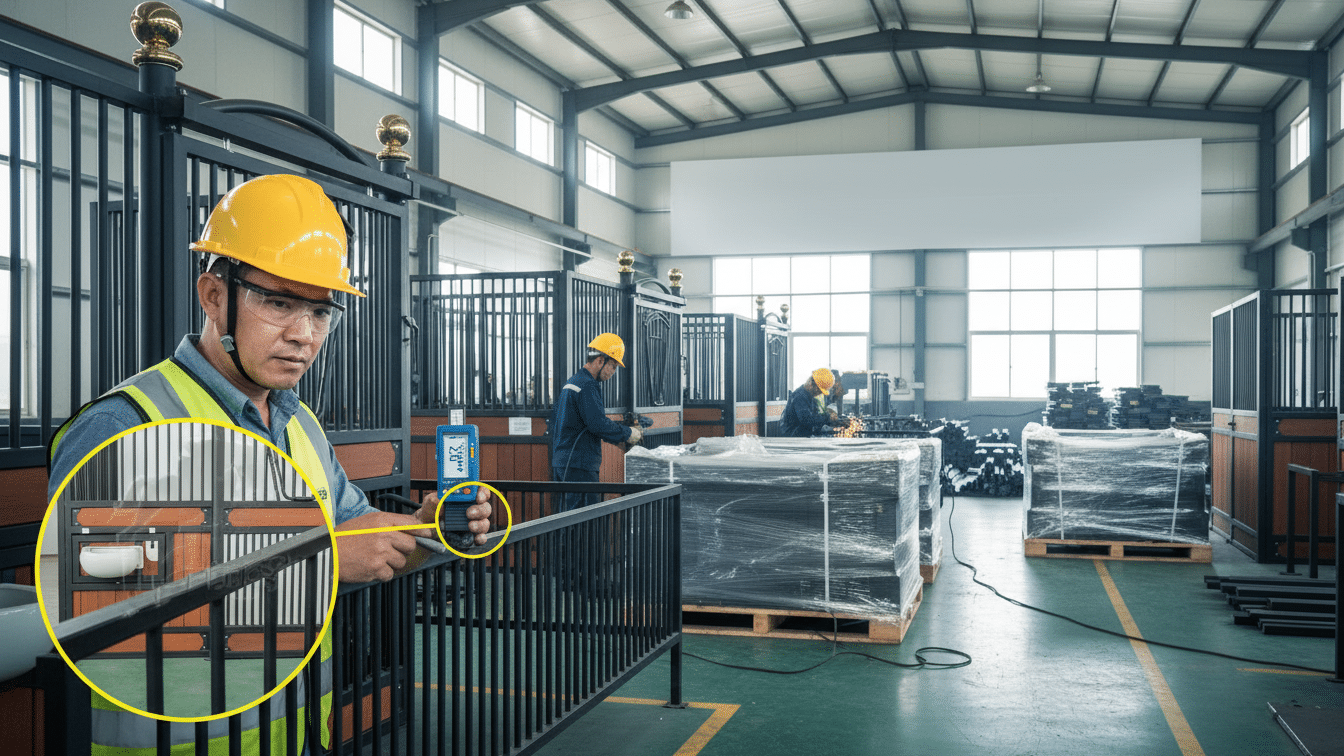
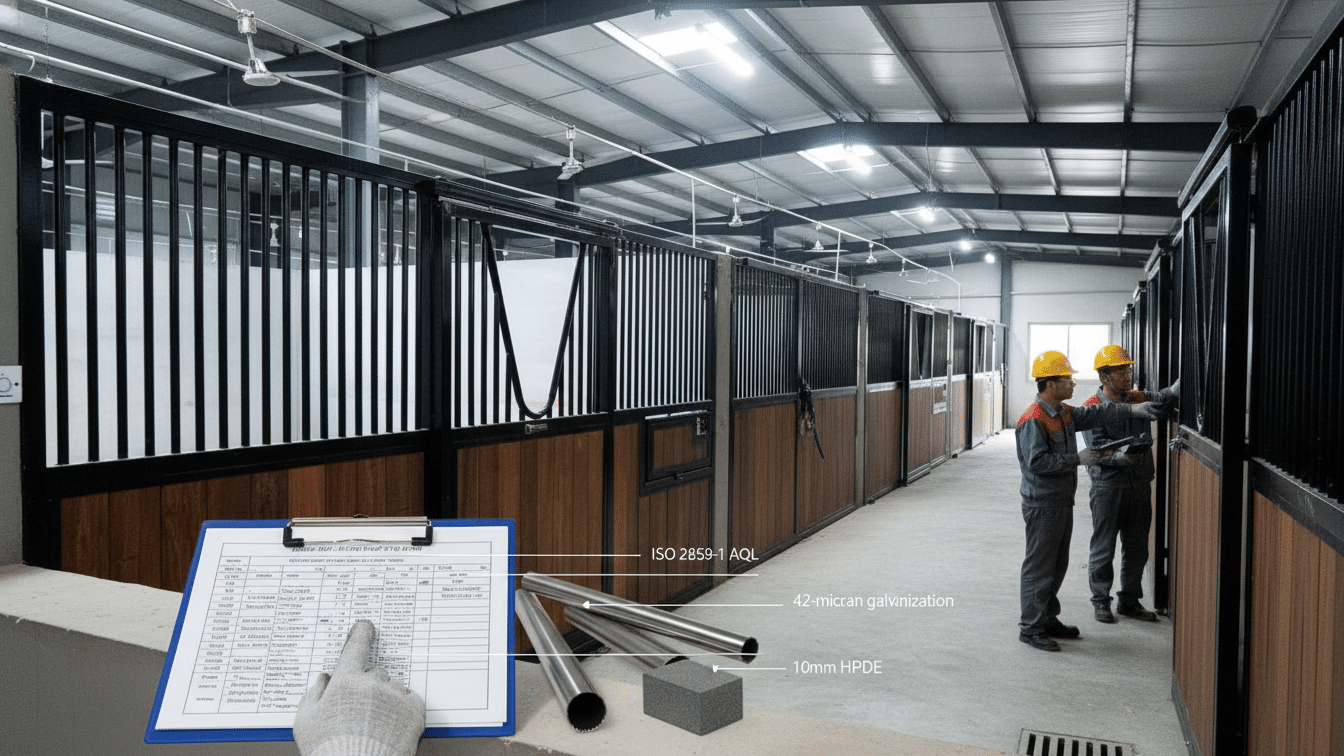
Pre-shipment inspection acts as a final quality firewall, typically occurring when production is 80-100% complete and at least 80% packaged. By using the ISO 2859-1 sampling standard, inspectors validate that critical specifications like material thickness and galvanization depth meet agreed benchmarks before the goods leave the factory floor.
Managing risk in international sourcing requires verifying that what you ordered matches what actually ships. A pre-shipment inspection provides this assurance by sending an independent agent to the factory before you make the final payment. This step prevents the costly nightmare of receiving a container full of unusable products.
The Critical Timing Window: When to Inspect
Timing is vital in quality control. Scheduling an inspection too early results in reviewing unfinished goods, while scheduling too late risks missing shipping deadlines. The industry standard balances these needs to ensure a representative view of the entire order.
- Completion Threshold: Inspectors visit when manufacturing is 80-100% finished to ensure the sample drawn represents the full production batch.
- Packaging Requirement: At least 80% of the goods must be packed. This allows verification of labels, barcodes, and protective materials alongside the product itself.
- Lead Time: The ideal window is 1-2 weeks prior to the shipping date. This buffer gives the factory time to rework defects without missing the vessel.
- Report Velocity: Professional agencies deliver reports within 24 hours, enabling you to make rapid decisions on whether to approve shipment or demand corrections.
Inspection Protocols and ISO 2859-1 Standards
Effective inspection relies on statistical validity rather than gut feeling. We use established protocols to ensure that the units checked accurately reflect the quality of the thousands of units in the container.
- Random Sampling: Inspectors use the ANSI/ASQC Z1.4 (ISO 2859-1) standard. Think of this like a medical blood test; analyzing a small, random sample gives accurate data on the whole system without checking every single cell.
- Defect Classification: Issues are sorted into Critical, Major, and Minor categories based on Acceptable Quality Levels (AQL). This separates cosmetic flaws from dangerous safety issues.
- Functional Testing: The process goes beyond visual checks. It includes assembling units onsite to ensure parts fit together and operate smoothly.
- Dimensional Verification: Tools like calipers are used to measure physical dimensions against the technical drawing, ensuring precise assembly compatibility.
Verifying DB Stable Quality Specifications
For high-value items like equine housing, general inspection is not enough. The inspection must verify the specific durability claims made by the manufacturer. At DB Stable, we focus on the metrics that define product longevity and safety.
- Galvanization Depth: Inspectors use a coating thickness gauge to verify the steel has a hot-dip galvanization layer over 42 microns. This thick zinc shield is what guarantees the 10-year rust resistance.
- Material Thickness: We verify that HDPE infill boards are a full 10mm thick and connection plates use 6mm steel. This prevents the common factory trick of substituting thinner, cheaper materials that look identical from a distance.
- Integridad estructural: Checks on the 40*40mm square metal tube framing and full welding points ensure the structure can withstand heavy impact from horses.
- UV Resistance Checks: Inspectors review material certifications to confirm the HDPE boards contain UV inhibitors, preventing them from becoming brittle under the Australian or New Zealand sun.
Identifying “Fake” Factories and Middlemen
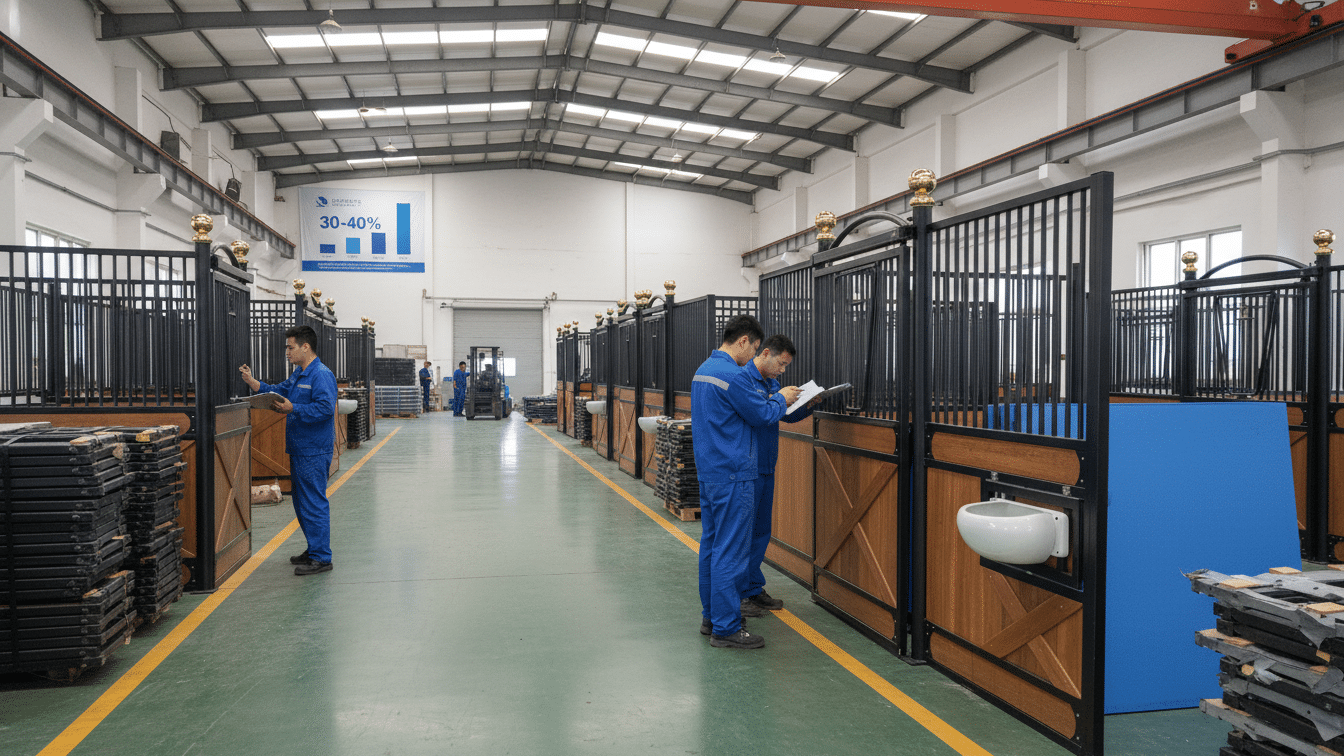
Validating a supplier requires a dual-layer approach: digital background checks and physical audits. Buyers must cross-reference the 18-digit business registration number on official portals like qcc.com to confirm manufacturer status. Secondary validation involves on-site inspections using ISO 9001-based 400-point checklists to ensure production reality matches documentation, specifically looking for equipment maintenance logs and raw material traceability.
Digital Verification: The First Line of Defense
Before you ever book a flight or hire an auditor, you can verify a supplier’s legitimacy from your desk. The most critical piece of data is the business registration number. Think of this 18-digit code as a company’s social security number or passport. It is a unique identifier that reveals exactly what the company is legally permitted to do.
You can verify this number on government-backed platforms like the National Enterprise Credit Information Publicity System or third-party aggregators like qcc.com. The key is to look at the “Business Scope” field. A legitimate factory will explicitly list terms like “Manufacturing” or “Production.” If you only see words like “Wholesale,” “Distribution,” or “Sales,” you are likely dealing with a middleman or a trading company rather than the source.
To further confirm their identity, follow these steps:
- ✅ Check the License: Locate the 18-digit code on the scanned business license provided by the supplier.
- ✅ Verify the Scope: ensure the registered activities match the product you intend to buy.
- ✅ Cross-Reference Leaders: Use sites like qixin.com to check legal representatives against the contact names you have.
- ✅ Map the Location: Use Baidu Maps to view the registered address. A factory should look like an industrial complex, not a residential high-rise or a shared office space.
On-Site Audits and ISO Standards
Digital checks confirm a legal entity exists, but physical audits confirm that they can actually make your product. Professional auditors typically use a 400-point checklist derived from ISO 9001 standards. This is a globally recognized system for quality management. You can think of it as a report card that grades the factory on consistency and organization.
One specific metric to look for is the first-pass yield chart. This chart tracks how many products come off the assembly line perfectly the first time, without needing repairs. If a factory cannot produce this data, or if the data looks too perfect, it is a warning sign. A real manufacturing floor tracks errors meticulously to mejorar la eficacia.
You should also inspect the machinery logs. Legitimate factories perform preventive maintenance to keep machines running smoothly. Look for tags or logbooks attached to equipment detailing when it was last serviced and calibrated. If these logs are missing or blank, it often suggests the machinery is just for show or the production is being outsourced elsewhere. Additionally, ask to see raw material traceability records. This ensures that the steel or plastic entering the factory matches the specifications of the final product leaving the dock.
Recognizing Deception Tactics and Red Flags
Sophisticated middlemen often stage elaborate ruses to appear as manufacturers. A common tactic is the “Staged Visit.” In this scenario, a trading company pays a factory to put up temporary signage and host a tour, posing as the owners. They essentially rent the stage for your visit. Detecting this requires looking for subtle inconsistencies.
Pay close attention to these warning signs during a visit:
- ⚠️ Restricted Access: If the host refuses to show you the raw material warehouse or specific assembly lines, be cautious. Real owners are usually proud to show off their entire operation.
- ⚠️ Inconsistent Answers: Ask random employees simple questions about their work hours or safety protocols. If they seem confused or their answers contradict management, it implies a lack of genuine oversight.
- ⚠️ Bank Account Mismatch: Ensure the beneficiary name on the bank account matches the company name on the business license exactly. A mismatch is a major indicator of a middleman or potential money laundering risk.
How DB Stable Demonstrates Manufacturer Authenticity
Transparency is the hallmark of a genuine manufacturer. At DB Stable, we operate as a verifiable direct factory, a model we have maintained since 2013. This eliminates the price markups added by trading companies and gives you direct access to the production floor. We encourage clients to witness the fabrication process firsthand.
When you visit a real facility, you can verify material specifications immediately. For example, we use hot-dip galvanized steel with a coating thickness exceeding 42 microns. Think of galvanization as a permanent shield that protects the steel from rust. We also utilize 10mm UV-resistant HDPE boards, which act as the durable infill for our stables. Because we control the manufacturing, we can prove these materials are used in your specific order.
Our production environment is open for inspection. You can see the welding of our 40*40mm square metal tubes and the assembly of our heavy-duty connectors. This level of access ensures that the durability and safety features you pay for are built into the product from the raw material stage up to the final loading.
Negotiating Terms: MOQ, Payment, and Lead Times
Negotiating with Chinese manufacturers requires understanding that published MOQs are often inflated by 30-50% as an opening tactic. Standard condiciones de pago typically follow a 30% deposit and 70% balance structure, while lead times and minimums have recently dropped by 15-25% due to manufacturing overcapacity since 2023.
The Reality of MOQ Inflation and Break-Even Points
Many buyers assume the Minimum Order Quantity (MOQ) listed on a supplier’s website is a strict rule. In reality, it functions more like an opening bid in a negotiation. Research indicates that suppliers often inflate these figures by 30-50% above what they actually need to run a production cycle. The true manufacturing break-even point is frequently just 62% of the published number.
Since 2023, the market has shifted significantly due to manufacturing overcapacity. Factories are now more eager to keep their lines running. Consequently, effective minimums have dropped by 15-25%. Where a factory might have previously demanded 1,000 units, many are now accepting orders of 600 to 800 units to maintain workflow.
Standard Payment Structures and Hidden Costs
Understanding the financial baseline is crucial for accurate budgeting. The industry standard for small to mid-sized orders follows a specific split. You typically pay a 30% deposit to start production, with the remaining 70% balance due before the goods are shipped. This protects the manufacturer while giving the buyer leverage until the product is ready.
However, budgeting often fails when buyers overlook hidden fees. Approximately 73% of importers underestimate their total costs, leading to an average of $3,500 to $5,000 in unbudgeted expenses per cycle. These often come from material choices. For instance, requesting custom materials can double your minimum order requirement from 500 pieces to 1,000 pieces because the factory cannot use standard stock.
Strategic Levers to Reduce Minimums
You can often lower your required order volume by adjusting specific product details. Factories are more flexible when you use components they already have in stock or when you absorb certain fixed costs yourself.
- Color Standardization: ✅ Choosing standard colors can drop minimums to 250 pieces, whereas custom RAL or Pantone colors often require 500 pieces.
- Setup Cost Absorption: ✅ Offering to pay for molds or setup fees separately can reduce the per-unit minimum requirement by 20-35%.
- OEM Multipliers: ✅ Be aware that custom parts like OEM straps can spike minimums to 5,000 units, while standard parts usually stay around 500.
How DB Stable Optimizes Value as a Direct Factory
Working directly with a manufacturer like DB Stable eliminates the rigidity often found with trading companies. Since 2013, DB Stable has operated as a direct factory, removing the margins that middlemen add. This structure secures the lowest price for buyers in Australia and New Zealand without sacrificing quality.
Because they control the production line, they can manage lead times more effectively than assemblers who outsource their work. This control extends to material quality, such as their hot-dip galvanized frames. These frames are coated with a zinc layer over 42 microns thick. Think of this as a heavy-duty shield that prevents rust for over a decade. Additionally, their flexible manufacturing process allows for varied configurations, such as single, double, or quadruple units, without the strict thresholds imposed by third-party traders.
Intellectual Property Protection
China operates under a strict ‘first-to-file’ system, meaning ownership belongs to whoever registers with the CNIPA first, regardless of prior use. With data showing 12% of IP theft occurs through vendors and 18% via internal staff, effective protection requires registering patents and trademarks immediately and recording them with Chinese Customs (GACC) to utilize their 90% interception rate at the border.
The ‘First-to-File’ Reality vs. Western Standards
China operates on a legal principle known as ‘first-to-file’ which differs significantly from the ‘first-to-use’ system common in Western countries. This concept works similarly to registering a website domain name. Even if you have been using a brand name or design for years, you do not own it in China until you formally file the paperwork. If a squatter registers your design before you do, they legally own the rights. Patents or trademarks held in the United States or Europe are not valid within Chinese borders until they are registered with the CNIPA (China National Intellectual Property Administration).
Protection generally falls into three main categories: Patents (for inventions and designs), Trademarks (for brand names), and Copyrights. Speed is critical in this environment. Sharing your diseños estables or technical schematics with a factory before filing leaves your intellectual property exposed. It is necessary to secure these rights before any manufacturing discussions begin.
Mitigating Theft: Internal Controls and Modular Production
Data analysis shows that theft often originates from trusted sources rather than external hackers. Approximately 12% of intellectual property theft occurs through vendor channels, while 18% involves internal staff. This reality requires strict vetting processes for both your manufacturing partners and your own team.
A strategic method to reduce this risk is modular production. This approach involves splitting the manufacturing process across multiple suppliers so that no single factory possesses the complete design schematic. For instance, one facility might fabricate the 42-micron hot-dip galvanized frames, while a separate facility produces the UV-resistant HDPE boards. By keeping these components separate until the final assembly stage, you limit the exposure of your full product design.
Legal protection also depends on your actions. Under Article 9 of the Anti-Unfair Competition Law, trade secrets are only enforceable if the owner can demonstrate that ‘reasonable confidentiality measures’ were taken. Implementing strategies like modular production serves as physical proof of your effort to protect your proprietary information.
Enforcement Mechanisms: Customs and Legal Frameworks
Registering your rights is only the first step; enforcement ensures those rights are respected. Chinese Customs (GACC) provides a powerful mechanism for this, intercepting approximately 90% of intellectual property violations at the border. This system allows you to block unauthorized exports of your goods.
To use this service, you must file a recordation with Customs. This recordation offers 10 years of protection that is renewable and applies nationwide across all Chinese ports. It effectively turns customs officers into your first line of defense against counterfeit exports. Additionally, Article 119 of China’s Civil Code formally establishes ownership rights within manufacturing contracts. This provides a solid legal basis for litigation if a dispute arises regarding who owns the molds or the final product designs.
Communication Protocols
Industrial communication protocols are standardized rule sets governing data exchange between manufacturing equipment, sensors, and PLCs. The landscape includes legacy systems like RS-232 and Modbus coexisting with modern Ethernet-based standards such as PROFINET and MQTT. Selection depends on specific requirements: real-time control processes demand deterministic latency found in EtherCAT, while non-critical telemetry utilizes lightweight protocols like MQTT.
Protocol Landscape: Legacy vs. Modern Standards
Manufacturing facilities often operate as a mix of historical infrastructure and cutting-edge technology. Legacy systems like RS-232, RS-485, and CAN bus remain active in many facilities, often requiring integration with newer networks rather than immediate replacement. This is similar to renovating an old house where you must make modern wiring work within existing structural walls.
Modern widely adopted protocols include Modbus, Ethernet/IP, PROFINET, PROFIBUS, and OPC UA. These standards handle higher data volumes and provide tighter integration than their predecessors. Alongside these, emerging standards such as MQTT (Message Queuing Telemetry Transport) and UMATI are gaining traction for IoT connectivity, allowing machines to send lightweight status updates to the cloud efficiently.
Production environments are often heterogeneous, requiring interoperability between proprietary systems like Fanuc CNC and Mitsubishi Melsec. The goal is to create a seamless conversation between machines that speak different technical languages.
Industry-Specific Protocol Applications
Different industrial sectors prioritize different metrics, such as speed, data volume, or resistance to interference. Choosing the right protocol is about matching the language of the machine to the environment it operates in.
- ✅ Automotive: Relies on CANopen for low latency and DeviceNet for reliable machine control.
- ✅ Food & Beverage: Utilizes Ethernet/IP for high-speed data transmission and Profinet for real-time communication.
- ✅ Chemical Processing: Prefers Profibus for its resilience in harsh environments and Modbus for robust sensor-controller loops.
- ✅ Critical Control: Robotics and machining require protocols with deterministic latency, specifically EtherCAT and PROFINET IRT, to ensure precise timing.
- ✅ Pharmaceutical: Combines Modbus for laboratory equipment with Ethernet/IP for real-time monitoring.
Architecture and Strategic Implementation
Implementation typically follows a layered stack similar to the OSI model, separating physical transmission from application functionality. Think of this model like a postal service where the truck driving the mail (physical layer) is separate from the language written in the letter (application layer). This separation allows engineers to upgrade hardware without rewriting all the software code.
Common Industrial Protocol (CIP) is used in Ethernet/IP deployments, employing a producer-consumer architecture to optimize bandwidth usage. In this setup, a device broadcasts data once, and multiple interested devices pick it up, rather than sending individual messages to every recipient.
OPC UA offers platform-independent architecture with built-in security frameworks and semantic data modeling for vertical integration. Multi-protocol capability ensures unrestricted equipment interoperability and facilitates scalability with minimal reconfiguration. This flexibility allows factories to expand their operations without being locked into a single vendor’s ecosystem.
Case Study: Successful Import
A successful B2B import strategy prioritizes technical alignment over lowest initial cost. In this case, a buyer achieved a 20% cost reduction compared to European alternatives by sourcing equivalent technical solutions rather than direct copies. Success relied on a strict 1-month vetting process to ensure full EU compliance certification and rigorous documentation checks, favoring China’s mature industrial base over emerging ASEAN alternatives.
Strategic Requirements: Compliance vs. Cost
The goal of this project was to establish a sourcing criteria that balanced affordability with strict regulatory standards. The buyer needed to secure equipment that functioned exactly like European models but at a significantly lower price point. This required a clear separation between essential functions and brand-specific designs.
- ✅ Cost Target: The mandate required a minimum 20% reduction in total cost compared to established European suppliers.
- ✅ Regulatory Hurdle: The most difficult constraint was obtaining full EU compliance certification to meet safety laws.
- ✅ Technological Approach: The team sought equivalent technical solutions. Think of this like buying a generic pharmaceutical drug; it has a different shape or color than the brand name, but the active ingredients work exactly the same way. This avoided intellectual property conflicts.
- ✅ Regional Selection: The team focused on China rather than Vietnam or Thailand, citing the need for a more mature industrial base to handle complex engineering.
The Three-Layer Supplier Vetting Protocol
To reduce the risk of scams or poor quality, the sourcing team used a specific validation timeline. They allocated one full month purely for online research to narrow the field down to just three final candidates.
- ✅ Layer 1 – Technical Capability: Suppliers had to prove they had previously exported to Western markets. This acted as a filter to ensure they understood high quality standards.
- ✅ Layer 2 – Design Competency: Manufacturers were required to submit custom technical drawings based on the buyer’s specs. This proved they had real engineers on staff, not just sales agents.
- ✅ Layer 3 – Commercial Transparency: The winning offers broke down the price in detail. Instead of one lump sum, they listed costs for the machine, warranty, and production timeline separately.
Execution: Documentation and Quality Control
Getting the product built is only half the battle. Ensuring it arrives legally and safely requires precise paperwork and physical checks. The project success relied on mandatory on-site inspections and third-party quality checks before the factory was allowed to ship the goods.
Documentation precision was equally critical to avoid customs delays. The Proforma Invoice, which serves as a preliminary bill of sale, had to list specific details. This included the Harmonized System (HS) number, which is a universal ID code that tells customs officials exactly what the product is to determine tax rates. The invoice also required exact item value, weight, and packed dimensions.
How DB Stable Mirrors These Standards
The principles of this case study directly apply to how we manufacture portable cuadras de caballos. Just as the case study prioritized strict technical alignment, DB Stable enforces rigorous material specifications to ensure longevity and safety for equine use.
- ✅ Material Specification: We mandate hot-dip galvanization over 42 microns. This is a process where steel is dipped in molten zinc to create a shield against rust, ensuring a 10-year lifespan even in harsh weather.
- ✅ Market Compliance: Similar to the case study’s focus on EU norms, we align our production with Australian and New Zealand standards. We have been successfully exporting to these regions since 2013.
- ✅ Transparency: We provide clear details on materials, such as our 10mm UV-resistant HDPE boards. These boards resist sun damage and do not expand in heat, mirroring the commercial transparency that defines successful sourcing.
Preguntas frecuentes
How do I verify a Chinese factory’s ISO certification?
To verify a certificate, you must first look for the CNAS accreditation mark. Think of CNAS as the official badge that proves the certification body is legitimate and not a fake agency. If this mark is missing, the certificate may be invalid.
Next, you should cross-reference the certificate number on the official CNCA database, which is the government administration that oversees certification in China. It is also critical to check the scope listed on the document. A factory certified to make ceramics should not be using that same certificate to validate their ability to manufacture glass or steel products.
What is the difference between Trading Companies and Manufacturers?
The core difference lies in ownership and control. A manufacturer owns the factory, the machines, and the production lines. This allows them to offer lower unit costs and direct customization, but they usually require you to buy larger quantities at once.
A trading company acts like a middleman or a waiter in a restaurant. They do not cook the food; they take your order and bring it to you from the kitchen. They charge a higher price to cover their service, but they can offer a wider variety of products and smaller order quantities since they source from multiple factories.
What are the risks of skipping Pre-Shipment Inspections?
Skipping this step is like buying a house without looking inside first. The biggest risk is financial loss due to critical defects. If a shipment arrives with riesgos para la seguridad or fails to meet regulations like CE or RoHS, you cannot legally sell the goods, and returning them to China is often too expensive to be viable.
Without an inspection when production is 80 percent complete, simple errors like wrong colors or poor packaging go undetected. These defects damage your brand reputation immediately. Catching these issues at the factory allows the manufacturer to rework the products before you pay the final balance.
Does buying direct really save 30% vs local distributors?
Not necessarily. While the unit price of the product is almost always lower when buying direct, this does not account for the total cost of ownership. You must factor in shipping fees, import duties, warehouse rental, labor for unloading, and the cash flow tied up in holding large amounts of inventory.
When you add these hidden costs, the savings often shrink significantly. Local distributors absorb these risks and costs for you. Direct sourcing usually only saves money if you are ordering high volumes consistently and have your own optimized logistics network.
What legal contracts protect overseas buyers?
To protect your purchase, you should use contracts based on international standards like the CISG (United Nations Convention on Contracts for the International Sale of Goods). This provides a neutral legal framework rather than relying on local laws that might favor the seller.
You should also clearly define delivery responsibilities using Incoterms and secure your payments using Letters of Credit. A Letter of Credit ensures the bank only releases your money after the supplier proves they have shipped the goods exactly as agreed, reducing the risk of non-delivery.
How DB Stable Ensures Manufacturing Transparency?
We operate as a direct manufacturer rather than a trading company, which eliminates unnecessary markups. Since 2013, we have specialized strictly in equine infrastructure, giving us deep technical expertise that general trading companies lack.
Transparency also means proving material quality. We use hot-dip galvanized steel with a coating thickness exceeding 42 microns. This specific thickness is critical because it ensures the steel remains rust-free for over 10 years, even in harsh outdoor environments. We back these claims with verifiable testimonials from long-term clients in Australia and New Zealand.
Final Thoughts on Direct Sourcing
Importing directly creates a 30-40% margin advantage, but that profit vanishes if the product fails. True value comes from strict technical verification—ensuring 42-micron galvanization and UV-stabilized materials rather than just accepting the lowest bid.
Bypassing middlemen requires a partner who understands durability standards, not just assembly speed. Securing these specifications at the factory level guarantees a decade of operational safety while protecting your bottom line.


 Spanish
  English
  French
  Arabic
  German
0 comentarios