


Sourcing high-grade Multi-Way Connectors is the primary safeguard against structural instability in expanding equestrian facilities. While generic drop-pin systems suffice for temporary events, they fail to provide the rigidity needed for permanent barns, often leading to loosened partitions and significant safety liabilities.
This technical breakdown benchmarks connection systems against the Q235B structural steel and ISO 1461 galvanization standard. We analyze the specific load-bearing capabilities of 2-way versus 4-way post configurations to help you design safe, modular layouts that maximize container yield and minimize installation labor.
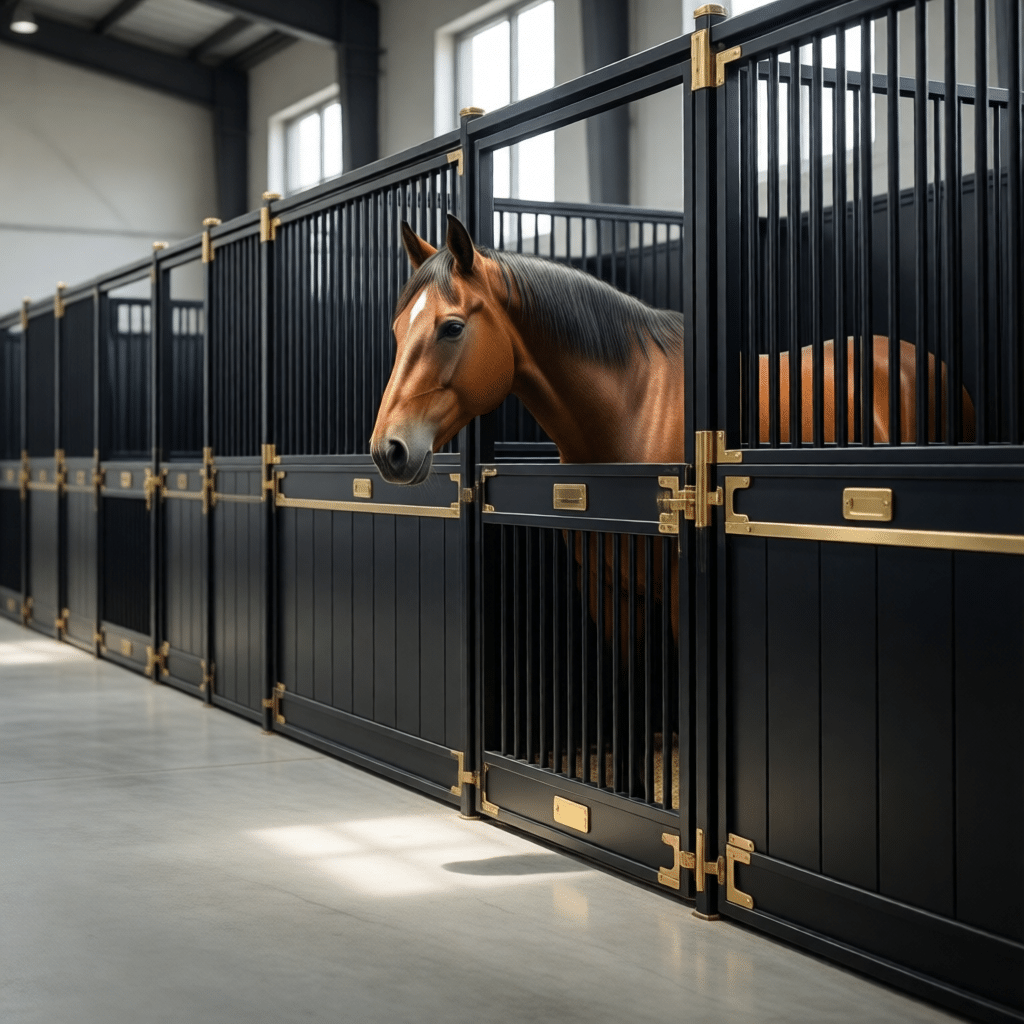
The Lego Concept of Modular Horse Stable Kits
Modular kits replace expensive on-site fabrication with standardized assembly, turning construction projects into efficient logistics operations that maximize container space and protect distributor margins.
The Mechanics of Modular Prefabrication
Traditional stable construction is a fabrication project requiring raw steel, cutting torches, and skilled welders on-site. The modular “kit” philosophy shifts this entirely to an assembly task. Much like a building block set, we manufacture standardized panels—typically 3.0m, 3.5m, or 4.0m in length—that arrive fully finished and ready to lock together. This system relies on precision engineering rather than brute force construction.
- Interchangeable Design: Standardized dimensions allow installers to configure layouts flexibly, easily switching between straight rows, L-shapes, or U-shapes without custom fabrication.
- Zero On-Site Welding: The system utilizes engineered connectors and 304 Stainless Steel hardware. This eliminates the need for expensive welding labor and preserves the hot-dip galvanized coating, which welding would destroy.
- Rapid Scalability: Facility owners can expand capacity linearly. Adding five new stalls is as simple as ordering the corresponding number of front and side panels, which bolt onto the existing structure.
Profit Protection via the Flat-Pack System
For B2B distributors, the primary enemy of profit is shipping “air.” Traditional fully welded stables are bulky and inefficient to transport, often capping a 40HQ container at just 12 to 15 units. This drives the landed cost per stable to unsustainable levels. We counter this with a strict “Profit Protection” logistics strategy centered on high-density loading.
- Steel Pallet Flat-Pack: We package components on dedicated steel pallets. This prevents loose-loading damage and allows for safe, rapid forklift unloading at the destination.
- Maximized Container Yield: By dismantling the “box” into flat panels, we fit 30 to 45 sets in a single 40HQ container, compared to the industry average of 12 fully welded units.
- Freight Cost Reduction: This density effectively reduces the shipping cost per unit by over 60%, allowing distributors to maintain healthy margins even when ocean freight rates fluctuate.
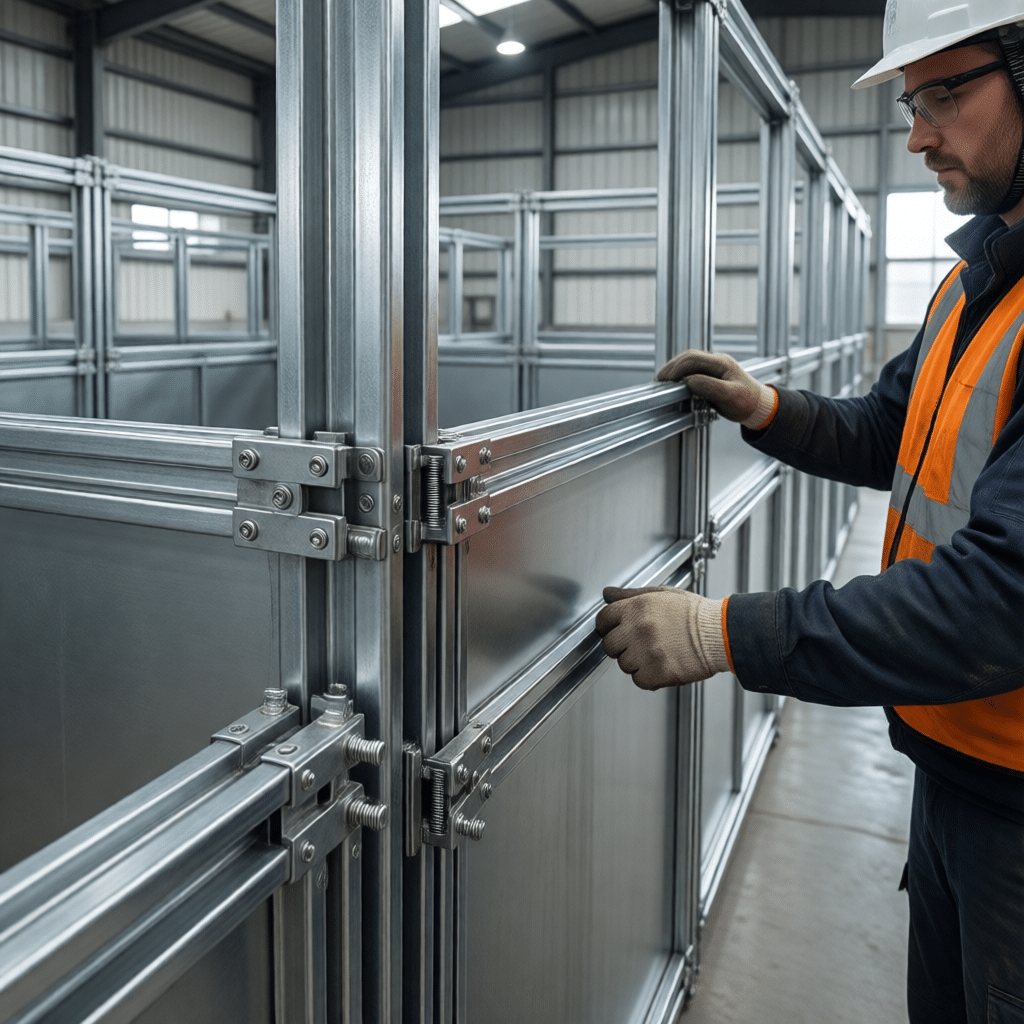
2-Way Connectors for Straight Walls
Executive Summary: 2-Way straight connectors lock stable fronts and partitions into a single, rigid linear structure. DB Stable utilizes hot-dip galvanized pins and 304 stainless steel hardware to maintain alignment and prevent corrosion in ammonia-rich environments.
Establishing Rigidity in Linear Stable Runs
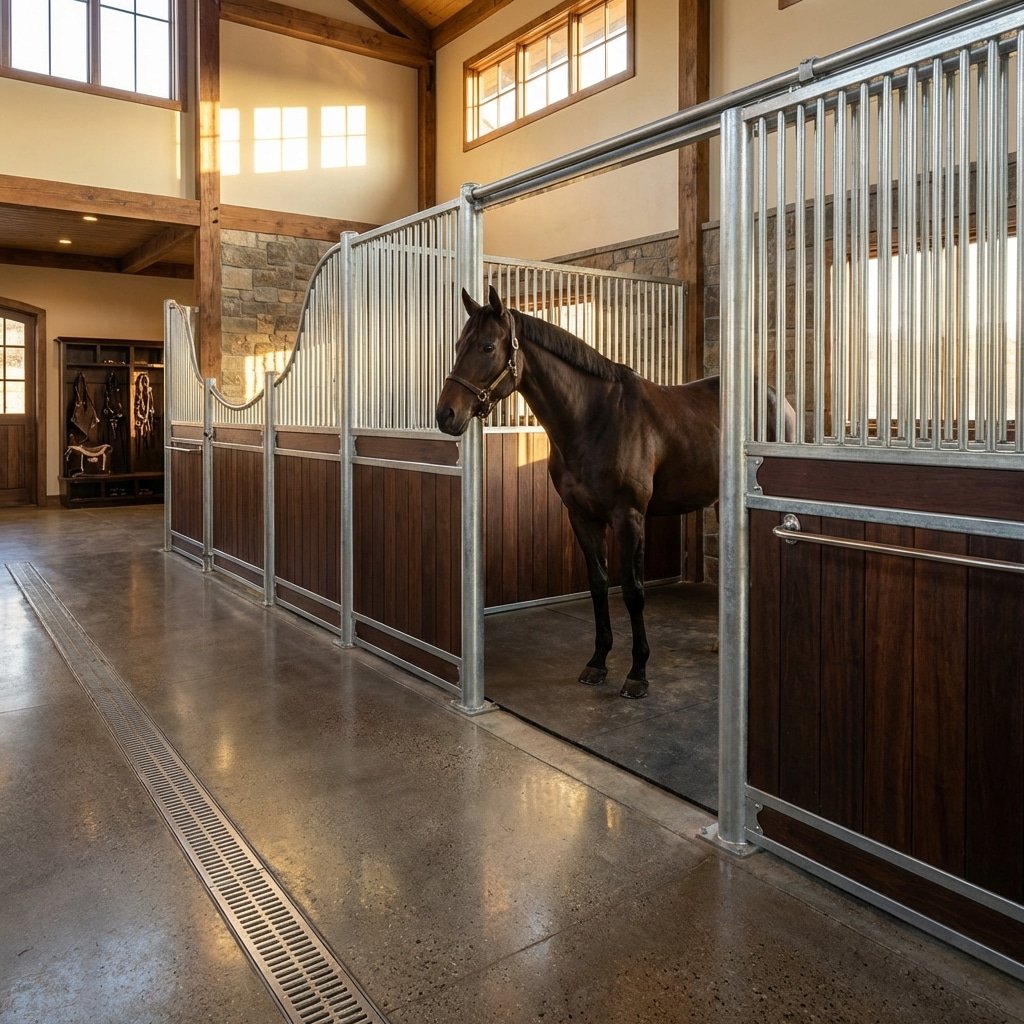
A stable row acts mechanically like a continuous beam. If the connections between panels are weak, the entire run will wobble when a 500kg horse leans against a partition. The 2-Way straight connector (180-degree joiner) solves this by locking the structural steel frames of side panels and fronts into a unified assembly. This prevents independent movement between sections, which is critical for long rows where cumulative instability can compromise the building’s safety.
In shared-wall configurations, where one partition serves two stalls, this connector bears the load from both sides. Beyond structural rigidity, these connectors enforce precise spacing between panels. We adhere to a strict “Cast-Proof” safety standard, ensuring the gap between connected frames remains approximately 50mm. This prevents hooves from getting trapped if a horse rolls near the wall, a common risk with poorly fitted clamp systems.
Hardware Specs: Hot-Dip Galvanized Pins & 304 Stainless Steel
Standard black steel connectors fail quickly in stable environments due to moisture and ammonia exposure. We engineer our connection hardware to resist these corrosive elements through specific material choices that match our “Lifetime” rust protection standard.
- ISO 1461 Galvanization: All connectors undergo hot-dip galvanization after fabrication, achieving a zinc coating thickness exceeding 70 microns. This matches the protection level of the main stable frames.
- Connect Way Pin & Cleek System: We use a heavy-duty pin system designed for impact resistance, rather than relying on friction-based clamps that can slip over time.
- 304 Stainless Steel Fasteners: We exclusively use 304-grade stainless steel for all assembly screws and anchor bolts. This prevents the fasteners from seizing inside the steel frame and eliminates the rust streaks often seen with standard zinc-plated screws.
Premium Custom Stables Built to Last Decades
3-Way and 4-Way Posts for Building Multi-Stall Blocks
Multi-way posts enable shared-wall configurations, significantly reducing panel counts and project costs while maintaining structural rigidity in continuous row or quadrant layouts.
| Post Configuration | Junction Shape | Primary Application | Structural Function |
|---|---|---|---|
| 3-Way Post | ‘T’ Junction | Continuous Rows (Side-by-Side) | Connects 1 Partition to Front Wall |
| 4-Way Post | ‘+’ Intersection | Quadrant Blocks (Back-to-Back) | Locks 4 Panels at Center Point |
Configuring T-Junctions and Quadrant Blocks
Efficient stable design relies on geometry, not just hardware. Using standard linear posts for every connection forces builders to double up on support columns, wasting steel and floor space. Multi-way posts solve this by integrating connection points directly into the structural column, allowing you to build “Lego-style” layouts where partitions are shared between stalls.
- 3-Way Posts (T-Junctions): These act as the backbone for standard shed rows. The post accepts the front wall panel on the left and right, while simultaneously anchoring the dividing partition extending backward.
- 4-Way Posts (Intersections): Critical for high-density “quadrant” layouts (four stalls clustered together). This single post sits at the absolute center, joining four separate panels to create a rigid, self-supporting block.
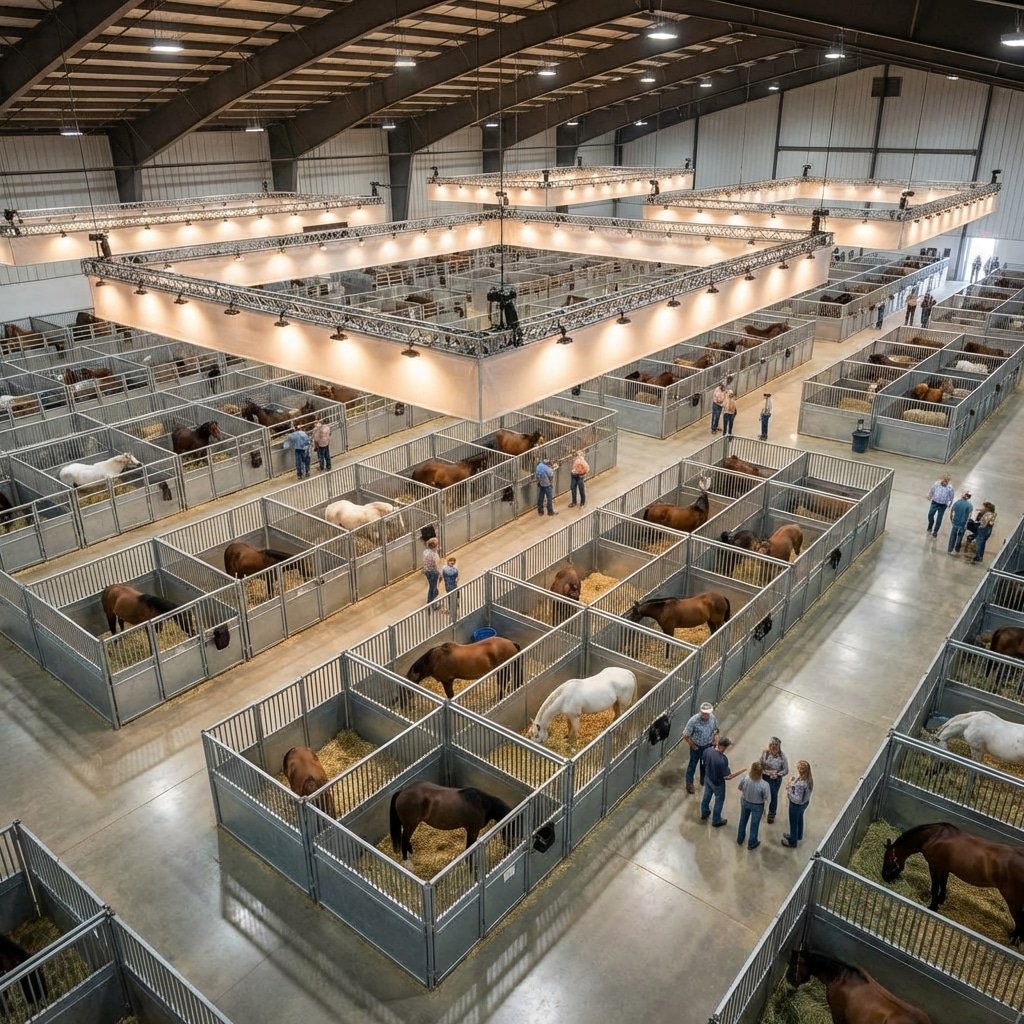
- Shared Wall Efficiency: By utilizing these connectors, stalls share partition walls rather than requiring double walls. This reduces the total panel count per project, directly improving profit margins for distributors and project managers.
- Modular Expansion: These posts allow for non-destructive expansion. You can extend a row simply by removing a termination post and replacing it with a 3-way post, without cutting or welding on-site.
Technical Specs: 50mm RHS Posts with 6mm Welded Plates
Structural integrity in a multi-way connection is non-negotiable. When three or four 400kg panels meet at a single point, the stress load on the connector is immense. We do not use bolt-on brackets that can loosen over time. Instead, our DB Stable system uses a fully welded, unified post design to handle the kinetic energy of stalled horses.
- Profile Dimensions: We utilize a standard 50mm x 50mm RHS (Square Hollow Section) for universal compatibility across all DB Stable panel lines.
- Heavy-Duty Connections: The receiving channels are formed by 6mm thick steel plates, fully welded to the main post. This prevents fatigue cracking under repeated impact.
- ISO 1461 Protection: All posts undergo hot-dip galvanization after fabrication. Complex weld points receive an average zinc coating of >85 microns, ensuring zero rust even in the deep crevices of the connector plates.
- Material Standard: We manufacture strictly from Q235B structural steel, with a Q345B option available for cold climates to maintain impact toughness in freezing conditions.

Drop-Pin vs Bolt-Through Connection Hardware
Drop-pins suit temporary layouts, while bolt-through systems act as permanent safety shackles. We utilize 304 stainless steel and 6mm welded plates to ensure connections withstand high-stress impact.
Operational Differences: Speed vs. Security
Drop-pin systems function similarly to simple door hinges. You align the panels, drop a pin through the sleeve, and gravity holds it in place. This mechanism is standard for temporary events or rental stables where crews must assemble and disassemble hundreds of stalls in a single day. Speed is the priority here, not structural rigidity.
However, permanent stables face a different set of physics. Horses constantly rub, kick, and lean against partition walls, creating continuous low-frequency vibration. In a drop-pin system, this vibration gradually “walks” the pin upwards or wears down the metal-on-metal contact point, leading to a loose, rattling fit.
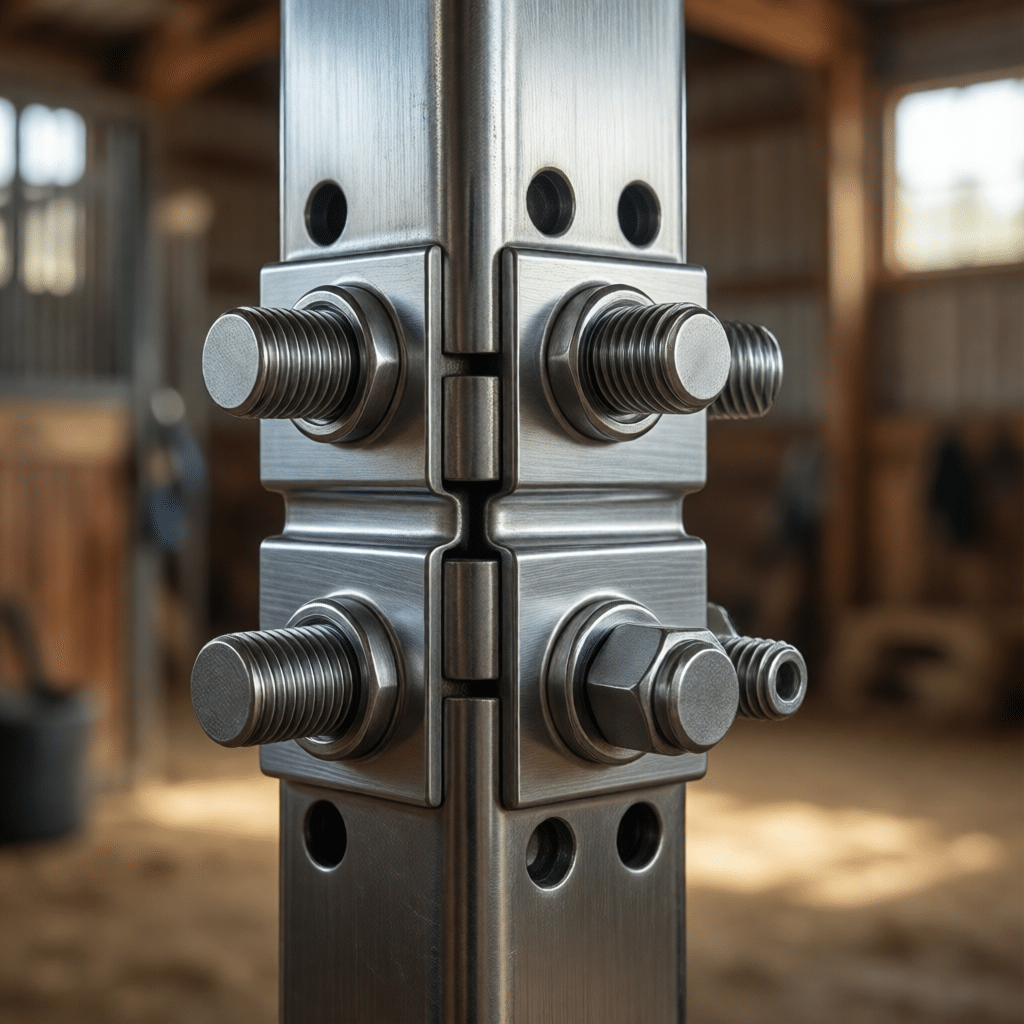
Bolt-through connections eliminate this movement. By using a threaded bolt secured with a nut and often a secondary cotter pin, the hardware acts as a “safety shackle.” It clamps the frame components together under tension, creating a monolithic structure that absorbs impact rather than rattling against it. For facilities housing valuable or active horses, this mechanical lock is non-negotiable for safety.
| Característica | Drop-Pin (Quick-Release) | Bolt-Through (Fixed) |
|---|---|---|
| Primary Use Case | Temporary events, rental kits | Permanent stable blocks |
| Vibration Resistance | Low (Loosens over time) | High (Tension-locked) |
| Assembly Speed | Rapid (No tools required) | Standard (Requires wrenches) |
| Security Level | Moderado | Maximum (Safety Shackle) |
Material Specifications: 304 Stainless Steel and 6mm Plates
Hardware failure in stables rarely happens because the steel snaps; it happens because the steel rusts. A corroded bolt loses its tensile strength and strips its threads when tightened. Unlike economy competitors who use zinc-plated hardware that degrades in ammonia-rich stable environments, we utilize **304 Stainless Steel** for all connection kits. This ensures that the threads remain sharp and the connection remains secure for the lifespan of the barn.
- 304 Stainless Steel: Used for all anchor bolts, connectors, and screws to prevent corrosion-induced failure.
- Heavy-Duty Lugs: Connection points utilize 40x40mm square metal tubes fully welded with 6mm steel plates to prevent tearing under impact.
- Kick-Proof Guarantee: The combination of 304 Grade hardware and 6mm mounting plates eliminates the weak points found in standard 2-3mm bracket systems.
Preguntas frecuentes
How do modular horse stall panels connect together?
Modular systems typically rely on three engineering methods depending on the application. Pin connectors (drop-pins) slide through pre-aligned steel lugs, offering the fastest assembly for temporary or portable layouts. Bracket systems involve bolting heavy-duty tabs to existing walls or posts, creating a rigid, vibration-resistant structure ideal for permanent barns. For self-supporting layouts without structural columns, multi-way connectors mechanically lock panels together at corners to form a stable block.
What is involved in building a row of horse stables?
Building a row requires establishing a precise “starter line” to ensure the entire run remains square. Installers set the first post or wall bracket, then connect panels sequentially. In professional setups, stalls share a single post or connector between them rather than double-posting; this reduces steel costs and maximizes floor space. Leveling is critical at this stage—if the bottom rail isn’t perfectly flat, the gravity latches and sliding door tracks will bind, leading to operational failure.
When is a 4-way connector required for stable installation?
You strictly need a 4-way connector when four separate panels meet at a single intersection point. This configuration appears frequently in “center grid” layouts where two rows of stalls sit back-to-back. The connector locks two side partitions and two rear walls into a rigid 90-degree cross. This component effectively replaces a structural column, maintaining the geometric integrity of the barn without requiring a ceiling-to-floor post.
Do I need permanent posts to install these stalls?
Technically, many modular designs are “freestanding” and support themselves through connected geometry. However, for any permanent facility, we strongly advise against relying solely on gravity. A 500kg horse impacting a wall generates massive force that can shift unanchored lines. We recommend bolting the base plates to the concrete footing or anchoring the system to existing structural supports to ensure the “Kick-Proof” safety standards are met.
Reflexiones finales
Cutting corners on connection hardware compromises the structural integrity of the entire facility. By standardizing on ISO 1461 hot-dip galvanized frames and 304 stainless steel fasteners, you eliminate the risk of corrosion-induced failure common in budget systems. This commitment to the “Lifetime” standard protects your reputation and ensures your clients’ investments withstand decades of daily abuse.
Secure your inventory quality before committing to a full container load. We invite you to request a specification sample or discuss a private label partnership to integrate these modular solutions into your existing catalog. Contact our engineering team today to optimize your next project’s logistics and profitability.


 Spanish
  English
  French
  Arabic
  German
0 comentarios