


Rodent damage accelerates structural decay and introduces severe injury liabilities in timber-lined equine facilities. While softwoods offer initial Kosteneinsparungen, they fail to resist the gnawing mechanics of common pests, leading to compromised containment walls and costly veterinary bills. Persistent baseboard repairs and biosecurity breaches quickly erode the operational margins of high-traffic barns.
This analysis benchmarks the efficacy of 14-gauge Q235B steel base profiles against traditional lumber. We detail how replacing the bottom perimeter with hot-dip galvanized steel removes the leverage points pests require, ensuring your facility meets the Kick-Proof Guarantee standard for long-term structural integrity.

The Hidden Threat of Rats Chewing Stall Bases
Rodents chew baseboards to file down continuously growing teeth, turning structural supports into brittle hazards. This damage compromises containment strength and creates jagged edges that threaten severe leg injuries.
How Rodent Gnawing Weakens Structural Bases
Rodents are not just nuisance pests; they are structural dismantlers. Their incisors grow continuously throughout their lives, driving a biological need to gnaw on materials to keep their teeth filed down. In a stable environment, wooden baseboards offer the perfect resistance for this activity. What starts as cosmetic damage quickly evolves into a structural failure point.
When rats target the base where the wall meets the floor, they effectively disconnect the partition from its foundation. A stable wall is engineered to withstand the lateral force of a horse leaning or kicking. Once the base material is riddled with tunnels and voids, the wall loses its anchor strength. Under the impact of a kick, a gnawed baseboard can snap or bow, leading to wall collapse or the horse breaking through into the adjoining stall.
The Injury Risks of Exposed and Jagged Edges
The most immediate threat to the horse is physical trauma from the damaged materials. Rodents do not chew cleanly; they leave behind splintered, jagged edges at ground level. This places sharp hazards directly in line with a horse’s fetlocks, coronet bands, and tendons. A horse rolling or pawing near the wall risks severe lacerations from these gnawed spikes.
- Entrapment Hazards: Industry standards dictate a bottom gap of approximately 50mm to prevent hoof entrapment. Rat damage widens these gaps irregularly. A hoof that slides into a chewed opening often cannot slide back out due to the inward-facing splinters, causing panic and leg fractures.
- Barrier Failure: Breaches in the baseboard destroy the bio-security seal between stalls. This allows bedding, waste, and pathogens to migrate freely, increasing cross-contamination risks.
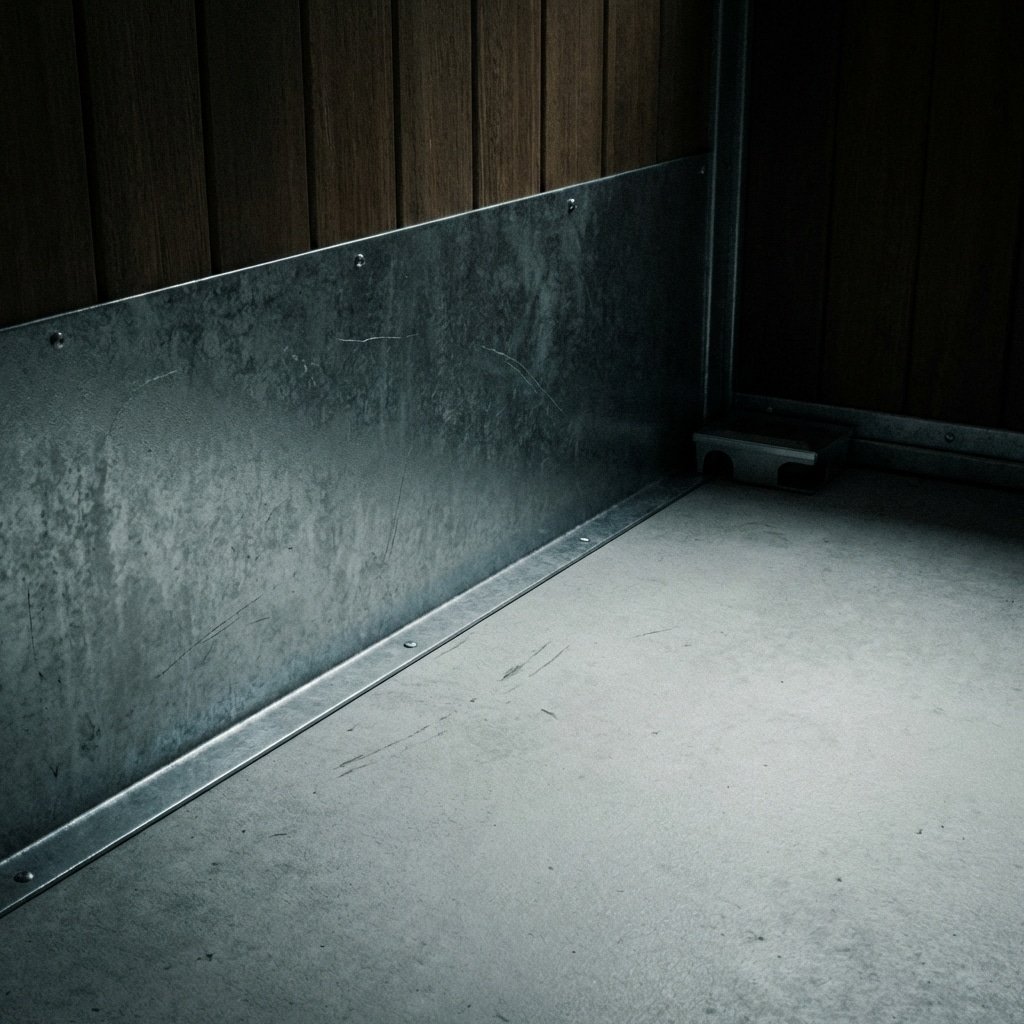
Why Wood Baseboards Are Easy Targets
Softwood acts as a biological sponge in damp stables, softening fibers that allow rodents to easily file their teeth and breach your facility’s perimeter.
Soft Timber Density vs. Rodent Dentition
Rodents do not gnaw on structures solely to gain entry; they do it to survive. Rats and mice possess incisors that grow continuously throughout their lives, requiring constant filing to prevent overgrowth. Standard softwoods—often used in skirting to cut costs—offer a mechanical mismatch against rodent enamel. The wood fibers lack the density to resist gnawing, turning your baseboards into a convenient tool for their dental maintenance.
The geometry of traditional lumber also works against you. Square wooden edges provide ideal leverage points for a rat to latch onto and strip away the initial layers. Once they breach the surface, the softer inner grain offers almost no resistance, allowing them to carve out entry holes in a matter of hours.
Moisture Absorption and Structural Decay
Stables are inherently wet environments. Baseboards sit at floor level, directly in the “splash zone” of daily wash-downs, spilled water buckets, and urine. Unlike galvanized steel or HDPE, wood is porous. It acts as a wick, drawing moisture deep into its core. Over time, this constant saturation triggers soft rot, breaking down the cellulose that gives the board its strength.
This decay process creates a self-reinforcing cycle of vulnerability. As the wood softens, it becomes significantly easier for pests to penetrate. Simultaneously, the rotting timber often warps or shrinks, pulling away from the wall structure. These resulting gaps serve as inviting, pre-made entryways for pests looking to nest within the stall walls.
Premium Galvanized Horse Stables Built To Last


The 14-Gauge Steel Defense Barrier
14-gauge Q235B steel (2.0mm) denies rodents the jaw leverage needed to gnaw, creating an impenetrable physical shield that thinner metals cannot match.
| Spezifikation | DB Stabiler Standard | Rodent Defense Function |
|---|---|---|
| Steel Grade | Q235B (ASTM A36 Equiv) | Hardness exceeds rodent tooth enamel |
| Wanddicke | 14-Gauge (2.0mm – 2.5mm) | Exceeds jaw leverage threshold |
| Coating | Hot-Dip Galv (>70 microns) | Prevents rust-induced soft spots |
Why Rodents Cannot Breach 2.0mm Steel
Rats are destructive, but they operate within specific physical limitations. To chew through a material, they require an edge or a soft surface to anchor their top incisors while the bottom teeth saw upwards. We utilize 14-Gauge-Stahl because it creates a surface geometry they cannot bite. A smooth 50mm steel profile offers zero purchase for their teeth.
Thickness is the primary deterrent. At 2.0mm to 2.5mm thick, the steel exceeds the maximum jaw gape leverage of common stable pests. They simply cannot open their mouths wide enough to apply the necessary puncture force on a flat plane. Coupled with this, standard Q235B steel is physically harder than the enamel of a rat’s teeth. Attempting to gnaw on this material results in tooth damage for the pest, not structural damage for the stable.
The Q235B Galvanized Framework Advantage
Many manufacturers reduce costs by using pre-galvanized, thin-walled tubing (often 1.5mm or less), which flexes under pressure and rusts at the weld points. We strictly adhere to the DB Stable Product Bible standards to ensure the framework acts as a permanent exclusion zone.
- Structural Standard: We use Q235B Structural Steel (ASTM A36 equivalent) for all 50mm x 50mm RHS base profiles, ensuring rigidity.
- Corrosion Defense: Our “Hot-Dip After Fabrication” process applies a zinc coating of >70 microns. This prevents rust, which rodents invariably target as a weak entry point.
- Unified Construction: Fully welded joints mean there are no loose gaps or bolted seams for pests to exploit.

Pairing Steel Bases with Inedible HDPE Panels
Steel bases isolate the ground-level “chew zone,” while 28mm HDPE panels replace rotting wood. This combination removes edible materials and eliminates the scents that attract rodents.
The Mechanics of a Dual-Material Barrier
Rodents invariably target the seam where the stable wall meets the concrete foundation. In traditional timber builds, this area absorbs moisture, softens, and emits the scent of rot—a primary attractant for nesting pests. By replacing this bottom junction with steel and synthetic infills, we mechanically block the only viable entry point for burrowing animals.
- Steel Base Sealing: The galvanized steel frame sits directly on the concrete, sealing the vulnerable seam. This blocks the primary zone where rats attempt to gnaw or burrow under the wall.
- Scent Elimination: Unlike timber, synthetic panels do not absorb urine or water. This eliminates the biological odors of rotting wood that signal “shelter” to rodents.
- Traction Denial: The smooth surface of non-wood panels denies rodents the traction required to climb vertical surfaces or initiate chewing.
Specifying 28mm HDPE for Maximum Resistance
Thin plastics and untreated metals fail quickly under gnawing pressure. We engineer our “Kick-Proof” and rodent-resistant systems using industrial-grade specifications derived from our internal product standards. The density and hardness of the materials are non-negotiable for long-term exclusion.
- High-Density Infill: We utilize 28mm-32mm HDPE. This gauge is too dense for rodents to digest or effectively gnaw, providing a permanent physical barrier.
- Zero Maintenance Composition: Our UV-stabilized formula ensures the material does not degrade or soften over time, maintaining its hardness even in high-ammonia environments.
- Edge Locking Standards: We integrate Hot-Dip Galvanized steel channels (conforming to BS EN ISO 1461) to lock the HDPE edges securely. This leaves no exposed gaps or edges for pests to exploit.
Abschließende Überlegungen
Relying on treated timber for stable bases guarantees a cycle of constant repair and injury liability. Upgrading to our Q235B hot-dip galvanized framework paired with 28mm HDPE creates a permanent, zero-maintenance defense that rodents cannot breach. Position your inventory as the definitive solution to pest damage to protect both your clients’ horses and your dealership’s reputation.
Stop guessing on durability and verify our 14-gauge wall thickness und >70 micron zinc coating firsthand. Request a material sample kit today to test the impact resistance and finish quality against your current suppliers. Contact our engineering team to discuss OEM specifications for your next facility project or bulk distribution order.



 German
  English
  Spanish
  French
  Arabic
0 Kommentare