


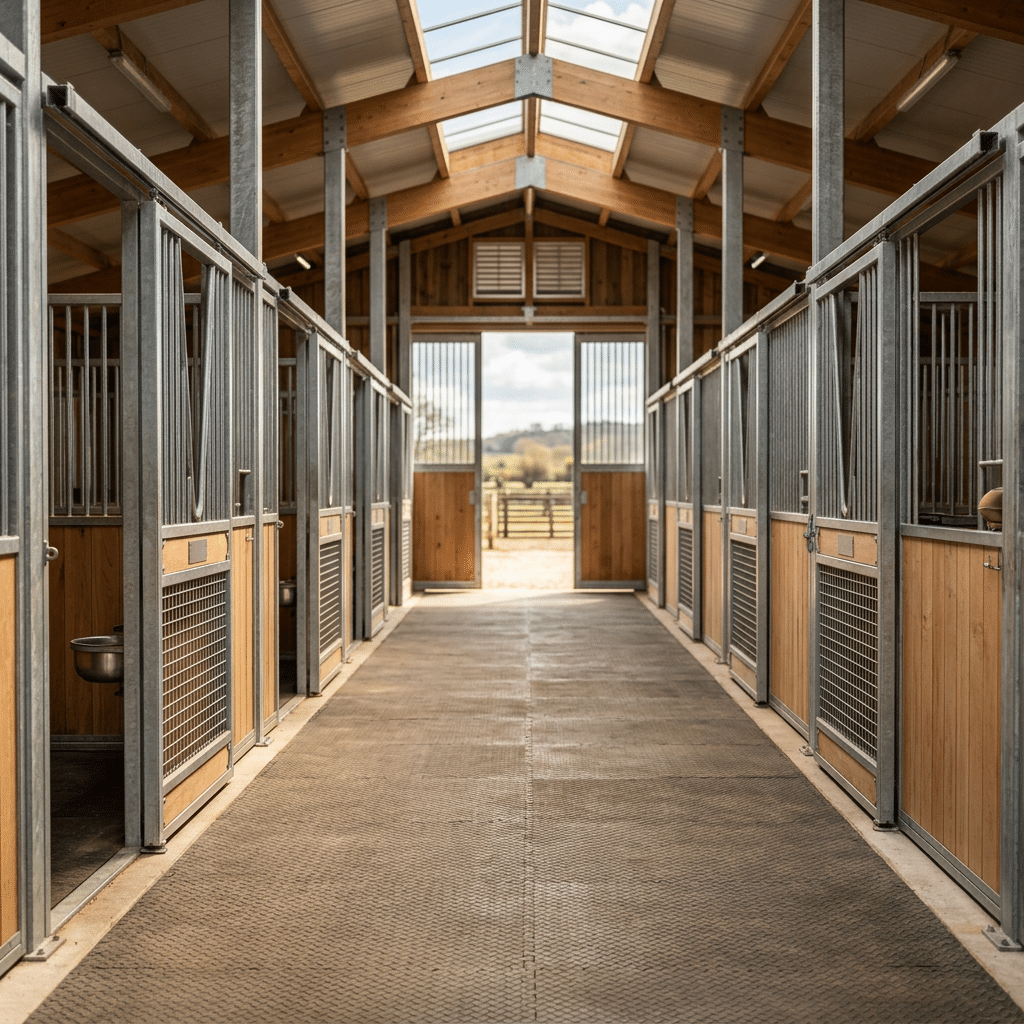
Deploying portable horse stables in Australia without specific UV engineering guarantees structural failure within two summers. While local timber options seem cost-effective initially, the inevitable warping and termite damage destroy profit margins through rapid replacement cycles and safety liability claims.
This report benchmarks UV-stabilized HDPE infills against traditional softwood to calculate total cost of ownership. We analyze the long-term performance of 28mm impact-absorbing profiles and ISO 1461 hot-dip galvanized steel frames to help you secure a zero-maintenance infrastructure solution.
The Harsh Australian Climate: Wood Splitting and Termites
Australian heat dries out softwood, causing structural splits that invite termites. We engineer against this failure with High-Density Bamboo that exceeds 3,000 lbf hardness.
Why Native Timber Warps and Splits
Standard timber fails in Australia because the environment is actively hostile to organic fiber. When ambient temperatures hit 40°C, retained moisture in softwoods evaporates rapidly. This aggressive drying process causes the wood fibers to shrink unevenly, leading to “checking”—deep longitudinal cracks that run along the grain. In a stable environment, this is a nuisance; in a horse stall, it creates sharp edges capable of lacerating a horse’s hide.
The structural consequences go beyond surface damage. As pine and untreated timber shrink, the tongue-and-groove connections loosen. This creates hazardous gaps between boards where a hoof can get caught during a cast or kick. More critically, these fissures expose the untreated heartwood to the environment, bypassing any surface chemical treatments applied at the sawmill.
These physical openings act as a highway for Australia’s aggressive termite colonies. Once the outer seal of a timber board is breached by heat-induced splitting, termites access the softer core, hollowing out the infill from the inside. You often won’t see the damage until a 500kg horse leans against the wall and the partition collapses.
The Strand Woven Bamboo Solution
We do not rely on passive chemical treatments to stop insects or warping. We rely on density. DB Stable utilizes High-Density Strand Woven Bamboo, a material engineered to eliminate the grain weaknesses found in natural timber. By compressing bamboo fibers under extreme pressure with resin, we create a board that effectively functions like a composite rather than a piece of wood.
- Janka Hardness > 3000 lbf: Our bamboo is significantly denser than traditional hardwoods. For context, this is roughly 3x harder than Oak.
- Termite Resistance: The material is too dense for termites to bore into, and the resin bonding process removes the cellulose food source they seek.
- Hydrophobic Stability: Unlike pine, strand woven bamboo resists the rapid moisture uptake and loss that causes warping. It handles coastal humidity without rotting and survives dry heat without splintering.
This engineering ensures that the partition wall installed today retains its structural integrity five years from now, regardless of the UV index or termite activity in the region.
What is HDPE? The Ultimate Horse Stall Material
HDPE is a non-toxic, kick-proof polymer that eliminates maintenance costs. It flexes under impact, repels bacteria, and withstands harsh Australian UV conditions without splintering.
| HDPE (DB Standard) | Traditionelles Holz | |
|---|---|---|
| Impact Reaction | Absorbs shock & flexes | Splinters or shatters |
| Hygiene | Non-porous (Bacteria proof) | Absorbs urine & odors |
| Wartung | Zero (Wash down only) | High (Sand, stain, seal) |
| UV Stability | UV8 Stabilized Additives | Fades, cracks, warps |
Engineering Safety: Impact Absorption and Hygiene
High-Density Polyethylene (HDPE) fundamentally changes how we approach stable safety. Unlike wood, which relies on rigidity, HDPE is engineered with specific tensile properties that allow it to absorb kinetic energy. When a horse kicks a stall wall, the material flexes momentarily to dissipate the force rather than shattering. This “Kick-Proof” mechanics eliminates the risk of jagged splinters or broken boards causing catastrophic leg injuries.
Beyond physical safety, HDPE solves the biosecurity issues inherent in timber. Wood is naturally porous; it acts as a sponge for urine, moisture, and bacteria, creating a breeding ground for ammonia and mold deep within the grain. HDPE provides a completely sealed, non-porous surface. It is impervious to acids and biological fluids, meaning facility managers can sanitize an entire row of stables with a pressure washer without risking rot or structural degradation.
The DB Standard: 28mm-32mm UV-Stabilized Profiles
Many competitors cut costs by using thin 15mm plastic sheets that warp in the heat. We strictly adhere to a heavy-duty manufacturing standard designed for commercial longevity. Our infill profiles are extruded at a thickness of 28mm to 32mm, providing the mass and structural density required to withstand repeated abuse in high-traffic equestrian centers.
For the Australian market, density alone is not enough. The intense UV radiation can make standard plastics brittle within months. We engineer our boards with specific UV-stabilization additives (UV8 rating) that prevent molecular breakdown under the sun. This ensures the material retains its flexibility and color without fading or cracking. This combination of thickness and chemical engineering allows us to offer a “Zero Maintenance” product—no painting, sealing, or treating is ever required.
Global Compliant Stables With 20-Year Durability

UV Resistance: Preventing Fading in 40°C Summers
Standard materials fail under Australia’s 40°C heat and UV load. We combat this with UV-stabilized HDPE infills, integrating protective additives directly into the resin for zero-maintenance durability.
The Combined Threat of UV Radiation and Thermal Expansion
Australia’s climate attacks stable materials on two fronts simultaneously: high UV radiation and extreme heat cycling. Most imported equine products fail here because they are designed for the milder climates of Europe or North America, not the 40°C+ days common in the Australian interior.
The damage mechanism is physical and chemical. UV radiation breaks down the chemical bonds in timber and untreated plastics, a process known as photo-oxidative degradation. In wood, this sucks out moisture, causing grey weathering and structural splitting. In cheap plastics, it manifests as “chalking,” where the surface turns to dust and the material becomes brittle enough to shatter under a horse’s kick.
Thermal shock compounds this issue. Rapid temperature shifts—swinging from a scorching afternoon to a cool night—force materials to expand and contract violently. Rigid materials like concrete or tightly fixed timber often crack under this stress. Without specific engineering allowances for this movement, infill panels warp, bow out of their frames, or snap loose entirely.

UV-Stabilized HDPE: The Zero-Maintenance Solution
To eliminate these failures, we utilize UV-stabilized High-Density Polyethylene (HDPE) for our infill panels. Unlike wood that requires annual oiling or painting to survive the sun, this material is engineered to perform without intervention.
- Integrated Protection: We do not spray UV protection on the surface. Stabilizers are compounded directly into the resin mix during manufacturing, ensuring the protection runs through the entire 28mm-32mm thickness of the board.
- Thermal Tolerances: We engineer our steel channels with specific expansion gaps. As the HDPE expands in the heat, the frame absorbs the movement without bowing or warping.
- Impact Retention: While untreated plastic becomes brittle in the sun, our stabilized HDPE retains its flexibility and shock absorption properties, maintaining our “Kick-Proof Guarantee” even after years of exposure.
This approach shifts the cost dynamic for stable owners. While the initial investment in UV-stabilized HDPE is higher than pine, the elimination of maintenance labor and replacement costs results in a lower total cost of ownership over the facility’s lifespan.
The Drop-Pin System for Portable Horse Stables
We replaced standard round pins with 40mm square hot-dip galvanized tubes reinforced by 6mm steel plates. This ensures the connection withstands heavy impact and never rusts shut.
Instant Assembly: How the Drop-Pin Mechanism Works
Most stable failures happen at the connection points. Traditional bolted systems require two people, power tools, and perfectly level ground to align. The drop-pin system eliminates these variables by using gravity as the primary locking force. You align the male and female brackets, drop the pin, and the panel locks instantly. There is no need for on-site welding or specialized labor.
- Zero-Tool Setup: Panels connect without drills, wrenches, or welders, reducing installation time by over 50%.
- Modular Expansion: Owners can
add, remove, or reconfigure stalls in minutes rather than days, adapting quickly to changing herd sizes.
- Terrain Tolerance: Gravity-based locking allows secure connections even on slightly uneven ground where rigid bolt holes would fail to align.
- Logistics Efficiency: This system supports our “Profit Protection” flat-pack model, allowing us to load 30-45 sets in a single 40HQ container compared to just 12-15 welded units.
Engineered for Safety: 40mm Reinforced Locking Pins
A drop-pin is only as good as its shear strength. Competitors often use thin, hollow round pipes that bend when a 600kg horse kicks the panel, permanently seizing the connection. We reject that approach. DB Stable engineers every pin as a structural component, not just a fastener.
- Superior Shear Strength: We use 40mm x 40mm square metal tubing, which offers significantly higher resistance to deformation than standard round pins.
- 6mm Steel Reinforcement: Critical stress points are reinforced with 6mm thick steel plates to prevent bending under heavy impact loads.
- Hot-Dip Galvanized Finish: Every pin is galvanized nach fabrication (ISO 1461), ensuring rust never seizes the pin inside the bracket.
- Interference-Free Tolerance: We design tight tolerances that keep the connection rigid but ensure horses cannot dislodge the pin with their lips or teeth.
Anchoring Free-Standing Stalls in the Outback
Securing 450kg steel frames in the Outback requires galvanized auger systems, not concrete, to counter shifting red dirt and high wind loads.
The Stability Challenge in Sandy and Compacted Soil
Standard anchoring methods often fail in the Australian Outback because the ground conditions are extreme and inconsistent. You rarely encounter the predictable soil density found in coastal regions. Instead, installers face loose sandy loam that offers zero friction for traditional hammer-in pegs, or “Red Dirt” clay that sets like concrete in the dry season and shifts aggressively during the wet season. A standard straight peg will either pull straight out of the sand under tension or bend uselessly when driven into rocky, compacted terrain.
This instability creates a significant risk for solid-wall structures. While our DB Stable frames are heavy—utilizing Q235B and Q345B structural steel—weight alone does not guarantee security against Australian wind loads. A solid HDPE or Bamboo infill wall acts as a sail during storm events. Without a subterranean mechanical lock, the entire structure can shift or tip. For hard-packed earth, attempting to drive anchors without preparation is a mistake; we require pre-drilling with masonry bits to ensure the anchor penetrates deep enough to hold without shearing off.
Deploying Auger-Style Anchors with the Steel Framework
To secure free-standing stables without a concrete slab, we utilize heavy-duty galvanized carbon steel screw-in pegs. Unlike smooth stakes, these auger-style anchors feature wide spiral flights that screw into the ground. As the anchor drives down, it compresses the soil above the flights, creating a cone of compacted earth. This generates a “double hold-down effect,” using the weight of the ground itself to lock the stable in place.
- Direct Base Integration: The auger anchor connects directly to the base plates of our 50mm x 50mm RHS posts, replacing the standard concrete expansion bolt.
- Mechanical Installation: We use high-torque impact drivers for rapid deployment, which allows for immediate load testing and easy removal if the stable needs to be relocated.
- Galvanization Synergy: The anchors must be hot-dip galvanized to match our ISO 1461 frame standards, ensuring the point of contact with the ground does not become a rust failure point.
Häufig gestellte Fragen
What features define the best portable horse stables for the Australian climate?
The Australian climate destroys cheap steel. The defining feature of a survivor is Feuerverzinkung nach der Herstellung (ISO 1461), not pre-galvanized “Duragal” which rusts at the welds. We strictly use Q235B or Q345B structural steel with a minimum 2.0mm wall thickness (avoiding the flimsy 1.6mm industry standard) to resist coastal salt spray. For infills, UV-stabilized HDPE is mandatory to prevent brittleness in the high UV index.
Will HDPE stable boards fade or crack in the sun?
Generic plastic will fail. But professional equestrian HDPE—like our 28mm-32mm profiles—is engineered with UV stabilizers specifically for this purpose. These additives block radiation that causes molecular breakdown. While you might see minor cosmetic lightening over a decade, the structural integrity and kick resistance remain intact even in 40°C heat.
Are HDPE panels effective against termites?
Yes, completely. Termites cannot digest or tunnel through high-density polyethylene. While timber stables (especially Pine) require constant chemical treatment to survive Australian pest pressure, HDPE offers a “Zero Maintenance” solution that is inherently immune to biological attacks, rot, and fungi.
How do you anchor a portable stable without a concrete slab?
If you are not pouring a slab, gravity alone is not enough. You must use heavy-duty screw-in ground anchors (augers) or duckbill earth anchors at every corner post. These bite deep into the soil to provide hold-down force against wind uplift. For temporary setups, ratchet tie-downs connected to deep stakes are a functional alternative, but augers provide superior security.
Pine vs. HDPE: Which is better for stable infills?
Pine offers a classic look and insulation but comes with a “maintenance debt”—it requires staining, rots, and horses chew it. HDPE is the superior commercial choice because it is strictly “Zero Maintenance,” sanitizes easily, and absorbs kick impacts without splintering. For longevity and hygiene, HDPE (or our high-density Bamboo option) outperforms softwood every time.
Abschließende Überlegungen
Selecting timber infills in the Australian climate guarantees future warranty claims from splitting and termite damage. Our ISO 1461 Hot-Dip Galvanized frames paired with UV-stabilized HDPE provide the only zero-maintenance solution capable of surviving 40°C heat without structural failure. Investing in this commercial-grade durability protects your brand reputation and eliminates costly replacement cycles for your clients.
Stop risking your supply chain on materials that fail in the Outback. Contact us today to request a sample of our 32mm “Kick-Proof” HDPE and validate the impact resistance yourself. Let’s configure a high-efficiency flat-pack container load that maximizes your logistics margins.

 German
  English
  Spanish
  French
  Arabic
0 Kommentare