


Sourcing modular horse stalls for the USA market requires navigating a landscape cluttered with under-spec lightweight tubing. While economy 18-gauge kits offer attractive retail price points, they represent a significant liability risk for facility owners and builders when a 1,200 lb animal strikes. Structural failure leads to expensive veterinary bills and immediate replacement costs that erase initial savings.
This analysis establishes why the 14-gauge (2.0mm) minimum is the non-negotiable safety baseline for professional equine projects. We examine the engineering behind Hot-Dip Galvanization After Fabrication (ISO 1461) and detail how flat-pack logistics allow distributors to optimize landed costs by fitting 30-45 sets per container.
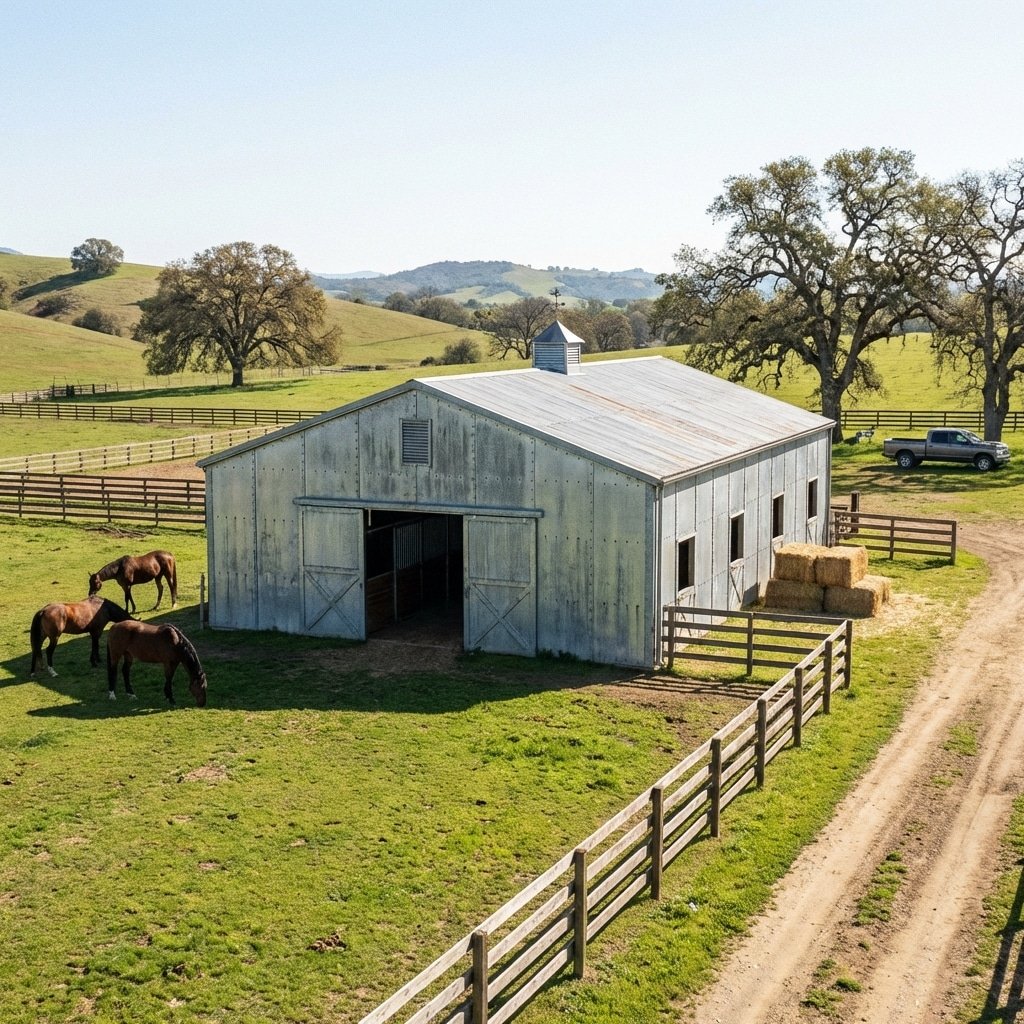
The American Standard: 12×12 Horse Stall Kits
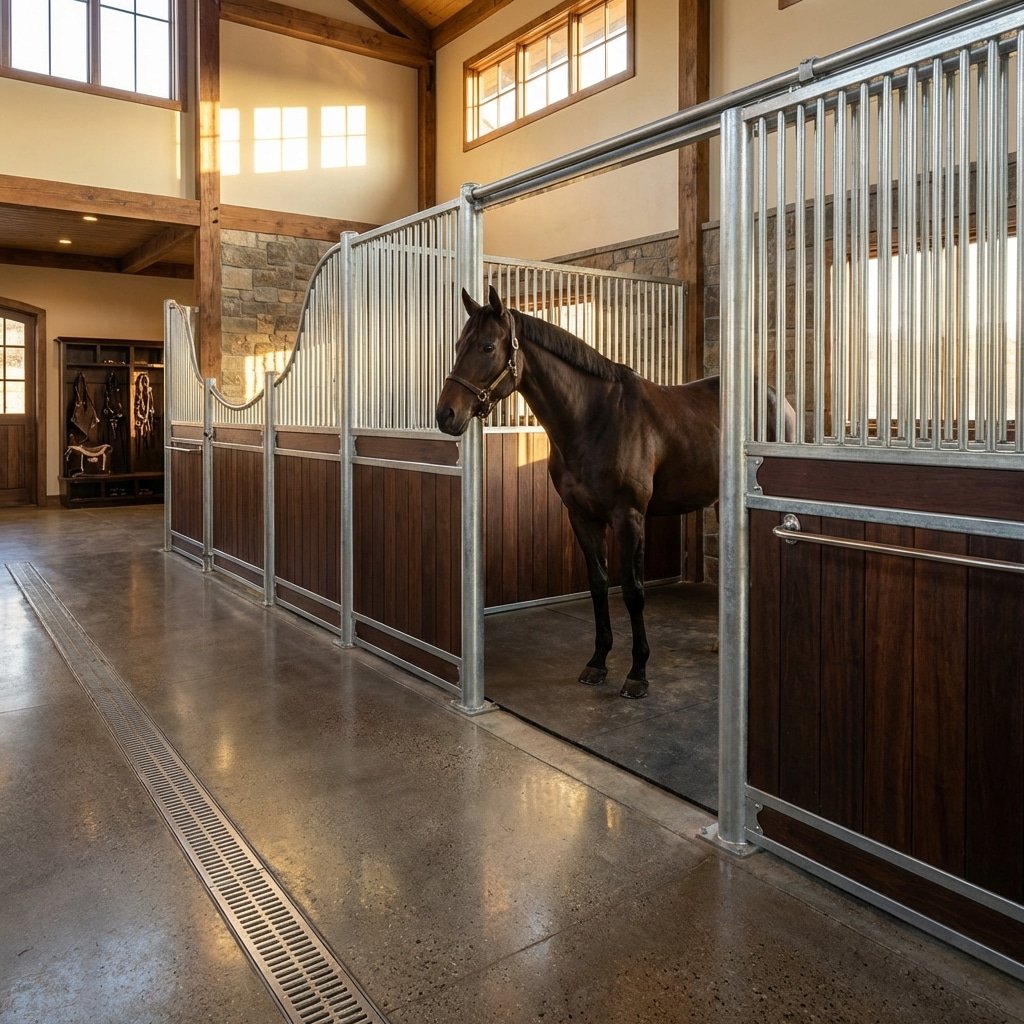
The 12ft x 12ft footprint is the North American baseline for property value and operational efficiency. Our kits optimize this standard with modular, bolt-together assembly for high-volume projects.
Why 12′ x 12′ Remains the Industry Benchmark
In the US market, 12′ x 12′ is not just a suggestion; it is the operational baseline. This dimension strikes the critical balance between animal welfare and construction economics. It provides sufficient square footage for larger breeds, such as Warmbloods, to lie down and turn safely without becoming “cast” against a wall. For facility owners, this size maximizes the number of units per aisle while maintaining the “standard” label required for high resale value.
Building smaller (e.g., 10′ x 10′) often alienates professional buyers and limits the facility’s marketability to pony or hobby farms. Conversely, building larger (e.g., 14′ x 14′) without specific veterinary or breeding requirements burns expensive square footage that rarely generates a proportional Return on Investment (ROI) for boarding or training operations.
Inside the Crate: Components of the DB Installation Kit
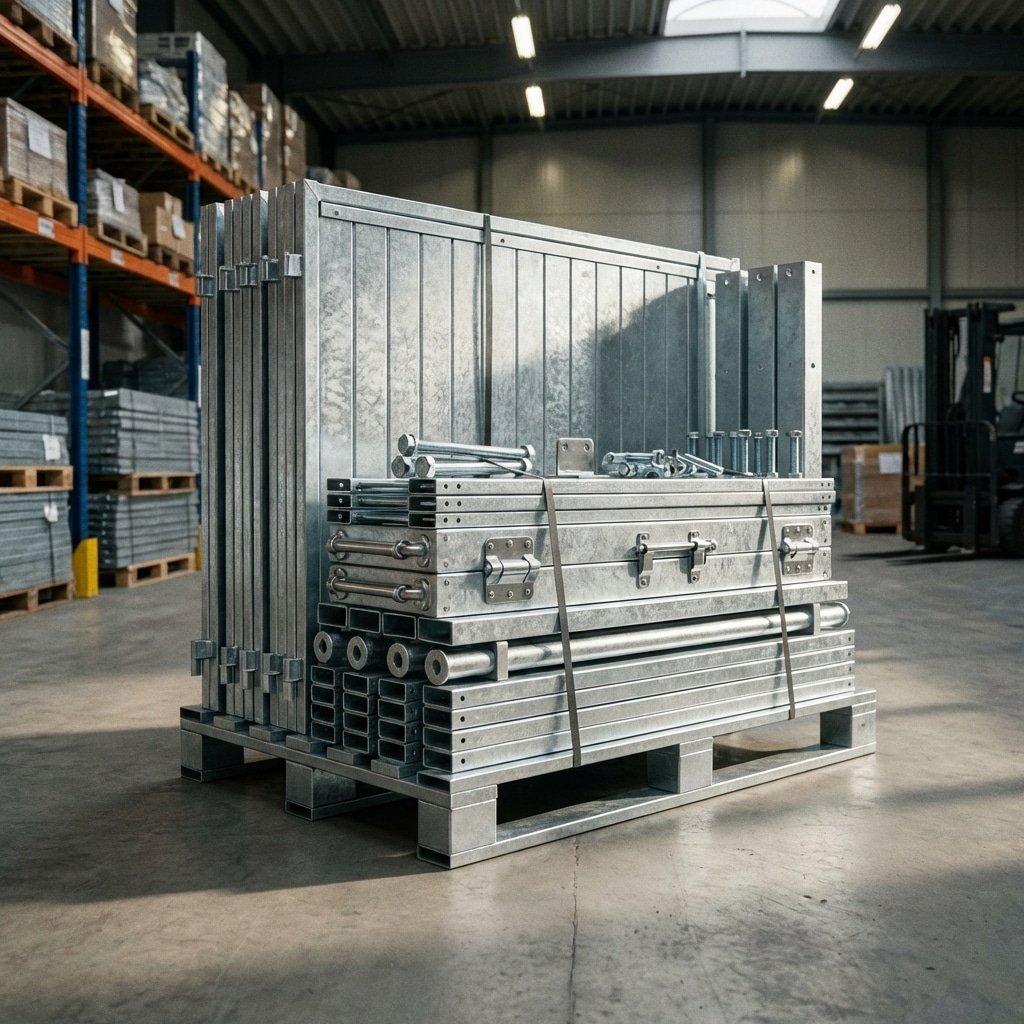
We do not ship loose steel. We ship complete systems designed to protect the distributor’s logistics margins and the contractor’s installation timeline. Every DB Stable 12×12 kit represents a modular unit, hot-dip galvanized after fabrication (ISO 1461) to ensure zero rust points at the weld seams. Here is the breakdown of the physical deliverables:
- Core Structure: 1x Stable Front Panel (choice of Sliding or Hinged) and 1x Side Partition Panel, engineered to exact 12ft specifications.
- Infill Materials: Pre-cut planks based on the series selected—High-Density Bamboo for the “Professional Series” or UV-Stabilized HDPE for the “Economy Series.”
- Assembly Hardware: A full kit of 304 Edelstahl anchor bolts and connectors. We use 304 grade exclusively to prevent the cosmetic “rust bleed” common with standard carbon steel fasteners.
- Maintenance Pack: Includes cold galvanizing spray for immediate touch-ups if the installer scratches the finish during the bolt-down process.
- Logistics System: All components are packed on our Steel Pallet Flat-Pack system. This allows for safe forklift unloading and enables us to fit 30-45 sets in a single 40HQ container, significantly lowering landed costs.

Unmasking “Heavy Duty”: The 14-Gauge Minimum
True safety requires a minimum 14-gauge (2.0mm) floor. Anything thinner is a liability disguised as “heavy duty” marketing.
| Spezifikation | Economy “Heavy Duty” | DB Stabiler Standard |
|---|---|---|
| Steel Gauge | 18-Gauge (approx. 1.2mm) | 14-Gauge (Min. 2.0mm) |
| Material Grade | Generic Commercial Tubing | Q235B / Q345B Structural Steel |
| Impact Risk | High (Denting/Buckling) | Kick-Proof Guarantee |
The Safety Threshold: Why Thinner Metals Bend
In the steel industry, the gauge system works in reverse: the higher the number, the weaker the material. Many economy stall kits market themselves as “heavy duty” while using 18-gauge (approx. 1.2mm) tubing. This thickness might suffice for a garden gate, but it fails catastrophically under the specific point-load impact of a horse’s kick. When a 1,200 lb animal strikes a thin profile, the metal doesn’t just dent—it buckles, creating sharp edges or structural collapse.
- The 14-Gauge Floor: We strictly adhere to a 14-gauge (approx. 2.0mm) minimum. This provides the necessary mass to absorb impact energy without deformation.
- Point-Load Resistance: Thicker walls prevent the tube from crimping effectively acting as a crumple zone that refuses to crumple.
- Structural Mass: Integrity relies on weight per foot. Heavier steel prevents frame distortion over years of daily abuse.
Material Grade Matters: The Q235B & Q345B Advantage
Thickness is only half the equation; chemical composition dictates performance. Generic tubing often lacks certified tensile strength specifications. We manufacture exclusively with structural grade steel to ensure consistency and safety. This material choice is not about aesthetics; it is about preventing brittle fractures and ensuring the stall remains standing after a direct hit.
- Standard Structural Steel (Q235B): We use Q235B, the equivalent of ASTM A36. This provides superior tensile strength compared to non-graded commercial tubing found in budget kits.
- Cold Climate Specialist (Q345B): For regions with freezing temperatures, we offer Q345B Low Alloy High Strength Steel (ASTM Grade 50 equivalent). This grade maintains impact toughness in sub-zero conditions, preventing the steel from shattering like glass when kicked in winter.
- Zero Tolerance Policy: Our manufacturing process strictly prohibits tubing thinner than 2.0mm, a protocol that directly supports our “Kick-Proof Guarantee.”
Precision-Engineered Stables with 20-Year Rust Resistance
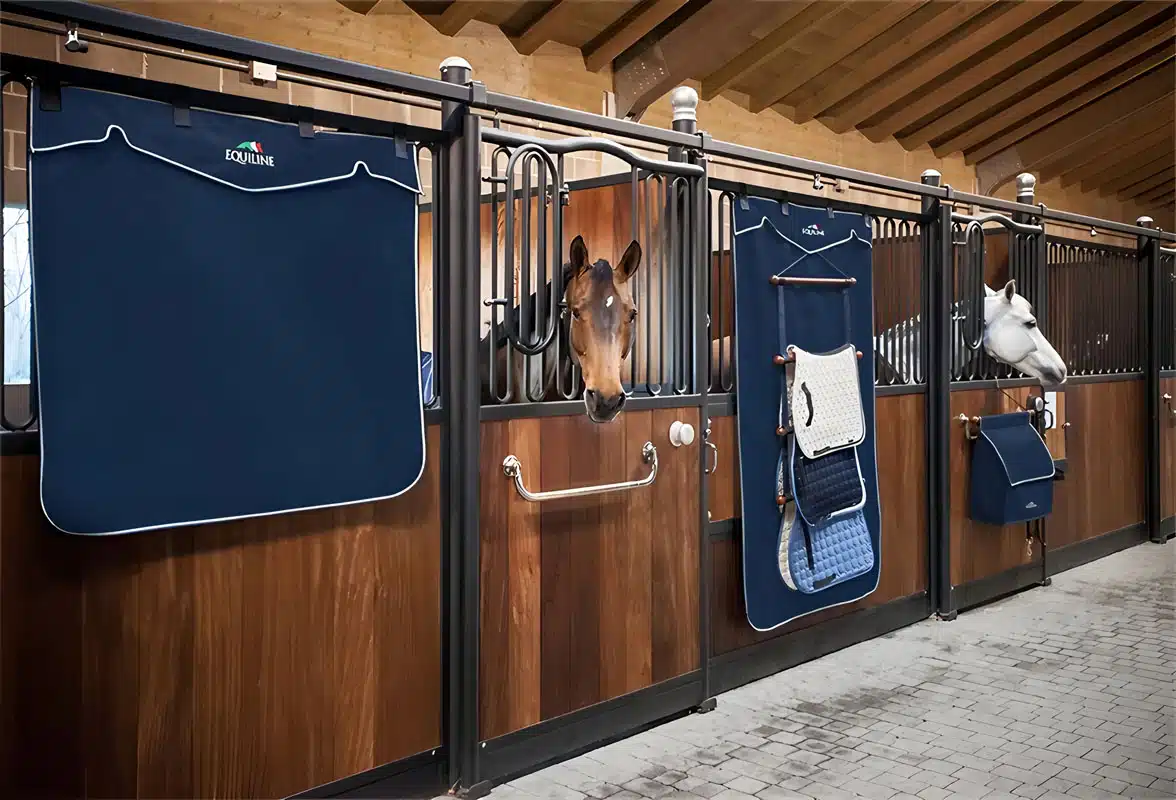
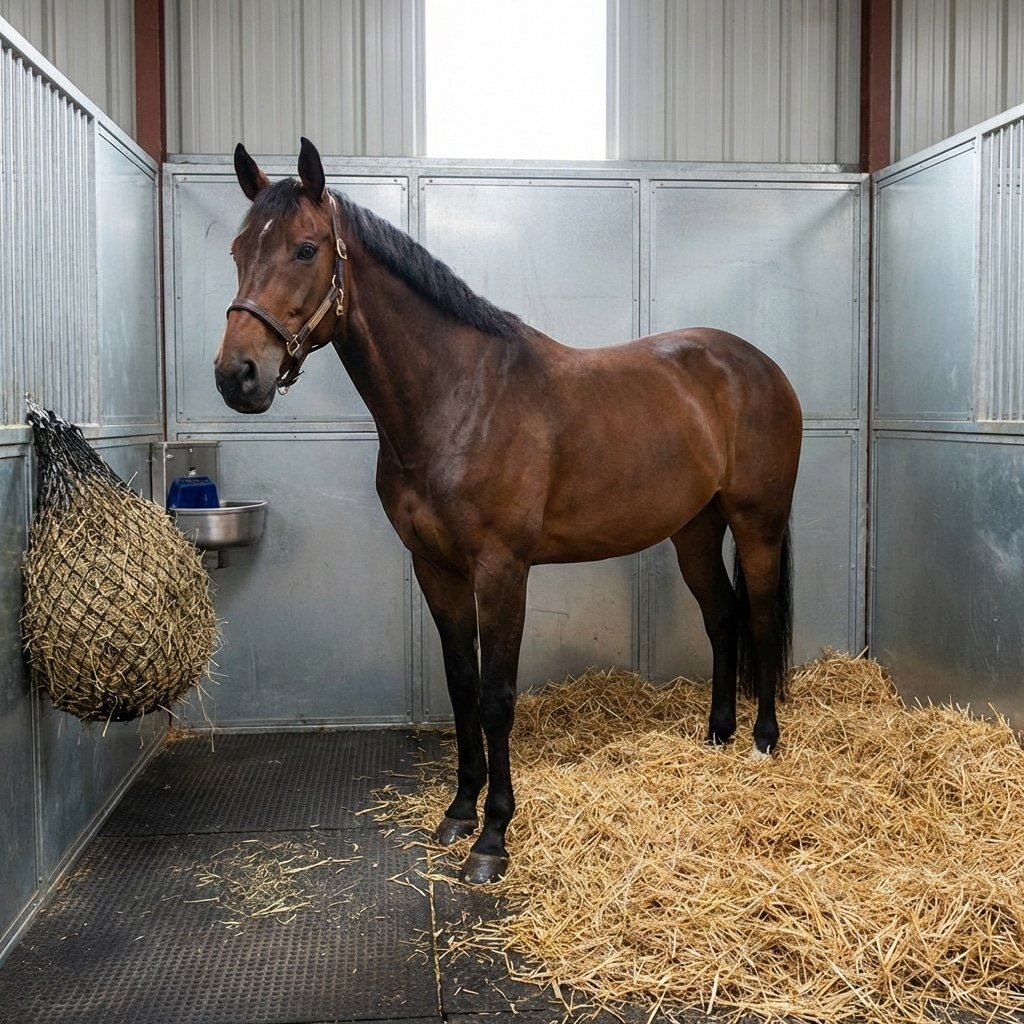
Bolt-Together Modularity: No Welder Required
Bolt-together systems reduce assembly time by 40-60% and eliminate costly “hot work” permits. This approach preserves the galvanized coating integrity that on-site welding inevitably destroys.
Eliminating Hot Work: Labor Savings and Site Safety
The industrial standard has shifted away from on-site fabrication. Bringing a welder into a finished stable environment introduces unnecessary liability and cost. Traditional fabrication requires specialized labor and strict “hot work” permits, which drive up project overhead and complicate scheduling.
Modular bolt-together systems solve these logistical bottlenecks. By utilizing pre-engineered connections, installation crews reduce assembly time by 40-60% compared to welding-intensive builds. This speed allows for faster project turnover and reduced labor hours per stall.
- Zero Fire Hazard: Eliminating open flames removes the risk of fire in environments often filled with flammable bedding or dust.
- Surface Protection: Welding generates spatter and heat that damages pre-finished surfaces. Bolting ensures the factory finish remains pristine.
- Simplified Labor: Installation requires basic tooling (impact drivers, wrenches) rather than certified welders, widening the pool of available contractors.
The 304 Stainless Steel Hardware Standard
A modular system is only as strong as its weakest connection. Using standard zinc-plated hardware on a premium stable is a failure point waiting to happen. DB Stable mandates a 304 Stainless Steel hardware kit for all connections, including anchor bolts and structural connectors.
This specification addresses two critical engineering challenges:
- Galvanic Corrosion Prevention: Mixing dissimilar metals in a damp stable environment accelerates rust. 304 Stainless Steel provides superior compatibility and longevity compared to carbon steel fasteners.
- Coating Preservation: Our steel frames undergo Hot-Dip Galvanization according to BS EN ISO 1461. On-site welding burns this protective zinc layer off, leaving the steel exposed to immediate rust. Bolting keeps the “sealed envelope” of the galvanization intact.
Sliding vs Hinged Horse Stall Doors for US Aisles
Executive Summary: Schiebetüren maximize safety and space in active commercial barns, while hinged doors offer a premium European aesthetic but demand 12-foot+ aisles and perfectly level concrete.
Aisle Clearance and Traffic Flow Considerations
The decision between sliding and hinged doors usually comes down to simple math regarding your aisle width. In a standard American working barn, efficiency dictates the design. A hinged door typically spans 48 inches. When you swing that open, you effectively kill four feet of aisle space. If you operate a standard 10-foot or 12-foot aisle, a single open door creates a bottleneck that stops tractors, wheelbarrows, and other horses from passing safely.
Sliding doors eliminate this obstruction entirely. They remain flush with the stall front, keeping the central artery of your barn clear regardless of whether stalls are open or closed. This makes them the default choice for boarding facilities, veterinary clinics, and busy training centers where multiple handlers move simultaneously.
- Obstruction Radius: Hinged doors create a 48-inch block, requiring handlers to fully retreat into the aisle to open them.
- Wind Hazards: Unlatched swinging doors become dangerous projectiles in drafty barns; sliding systems stay fixed on their track.
- Traffic Safety: Sliding doors prevent horses from lunging out into the aisle as the door opens, giving the handler better leverage and control.
Hardware Specs: Hidden Tracks vs. Stainless Hinges
Durability failures in stall doors almost always happen at the connection points. For sliding doors, the enemy is dust and debris clogging the rollers. Standard open-track systems allow dirt to accumulate, eventually causing the door to jump the track. To solve this, our Professional Series utilizes a Hidden Track System. This encapsulates the rollers within the steel header, protecting the mechanism from bedding dust and preventing derailment.
Hinged doors face a different challenge: sagging. A 4ft x 7ft steel-framed door filled with hardwood or HDPE is heavy. If the hinges are weak, gravity pulls the door out of square, causing the latch to misalign. We reject standard zinc-plated hinges for this application. Instead, we engineer our hinged systems with heavy-duty adjustable hinges to handle the torque.
- Material Standard: All latches, connectors, and hardware kits utilize 304 Edelstahl rather than standard galvanized steel to prevent seizing.
- Corrosion Protection: We apply Hot-Dip Galvanization After Fabrication (ISO 1461) to all steel frames, ensuring welds are sealed against ammonia exposure.
- Floor Leveling: Hinged doors require perfectly level floors; sliding doors are more forgiving of minor concrete imperfections.

Sourcing Direct: How B2B Ordering Saves Farm Builders Money
Buying direct removes retail markups and leverages high-density flat-pack shipping, fitting 3x more units per container to cut freight costs by over 60%.
Bypassing Retailers for Factory-Direct Pricing
The traditional supply chain bleeds profit at every handover. When you buy from a local dealer or retailer, you aren’t just paying for the steel; you are funding their showroom rent, sales commissions, and inventory holding costs. These layers often result in markups ranging from 30% to 50% above the landed cost.
Sourcing directly from an OEM manufacturer like DB Stable strips these costs away. We operate as a Source Factory, meaning our pricing reflects raw material and production labor, not marketing fluff. For farm builders and distributors, this “factory-gate” pricing model is the only way to protect margins on large projects. By committing to volume—specifically full container loads (20GP or 40HQ)—you access a pricing tier unavailable to the retail market.
The Logistics Edge: Flat-Pack vs. Welded Shipping
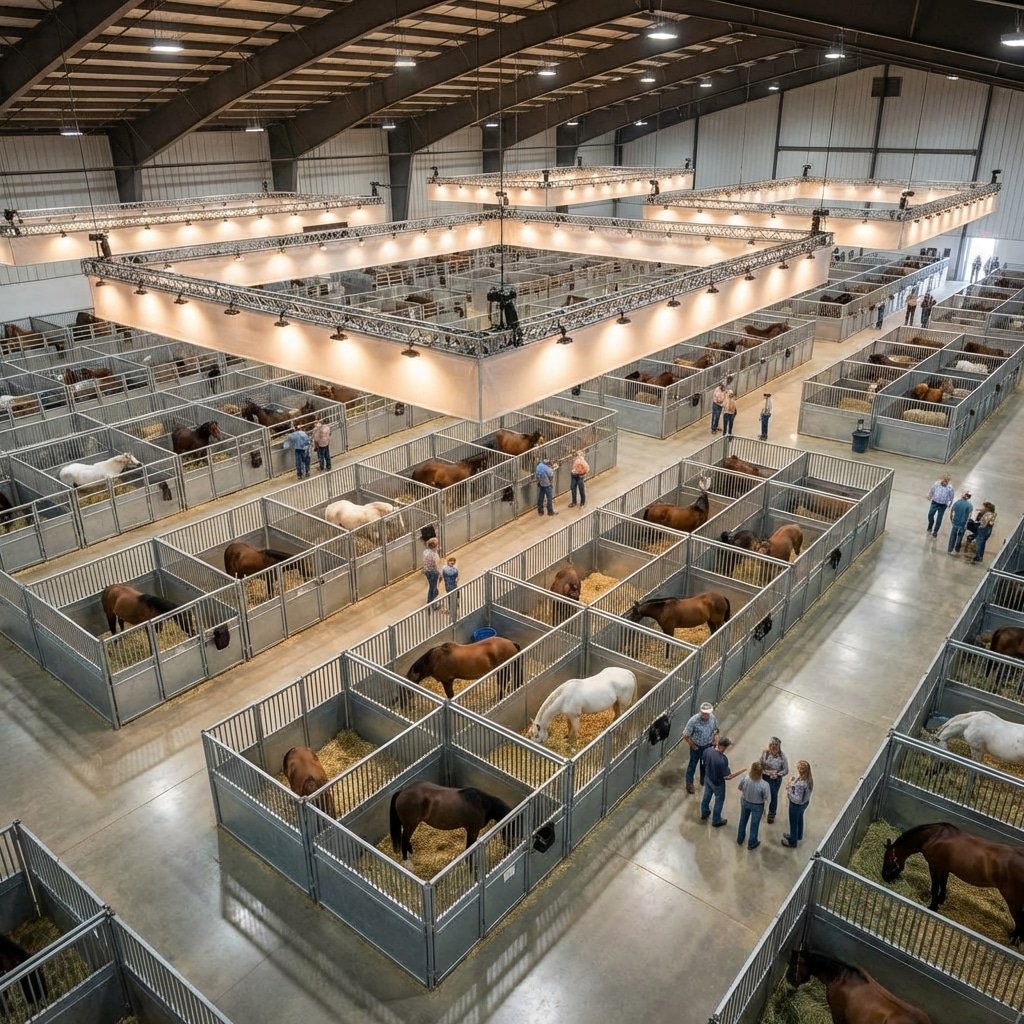
Freight is often the silent killer in heavy steel procurement. The geometry of your product dictates your shipping bill. Many domestic options rely on fully welded frames. While convenient for the end-user with one horse, they are a logistical nightmare for volume buyers because you are essentially shipping expensive air.
- Traditional Welded Stalls: Rigid structures limit loading capacity. A standard 40HQ container maximizes at just 12-15 sets.
- DB Stable Flat-Pack System: Our modular design stacks efficiently on steel pallets, allowing 30-45 sets in the same container.
- Cost Impact: This density reduces the freight cost per unit by over 60%.
This difference often exceeds the profit margin of the stalls themselves. By utilizing our flat-pack system, you optimize the landed cost per unit, giving you room to absorb local transport costs or undercut competitors who are still paying to ship empty space.
Häufig gestellte Fragen
What is the best steel gauge for safe horse stalls?
While 16-gauge steel is often pushed as an “industry standard” by budget retailers, it lacks the structural mass required for professional facilities. We strictly use 14-gauge (approx. 2.0mm – 2.5mm) structural steel as our baseline. Thinner materials (like 1.5mm tubing) suffer from metal fatigue and bending when subjected to the repeated impact of a 1,200 lb animal. For cold climates, we upgrade this further to Q345B Low Alloy High Strength steel to prevent brittle fractures during winter kicks.
Do I need a welder to install these stall kits?
No. Welding on-site creates fire hazards and destroys protective zinc coatings. Our system is engineered as a purely mechanical, bolt-together assembly. We provide 304 stainless steel hardware and pre-drilled connectors, allowing you to assemble the frames using standard hand tools (drills and wrenches). This modular approach also means damaged components can be swapped out individually without cutting or grinding.
Should I choose sliding or hinged stall doors?
This depends on your aisle width and traffic flow. Schiebetüren are the operational standard for busy commercial barns and narrow aisles because they don’t protrude into the walkway. Hinged doors offer a classic European aesthetic and an open aperture, but they require significant clearance to swing outward safely. If you choose hinged, ensure your aisle floors are perfectly level to prevent the door bottom from dragging.
What is the difference between Pre-Galvanized and Hot-Dip Galvanized After Fabrication?
This is the single biggest factor in product lifespan. “Pre-galvanized” means the manufacturer welded tubes that were already coated; the intense heat of welding burns the zinc off at the joints, leaving the most critical stress points prone to immediate rust. Hot-Dip After Fabrication (our standard, ISO 1461) involves welding raw black steel first, then dipping the entire frame into molten zinc. This seals every weld, crevice, and interior surface with over 70 microns of zinc, ensuring true lifetime rust protection.
Is HDPE or Bamboo better for stall infill?
It is a trade-off between maintenance and tradition. HDPE (High-Density Polyethylene) is the “zero maintenance” utility choice—it is waterproof, rot-proof, and absorbs kick impact without splintering. Bamboo is the premium structural option. It provides the warmth and look of traditional wood but is engineered to be three times harder than oak (Janka hardness > 3000 lbf), making it highly resistant to cribbing and wear.
Abschließende Überlegungen
Compromising on steel gauge creates liability risks that far outweigh any initial savings. DB Stable’s adherence to 14-gauge structural steel and ISO 1461 hot-dip galvanization ensures your facility withstands daily impact without buckling or rusting. Choosing professional-grade materials safeguards your reputation and eliminates the heavy cost of premature replacement.
Leverage our high-density flat-pack system to fit up to 45 sets per container and slash your freight costs by over 60%. We invite you to validate our “Kick-Proof Guarantee” by discussing your specific project layout with our engineers. Contact us today to secure factory-direct pricing and production availability.


 German
  English
  Spanish
  French
  Arabic
0 Kommentare