


Pressure washing frequently creates a conflict between biosecurity standards and asset preservation in equine facilities. While high-pressure sodium hypochlorite solutions eliminate respiratory pathogens, they simultaneously saturate wood fibers and strip weak zinc coatings from pre-galvanized steel. This sanitization process often accelerates rot and rust, forcing facility managers to replace stall fronts years before their expected service life ends.
We resolve this durability gap by engineering stables with UV Stabilized HDPE infill and ISO 1461 hot-dip galvanization specifically for wet environments. This technical review demonstrates how our post-fabrication dipping process achieves an 85-micron protective barrier that withstands aggressive chemical exposure. By utilizing non-porous 32mm HDPE planks, facility managers ensure their infrastructure remains structurally sound regardless of cleaning frequency.
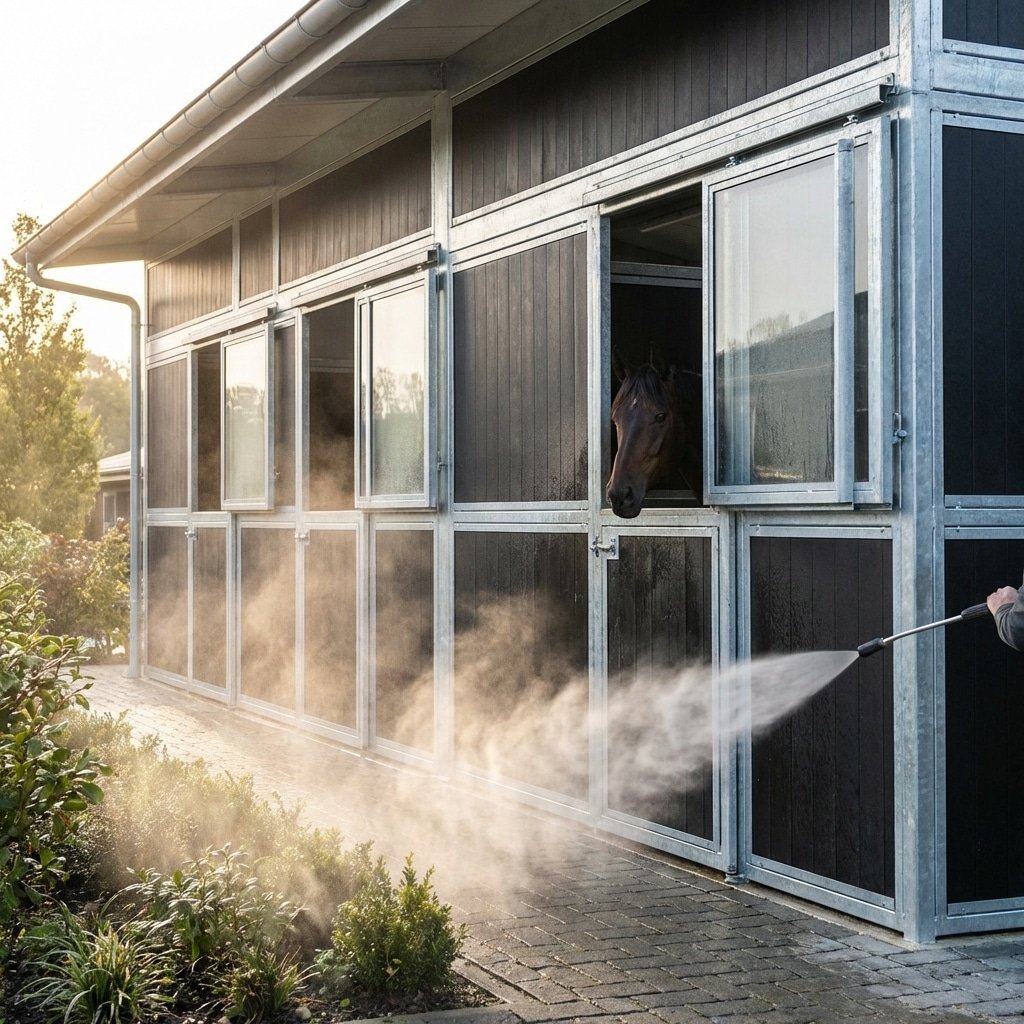
The Spring Deep Clean: Power Washers and Bleach
Spring deep cleaning eliminates respiratory risks. While bleach and pressure washers effectively disinfect, they destroy wood; DB Stable’s HDPE infill withstands aggressive sanitation without absorbing moisture.
Combating Mold and Allergens with Bleach Solutions
Spring weather acts as a catalyst for mold, mildew, and allergen growth within stable environments. These contaminants compromise equine respiratory health if left unchecked. To combat this, professional facility managers rely on a strict disinfection protocol. The industry standard involves a **1:10 bleach-to-water ratio**, which effectively kills bacteria and breaks down organic buildup on contact.
Manual scrubbing rarely penetrates deep enough to remove stubborn pollen and debris accumulated over winter. High-pressure washing is the only method capable of forcing these contaminants out of crevices. This aggressive approach ensures a sterilized environment but places significant stress on stable materials.
HDPE Infill: Waterproofing for Heavy Washdowns
Traditional wood stalls fail under this cleaning regimen. Bleach breaks down wood fibers chemically, while high-pressure water forces moisture into the grain, causing rot, warping, and dangerous splintering over time. This forces facility managers to choose between proper sanitation and preserving their equipment.
DB Stable resolves this with **UV Stabilized HDPE (High-Density Polyethylene)** infill. Unlike wood, our 28mm-32mm HDPE planks are completely non-porous. This material allows your clients to use aggressive bleach solutions and high-pressure washers frequently without risk of water absorption or degradation. The “Zero Maintenance” design ensures the stables remain structurally sound and visually pristine, regardless of how often they are deep cleaned.
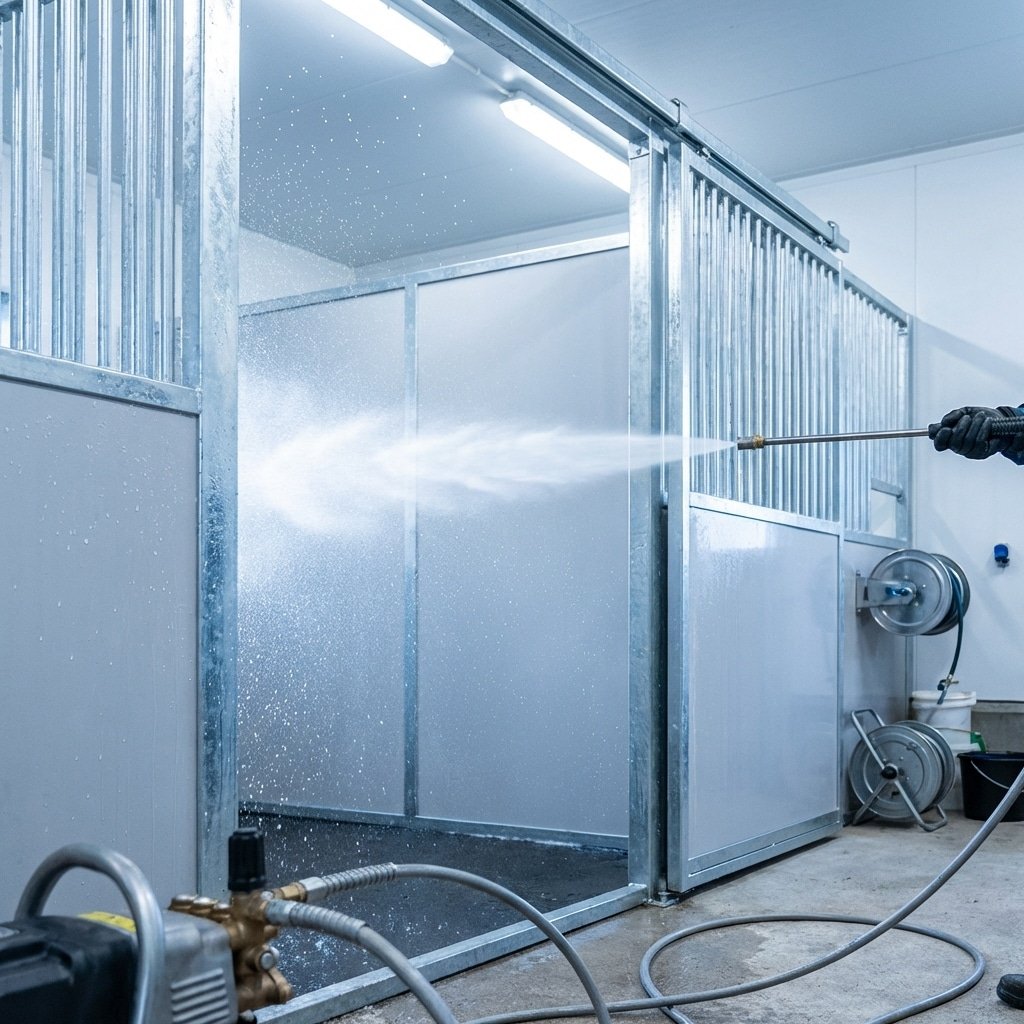
The Pre-Galvanized Scam: Why Welds Bleed Rust
Welding pre-galvanized tubing vaporizes the zinc coating instantly, leaving joints exposed to rust. True corrosion protection requires welding raw steel first, then hot-dipping the entire structure.
Zinc Vaporization: The Weak Link in Pre-Galvanized Welds
Many manufacturers cut costs by using “pre-galvanized” tubing—steel that was coated in zinc before it ever reached their factory floor. While the tube looks protected, the manufacturing process destroys that protection exactly where you need it most: the weld joints. This creates a fundamental metallurgical failure point that no amount of marketing can fix.
The physics are simple and unforgiving. Zinc boils at 1,665°F. Welding arcs generate temperatures exceeding 2,000°F. The moment the welder touches the pre-galvanized tube, the protective zinc layer instantly vaporizes. This leaves the “Heat Affected Zone” (HAZ) as bare, oxidized steel with zero protection against moisture or ammonia.
- The Hidden Damage: The welding process burns the zinc off both the outside and the inside of the tube, leaving internal surfaces completely exposed.
- The Cosmetic Cover-Up: Competitors hide these black burn marks with “Cold Galv” silver spray paint. This paint lacks a metallurgical bond and typically peels within 12 months.
- Rapid Failure: Without the zinc-iron alloy layers formed by hot-dipping, rust begins forming under the paint almost immediately after installation.
The DB Standard: Hot-Dip Galvanization After Fabrication
We eliminate this vulnerability by reversing the industry’s cheap workflow. At DB Stable, we do not weld galvanized materials. Instead, we fabricate every door, panel, and frame using raw Q235B (or Q345B for cold climates) black steel. The structure is welded while the steel is raw, ensuring the structural integrity of the joint is not compromised by zinc inclusions or gas pockets.
Once the fabrication is complete, we submerge the entire unit into a bath of molten zinc. This “Hot-Dip After Fabrication” process forces liquid zinc to flow over every weld, into every crevice, and through the interior of the tubing. The result is a seamless barrier that meets BS EN ISO 1461 standards.
- Structural Coating Thickness: We achieve an average coating exceeding 85 microns on structural parts (>6mm), significantly thicker than pre-galv films.
- Internal Protection: Molten zinc floods the inside of the tubing, protecting the steel from the “inside-out” rust caused by condensation and washing.
- Metallurgical Bond: The zinc fuses with the steel to form zinc-iron alloy layers, making the coating part of the metal rather than just a surface layer.
Global Compliant Stables With 20-Year Durability
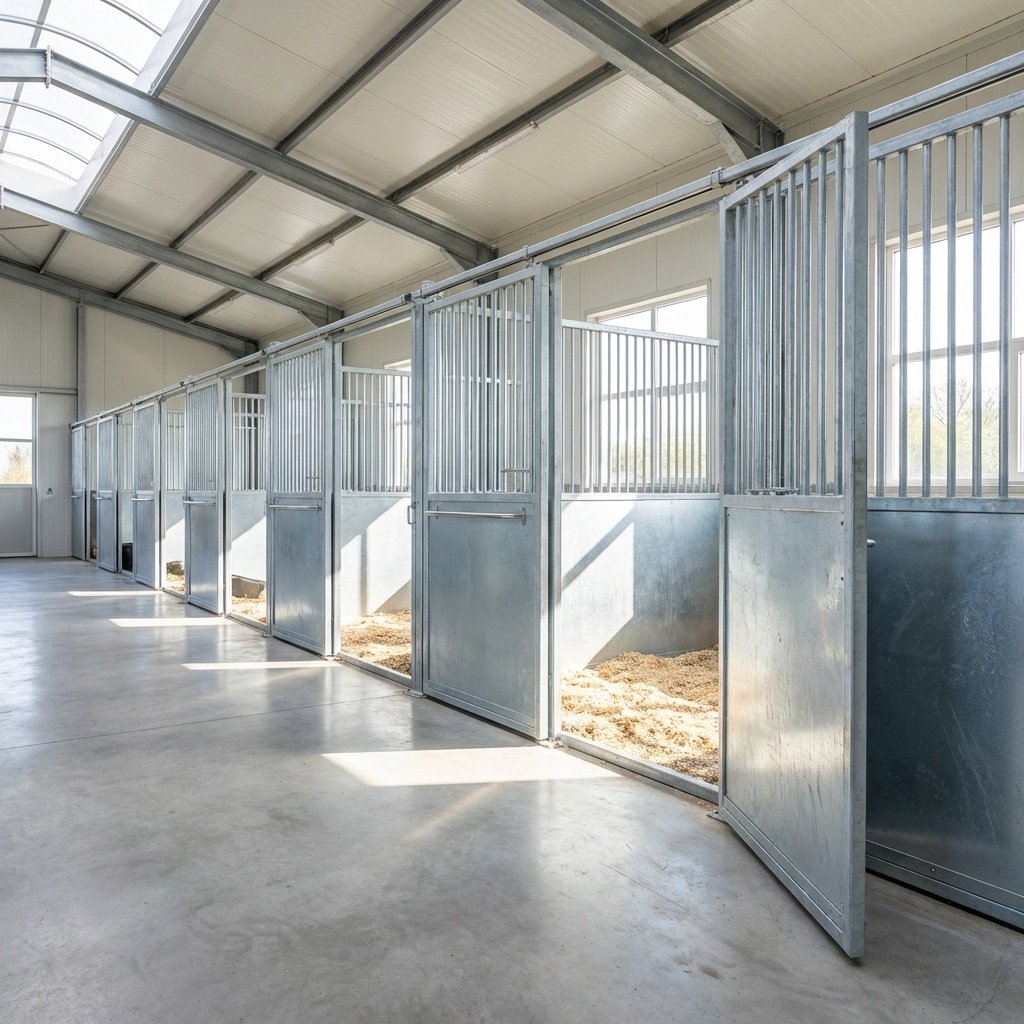
ISO 1461 Hot-Dip Galvanizing: Dipping After Fabrication
ISO 1461 mandates welding black steel first, then submerging it in 450°C zinc, creating a metallurgical bond that protects welds and internal surfaces far better than pre-galvanized alternatives.
| Merkmal | DB Stable (Post-Fabrication) | Standard Competitor (Pre-Galv) |
|---|---|---|
| Manufacturing Sequence | Weld Black Steel → Dip in Zinc | Buy Galv Tube → Weld → Paint |
| Weld Protection | 100% Zinc Alloy Coverage | Zinc Burned Off (Rust Risk) |
| Internal Surface | Fully Coated (Immersion) | Often Exposed/Unprotected |
| Coating Bond | Metallurgical (Iron-Zinc Alloy) | Mechanical (Surface Only) |
The Mechanics of Post-Fabrication Galvanizing
Most cheap stable manufacturers buy “pre-galvanized” tubing because it is cleaner to work with and cheaper to source. The problem arises during fabrication: welding generates heat exceeding 2,000°F, which instantly vaporizes the zinc coating (boiling point ~1,665°F) around the joint. This leaves the most critical structural points—the welds—completely exposed to rust. They try to hide this with cold zinc spray paint, but surface paint does not bond with the steel like hot zinc does.
We take a different approach. We fabricate the entire stable front and partition using raw “black” Q235B or Q345B steel first. Only after all welding, drilling, and cleaning is complete do we submerge the entire unit into a bath of molten zinc at 450°C.
- Total Immersion: Because the steel is dipped, the liquid zinc flows into every tubular profile, coating the inside just as thickly as the outside.
- Metallurgical Bonding: The heat causes a reaction between the steel and zinc, creating a hard iron-zinc alloy layer that is part of the metal itself, not just a surface coating.
- Self-Healing: Zinc provides cathodic protection. If the surface is scratched, the surrounding zinc sacrifices itself to protect the steel, preventing rust creep.
Zinc Coating Specifications: The >85 Micron Standard
In the stable industry, “galvanized” is often thrown around as a generic marketing term, but the thickness of that coating dictates the lifespan of the product. A thin layer of zinc will dissolve quickly in the ammonia-rich environment of a horse stable.
We strictly adhere to BS EN ISO 1461 standards, which sets minimum thickness requirements based on steel gauge. At DB Stable, our quality control ensures we exceed these minimums to guarantee longevity in wet, corrosive environments.
- Structural Parts (>6mm steel): We achieve an average coating thickness of >85 microns (μm).
- Tubing Components (3-6mm steel): We maintain an average coating of >70 microns (μm).
- Consistency: Random batch testing prevents “shadowing” or thin spots often found in automated line galvanizing.
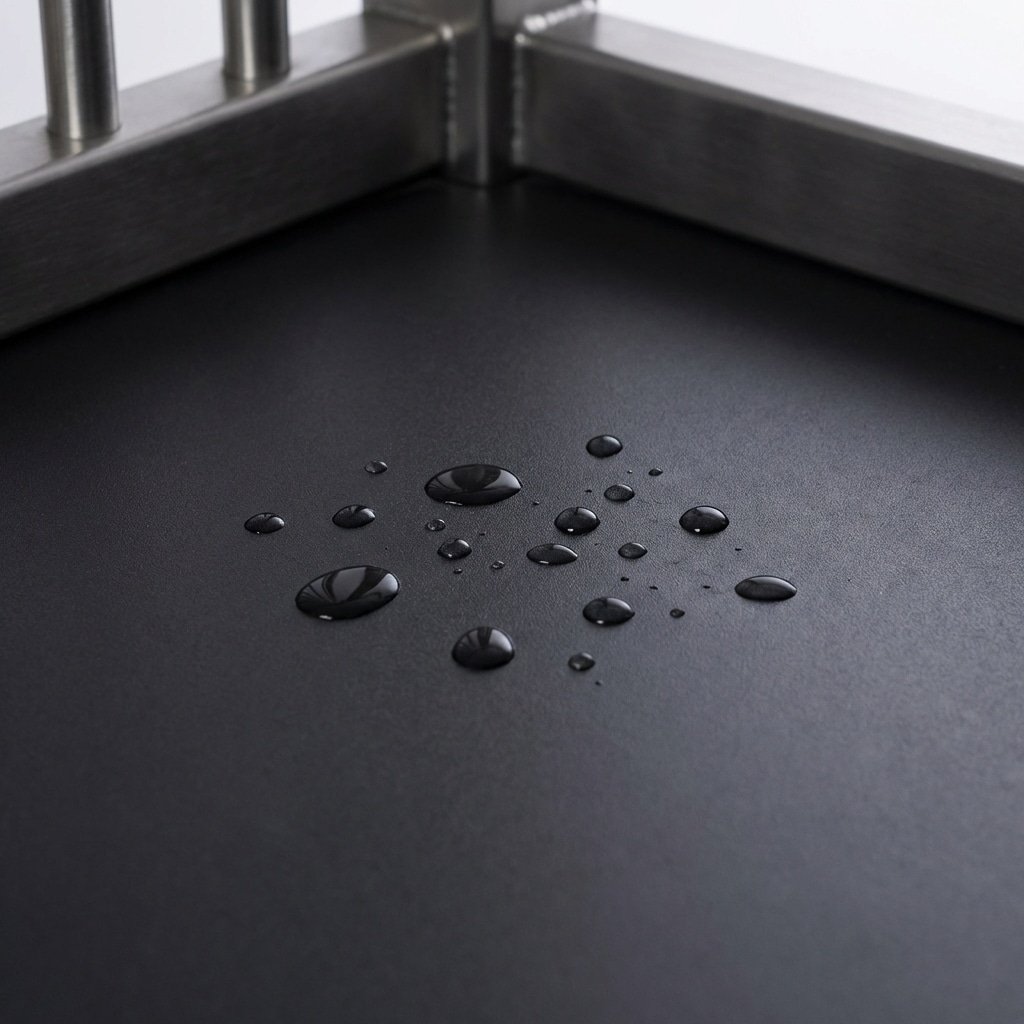
304 Stainless Hardware Resistance to Chlorine
304 stainless steel resists general corrosion but fails against bleach if chloride levels exceed 200 ppm. Immediate rinsing is non-negotiable to prevent pitting.
Chloride Thresholds and Pitting Corrosion
Stainless steel is “stainless” because of a microscopic passive chromium oxide layer that seals the metal against oxygen and moisture. Chlorine-based cleaners (bleach) act as a direct solvent to this protective layer. Once that layer is breached, the underlying steel is exposed, leading to rapid, localized corrosion known as pitting.
Research dictates specific chemical limits for 304-grade steel. You cannot treat it like plastic or hot-dip galvanized steel when using harsh chemicals:
- Safe Zone (< 200 ppm): At chloride concentrations below 200 parts per million, 304 stainless performs well long-term.
- Danger Zone (200-1000 ppm): Most diluted bleach cleaning solutions fall here. Performance is marginal and depends entirely on contact time.
- Failure Zone (> 1000 ppm): Direct application of concentrated bleach will cause immediate surface damage and eventual structural failure.
The biggest risk in a stable environment is evaporation. If you spray a 150 ppm bleach solution and let it air dry, the water evaporates, but the chlorides stay behind. This dramatically spikes the local concentration on the metal surface, often exceeding the 1000 ppm threshold and causing “tea staining” or deep pits within hours.
Protecting Your DB Stable Hardware Kit
We engineer our DB Stable installation kits—specifically the anchor bolts, connectors, and assembly screws—using 304 Edelstahl. We select this grade because it offers the optimal balance of tensile strength and resistance to atmospheric humidity, urine, and manure. However, it is not immune to chemical negligence.
To maintain the structural integrity and aesthetic of your hardware while maintaining hygiene standards, you must adjust your cleaning protocols:
- Rinse Immediately: If you sanitize walls with bleach, rinse all stainless hardware with fresh water within 10-15 minutes.
- Watch the Crevices: Chlorides accumulate in the threads of screws and the gaps between connectors. High-pressure rinsing helps flush these trap points.
- Use Alternatives: For daily cleaning, accelerated hydrogen peroxide (AHP) is far less aggressive on 304 hardware than sodium hypochlorite (bleach).
Häufig gestellte Fragen
What is the difference between hot-dip galvanized and pre-galvanized steel?
The difference is the timing of the zinc bath. Pre-galvanized steel is coated before fabrication; when you cut and weld it, you burn that protection off at the joints, creating an immediate rust point. Hot-dip galvanization (ISO 1461), which is our standard, happens after the frame is fully welded. We submerge the entire unit in molten zinc, sealing every weld, edge, and internal surface with a coating over 85 microns. This seals the steel completely, whereas pre-galvanized material leaves the most critical stress points exposed.
Is bleach safe and effective for cleaning horse stalls?
Bleach is rarely effective in active barns because organic matter like manure and soil instantly neutralizes it. Unless you scrub the stall perfectly clean first, the bleach does nothing to disinfect. Worse, chlorine is highly corrosive to galvanized coatings and 304 stainless steel hardware. Frequent use will degrade the protective zinc layer. Agricultural experts recommend using phenolic compounds or accelerated hydrogen peroxide, which handle organic loads better without eating into your metal investment.
Are there truly ‘rust-proof’ horse stalls?
“Rust-proof” implies materials like aluminum or plastic, which often lack the impact strength of steel. For structural steel, the honest term is “rust-resistant.” Our hot-dip galvanized finish provides sacrificial protection; if a horse kicks and scratches the steel, the surrounding zinc corrodes instead of the metal. This self-healing property makes hot-dip galvanized steel the industry standard for long-term durability in wet climates, vastly outperforming paint or powder coating alone.
How does the ‘flat-pack’ system affect shipping costs?
Traditional fully welded stalls are mostly air—you can only fit 12-15 sets in a 40HQ container, which kills your landed cost. Our flat-pack system stacks efficiently, allowing us to load 30-45 sets in the same container. This logistics optimization reduces per-unit shipping costs by over 60%. For distributors and developers, this directly protects profit margins against volatile freight rates.
Abschließende Überlegungen
Relying on pre-galvanized tubing or wood infill in a sterile environment guarantees structural failure and costly warranty claims. DB Stable’s ISO 1461 hot-dip galvanized frames and HDPE infill withstand aggressive bleach sanitation without rotting or rusting at the welds. This “Zero Maintenance” standard secures your reputation and protects your clients’ long-term capital investment against corrosion.
Stop guessing on durability and start validating your supply chain. We invite you to request a technical specification sheet and a sample of our >85 micron coated steel to inspect the build quality firsthand. Contact our commercial team today to configure a trial order that maximizes your container space and profit margins.


 German
  English
  Spanish
  French
  Arabic
0 Kommentare