


Base Plate Rust is the silent killer of stall structural integrity and the leading cause of premature replacement costs. While standard powder-coated steel looks pristine on installation day, the bottom six inches face a constant chemical attack from equine urine and ammonia. This acidic environment creates a wet poultice effect that rapidly dissolves inferior coatings, turning a safety feature into a liability within months.
Preventing this failure requires moving beyond cosmetic paint to metallurgical protection. This analysis details why Hot-Dip Galvanization After Fabrication, adhering to BS EN ISO 1461, is non-negotiable for durability. We explore how a zinc coating exceeding 85 microns and 304 Grade Stainless Steel anchors provide the only defense against ammoniacal corrosion at ground level.

The Chemistry of Equine Urine and Acidic Bedding
Equine urine creates a “wet poultice” of ammonia that destroys standard steel. Only Hot-Dip Galvanization exceeding 85 microns provides the necessary sacrificial barrier against this chemical attack.
The Corrosive Interaction Between Urea and Steel Surfaces
Horse urine is not just water; it is a chemical weapon against mild steel components. The process begins with urea, a primary compound in equine waste. When urea hits the stable floor, it encounters urease-producing bacteria naturally present in manure and soiled bedding. This biological reaction hydrolyzes the urea, splitting it into ammonia and carbon dioxide.
The real structural damage occurs when this ammonia dissolves in the moisture trapped within the bedding. This reaction forms ammonium hydroxide, creating a highly alkaline and corrosive environment. Absorbent bedding materials, such as wood shavings or straw, act like a sponge. They hold this chemical mixture directly against the base plate, creating a “wet poultice” effect.
Unlike atmospheric rust, which relies on humidity, this poultice forces the steel into a constant oxidation cycle 24 hours a day. It strips away weak protective coatings, such as standard paint or thin pre-galvanization, leading to rapid structural failure at ground level.
Defending the Splash Zone with 85-Micron Hot-Dip Galvanization
Standard pre-galvanized tubing, often used by budget manufacturers, typically features a zinc layer thinner than 20 microns. Against the ammoniacal compounds found in stables, this thin layer dissolves rapidly. Powder coating provides a barrier, but once the coating chips or develops pinholes, moisture gets trapped underneath, accelerating rust from the inside out.
To counter this, DB Stable utilizes Hot-Dip Galvanization After Fabrication, strictly adhering to the BS EN ISO 1461 standard. We weld the black steel frames first, then submerge the entire assembly into molten zinc. This process ensures the zinc bonds metallurgically to the steel, rather than just sitting on top of it.
- Structural Thickness: Our base plates and structural parts achieve an average coating thickness exceeding 85 microns.
- Sacrificial Protection: The zinc acts as a sacrificial anode. When exposed to ammonia, the zinc corrodes instead of the steel, preserving the structural integrity of the post.
- Complete Coverage: Dipping after fabrication ensures that welds, corners, and internal surfaces—areas usually missed by spray guns—are fully coated and sealed against moisture.
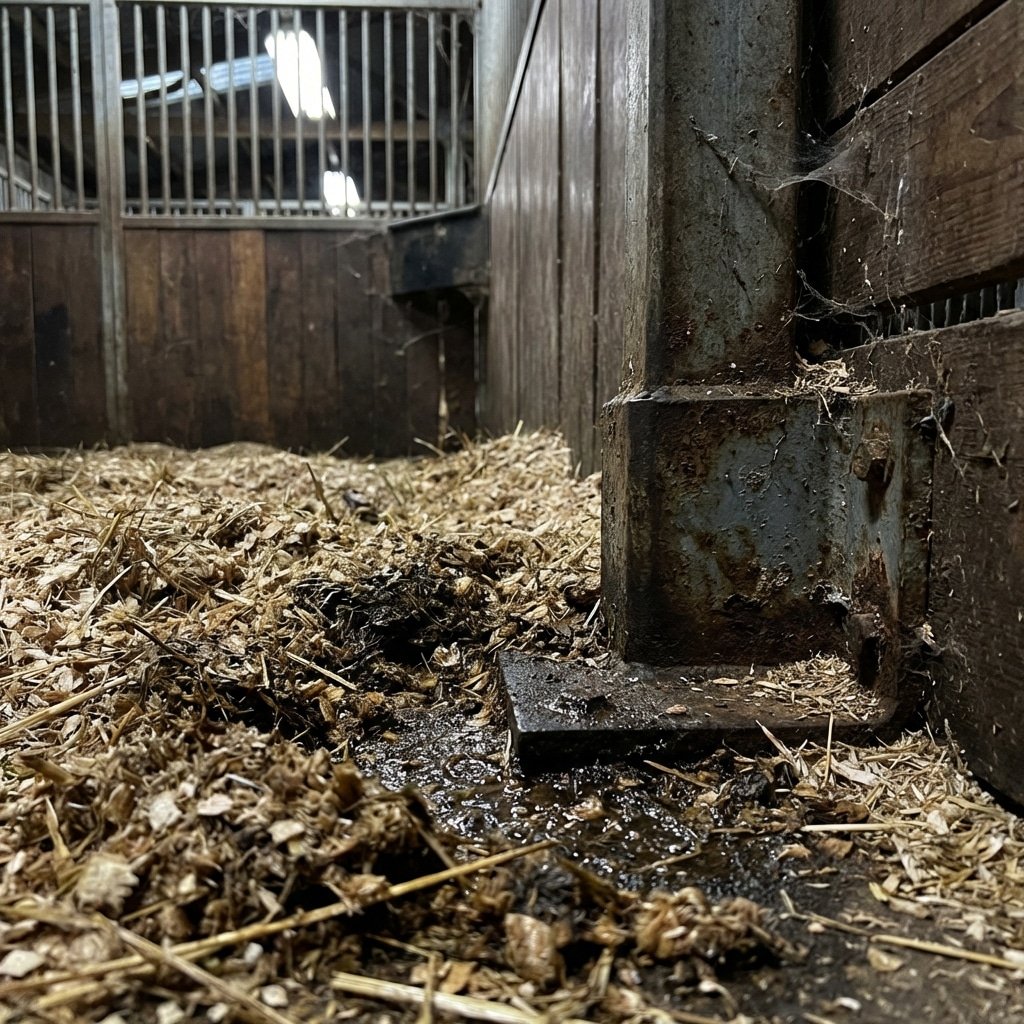
Why Powder-Coated Posts Rot at Ground Level
Powder coating on bare metal traps moisture against steel. Without a sacrificial zinc layer, ammonia penetrates pinholes, causing the post to rot structurally from the inside out.
Moisture Entrapment and Acidic Corrosion
In an equestrian environment, the bottom six inches of a stable post face aggressive chemical attacks. Bedding holds urine against the steel, creating a constant exposure zone of ammonia and moisture. When manufacturers apply powder coating directly to bare metal (often to cut costs), they create a sealant rather than a protector. The coating invariably contains microscopic gaps, known in the industry as “holidays,” or develops micro-cracks from thermal expansion.
Once acidic fluids penetrate these gaps, the coating acts as a trap. Moisture cannot evaporate, creating a localized corrosive cell that eats the steel substrate beneath the paint. This results in the familiar “bubbling” effect where the paint peels away to reveal advanced rot. By the time this damage becomes visible, the structural integrity of the post is often already compromised.
The Protective Role of BS EN ISO 1461 Galvanization
To eliminate this failure point, we refuse to powder coat bare metal. DB Stable mandates “Hot-Dip Galvanization After Fabrication” as the non-negotiable base layer for all colored stables. We weld the black steel first, then submerge the entire structure into molten zinc. This process creates a metallurgical bond that separates the steel from the environment, regardless of the paint’s condition.
- Standard Compliance: All posts undergo processing to BS EN ISO 1461 Normen.
- Zinc Thickness: We achieve an average coating of > 70 microns on tubing and > 85 microns on structural parts.
- Sacrificial Protection: If the aesthetic powder coat scratches, the zinc layer oxidizes sacrificially to protect the steel, preventing rust creep.
20-Year Rust-Free Modular Horse Stables

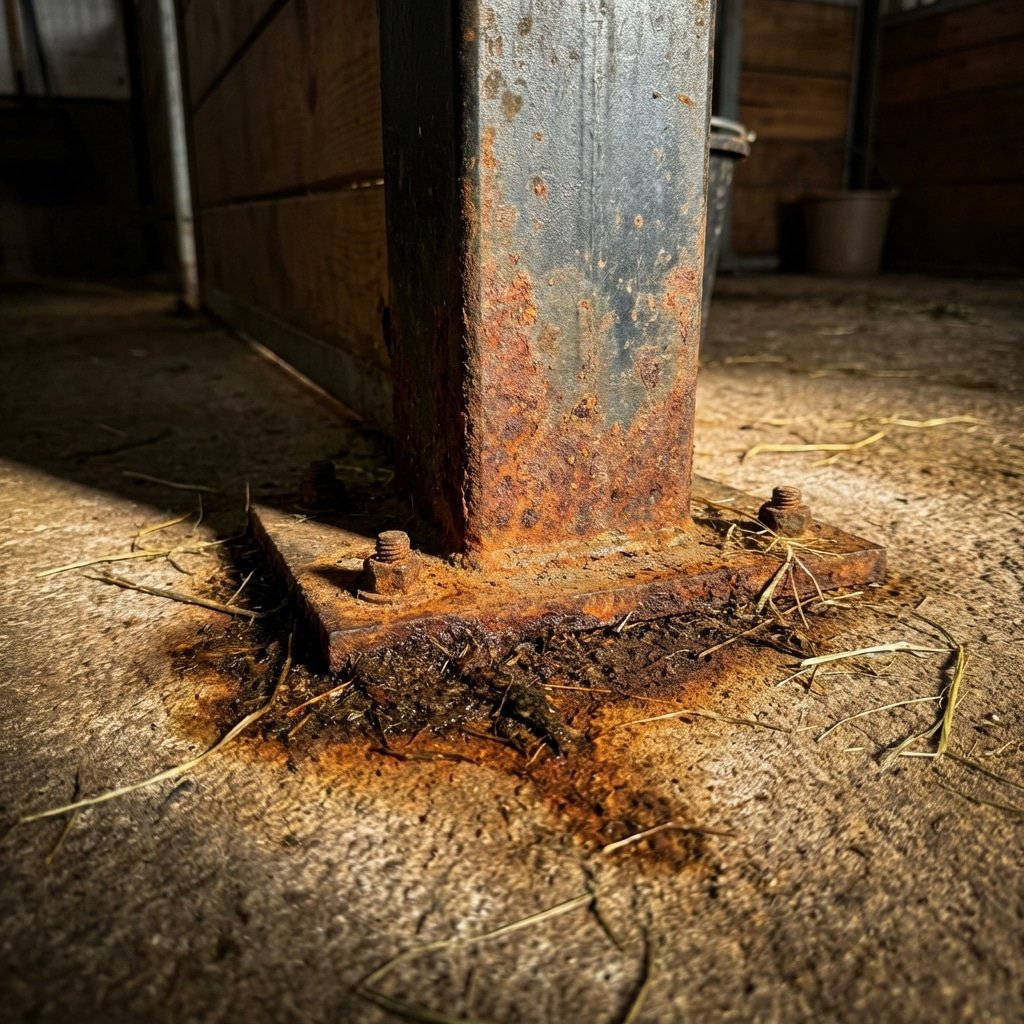
The Defense: Heavy HDG Base Plates on Horse Stalls
Welding burns off zinc on standard plates. We use “Hot-Dip After Fabrication,” bonding 85+ microns of zinc to the steel to seal the weld against ammonia.
| Merkmal | Pre-Galvanized (Standard) | Hot-Dip After Fabrication (DB Stable) |
|---|---|---|
| Weld Condition | Zinc burned off by heat | Fully coated after welding |
| Coating Thickness | 15-20 microns (Spray paint) | > 85 microns (Metallurgical bond) |
| Interior Protection | None (Raw steel inside) | Full internal zinc coverage |
| Ammonia Resistance | Fails quickly at floor level | Decades of protection |
The Critical Failure of Pre-Galvanized Welds
Most manufacturers take a shortcut here. They buy pre-galvanized tubes and weld a steel plate to the bottom. The intense heat of the welding arc (approx. 1600°C) instantly vaporizes the zinc coating around the joint. This creates a “Heat-Affected Zone” of raw, unprotected steel exactly where protection matters most: the floor level.
Urine and ammonia concentrate at the bottom of the stall. These corrosive agents attack the exposed weld immediately. To hide the damage, factories apply “cold spray” (silver paint) over the black weld. This cosmetic layer offers zero structural protection. It flakes off within months, allowing rust to eat through the base plate connection and compromise the entire stall front.
Achieving 85 Microns: The ISO 1461 Galvanizing Standard
We eliminate this weak point by using the “Hot-Dip After Fabrication” process. Our team welds the entire stall front using raw black steel first. Only after all welding and fabrication are complete do we submerge the entire assembly into a bath of molten zinc at 450°C.
This process ensures the liquid zinc flows over every weld, into every crevice, and through the interior of the tubes. According to ISO 1461 standards, the steel thickness dictates the zinc absorption. Since our base plates use heavy structural steel (>6mm), they achieve a significantly thicker coating than the tubing itself:
- Structural Base Plates: Average coating > 85 microns.
- Tubing Walls: Average coating > 70 microns.
- Bond Type: Metallurgical alloy bond (harder than the base steel), not just a surface layer.
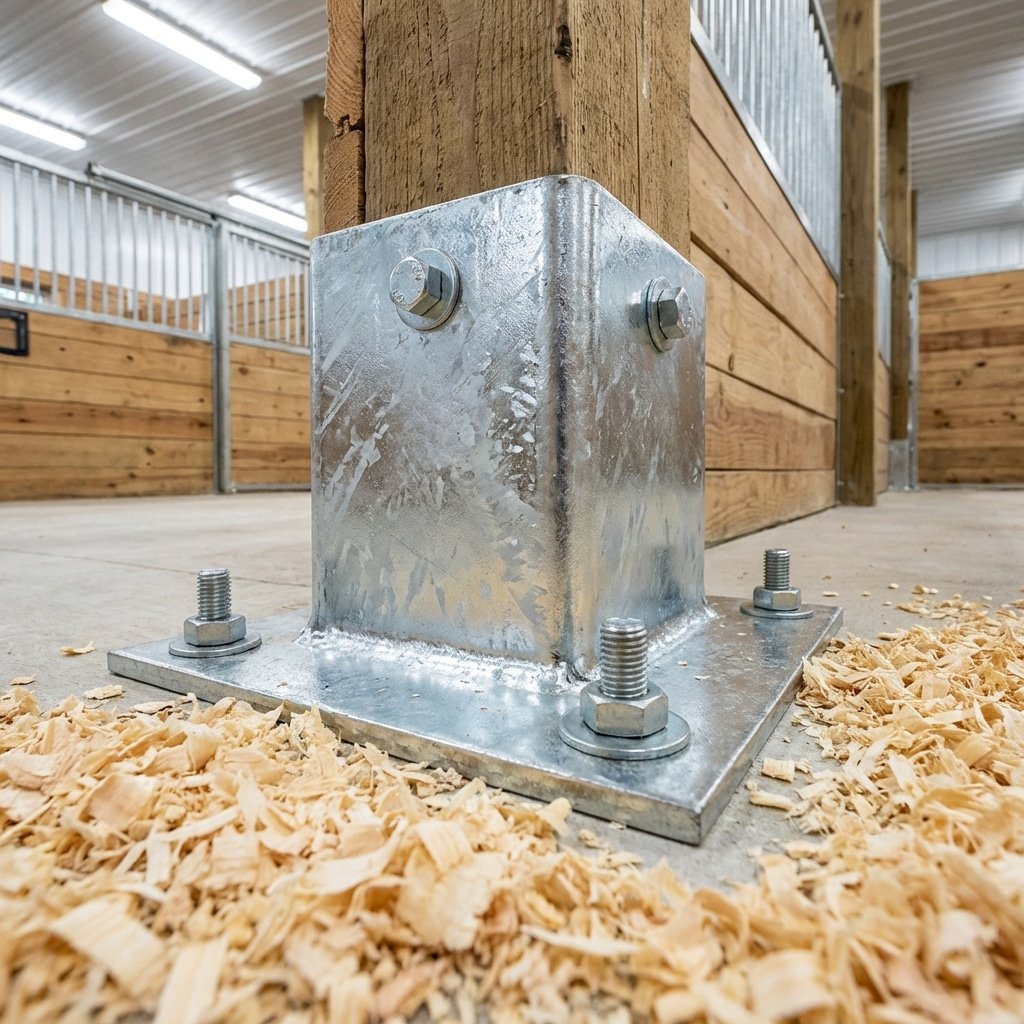
Using 304 Stainless Steel Concrete Anchor Bolts
We utilize 304 stainless steel wedge anchors standard to prevent rust expansion from cracking concrete, ensuring structural stability against ammonia and moisture.
Corrosion Resistance in Ammonia-Rich Environments
Standard carbon steel anchors are a liability in professional equestrian facilities. Horse urine releases ammonia gas, which accelerates corrosion significantly faster than coastal salt air. When a carbon steel anchor rusts inside the slab, it undergoes “oxide jacking.” The resulting rust expands up to ten times the volume of the original steel, exerting massive internal pressure that cracks the concrete foundation from the inside out.
We strictly use 304 Grade Stainless Steel to eliminate this failure point. Unlike plated steel, solid stainless steel does not rely on a surface coating that can be scratched during installation. It also prevents galvanic corrosion between the fastener and our hot-dip galvanized base plates, maintaining structural integrity even in wash-down areas where water and manure accumulate.
Technical Specifications: The 304 Stainless Wedge Anchor
We do not treat safety hardware as an upsell. Every DB Stable Installation Kit includes 304 Grade Stainless Steel wedge anchors as the baseline standard. These fasteners are engineered to handle the dynamic loads specific to stables, particularly the lateral shear force generated when a 1,200 lb horse kicks a partition wall.
- Expansion Mechanism: Wedge design with dual undercutting embossments for secondary expansion grip.
- Shear Capacity: High resistance to lateral impact (kick loads).
- Installation Torque: 55-65 ft./lbs (for standard 1/2″ diameter anchors).
- Included Components: Pre-assembled with matching 304 stainless steel nuts and washers.
Abschließende Überlegungen
Relying on thin pre-galvanized welds creates a liability that inevitably results in warranty claims and damaged dealer reputation. By standardizing on Hot-Dip Galvanization After Fabrication to ISO 1461, you ensure every base plate withstands aggressive ammonia exposure for decades. Choosing the >85 micron zinc barrier is not an upsell; it is the only way to guarantee structural safety in an equine environment.
Do not risk your inventory on generic specifications; verify our engineering standards firsthand. Request a sample corner section to inspect the metallurgical bond of our zinc coating and test the fitment of our 304 stainless anchors. Contact our team today to discuss OEM customization or to secure a production slot for your next container.


 German
  English
  Spanish
  French
  Arabic
0 Kommentare