


Dealing with bedding in hinges is the single largest maintenance drain for high-volume equestrian facilities. Traditional floor-mounted pivots inevitably trap shavings and ammonia, creating a corrosive paste that seizes hardware and forces costly emergency replacements.
This analysis contrasts failing floor pivots against the DB Stable 50mm Cast-Proof Design. By elevating the mechanism onto the Q345B structural frame, we isolate critical components from the ammonia zone, eliminating debris ingestion and extending operational life.
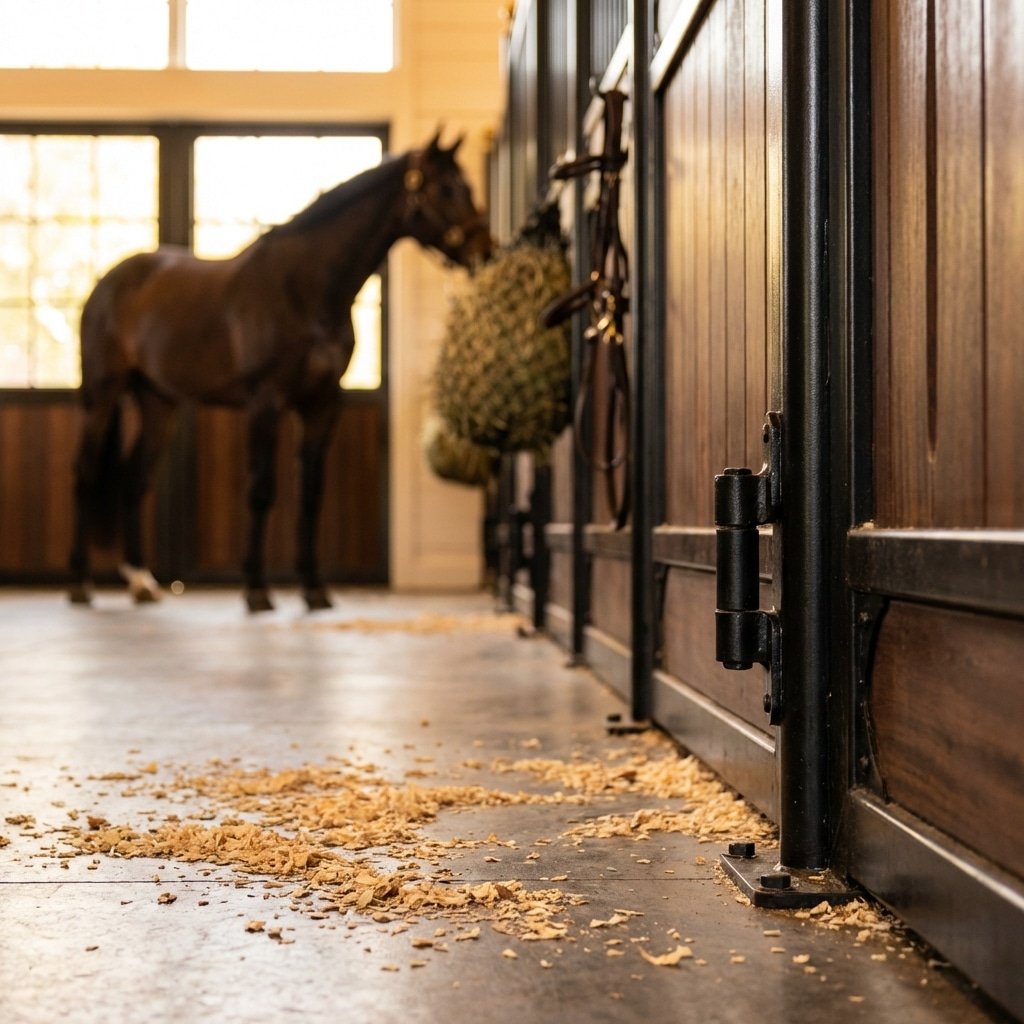
The Gravity Trap: Floor-Mounted Pivot Hinges
Gravity pivots use door weight for self-centering, but slight floor misalignment causes friction and failure, making “bedding-in” precision critical for operation.
How Gravity-Assisted Pivot Mechanisms Work
Gravity-assisted pivots operate on a simple mechanical paradox: they use the heavy vertical weight of the door to drive the return action. Unlike spring-loaded hinges that fight against resistance, these systems utilize a cam-like action where the door physically lifts slightly as it opens. Gravity then pulls it back down into the closed, centered position. This design eliminates the fatigue points common in spring-based hardware.
In heavy-duty industrial applications, this mechanism transfers immense loads directly into the floor structure rather than hanging them from the frame. High-capacity variants utilize heat-treated alloy steel pins to maintain the rotation axis under extreme stress.
- Load Transfer: Direct-to-floor weight distribution supports up to 20,000 lbs in industrial configurations.
- Material Spec: Reliance on precision-ground alloy steel pins to prevent axis deformation.
- Mechanism: Spring-free, self-centering action driven purely by vertical mass.
The Vulnerability of Precise Bedding-In
The mechanical efficiency of a gravity pivot depends entirely on the “bedding-in” process. This is the initial operational period where the bearing surfaces mechanically settle under the door’s full weight. For the system to function, this settling must occur while the pin maintains absolute vertical alignment.
This creates the “Gravity Trap.” In a controlled lab, experts can align these systems in under 30 minutes. But on a real job site, slight floor irregularities or inadequate shimming cause the load to distribute unevenly across the bearing surface. If the bedding-in is not perfectly level, the gravity mechanism that is supposed to close the door will instead cause it to bind, lock up, or grind the bearings into premature failure.

How Pine Shavings and Mud Pack into the Pivot Mechanism
Floor-mounted pivots act as sediment traps where shavings and ammonia create a concrete-like paste. This “mortar effect” seizes the bearing, often requiring sledgehammers to break the door free.
The “Mortar Effect”: Mixing Ammonia and Pine Dust
The primary failure mode of floor-mounted pivots in equestrian environments is not mechanical fatigue; it is chemical adhesion. Stable bedding, specifically pine shavings, is engineered to be highly absorbent. When these shavings come into contact with equine urine (ammonia) and water, they break down into a dense, sticky pulp.
In a standard floor-pivot setup, the bottom cup acts as a gravity-fed collection point. Every time a horse steps near the threshold, this wet pine pulp is forced into the gap between the pivot pin and the housing. The heavy steel door then compresses this mixture, acting like a hydraulic press.
Over time, this compressed mixture dries and hardens. The result is a composite material similar to low-grade mortar. The pivot pin does not just rust; it becomes physically cast into the housing. At this stage, the door creates a solid mechanical lock with the floor, rendering the hinge useless and often requiring the entire assembly to be cut out with an angle grinder.
The Design Fix: The 50mm Cast-Proof Clearance
The fundamental flaw of floor pivots is their requirement for zero clearance, which forces the mechanism to sit directly in the “bedding zone.” If the hardware touches the floor, it will eventually ingest debris.
To eliminate this risk, DB Stable implements a strict **50mm Cast-Proof Design** specification across our Professional and Royal Series. By engineering a mandatory gap at the bottom of the door, we isolate the moving components from the stable environment entirely.
- Elevation: Die 50mm gap ensures all hinge mechanisms operate significantly above the bedding line.
- Debris Rejection: Even if bedding piles up, the clearance prevents the door bottom from dragging or packing material into the frame.
- Safety: This gap is calculated to be small enough to prevent a foal’s hoof from getting stuck (Cast-Proof) while large enough to clear standard bedding depths.
Premium Horse Stables Engineered For Durability
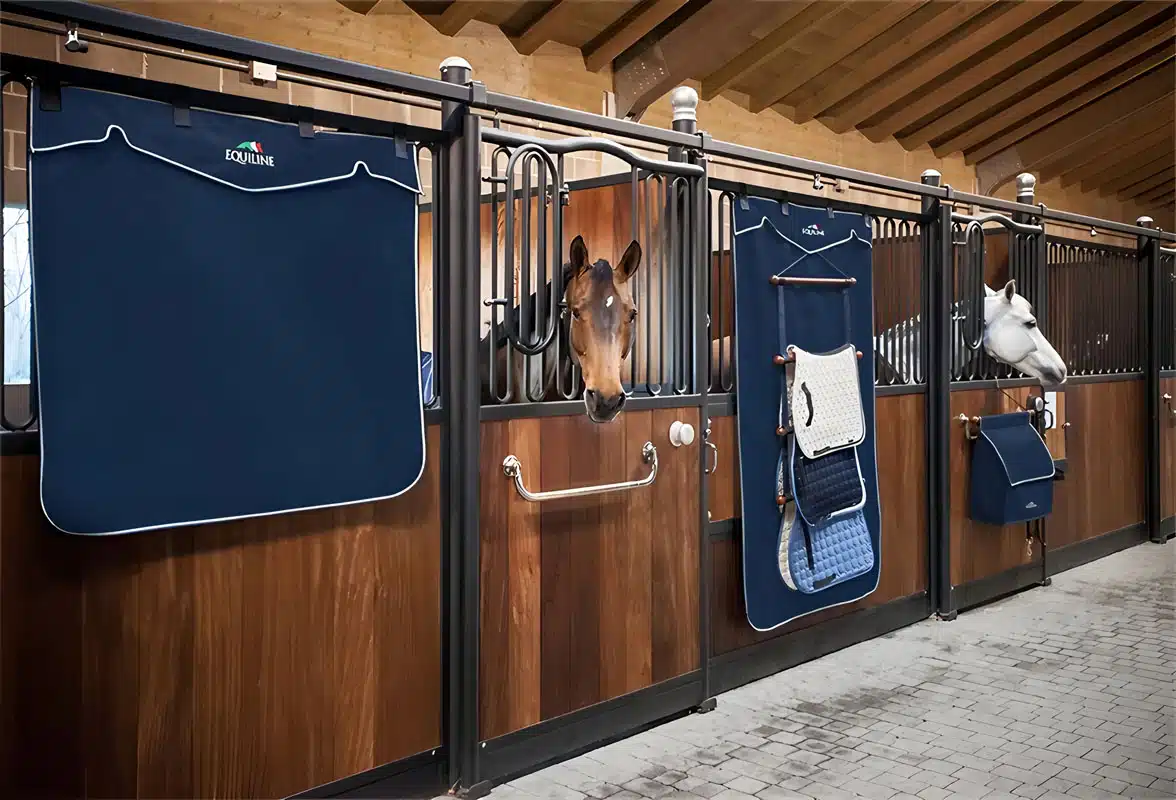
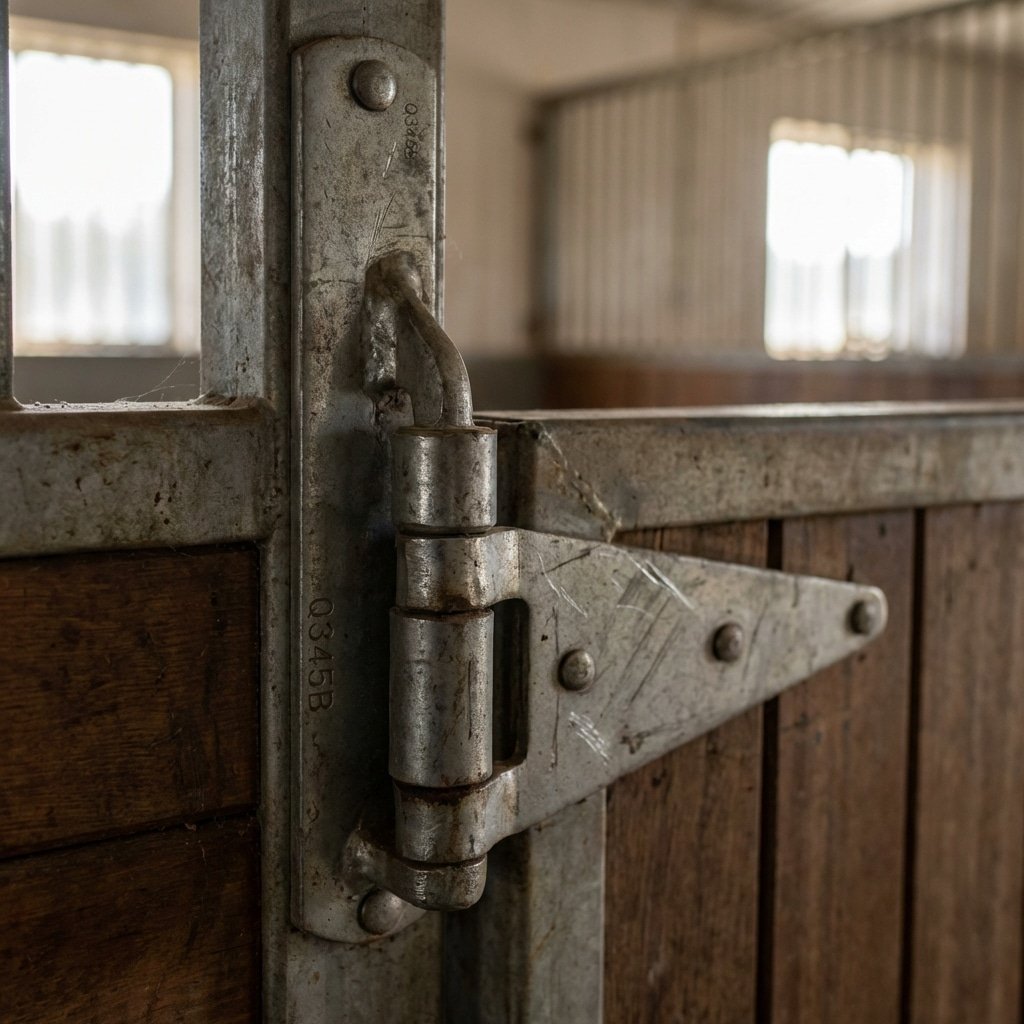
The DB Wall-Mounted Adjustable Hinge Advantage
DB’s wall-mounted system elevates mechanics out of the “ammonia zone,” preventing corrosion and jam-ups caused by bedding, while supporting heavy Q345B frames with 3-way adjustability.
| Merkmal | Floor-Mounted Pivot (The Risk) | DB Wall-Mounted (The Solution) |
|---|---|---|
| Debris Interaction | Traps pine shavings and mud (“Gravity Trap”) | Suspended above bedding line |
| Corrosion Risk | High (Sits in wet ammonia zone) | Low (Elevated away from moisture) |
| Structural Settling | Door drags on floor; hard to shim | 3-Way adjustable correction |
Zero-Floor-Contact Suspension Design
Traditional floor pivots rely on gravity and ground clearance to function, which creates an immediate engineering conflict in active horse stables. We call this the “Gravity Trap.” When a hinge mechanism sits flush with the floor, it becomes a magnet for wet pine shavings, mud, and manure. This mixture packs into the pivot bearing, causing friction, noise, and eventual seizure.
- Eliminates the ‘Mud Trap’: By mounting the hinge directly on the vertical 50mm or 114mm post, the entire mechanical assembly remains clear of the bedding layer. This prevents debris from packing into the barrel.
- Prevents Ammonia Corrosion: The bottom 6 inches of any stall is the “ammonia zone,” where urine concentration is highest. Our design keeps critical moving parts out of this corrosive layer, significantly extending the hardware’s operational life.
Heavy-Duty 304 Edelstahl Adjustability
Stable doors are heavy. A Professional Series door using Q345B steel framing and high-density bamboo infill exerts significant torque on its suspension points. Most standard hinges sag under this load, leading to doors that scrape the concrete. We engineer our hinges not just to hold weight, but to adapt to the reality of barn construction.
- Material Standard: We utilize 304 Edelstahl exclusively for the hinge assembly. This resists rust even in high-humidity stable environments where lesser steels fail.
- Load-Bearing Precision: The design specifically supports the mass of heavy Bamboo and HDPE infills without the “hinge droop” common in lighter agricultural hardware.
- Future-Proofing: All barns settle. Concrete shifts. Wood posts warp. Our adjustable design allows facility managers to realign the door in three dimensions (vertical, horizontal, and depth) using simple hand tools, ensuring the door remains level years after installation.

Keeping Hardware 6 Inches Above the Bedding Line
Deep bedding creates a corrosive “ammonia zone” at floor level. Elevating hardware prevents rust and mechanical failure common in floor-pivot systems.
The Corrosive Danger of the “Ammonia Zone”
Most facility managers underestimate the chemical aggression occurring at the floor level of a horse stall. Gravity dictates that urine settles at the very bottom of the shavings or straw, creating a highly concentrated layer of ammonia and moisture. This area, extending roughly 4 to 6 inches up from the concrete, effectively acts as a wet, acidic sponge that never truly dries out.
When you install floor-mounted pivots or low-lying tracks in this zone, you are burying mechanical components in a corrosive agent 24/7. The results are predictable and costly:
- Accelerated Corrosion: Even galvanized steel degrades rapidly when submerged in wet, acidic bedding, leading to seized bearings.
- Mechanical Obstruction: Bedding material packs into pivot points, preventing the door from closing flush or latching securely.
- Winter Freezing: In cold climates (like Northern Europe or Canada), wet bedding around floor pivots freezes solid, rendering the door immovable until thawed.
Wall-Mounted Geometry vs. Floor Pivots
To eliminate these risks, DB Stable engineers the door geometry to bypass the floor entirely. We replace the industry-standard floor pivot with heavy-duty adjustable hinges mounted directly to the vertical structural posts. Whether using our standard 50mm x 50mm RHS or the 114mm Round Post profiles, the load is transferred to the frame, not the floor.
This design shift ensures that all critical moving parts remain well above the 6-inch bedding line. The feuerverzinkt coating (BS EN ISO 1461 standard) performs best when it can breathe, rather than being encapsulated in wet manure. By keeping the hardware dry and accessible, we extend the service life of the stable front significantly.
This elevation strategy works in tandem with our “Cast-Proof Design,” which maintains a strict 50mm gap at the bottom of the door. This gap is small enough to prevent a rolling horse from getting a hoof stuck, but large enough to allow excess bedding to be swept clear without jamming the door operation.
Häufig gestellte Fragen
Why won’t my barn door close properly?
Barn doors typically fail to close due to track misalignment, header sag, or obstruction in the bottom guide. Heavy doors naturally strain hardware over time, altering the swing radius or causing the rollers to sit unevenly in the track. In stable environments, bedding and dirt often pack into floor guides, physically blocking the door’s path.
To fix this, first clear all debris from the bottom guide. Next, check the track level; if the header has settled, you must shim the track back to a perfectly horizontal position. Finally, tighten all roller mounting bolts, as loose hardware allows the door to drag against the frame.
How do I fix jammed horse stall hinges?
Jammed hinges in stables usually result from rust buildup (oxidation) or accumulated layers of paint that seal the pin in the barrel. Lack of lubrication allows moisture and ammonia to seize the mechanism.
Start by applying a silicone-based lubricant or penetrating fluid. Avoid standard grease or oil initially, as these attract dust. Let it sit for 15 minutes. If it remains stuck, use a pin punch and hammer to tap the hinge pin upward from the bottom. Once removed, clean the pin with steel wool. If the hinge is painted shut, use a utility knife to score the paint along the seam before tapping.
What are the best hinges for dirty stable environments?
In high-ammonia and dust environments, standard steel hinges fail quickly. The best option is **Hot-Dip Galvanized (ISO 1461)** hinges, which offer a metallurgical bond that prevents rust even if scratched. Stainless steel (304 grade) is a viable alternative for aesthetics but comes at a higher cost.
Mechanically, look for heavy-duty barrel hinges equipped with **grease fittings (zerks)**. These allow you to inject fresh grease into the barrel, physically purging out contaminants like sand and dust while lubricating the pin. Avoid sealed bearings in extremely dirty areas, as they cannot be flushed if grit penetrates the seal.
Abschließende Überlegungen
Relying on floor-mounted pivots in active stables guarantees maintenance headaches and hardware failure due to the corrosive “ammonia zone.” Switching to DB Stable’s wall-mounted system with 304 Stainless Steel and 50mm Cast-Proof clearance eliminates this “Gravity Trap” entirely. This engineering shift safeguards your inventory against rust claims and positions your brand as a provider of long-term, high-performance facility solutions.
Stop settling for hardware that cannot survive the reality of barn environments; verify our engineering standards yourself. Request a technical specification sheet or sample kit today to test our hot-dip galvanization and adjustable mechanics firsthand. Contact our production team now to secure wholesale pricing for your next container load.


 German
  English
  Spanish
  French
  Arabic
0 Kommentare