


Improperly specified Foaling Dividers turn standard stalls into liability traps for high-value breeding operations. While standard vertical bars suffice for adults, their spacing creates immediate fracture risks for uncoordinated newborns, leading to catastrophic veterinary costs and lost genetic potential.
This analysis benchmarks safety protocols against our Cast-Proof Design standard, focusing on flush 50mm bottom gaps and impact-absorbing HDPE infill. We examine how swapping open bars for solid lower sections or 1×1 heavy wire mesh prevents hoof entrapment while maintaining the structural integrity required for ISO 1461 certified longevity.

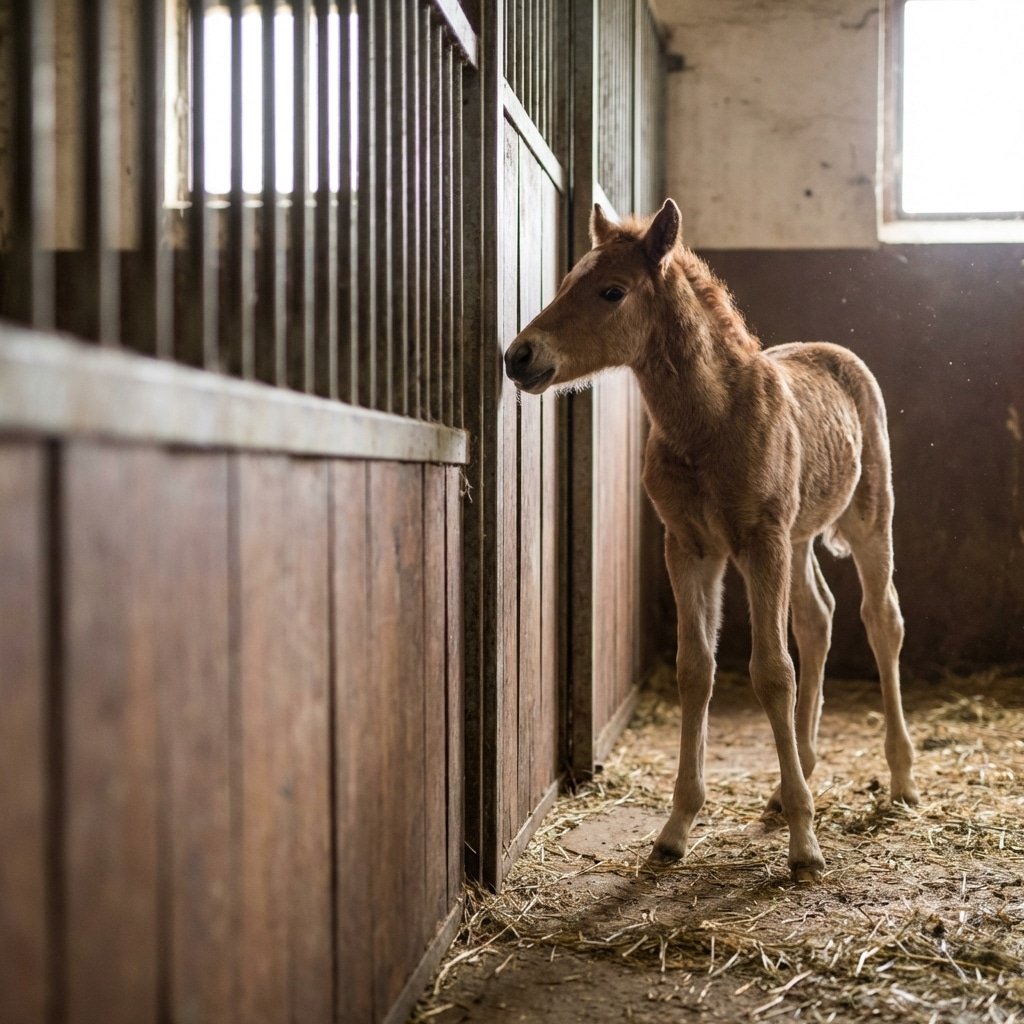
The Curiosity and Clumsiness of Newborn Foals
Newborn foals display severe lack of coordination in their first 24 hours. Without “Cast-Proof” engineering, this natural clumsiness turns standard stable gaps into immediate limb-trapping hazards.
Coordination Milestones and Physical Vulnerability
Foals are not born graceful. While nature wires them to stand quickly, the execution is messy and dangerous. Immediately after birth, a foal typically remains sternal (chest-down) for about 15 minutes just to establish head control. When they finally attempt to rise, their center of gravity is high, and their legs are uncooperative. This isn’t just awkwardness; it is a period of high liability for the facility.
- The “Collapse” Phase: The process of lying down is often uncontrolled. Foals will repeatedly bend their knees, struggle, and eventually throw themselves onto their side due to fatigue. If the wall has wide gaps or protruding edges, this collapse results in injury.
- Delayed Motor Skills: Initial movements involve a wobbling head and neck. Coordinated walking does not typically develop until after the first two hours.
- Shoulder-Height Exploration: Curiosity kicks in within 30 minutes. The foal explores surfaces at shoulder height to find the dam’s udder, leading to frequent, uncoordinated contact with stable partitions.
Addressing Safety Risks with Cast-Proof Engineering
We engineer DB Stable systems specifically to mitigate the risks posed by a foal’s lack of motor control. Standard “farm gates” or lightweight partitions often fail here because they allow legs to slide underneath during a fall. Our design philosophy focuses on creating a flush, unforgiving barrier that guides the foal back to a safe position rather than trapping it.
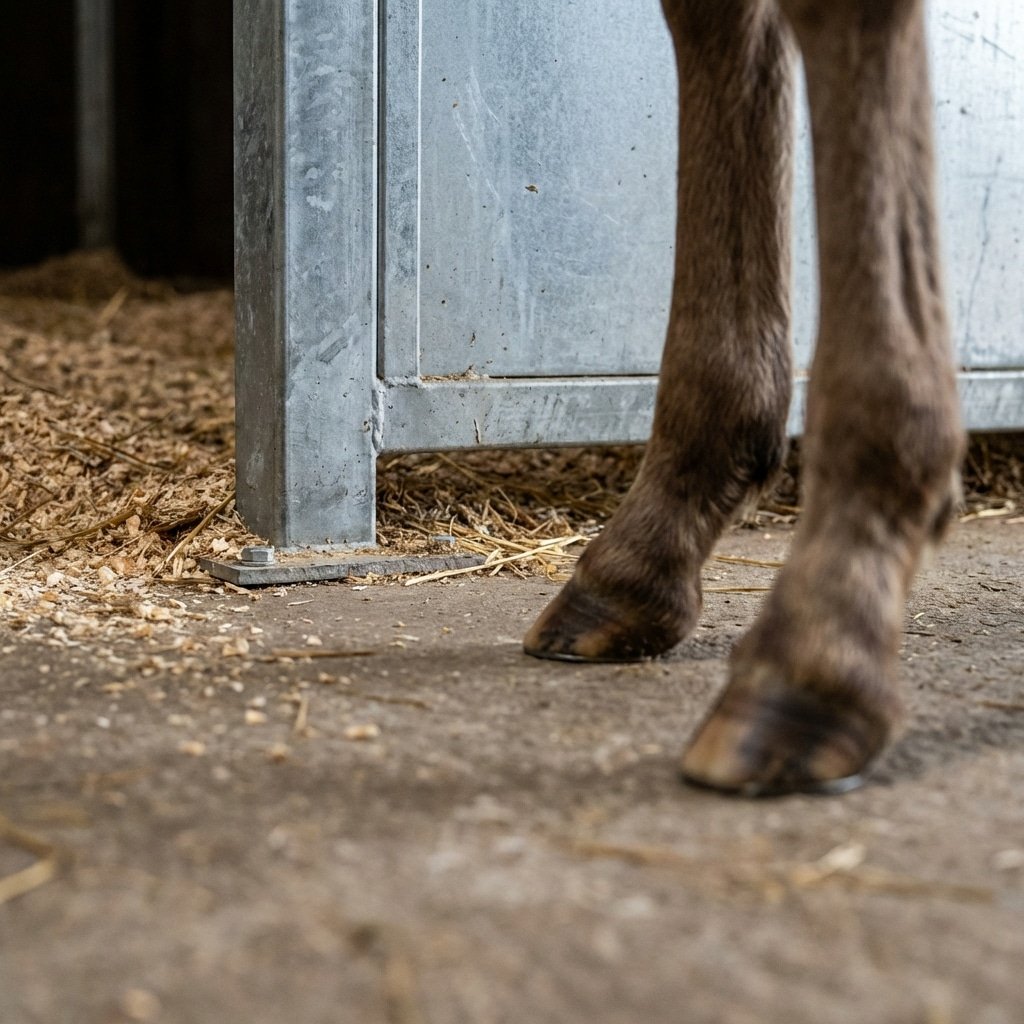
- Cast-Proof Design: We restrict the bottom gap of our partitions to approximately 50mm. This prevents a foal’s hoof or leg from sliding under the wall when they collapse or roll.
- Kick-Proof Guarantee: We utilize Q345 High Strength Steel paired with shock-absorbing HDPE infill. This combination withstands the impact of a falling foal or “play-fleeing” episodes without warping or splintering.
- Solid Lower Sections: By keeping the lower portion of the divider solid, we eliminate entrapment points where a struggling foal might catch a hoof while trying to right itself.
- Flush Surfaces: All welds and joints are smoothed to ensure that when a foal inevitably slides down the wall, they do not catch on rough steel or bolts.
The Danger of Standard Vertical Bars on Divider Walls
Executive Summary: Standard vertical bars are engineered for adult anatomy. Newborn foals have smaller hooves that slip through these gaps, turning rigid protective steel into a limb-breaking hazard.
The Mechanics of Limb Entrapment
Most standard stable partitions are designed assuming the horse will be standing or resting in a sternal position. Adult horses rarely sleep flat on their sides for extended periods in a way that endangers their legs near the walls. Newborn foals operate on a completely different behavioral set. They sleep fully recumbent—flat on their sides—to support rapid developmental growth.
This sleeping position places their hooves directly at ground level, adjacent to the partition walls. The danger arises when the foal wakes or rolls over. During these movements, their legs naturally extend outward. If the divider wall features vertical bars starting near the floor, the foal’s hooves act like wedges.
- The Entry: A newborn’s hoof is significantly narrower than an adult’s. It slides easily through standard 50mm-80mm bar spacing without resistance.
- The Lock: Once the leg extends through the bars, the fetlock or knee joint passes the threshold. When the foal attempts to retract the limb, the joint catches against the steel bars.
- The Panic Response: Unlike an experienced adult horse that might freeze, a foal’s instinct is to thrash. This panic drives the joint harder against the steel, often leading to severe fractures or degloving injuries before a handler can intervene.
The Unforgiving Nature of Structural Steel
At DB Stable, we engineer our systems using Q235B Structural Steel and, for colder climates, Q345B Low Alloy High Strength Steel. We use heavy-gauge 14-gauge (2.0mm – 2.5mm) tubing to ensure our stalls are “Kick-Proof.” For adult horses, this rigidity is a safety feature; it prevents the walls from collapsing under the force of a 600kg animal.
In the context of a trapped foal, this structural integrity becomes the primary hazard. High-tensile steel does not yield. If a foal’s leg is leveraged against a Q345B steel bar, the steel will not bend to release the pressure—the bone will.
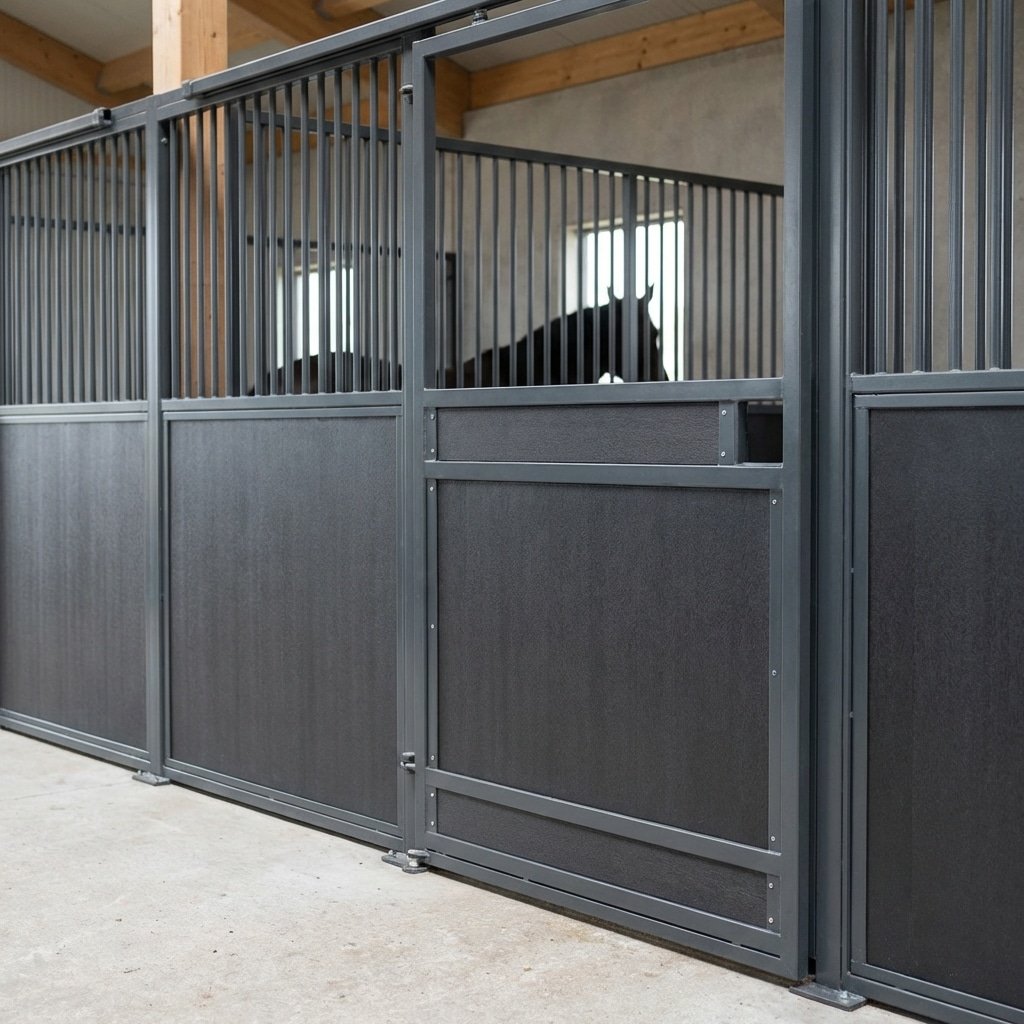
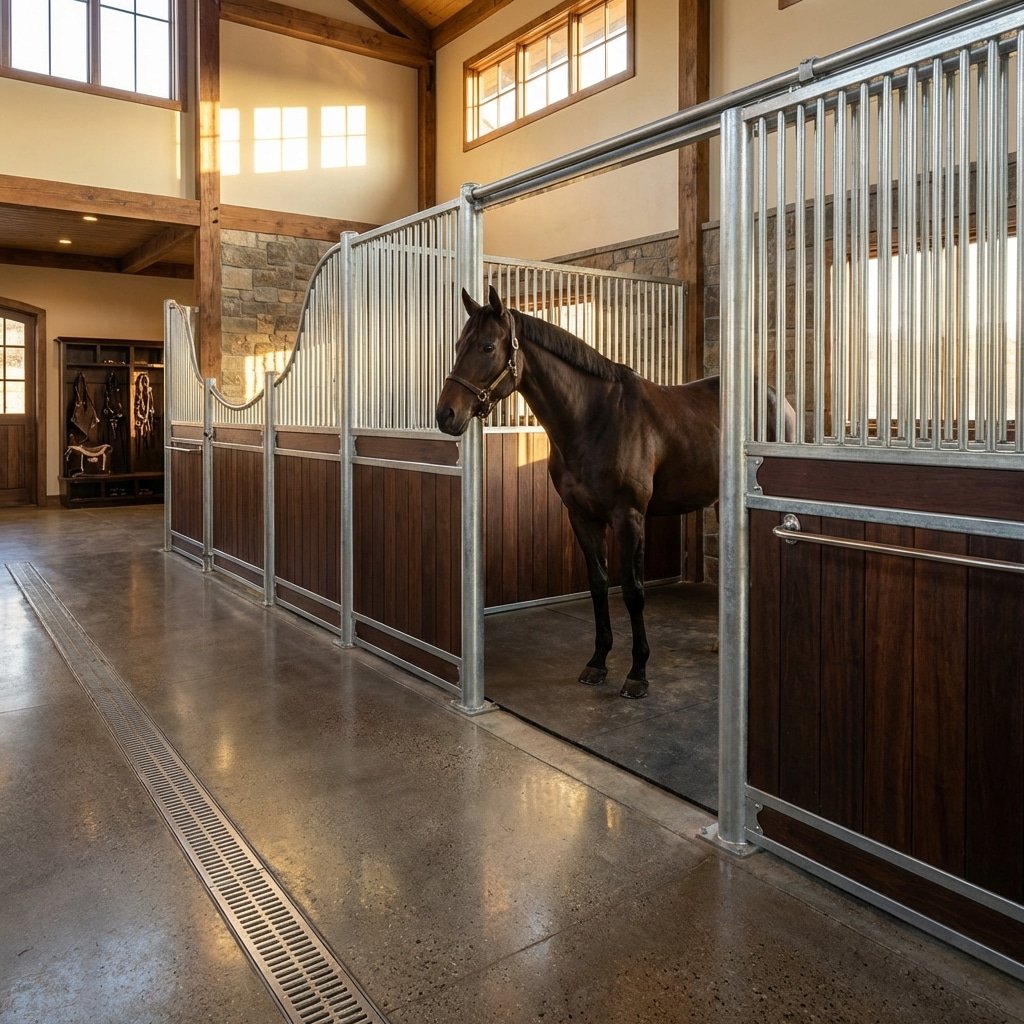
This reality dictates our “Cast-Proof Design” philosophy for breeding facilities. We strictly advise against full-length vertical bars for foaling boxes. Instead, the bottom portion of the divider—typically the first 1.2 meters—must be solid. This eliminates the interface between the foal’s legs and the vertical bars entirely, ensuring that when a foal kicks or rolls, they contact a flat, solid surface rather than an entrapment hazard.
Engineered For Durability: 20-Year Rust-Free Stables
Why Solid Bottom Panels are the Safest Choice
Quick Answer: Solid bottoms prevent life-threatening “casting” accidents and hoof entrapment. We use 32mm HDPE or bamboo in welded frames to create an impenetrable, kick-proof barrier.
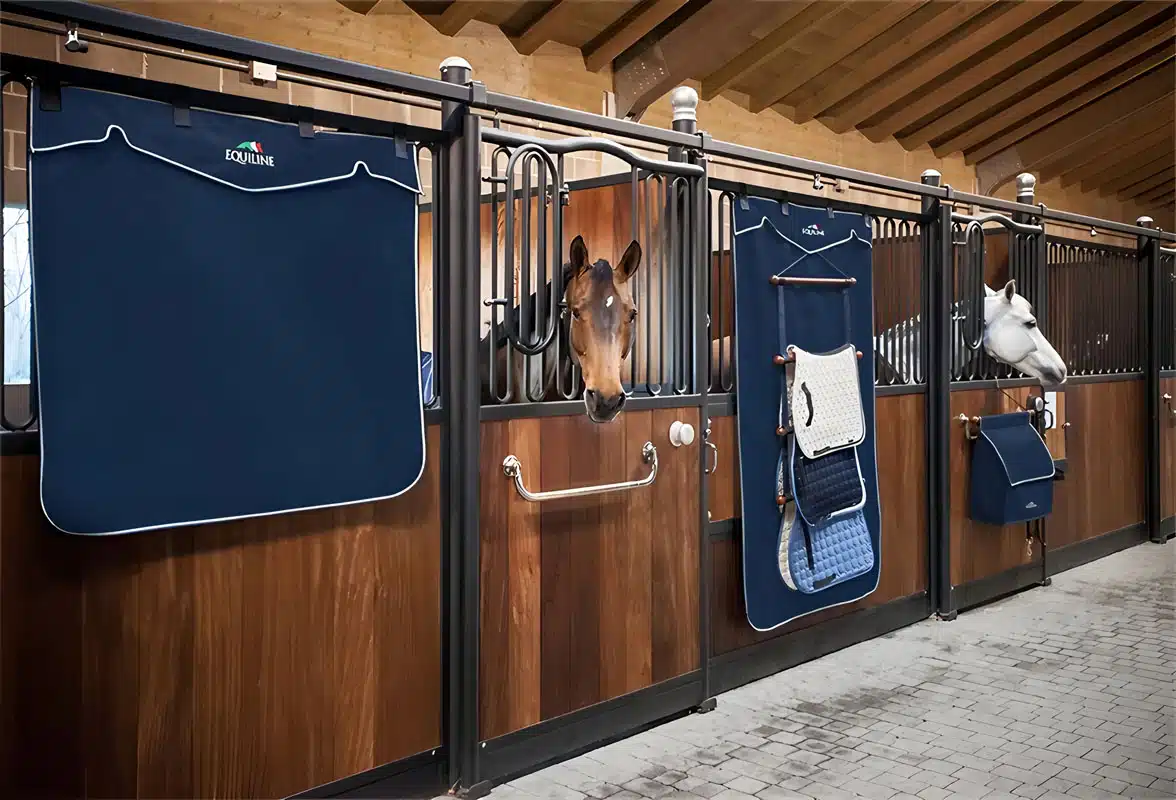
Standard barred partitions work well for ventilation, but they pose significant liabilities when installed at ground level, especially in breeding barns. Foals and spirited horses have smaller hooves that easily slip through standard bar spacing during a roll or a kick. Once a leg passes through, panic sets in, often resulting in severe fractures or soft tissue damage.
| Safety Factor | DB Stable Solid Bottom | Open Bar/Mesh Bottom |
|---|---|---|
| Entrapment Risk | Zero. No gaps for hooves to penetrate. | High. Hooves can slip through bars during rolling. |
| Casting Prevention | Create a flat surface for horses to push against. | Legs can get stuck under rails, preventing righting. |
| Bedding Retention | 100% containment keeps bedding in the stall. | Bedding migrates between stalls, increasing waste. |
Preventing Entrapment via Zero-Gap Design
The primary function of a solid bottom is to eliminate the “casting” hazard. Casting occurs when a horse lies down too close to a wall and cannot get the leverage to stand back up. If the wall has gaps or bars, the horse’s legs often push through into the adjacent stall. When they attempt to stand, the legs are trapped, leading to panic and catastrophic injury.
Our “Cast-Proof Design” focuses on creating a unified, smooth surface from the ground up:
- Flush-to-Floor Framework: We minimize the gap between the bottom channel and the floor (approx. 50mm) to prevent foals from getting a hoof stuck underneath.
- Elimination of Bevels: Unlike cheaper kits that leave gaps between boards, our tongue-and-groove system creates a sealed wall preventing bedding cross-contamination.
- Rejection of Bottom Bars: We strictly advise against vertical bars on the bottom half of dividers for any facility housing foals or high-value breeding stock.
High-Impact Resistance: HDPE and Bamboo Infills
A solid wall is only safe if it stays intact under impact. Thin plywood or hollow PVC eventually shatters, creating sharp shards that lacerate legs. We engineer our panels to withstand aggressive kicks without structural failure, backed by our “Kick-Proof Guarantee.”
We rely on two specific high-density materials to ensure this durability:
- UV Stabilized HDPE (28mm-32mm): This material offers necessary shock absorption. When a horse kicks, the plastic flexes slightly to absorb the energy rather than shattering or injuring the horse’s leg. It requires zero maintenance.
- High Density Strand Woven Bamboo: For facilities requiring maximum rigidity, we use bamboo with a Janka Hardness > 3000 lbf. This is 3x harder than Oak and resistant to mold and rot.
- Structural Steel Frame: All infills are encased in Q235B (Standard) or Q345B (Cold Climate) steel channels. We weld the frame first, then Hot-Dip Galvanize the entire unit to ISO 1461 standards, ensuring the welds never rust or snap.
Upgrading to 1×1 Inch Heavy Wire Mesh Bottoms
For foaling boxes, a 1×1 inch heavy wire mesh bottom is the safest configuration. It prevents small hooves from slipping through gaps while maintaining airflow and visual contact.
The Safety Mechanics of 1-Inch Grid Spacing
Standard 50mm (2-inch) vertical bars are the industry default for adult horses, but they pose a significant liability in foaling operations. Newborn foals are neurologically immature and clumsy; within the first hour of life, they struggle to stand and often collapse or roll awkwardly. A standard 2-inch gap is large enough for a small hoof to slide through but too narrow for the foal to retract it easily, leading to potential fractures or panic-induced injuries.
Replacing bars with a tight 1×1 inch (25mm) grid eliminates this entrapment zone entirely. This “Cast-Proof Design” ensures that even if a foal rolls directly against the divider, their legs remain on the safe side of the wall. Beyond impact safety, this mesh density supports better biological management:
- Full Visibility: Mares can monitor their foal continuously, even when the foal is lying sternal in the straw.
- Ammonia Removal: Solid bottom walls trap heavy ammonia gas at the bedding level where the foal sleeps. Mesh promotes “Stack Effect Ventilation,” allowing bad air to drift out without creating a cold draft.
- Limb Protection: The grid acts as a solid surface to the touch, preventing legs from passing through during the foal’s initial, uncoordinated attempts to stand.
Durability Through Hot-Dip Galvanization
Foaling stalls are high-moisture environments. Between birth fluids, frequent washing, and urine, the lower 4 feet of a divider faces aggressive corrosion triggers. Standard pre-galvanized wire (where the wire is dipped before welding) is insufficient here. The welding process burns the zinc off the cross-points, leaving the steel exposed to rust immediately after installation.
We strictly utilize Hot-Dip Galvanization After Fabrication (ISO 1461 standards) for these mesh panels. This means we weld the raw black steel first, then submerge the entire panel into molten zinc. This process seals every weld point and joint, creating a metallurgical bond that resists rust for decades, not just seasons.
For structural integrity, we reject lightweight “chicken wire” gauges. Our specification requires heavy-duty steel to withstand impact from the mare or a kicking foal without deforming:
- Heavy Gauge Requirement: We use 10-gauge to 14-gauge wire. Thinner wires (16-gauge+) are too flimsy for professional equine applications.
- Burr-Free Finish: The hot-dip process, followed by careful inspection, ensures a smooth surface free of sharp snags that could cut delicate foal skin.
- Chemical Resistance: The thick zinc coating creates a sacrificial barrier against the acidic nature of urine and wet bedding.
Häufig gestellte Fragen
What is the safest bar spacing for foal stall dividers?
Standard horse stalls often have 3-inch or 4-inch spacing, but this is a fracture risk for foals with smaller hooves. Safety standards dictate bar partitions must have no more than 3 inches of clear space between bars. For professional breeding facilities, we engineer lower grills using 1-inch steel bars on 2.5-inch centers (leaving only a 1.5-inch gap). This tight profile eliminates the possibility of a foal getting a leg trapped during a cast or while rolling.
Should I choose solid or grilled partitions for a foaling stall?
Solid partitions are the default for minimizing stress, as they prevent neighboring horses from disturbing the mare during labor. But a fixed solid wall limits the stall’s utility later. The industry-preferred solution is a hinged partition system. This design allows you to swing the divider open to combine two standard stalls into a massive 24′ x 12′ foaling suite, giving the mare room to maneuver while maintaining the flexibility to revert to two separate stalls after weaning.
How do I make a standard stall safe for a newborn foal?
First, address the bottom gaps. While general advice suggests keeping gaps under one foot, our manufacturing standard for “Cast-Proof Design” is a strict 50mm (approx. 2 inches) from the floor to prevent tiny hooves from sliding under. Inspect all steelwork for smooth welds—our hot-dip galvanization after fabrication ensures no sharp burrs remain. Finally, avoid shavings for the first few days as they stick to wet foals; straw provides a safer, cleaner start.
What is the advantage of using HDPE infill for foaling boxes?
Hygiene and safety are the primary drivers here. Unlike wood, which can splinter under impact or harbor bacteria in deep grains, 28mm-32mm HDPE (High-Density Polyethylene) provides a smooth, non-porous surface that is easy to sanitize—crucial for a newborn’s immune system. It acts as a “Kick-Proof” barrier that absorbs impact without cracking, and because it is bite-resistant, foals cannot chew on it and ingest splinters. It effectively offers a “Zero Maintenance” solution for high-traffic breeding barns.
Abschließende Überlegungen
Cutting costs on stall partitions introduces massive liability when a foal inevitably casts itself against a weak barrier. Investing in our “Cast-Proof” engineering and ISO 1461 Hot-Dip Galvanization protects your clients’ high-value stock from catastrophic limb injury. For dealers, supplying this level of safety builds a reputation for reliability that cheap, pre-galvanized alternatives cannot match.
Don’t gamble on catalog specs; verify our structural integrity firsthand. We recommend requesting a specific 1×1 inch mesh sample or a trial LCL order to test our weld quality and finish against your current stock. Contact our engineering team today to configure a “Kick-Proof” solution tailored to your facility’s layout.


 German
  English
  Spanish
  French
  Arabic
0 Kommentare