


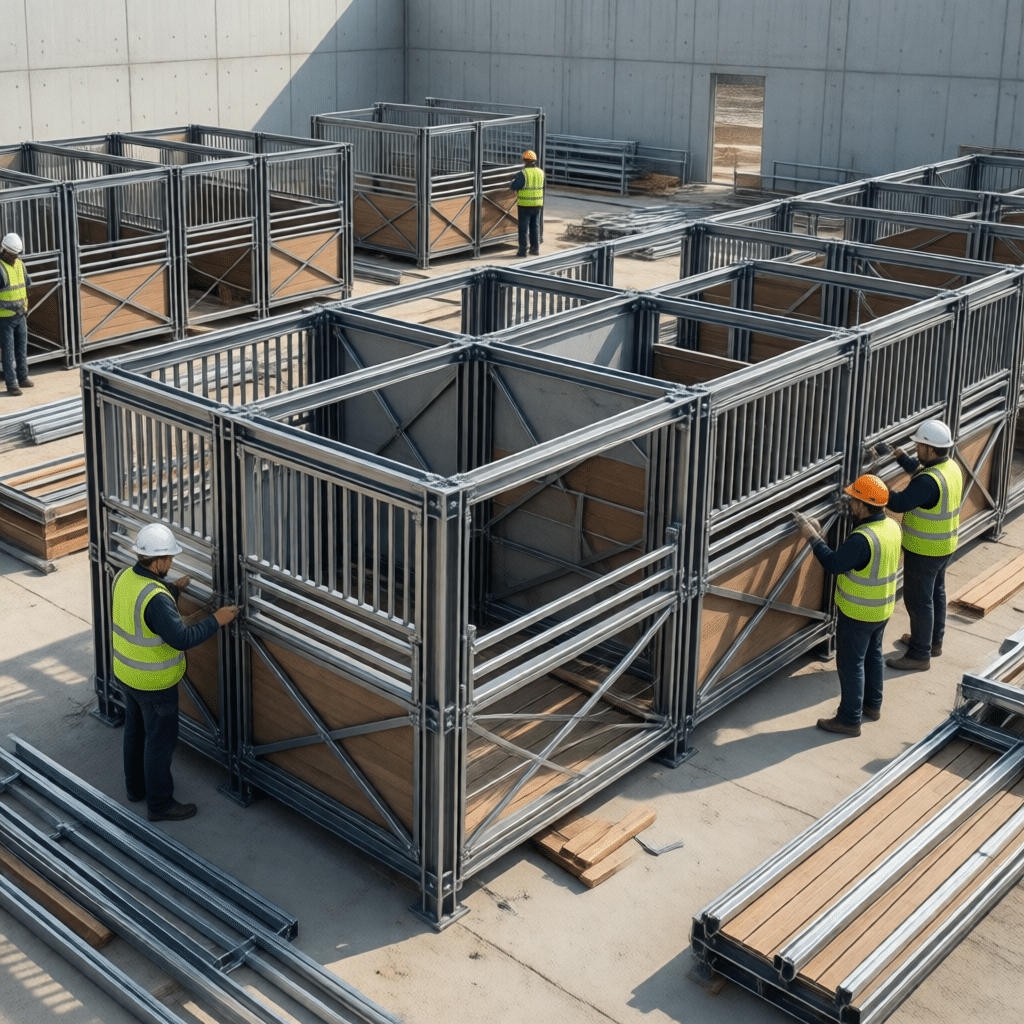
Rapid Assembly (Pin-System) designs determine if your event setup finishes under budget or drowns in overtime wages. Contractors often default to bolted connections to save on material costs, only to lose those margins when crew hours triple during installation.
This analysis benchmarks installation speed against the DB Stable Flat-Pack standard and Q235B structural rigidity. We evaluate how hot-dip galvanized modular connections reduce labor requirements and maximize container loading to 45 sets, securing your bottom line against volatile site costs.
The Rise of ESG (Environmental, Social, Governance) in Construction
ESG compliance now dictates procurement. By 2026, strict ca
rbon limits will compel builders to prioritize renewable bamboo infills and efficient flat-pack logistics to meet net-zero targets.
Regulatory Shifts Toward Net-Zero Building
The construction sector faces a hard pivot from voluntary green guidelines to mandatory operational energy standards. Regulators now enforce strict embodied carbon limits, meaning the carbon footprint of the materials used to build a facility matters just as much as how the facility operates. Investors increasingly require detailed carbon budgets before approving green financing or sustainability-linked loans, making ESG performance a financial gatekeeper rather than a marketing bonus.
Circular economy practices drive this shift, pushing project owners to select materials with extended lifecycles. The goal is to minimize construction waste by choosing components that do not require replacement every few years. This approach reduces the long-term carbon load of a project and aligns with new waste-reduction mandates hitting the heavy industry and agricultural sectors.

Sustainable Sourcing: Bamboo and Galvanized Longevity
Meeting these new standards requires specific material choices. DB Stable integrates renewable resources and industrial longevity to satisfy ESG criteria without sacrificing structural integrity.
- Renewable Infill: We utilize High Density Strand Woven Bamboo (Janka Hardness > 3000 lbf). Unlike slow-growing hardwoods like Oak which take decades to mature, bamboo reaches harvest maturity in 3-5 years, acting as a rapid carbon sink.
- Extended Lifecycle: Our steel frames undergo Feuerverzinkung (ISO 1461) nach fabrication. This creates a zinc coating >85 microns thick, preventing rust for over 10 years. Extending the product lifespan directly supports waste-reduction goals.
- Logistics Efficiency: Traditional welded stables waste shipping volume, transporting mostly air. Our optimized flat-pack system fits 30-45 sets per 40HQ container (vs. 12-15 welded sets). This drastically lowers the carbon emissions per unit associated with ocean freight.
Häufig gestellte Fragen
How to build an ESG compliant equestrian center?
Building an ESG-compliant center requires a three-pronged approach. Environmentally, you must prioritize renewable energy (solar) and closed-loop water systems, while sourcing materials with documented low-carbon footprints, such as bamboo or recycled steel. Socially, the design must ensure high welfare standards for horses and safe working conditions for staff. Governance involves maintaining transparent supply chains and tracking carbon data year-over-year to demonstrate reductions to stakeholders and investors.
Is bamboo a sustainable building material?
Yes, bamboo is highly sustainable due to its rapid growth cycle. It reaches maturity in 3-5 years, compared to 30-50 years for hardwoods, and regenerates from its own root system without replanting. It sequesters carbon efficiently during growth. However, for construction use, it must be properly processed. We use High Density Strand Woven bamboo, which compresses the fibers with resin to create a board significantly harder and more durable than oak, ensuring the product lasts long enough to be truly eco-friendly.
Environmental impact of steel vs wood barns?
Wood barns typically have lower embodied carbon during the initial manufacturing stage because trees grow naturally. However, steel barns (specifically Q235B structural steel) offer superior longevity and are 100% recyclable at the end of their life without losing strength. Steel does not rot, warp, or require frequent chemical treatments for pests. For long-term ESG goals, the durability and recyclability of steel often outweigh the initial production emissions, especially when Hot-Dip Galvanized to prevent premature replacement.
Green certifications for horse stables?
There is no specific global certification solely for horse stables. However, commercial equestrian facilities often pursue LEED (Leadership in Energy and Environmental Design) certification by treating the stable as a commercial agricultural building. In regions like California, the CalGreen Code mandates specific water and material efficiency standards. Facilities achieve these by implementing stormwater management, natural ventilation (stack effect), and using certified materials like ISO 1461 galvanized steel and renewable bamboo infills.
Eco-friendly horse barn manufacturers?
The market includes timber-focused builders like DC Structures and modular steel specialists. DB Stable operates as a B2B OEM manufacturer, focusing on the supply chain side of eco-friendliness. We enable distributors to offer sustainable solutions by providing Q235B steel components that are 100% recyclable and Bamboo infills that reduce reliance on old-growth forests. Our flat-pack design specifically targets the reduction of logistics-related carbon emissions, a critical factor often overlooked by traditional local builders.
Moving Away from Old-Growth Timber (Oak/Pine)
Traditional oak and pine rot, warp, and splinter. We engineer safety with High-Density Bamboo (3x harder than oak) and UV-stabilized HDPE for zero-maintenance, kick-proof durability.
The Structural and Maintenance Limits of Softwood
Softwood creates liability in active commercial stables. Natural timber inherently holds moisture, leading to warping and shrinking as humidity levels fluctuate. This movement compromises the alignment of rapid-assembly pin systems, often making partitions difficult to operate or secure over time.
Maintenance costs ruin long-term margins with traditional pine. The wood acts like a sponge in damp stable conditions, requiring constant chemical treatment to fight rot and fungal decay. More critically, softwoods possess low impact resistance. A direct kick from a powerful horse can splinter a pine board instantly, creating jagged edges that pose immediate veterinary hazards.
High-Density Bamboo and HDPE: The Engineered Replacements
We replaced variable organic material with engineered precision. DB Stable utilizes materials designed to survive high-impact environments without the degradation seen in old-growth timber.
- High-Density Strand Woven Bamboo: We process bamboo to achieve a Janka Hardness rating over 3000 lbf. This makes it three times harder than oak and effectively kick-proof, while resisting mold and rot better than any natural hardwood.
- UV-Stabilized HDPE: For a true “Zero Maintenance” facility, we use 28mm-32mm synthetic recycled plastic. It is impervious to moisture, bacteria, and cribbing. You never paint it; you simply power wash it.
- Precision Fit: Unlike warped lumber, our infills are pre-cut to exact tolerances. They slide effortlessly into our hot-dip galvanized channels during assembly, eliminating on-site modification.
Precision-Engineered Stables Built for Lifetime Durability

Top Factories Embracing Sustainable Materials
Global leaders like Lego and Ferrari prove that carbon neutrality drives efficiency, while industrial OEMs use flat-pack logistics and recyclable steel to slash Scope 3 emissions.
Sustainability in manufacturing has shifted from a “nice-to-have” marketing tag to a hard operational requirement. Major global players are re-engineering their facilities not just to meet 2030 climate targets, but to secure energy independence and reduce long-term operational costs. For B2B buyers, understanding these benchmarks helps identify suppliers who are future-proofing their supply chains against carbon taxes and regulatory shifts.
| Hersteller | Key Material Strategy | Operational Impact |
|---|---|---|
| Lego (Vietnam)> | Carbon-neutral facility design | 100% energy matched by onsite solar arrays. |
| Ferrari (Italy) | Closed-loop water systems | Massive reduction in industrial water waste for E-Building. |
| First Solar (USA) | Cadmium Telluride (CdTe) | 90% material recovery rate via high-value recycling programs. |
| DB Stable (OEM) | Q235B/Q345B Recyclable Steel | Flat-pack logistics reduce shipping carbon by 60% per unit. |
The Consumer Giants: Lego and Ferrari
High-volume consumer manufacturers set the pace for the industry. Lego’s new factory in Vietnam represents a complete departure from traditional plastic molding facilities. By integrating massive solar arrays directly into the facility’s infrastructure, they achieve carbon neutrality without relying solely on offsets. Similarly, Ferrari’s “E-Building” in Maranello integrates closed-loop water systems and renewable energy to support the production of electric and hybrid vehicles. These factories demonstrate that even energy-intensive production lines can decouple growth from emissions.
The Industrial Sector: Steel and Logistics
For heavy industry and structural fabrication, sustainability often comes down to material selection and logistics. Unlike wood, which releases carbon when it rots, or concrete, which has a massive embodied carbon footprint, steel is a permanent material in the circular economy.
At DB Stable, we align with these global standards through specific material and logistical choices:
- 100% Recyclability: We utilize Q235B Baustahl und Q345B Niedrig legierter hochfester Stahl. These materials can be re-smelted indefinitely without losing structural integrity, ensuring a zero-waste lifecycle.
- Logistics as Sustainability: Shipping “air” is a major source of carbon emissions. Our Flat-Pack System allows us to load 30-45 Sätze in a 40HQ container, compared to the industry average of 12-15 fully welded sets. This reduces the carbon footprint per stable by over 60%.
- Longevity Over Replacement: Sustainability means building things that don’t need replacing. Our Feuerverzinkung (ISO 1461) applies a zinc coating exceeding 70 microns (up to 85 microns on structural parts), ensuring the steel resists rust for decades, not years.

Energy and Material Recovery
Beyond the facility walls, manufacturers like First Solar and Schneider Electric focus on the full lifecycle. First Solar’s recycling program recovers over 90% of semiconductor materials and glass, proving that “high-tech” does not have to mean “high-waste.” Schneider Electric pushes this further with Net Zero operations, integrating digital twins to monitor and reduce energy consumption in real-time.
This shift affects procurement. B2B buyers now prioritize suppliers who can document their carbon reduction strategies—whether through advanced solar integration like Lego or optimized logistics and recyclable materials like DB Stable.
Strand-Woven Bamboo: A High-Yield Carbon Sink
Strand-woven bamboo sequesters 50–60kg of CO2 per culm. High-density compression locks this carbon into a structural vault for decades, often resulting in a negative material footprint.
The Science of Rapid Carbon Sequestration
Most timber takes 30 to 50 years to reach harvest maturity. Bamboo achieves this in three to five years, acting as a rapid-cycle carbon pump. Unlike trees that are clear-cut, bamboo relies on a rhizome root system that remains intact after harvest, continuing to store carbon underground while generating new shoots without replanting. This biological efficiency creates a sequestration rate that significantly outperforms traditional forestry.
- Individual Absorption: A single bamboo culm absorbs 50–60 kilograms of CO2 over its short lifespan.
- Yield Efficiency: Managed bamboo plantations store approximately 12 tons of carbon per hectare annually, compared to just 6–8 tons for typical managed forests.
- Continuous Storage: The dense underground rhizome system prevents soil erosion and maintains carbon storage even during harvest cycles.
High-Density Compression: Locking Carbon for Decades
Sequestration is only half the battle; storage is the other. If a material rots or breaks quickly, that carbon returns to the atmosphere. We process raw bamboo into strand-woven boards using massive compressive force, effectively turning the material into a carbon vault. By crushing the fibers and resin together, we eliminate air pockets and potential failure points, extending the service life of the stable far beyond that of standard hardwoods.
- Extreme Density: Manufacturing compresses fibers to a density of 1,080 kg/m³, locking the carbon within the board for its entire lifecycle.
- Impact Resistance: With a Janka Hardness exceeding 3000 lbf (3x harder than Oak), these boards resist the hoof impacts that typically destroy pine infills.
- Strukturelle Integrität: Tensile strength reaches 28,000 kgf/in², exceeding the yield strength of many steel grades and ensuring the stable acts as a long-term carbon repository.
This durability is critical for ESG metrics. By preventing premature replacement due to rot, mold, or horse damage, strand-woven bamboo minimizes the manufacturing emissions associated with repairs, maintaining a negative carbon footprint for the duration of the installation.
Q235B Steel: The 100% Recyclable Framework
Q235B is the industrial equivalent of ASTM A36—a low-carbon steel offering high ductility and 100% recyclability, forming the sustainable core of our modular stable systems.
The Material Science of Q235B and Recyclability
We build with Q235B (standardized under GB/T 1591) because it balances structural rigidity with essential plasticity. In an equestrian environment, you do not want brittle steel. When a horse kicks a partition, the material must absorb that kinetic energy rather than snapping. Q235B’s high ductility prevents catastrophic brittle fractures, protecting both the animal and the structural integrity of the pin-jointed assembly.
From an environmental standpoint, this material supports a closed-loop circular economy. Unlike composite materials or treated timbers that end up in landfills, Q235B is 100% recyclable. Smelters can re-process this steel indefinitely without degrading its core properties, significantly lowering the embodied carbon of future production cycles.
Engineering Specifications: 50mm RHS and 14-Spur Wände
Material grade means nothing if the profile is too thin. We engineer our main structural posts using 50mm x 50mm Square Hollow Sections (RHS) to ensure stability. While many competitors reduce costs by using 1.6mm or 1.8mm tubing, we strictly adhere to a minimum 14-Gauge (2.0mm – 2.5mm) wall thickness. Our internal protocols strictly prohibit tubing thinner than 2.0mm to maintain our “Kick-Proof” standard.
This specific steel specification also serves as the optimal substrate for our corrosion protection. The chemical composition of Q235B allows for a metallurgical bond during Hot-Dip Galvanization (conforming to BS EN ISO 1461), enabling us to achieve a zinc coating thickness that consistently exceeds 85 Mikrometer on structural parts.
Häufig gestellte Fragen
How does the interlocking pin system support sustainable building practices?
Modular pin-connection systems eliminate the need for heavy on-site construction machinery and welding, which immediately cuts energy consumption and noise pollution at the job site. Unlike permanent concrete or welded builds, these stables are fully demountable. You can disassemble and relocate the entire structure, which prevents demolition waste and directly supports a circular economy model by keeping materials in use longer.
Why is hot-dip galvanized steel considered an eco-friendly choice despite high production energy?
Steel’s sustainability rating depends on its full lifecycle, not just initial production. We use Hot-Dip Galvanization after fabrication (ISO 1461), which provides a maintenance-free lifespan of decades without the need for toxic chemical preservatives or paints often required by wood. At the end of this long service life, the steel is 100% recyclable. This closed-loop recyclability significantly reduces the long-term landfill impact compared to treated timber that often requires special disposal.
Does using bamboo infill actually reduce the stable’s carbon footprint?
Yes. Bamboo absorbs up to four times more CO₂ than many tree species and regenerates its full structural mass in just 3-5 years. Our high-density strand woven bamboo (Janka hardness > 3000 lbf) avoids the deforestation associated with slow-growing hardwoods like oak. It provides a material three times harder than oak while acting as a verifiable carbon sink, aligning with green procurement policies.
How does flat-pack delivery influence the project’s environmental impact?
Logistics is a massive, often overlooked source of carbon emissions in construction. Our flat-pack system allows us to load 30-45 sets per 40HQ container, whereas fully welded alternatives only fit 12-15 sets. This high density reduces freight emissions by over 60% per unit. For large B2B projects, this drastically lowers Scope 3 emissions related to transportation.
Do portable stables align with ESG animal welfare standards?
Absolutely. High welfare standards are a critical component of the “Social” pillar in ESG compliance. Our designs prioritize animal safety through “kick-proof” steel (Standard Q235B or Cold-Climate Q345B) and a “cast-proof” bottom gap of approximately 50mm to prevent leg entrapment. These engineered safety features reduce injury risks, directly supporting the ethical governance required by modern equestrian facilities.
Abschließende Überlegungen
Ignoring carbon metrics is no longer a strategic option for large-scale facility procurement. While traditional timber rots and welded frames ship mostly air, our ISO 1461 galvanized steel and flat-pack logistics slash Scope 3 emissions by over 60%. Choosing Q235B recyclability over disposable alternatives future-proofs your inventory against tightening ESG regulations.
Sustainability claims require verification, so we invite you to audit our supply chain firsthand. Request a material sample of our High-Density Bamboo or a specification sheet for our Q345B Cold-Climate frames to validate the quality yourself. Contact our engineering team today to configure a trial order that meets both your structural needs and carbon targets.

 German
  English
  Spanish
  French
  Arabic
0 Kommentare