


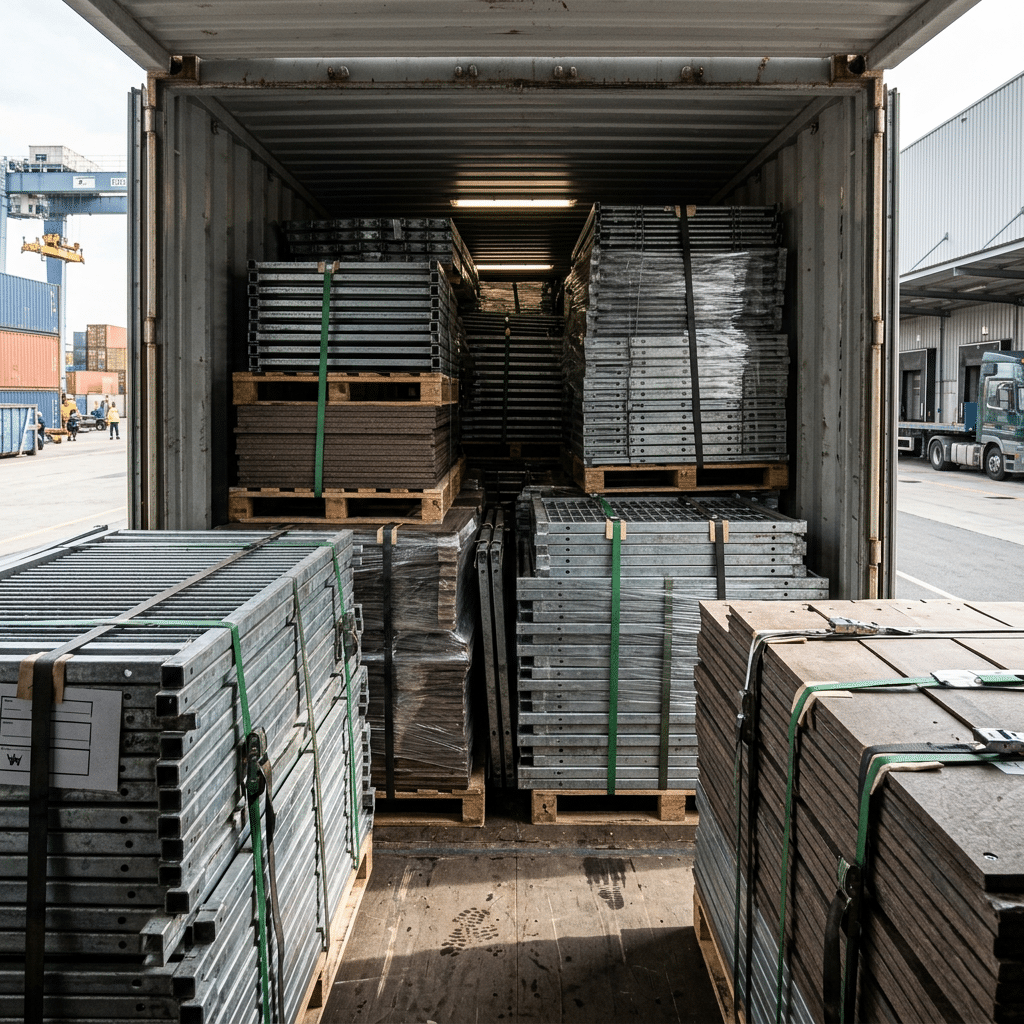
Equipping facilities in Denmark demands structural steel capable of withstanding the ductile-to-brittle transition found in sub-zero climates. Standard mild steel often fractures under equine impact during a hard freeze, turning a budget renovation into a significant liability for stable managers.
This briefing prioritizes Q345B Low-Alloy High Strength Steel and Feuerverzinkung to BS EN ISO 1461 standards as the baseline for Nordic durability. We examine how solid bamboo bottom panels and 6mm tempered glass windows prevent drafts while maintaining the structural integrity required for heavy commercial use.
Preparing Your Barn for Freezing Danish Winters
Effective winter prep requires Q345B low-alloy steel to prevent brittle fractures and active ventilation to manage condensation, ensuring structural integrity in sub-zero Danish climates.
Managing Ventilation and Insulation Balance
A common mistake in Danish stable management is equating “warmth” with “airtight.” Sealing a barn comple
tely to retain heat creates a dangerous environment. Horses generate significant moisture through respiration and waste. If you insulate heavily without providing an escape route for this moisture, you create a breeding ground for ammonia buildup, mold, and respiratory infections.
The solution lies in “Stack Effect Ventilation.” This passive airflow strategy relies on thermal buoyancy: warm, humid air naturally rises. By installing continuous ridge vents or cupolas, you allow this stale air to escape the roof. This negative pressure pulls fresh, drier air in through lower intakes. The result is a barn that remains dry and temperate without becoming a humid box.
When installing insulation to combat the Danish freeze, the vapor barrier placement is critical. It must sit on the warm side of the insulation (the interior face). If placed incorrectly, moisture travels through the insulation, hits the cold outer wall, and freezes. This leads to hidden rot in your timber framing and structural degradation over time.
The Role of Q345B Low-Temperature Steel
Materials react differently when temperatures drop below zero. Standard structural steel (often Q235B or generic mild steel) suffers from a phenomenon called the ductile-to-brittle transition. In simpler terms, the steel loses its ability to bend and absorb energy in freezing conditions. If a 600kg warmblood kicks a standard steel post during a hard freeze, that post is liable to snap rather than deform.
- Material Selection: We strictly specify Q345B (ASTM Grade 50) Low Alloy High Strength Steel for our Nordic exports. This alloy retains high impact toughness in sub-zero temperatures, ensuring the “Kick-Proof” guarantee holds even in winter.
- Galvanization Standards: Denmark’s coastal geography adds salt spray to the mix. Paint and powder coats often peel after a few freeze-thaw cycles.
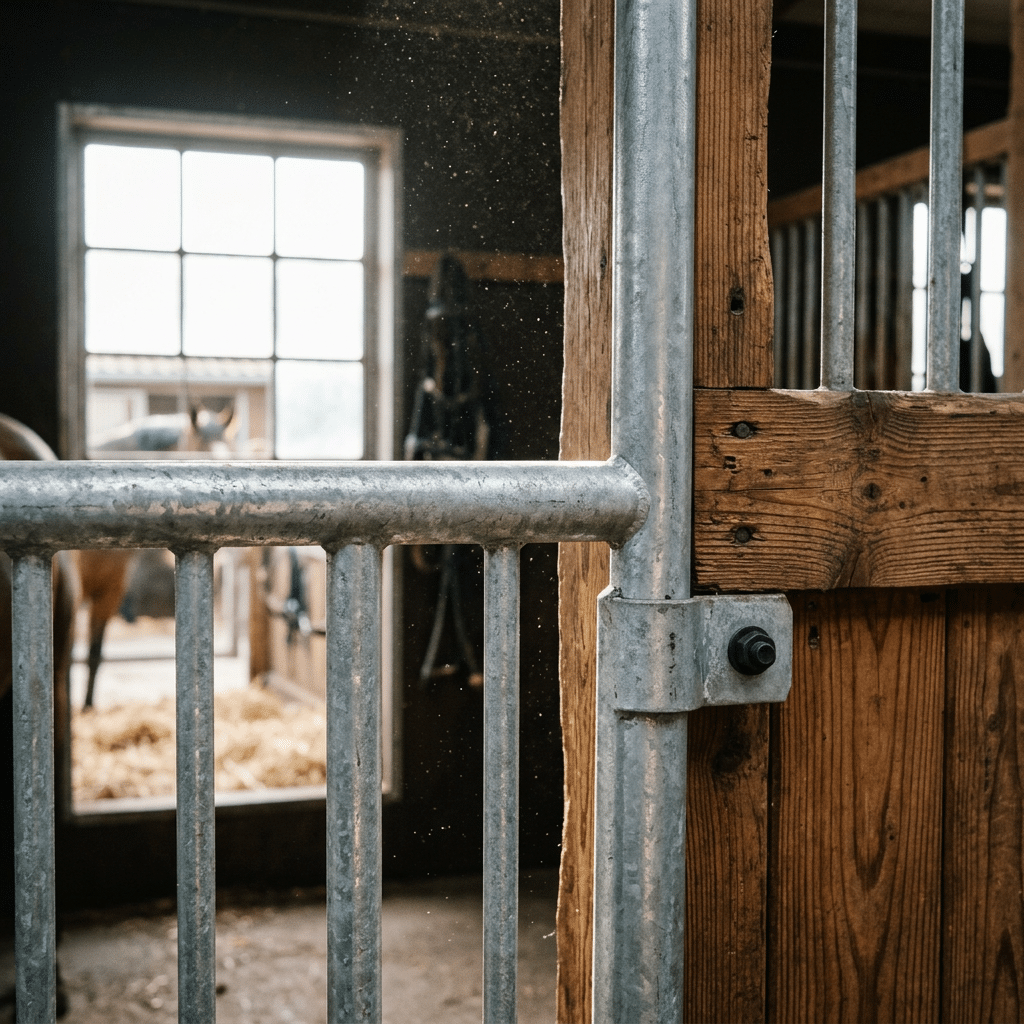
- Protection Specs: We use Hot-Dip Galvanization nach fabrication, adhering to BS EN ISO 1461 standards. This ensures a zinc coating average of >85 microns on structural parts, protecting the steel from the corrosive combination of ammonia inside and thawing snow outside.
Solid Bottom Horse Stall Panels: Stopping Floor Drafts
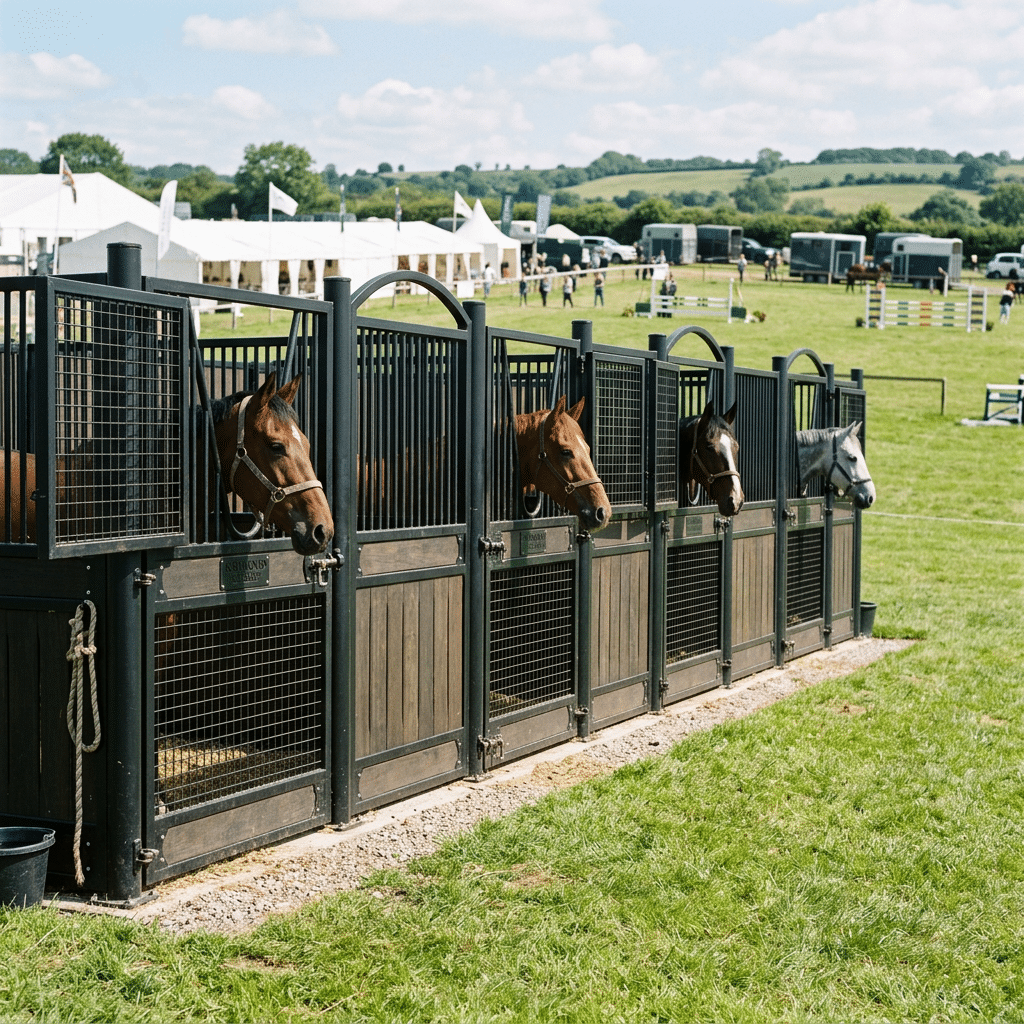
Solid bottom panels create a critical thermal barrier at the bedding level to stop cold floor drafts. We use 38mm High Density Bamboo or 32mm HDPE held in 14-gauge steel channels to ensure a draft-proof, kick-resistant seal.
| Performance Metric | High-Density Bamboo (38mm) | HDPE Synthetic (32mm) |
|---|---|---|
| Thermal Mass | High (Retains Heat) | Neutral (Insulates) |
| Schlagfestigkeit | >3000 lbf (Janka Hardness) | Impact Absorbing (Flexible) |
| Moisture Reaction | Rot Resistant (Ventilated) | Impervious (Waterproof) |
| Wartungsebene | Low (Occasional Oil) | Zero Maintenance |
The Impact of Low-Level Drafts on Equine Health
Cold air naturally sinks to the lowest point in a structure. In a barn environment, this creates a specific airflow pattern known as the “Stack Effect,” where freezing air sweeps across the floor to displace rising warm air. This draft targets the horse’s legs and lower body directly. Continuous exposure to cold drafts at this level causes muscles to stiffen and joints to lock up, significantly increasing the warm-up time required before exercise and raising the risk of injury.
Solid base walls address more than just temperature. They contain the air movement around the bedding layer. Open-bottom stalls allow drafts to pick up ammonia dust and disperse it into the aisle or neighboring stalls. By sealing the base, you keep bedding particulate localized for easier cleaning. Our engineering also aligns with strict “Cast-Proof Design” safety standards. We eliminate gaps at the bottom of the partition, ensuring a rolling horse cannot get a hoof trapped under the wall.
Specifying the Barrier: 38mm Bamboo and HDPE Options
The effectiveness of a solid bottom panel depends entirely on the material density and the steel framework holding it. Thin plywood or hollow PVC cannot withstand the dual pressure of thermal fluctuation and equine impact. We specify heavy-duty infill materials secured within 14-gauge (2.0mm-2.5mm) steel U-channels to prevent warping and gaps.
- Bamboo Infill (28mm-38mm): We use High Density Strand Woven planks. These are three times harder than oak with a Janka hardness over 3000 lbf. The density provides superior thermal mass, helping to stabilize stall temperatures against rapid drops.
- HDPE Infill (28mm-32mm): For facilities prioritizing “Zero Maintenance,” we install UV-stabilized synthetic boards. These provide a complete draft seal and are impervious to moisture, urine, and rot.
- Structural Support: The steel channels holding these planks are Hot-Dip Galvanized after fabrication (ISO 1461). This ensures the frame does not rust from the inside out due to damp bedding contact.
- Kick-Proof-Garantie: Both material options are tested to withstand direct impact without shattering, maintaining the draft barrier’s integrity even in active stables.
Precision-Engineered Stables Built to Last

Sealing the Aisle: Heavy-Duty Sliding Barn Doors
Hochbelastbar sliding barn doors maximize aisle space by eliminating swing clearance. Featuring DB Stable’s hidden track system and Q345B structural steel, they prevent jamming and withstand high-impact equestrian demands.
Maximizing Aisle Efficiency with Sliding Designs
Traditional swing doors create dead zones. In busy stables, a 1.2-meter swing radius blocks traffic and creates safety hazards during feeding times or machinery movement. Sliding designs eliminate this clearance requirement entirely, keeping the central corridor open for tractors and handlers.
- Zero Swing Radius: Removes physical obstructions in the aisle, allowing unhindered access for feed carts and machinery.
- Enhanced Safety: Reduces the risk of injury to horses passing through the aisle during peak activity, as there are no protruding doors to catch on tack or blankets.
- Optimized Layouts: Supports efficient workflow in tighter barn layouts, a frequent requirement in Danish refurbishment projects where expanding the footprint isn’t an option.

The Hidden Track System: Engineering Durability
A common failure point in barn doors is the accumulation of dust and bedding in the track, leading to jamming. Our Professional Series addresses this with a “Hidden Track System” that shields the rolling mechanism from debris. We pair this design with materials specifically chosen for structural integrity in cold, damp environments.
- Debris Prevention: The enclosed track design prevents shavings and dust build-up, ensuring smooth operation without constant cleaning.
- Korrosionsbeständigkeit: All hardware, including anchors and connectors, is manufactured from 304 Edelstahl to resist ammonia and humidity.
- Structural Steel Grade: Wir verwenden Q345B steel framing rather than standard Q235B. This provides superior low-temperature impact toughness, preventing track warping or brittle fracture under heavy daily use in winter conditions.
Barn Windows: 6mm Tempered Glass for Safety and Light
Executive Summary: 6mm tempered glass is non-negotiable for barns because it crumbles into blunt granules rather than shattering into jagged shards. This “fail-safe” mechanic prevents life-threatening lacerations during impact.
The Safety Advantage of 6mm Tempered Glass
Standard residential glass has no place in an equine facility. In a barn, a window isn’t just a light source; it is a potential hazard situated in a high-impact zone. We strictly specify 6mm tempered glass (often referred to as Safety VSG) because the physics of livestock containment demand it. Unlike standard annealed glass, which breaks into large, jagged shards that act like guillotines, tempered glass is heat-treated to alter its internal tension.
- Structural Strength: The tempering process creates a material 4-5 times stronger than standard glass, capable of withstanding significant blunt force.
- Granular Failure Mode: Upon structural failure, the glass instantly crumbles into small, cubical granules. This prevents deep lacerations if a horse panics and kicks through the opening.
- Optical Clarity: It maintains the transparency needed for natural light cycles—critical for coat shedding and circadian rhythms—without compromising the physical barrier.
Integrating Protective Grilles and Galvanized Frames
Glass is the final barrier, not the first. A professional barn window system must prevent the animal from making contact with the glazing in the first place. We engineer our window systems with integrated steel protective grilles or bars that absorb the kinetic energy of a kick. This protects the glass from breaking and the horse from the window mechanism.
The frame itself is just as critical as the glass. Barn environments are inherently corrosive due to ammonia and humidity. Standard aluminum residential frames or pre-galvanized steel often fail at the joints within a few years. We apply our core manufacturing standard here: Hot-Dip Galvanization After Fabrication (ISO 1461). By welding the steel frames first and dipping them second, we ensure the zinc coating seals every seam and weld point, preventing rust from bleeding through.
- >Protective Grilles: Heavy-duty steel bars positioned to intercept kicks before they reach the glass.
- ISO 1461 Galvanization: Frames are dipped after welding to ensure 360-degree rust protection, matching the longevity of our stall fronts.
- Ventilation Mechanics: Tilt-and-turn or hopper designs allow windows to open inwardly at the top, promoting airflow while keeping the aperture secure.
- Weather Sealing: Integrated drip caps and seals manage moisture ingress, particularly vital in freezing climates like Denmark where water intrusion leads to ice damage.
Integrating Auto-Heated Waterers into Steel Posts
Route electrical lines internally through pre-drilled Q235B or Q345B steel posts before hot-dip galvanization to ensure frost protection and maintain rust resistance.
Concealed Cable Management for Frost Protection
Running heating cables and water lines along the exterior of a stall front invites trouble. Horses are naturally curious and will chew exposed wiring or plastic piping, creating fire hazards and electrical failures. We utilize the hollow profile of our 50mm x 50mm RHS or 114mm round posts as a protective internal conduit, keeping all sensitive components physically separated from the animal.
Internal routing does more than protect the hardware from the horse. It allows you to insulate the water line directly within the steel cavity. In Danish winters, this additional layer of insulation—protected by the steel shell—helps maintain water temperature and prevents the freezing that often occurs with external, exposed plumbing.
Factory-Grade Customization: Pre-Drilling Before Galvanization
The most common installation error is drilling mounting holes for waterers nach the stalls arrive on site. As soon as a drill bit breaks the zinc surface, that exposed raw steel becomes a rust magnet in a high-ammonia stable environment. We eliminate this failure point by laser-cutting all mounting patterns into the Q235B or Q345B steel framework during the fabrication phase, long before the posts reach the zinc bath.
Once fabrication finishes, we submerge the entire post in the zinc tank. This ensures the protective coating covers every edge of the drilled mounting holes. This method guarantees that your integration points are as rust-resistant as the rest of the frame.
- Steel Selection: Q235B (Standard) or Q345B (Cold Climate) Structural Steel.
- Coating Standard: BS EN ISO 1461 Hot-Dip Galvanization.
- Protection Level: Average zinc thickness > 85 microns on structural posts.
- Process Sequence: Cut and weld first, galvanize second (Hot-Dip After Fabrication).
Häufig gestellte Fragen
What materials work best for stables in freezing climates?
For structural frames in sub-zero environments, we strictly specify Q345B Low-Alloy High Strength Steel (equivalent to ASTM Grade 50). Standard Q235B steel can become brittle in extreme cold, posing a fracture risk if kicked. Q345B maintains high impact toughness at low temperatures.
For infills, avoid softwoods that absorb moisture and warp during freeze-thaw cycles. We recommend High-Density Bamboo (28mm-38mm) oder HDPE. Bamboo is 3x harder than oak and resists rot, while HDPE offers a zero-maintenance solution that remains impact-absorbent even in freezing conditions.
How do solid bottom panels help with stable drafts?
Solid bottom partitions function as a mechanical windbreak at the “bedding zone.” Cold air naturally settles at floor level, which chills horses while they sleep. By blocking the lower 1.2 meters, you force airflow to circulate higher up in the stall (the Stack Effect). This keeps fresh air moving through the barn without subjecting the animal to direct, freezing drafts at ground level.
Are sliding barn doors effective for winter insulation?
They are effective only if you select the right core materials. Hollow-core doors are useless for thermal retention. We use heavy 28mm-40mm bamboo or hardwood infills to create a dense thermal barrier. In extreme climates, we recommend adding heavy-duty weatherstripping to the door overlaps. This seals the gap between the door and the post, preventing wind and snow infiltration.
Why is tempered glass necessary for barn windows?
Tempered glass is a non-negotiable safety standard in professional equestrian engineering. Horses are large, unpredictable animals; if they kick a standard glass window, it shatters into jagged shards that can sever tendons or arteries. Tempered glass crumbles into small, harmless granular chunks upon impact, eliminating the risk of catastrophic injury.
Can I integrate heated waterers into the stall front?
Yes. We engineer our structural posts—specifically the 50mm RHS und 114mm Round profiles—with hollow interiors to accommodate insulated water lines. Running plumbing inside the steel framework serves two purposes: it protects the water lines from freezing by utilizing the thermal mass of the building, and it physically shields the pipes from horses chewing on them.
Abschließende Überlegungen
Specifying Q345B structural steel and ISO 1461 galvanization is not an optional upgrade; it is a necessity for surviving Danish winters. Generic mild steel risks brittle fracture under impact and rapid corrosion from coastal salt spray. Your reputation as a supplier depends on delivering infrastructure that withstands these extremes without failure.
Secure your inventory against the freeze by partnering directly with a manufacturer that understands Northern European requirements. We encourage requesting a technical specification sheet or scheduling a trial order (LCL) to evaluate our flat-pack logistics and finish quality. Contact our engineering team today to configure your winter-ready stable solution.

 German
  English
  Spanish
  French
  Arabic
0 Kommentare