


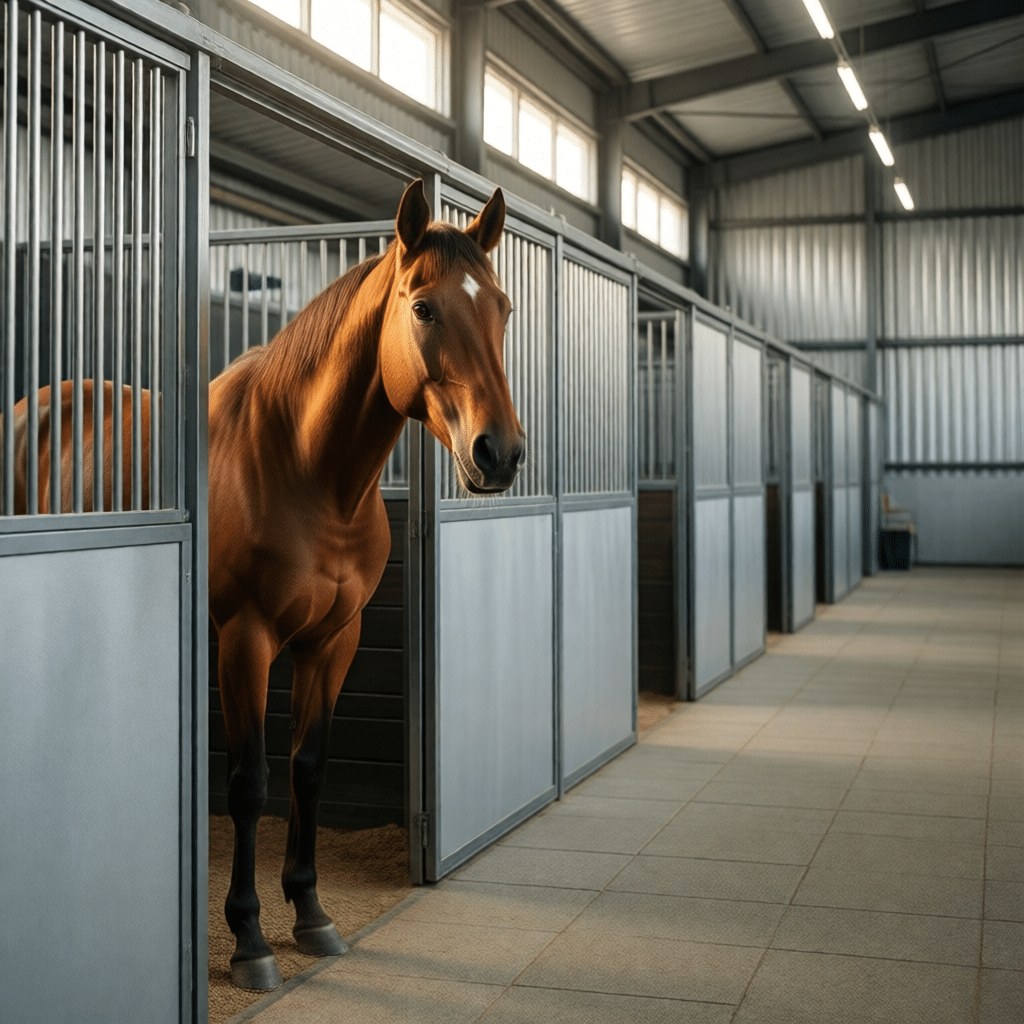
Sourcing compliant UK horse stables is critical to preventing facility liability and operational bottlenecks in narrow barns. Relying on traditional hinged doors sacrifices 1.2m of aisle space, creating safety hazards that increase insurance risk and impede daily workflow.
This analysis demonstrates how sliding stall fronts satisfy strict British Horse Society dimensions without expanding your footprint. We detail the technical advantages of ISO 1461 Hot-Dip Galvanization and heavy-duty Q345B track systems in delivering a zero-maintenance, welfare-compliant infrastructure.
Navigating BHS (British Horse Society) Stabling Guidelines
The BHS sets the benchmark for equine welfare in the UK. We engineer our layouts to strictly meet their 3.65m x 3.65m minimums and safety clearances.
BHS Recommended Dimensions for Loose Boxes
le=”line-height: 1.8; margin-bottom: 28px;”>Compliance starts with floor area. The British Horse Society (BHS) provides specific spatial requirements to ensure horses can stand, turn, and lie down without restriction. For commercial projects and livery yards in the UK, these figures represent the baseline for professional operations rather than optional suggestions.
- Standard Horses: Minimum floor area of 3.65m x 3.65m (12ft x 12ft) allows for natural movement and rest.
- Large Horses (17hh+): Extended depth of 3.65m x 4.25m (12ft x 14ft) is required to accommodate wider turning circles and longer bodies.
- Vertical Clearance: A minimum clear headroom of 3m (10ft) prevents head injuries and ensures adequate air volume for ventilation.
Meeting Safety Standards with Hot-Dip Galvanized Engineering
Beyond dimensions, the BHS dictates strict safety protocols regarding fixtures and fittings. At DB Stable, our manufacturing process is calibrated to pass these inspections, specifically focusing on entrapment prevention and surface safety. We adhere to these standards to protect facility managers from liability and ensure longevity.
- Door Width Compliance: Our standard fronts feature 1.25m (4ft) openings to meet BHS safe passage rules, preventing hip injuries during entry and exit.
- Projection-Free Surfaces: We utilize ISO 1461 Hot-Dip Galvanization nach fabrication. This ensures a smooth zinc coating (averaging >85 microns on structural parts) that eliminates sharp weld slag or rust edges that could lacerate a horse.
- Gussfestes Design: To prevent rolling horses from getting hooves stuck under the door, we engineer the bottom clearance to approximately 50mm, aligning with safety best practices.
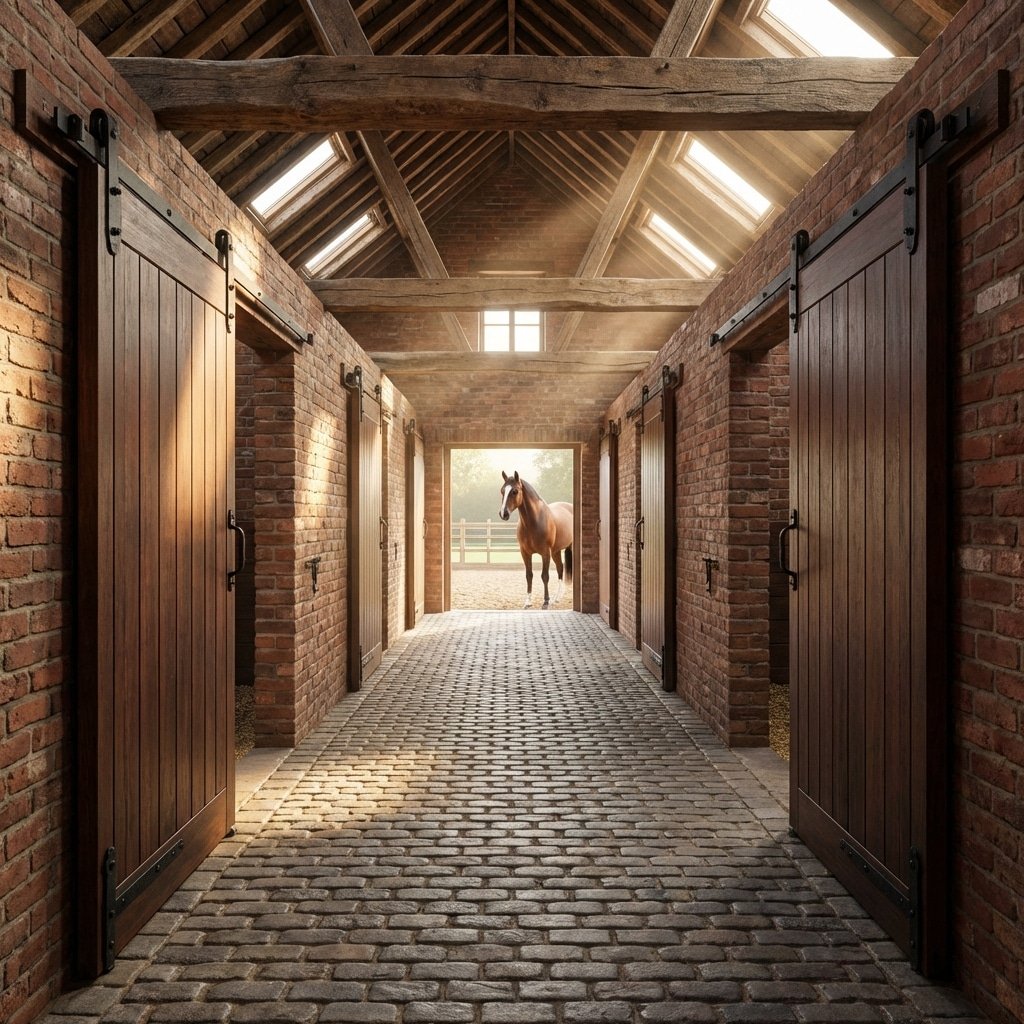
Aisle Space in Classic UK Barns: The Sliding Door Advantage
Sliding doors eliminate the “dead zone” required by hinged door arcs, reclaiming critical square footage in narrow UK heritage barns for safer livestock and machinery movement.
| Operational Factor | Traditional Hinged Door | DB Stable Sliding System |
|---|---|---|
| Aisle Clearance | Requires 1.2m+ swing radius arc | Zero-swing (Parallel to wall) |
| Wind Safety | High risk of slamming shut | Stable in drafty corridors |
| Space Utility | Blocked “dead space” behind door | 100% usable floor area |
Maximizing Layout Efficiency with Zero-Swing Profiles
In heritage UK barns, square footage is often limited by historical footprints that cannot be expanded. Traditional hinged doors create a substantial “dead space”—a 1.25m (4ft) radius that must remain clear for the door to operate. This reduces the usable floor area and complicates workflow. Sliding barn doors solve this by operating strictly parallel to the stall front. This “zero-swing” profile is critical for maximizing narrow aisles, allowing feed carts, wheelbarrows, and even small machinery to pass unobstructed without the operator needing to stop and manipulate gates.
Safety is another immediate benefit of this layout. Hinged doors in drafty barns are prone to catching the wind and slamming shut, which poses a significant injury risk to both handlers and horses. A sliding mechanism removes this variable entirely. The door remains securely on its track regardless of air pressure changes, preventing the sudden movements that often startle livestock in busy environments.
Ensuring Reliability: The Hot-Dip Galvanized Track System
A sliding door is only effective if the mechanism withstands the environment. In the UK, high humidity and ammonia levels inside barns cause standard steel tracks to rust quickly. Once rust forms, friction increases, and the door eventually seizes. We address this by manufacturing our track systems using Feuerverzinkung nach der Herstellung (ISO 1461). Unlike competitors who use pre-galvanized sheet metal, we weld the black steel components first and then submerge the entire unit in molten zinc. This ensures a coating thickness exceeding 85 microns on structural parts, providing a metallurgical bond that resists corrosion for decades.
- Professional Series Alignment: Our tracks are paired with heavy-duty rollers designed specifically for the Profi-Serie. These rollers are engineered to handle the weight of solid infill (Bamboo or HDPE) without degrading.
- Tolerance for Settling: Timber-framed barns often settle or warp slightly over time. Our track hardware includes adjustment tolerances to ensure smooth operation even if the mounting surface shifts.
- Maintenance Reduction: The hot-dip process eliminates the need for repainting or rust treatment, aligning with our “Zero Maintenance” philosophy for B2B facility operators.
Premium Custom Horse Stables Built To Last
Safe Ventilation: Using Half-Mesh Horse Stall Dividers
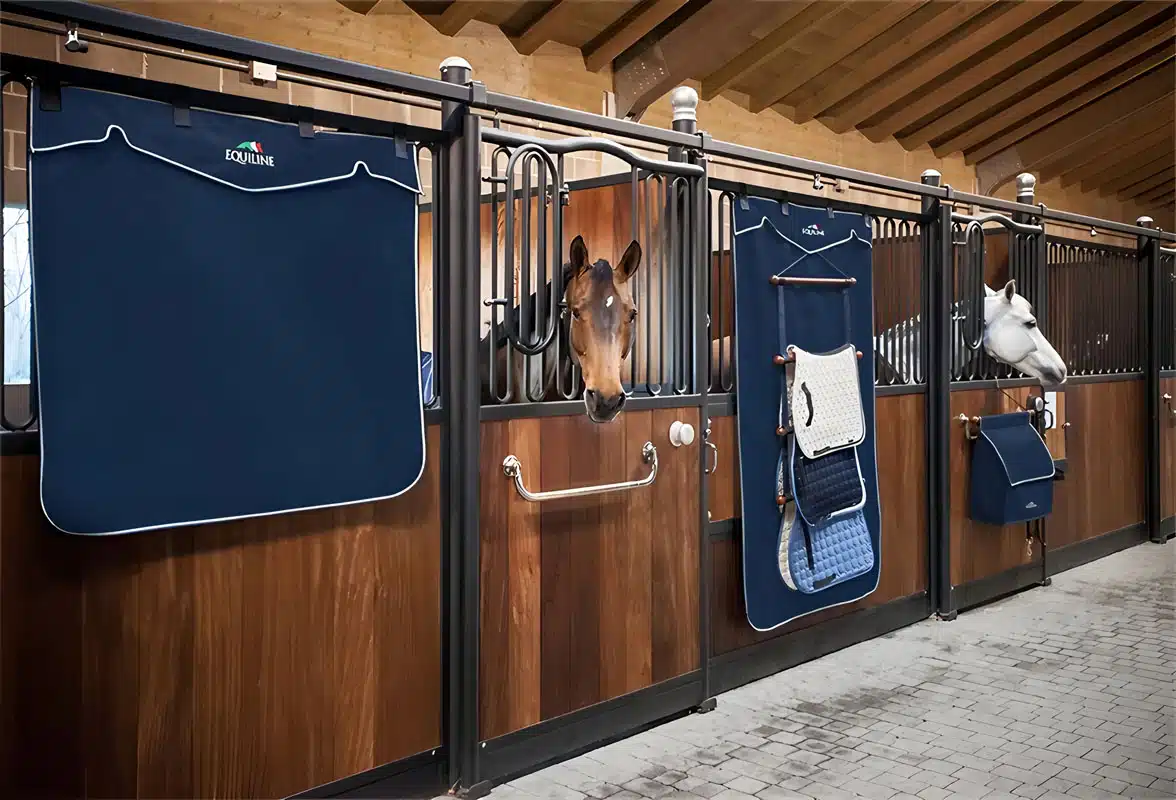
Half-mesh dividers optimize stable health by combining upper-level airflow channels with solid lower safety barriers, preventing respiratory issues while maintaining herd socialization.
Promoting Stack Effect Ventilation and Social Interaction
Professional stables often struggle to balance physical security with air quality. A fully solid wall blocks airflow, trapping ammonia and dust at the horse’s breathing level. Half-mesh dividers solve this by facilitating “Stack Effect Ventilation.” As heat radiates from the horse, warm air rises, carrying airborne pathogens and ammonia with it. The open upper grid allows this stale air to escape into the barn’s ridge vents rather than recirculating within the stall.
Beyond ventilation, these dividers address the psychological needs of the animal. Horses are herd animals that experience high stress when isolated. The upper mesh permits visual and auditory contact between neighbors, which significantly reduces weaving, cribbing, and stall walking. Unlike full bars which might allow biting, or full walls that cause isolation, the half-mesh design creates a safe boundary. It prevents aggressive dominance behaviors while maintaining a calm, social environment.
Engineered for Safety: 14-Gauge Framework and HDPE Infill
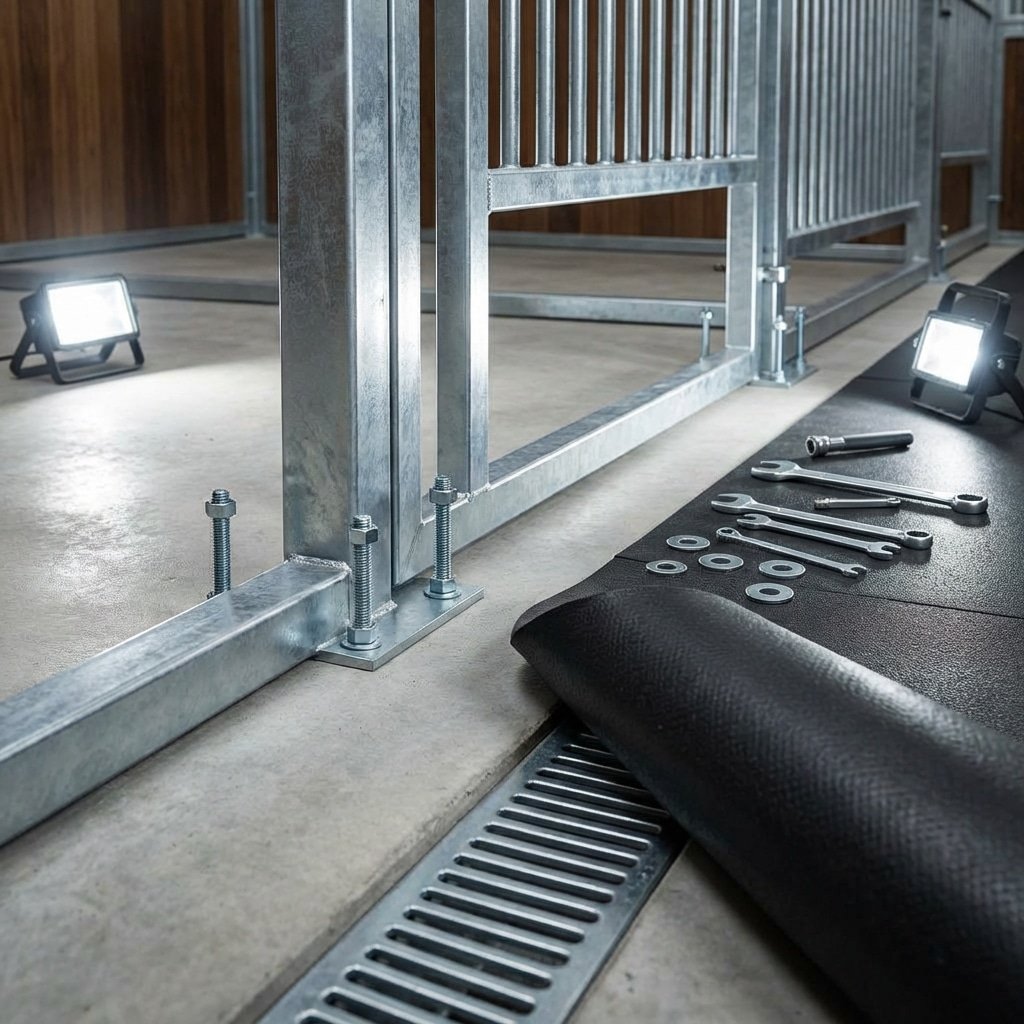
Structural integrity is the only metric that matters when a 1,200lb animal kicks a partition. Many market alternatives fail because they rely on thin 1.5mm tubing that buckles under impact. We strictly adhere to a heavier industrial standard to ensure the divider acts as a genuine safety barrier rather than a potential hazard.
- 14-Gauge Structural Steel: The framework uses 2.0mm (14-gauge) Q235B steel. This thickness prevents the partition from bending or snapping if a horse kicks it, a common failure point in lighter 16-gauge products.
- Hot-Dip Galvanization (ISO 1461): We do not use pre-galvanized (black weld) tube. Every grid undergoes Feuerverzinkung nach der Herstellung. This seals all weld points against the corrosive mix of ammonia and humidity found in active stables.
- Impact-Absorbing Infill: The lower solid section features 28mm-32mm UV Stabilized HDPE. Unlike wood, which splinters and requires annual staining, HDPE offers a “Kick-Proof Guarantee” and “Zero Maintenance” durability, absorbing shock without cracking.
The V-Drop Door: Allowing Safe Socialization
The V-Drop design allows safe head-out socialization to reduce boredom, secured by heavy-duty Q345B steel frames to prevent mechanical failure.
Reducing Stable Boredom Through Controlled Interaction
Horses are herd animals that experience stress when isolated behind solid walls. The V-Drop door solves this by featuring a hinged V-shaped opening in the top grill. This design allows the horse to extend its head into the aisle, effectively reducing boredom and “stall sour” behaviors.
- Mimics Herd Dynamics: Allows horses to view aisle activity and interact with neighbors, mimicking natural social structures.
- Reduces Vices: Significantly lowers the risk of isolation-induced vices like cribbing or weaving by keeping the horse mentally stimulated.
- Ausgewogenes Design: Provides a balance between the open airflow of the Economy Series and the containment security of full grill partitions.
Engineering Safety: Q345B Frames and Stainless Hardware
A drop-down door introduces moving parts, which creates potential failure points if engineered poorly. We refuse to use standard structural steel for these high-stress components. Instead, we rely on specific material upgrades to ensure the mechanism withstands the weight of a leaning horse.
- Q345B Low Alloy High Strength Steel: We use this superior grade for the V-drop frame to resist impact and deformation if a horse pushes against the opening.
- 304 Stainless Steel Hardware: All latches and connectors are cast from 304 Stainless Steel to ensure the drop mechanism operates smoothly without rusting or seizing.
- BS EN ISO 1461 Galvanization: All edges are Hot-Dip Galvanized After Fabrication, ensuring smooth, burr-free surfaces that protect the horse’s neck from scratches.
U-Channel Steel: Eliminating Chew Hazards
Steel U-channel profiles fully encase infill edges, eliminating purchase points for cribbing. This protects horses from splinters and prevents costly structural damage to bamboo or HDPE boards.
The Dangers of Exposed Infill Edges
Stabled horses frequently develop cribbing or wood-chewing behaviors due to boredom, stress, or dietary habits. Leaving infill edges exposed invites this destructive activity. When a horse chews on uncapped timber or bamboo, they risk ingesting splinters, suffering significant dental wear, or causing digestive blockages. From a facility management perspective, this behavior rapidly degrades the structural integrity of stall walls, turning a high-value investment into a maintenance liability that requires frequent board replacement.
Protective Design: Hot-Dip Galvanized Steel Profiles
We eliminate this risk by engineering unyielding U-channel caps that physically block access to vulnerable edges. Unlike standard flat bars, our U-channel design wraps around the infill material, creating a seamless steel barrier that withstands aggressive cribbing forces.
- Structural Material: We use Q235B structural steel to create a rigid cap that resists deformation from biting pressure.
- Complete Encasement: The profile covers 28mm-38mm infills completely, denying the horse any purchase point for their teeth.
- Acid Resistance: We apply Hot-Dip Galvanization (ISO 1461) after fabrication to prevent rust caused by the constant contact with acidic horse saliva.
Häufig gestellte Fragen
What are the standard dimensions for a horse stable in the UK?
The British Horse Society (BHS) sets the baseline for animal welfare. A standard horse typically requires 3.65m x 3.65m (12ft x 12ft). Larger horses (17hh+) need the extra depth of a 3.65m x 4.25m (12ft x 14ft) box to turn comfortably. For foaling boxes, you should never go smaller than 4.25m x 4.25m (14ft x 14ft) to ensure safety during labor and nursing.
Why use hot-dip galvanization instead of pre-galvanized steel?
We strictly reject pre-galvanized steel (black tube welded together) because the welding process burns off the zinc, leaving seams exposed to rust immediately. Instead, we use Hot-Dip Galvanization nach fabrication (ISO 1461 standard). We weld the black steel frame first, then dip the entire unit into molten zinc. This seals every weld and coats the steel—inside and out—with over 70 microns of zinc for true lifetime corrosion protection.
Are sliding doors better than hinged doors for indoor barns?
Sliding doors are the operational standard for indoor aisles, particularly in the UK where square footage is at a premium. Unlike hinged doors that swing out and block the walkway, sliding doors operate flush against the front. This keeps the aisle clear for handlers and machinery while eliminating the safety risk of wind slamming a heavy door on a horse.
How durable are the infill planks against kicking?
Standard pine boards often snap under impact. We utilize two superior materials: UV-stabilized HDPE (28mm-32mm), which absorbs kick energy without cracking, and High-Density Bamboo. Our bamboo rates over 3000 lbf on the Janka Hardness scale—making it three times harder than oak. Crucially, all edges are encased in 14-gauge steel channels so horses cannot chew or damage the plank ends.
How is the ventilation managed in these stables?
We design for the “Stack Effect.” Heat naturally rises. By utilizing open grill tops on stall fronts and partitions, warm, stale air escapes vertically rather than getting trapped. This negative pressure draws fresh, cooler air in through lower vents or mesh sections. This constant passive air exchange is non-negotiable for preventing ammonia buildup and respiratory issues.
Abschließende Überlegungen
Meeting BHS guidelines is a commercial necessity for professional UK yards, not just a welfare suggestion. Our Hot-Dip Galvanized After Fabrication process ensures your stabling withstands the corrosive mix of ammonia and humidity where cheaper pre-galvanized steel fails. This strict adherence to ISO 1461 standards safeguards your reputation and protects your clients from long-term liability claims.
Reliability is best proven through direct inspection rather than spec sheets. We invite you to schedule a consultation to discuss how our flat-pack logistics significantly reduce your landed costs per unit compared to fully welded alternatives. Reach out to our engineering team now to configure a Professional Series trial order tailored to your specific facility layout.

 German
  English
  Spanish
  French
  Arabic
0 Kommentare